


Most australian businesses find that nearly 80 percent of leads drop off before making a purchase decision. Understanding how modern marketing funnels work can be the difference between stagnant sales and sustainable growth in a fast-changing market. This guide unpacks the crucial stages of the marketing funnel and explains practical strategies that help australian companies convert interest into loyalty with real, measurable results.
Table of Contents
- Marketing Funnel Defined For Modern Businesses
- Core Stages Of The Marketing Funnel Process
- Types Of Marketing Funnels And When To Use Them
- Driving Growth Through Effective Funnel Strategies
- Common Funnel Mistakes And How To Avoid Them
Key Takeaways
| Point | Details |
|---|---|
| Understanding the Marketing Funnel | The marketing funnel helps businesses map customer journeys and tailor strategies for each stage to enhance engagement and conversions. |
| Core Stages of the Funnel | The funnel comprises five key stages: awareness, interest, consideration, conversion, and retention, each requiring targeted strategies. |
| Types of Marketing Funnels | Various funnels, such as lead generation and sales funnels, allow businesses to effectively guide potential customers based on specific objectives. |
| Common Funnel Mistakes | Avoid generic approaches and ensure personalised messaging and seamless user experiences to enhance conversion rates. |
Marketing Funnel Defined for Modern Businesses
A marketing funnel represents the strategic journey a potential customer travels from initial brand awareness through to final purchase and ongoing loyalty. Modern businesses rely on this powerful conceptual framework to systematically understand consumer purchasing processes and optimise their marketing strategies.
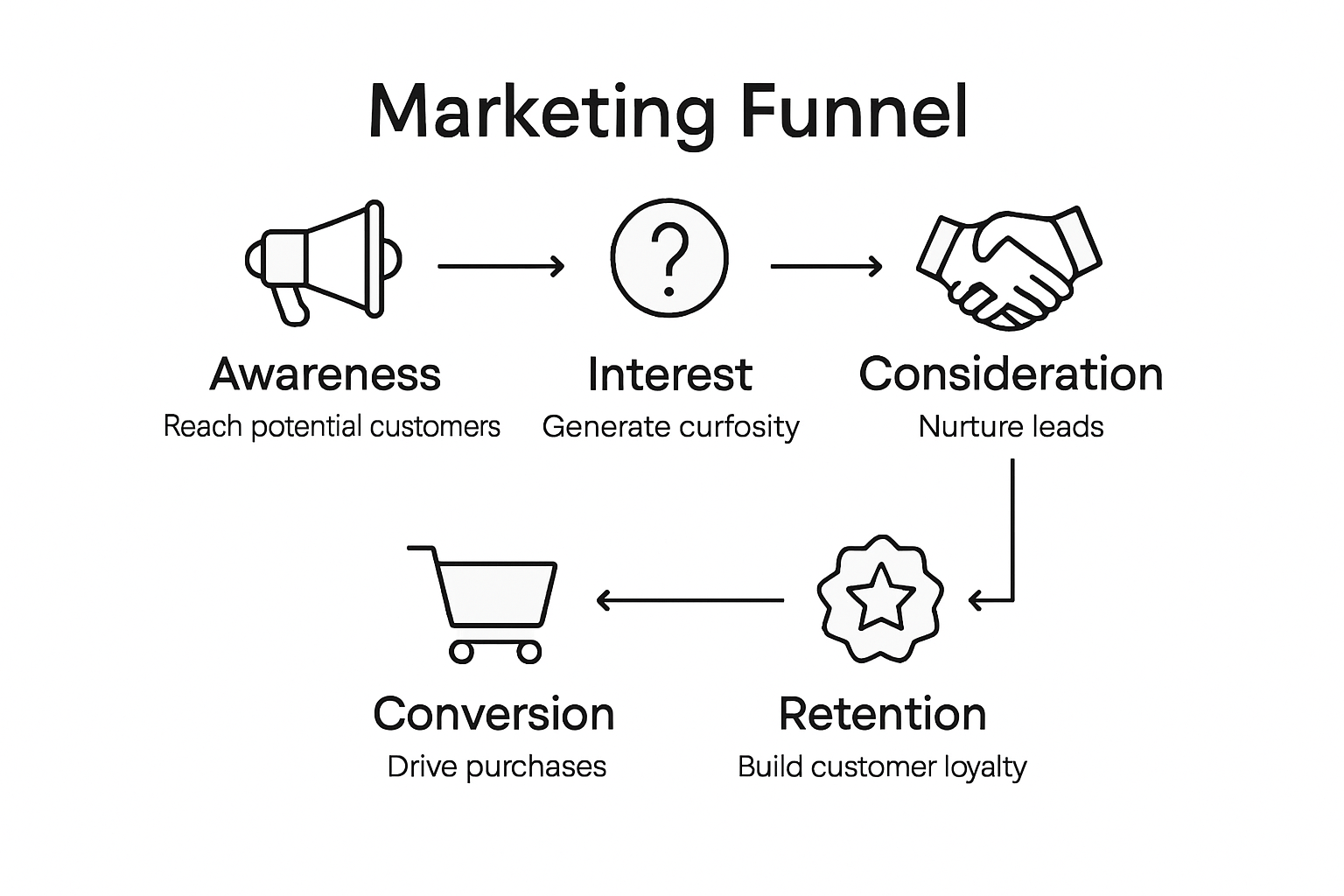
The marketing funnel visualises consumer interaction as a multi-stage progression, typically structured across awareness, interest, consideration, conversion, and retention phases. Unlike traditional linear marketing approaches, this model acknowledges that customer journeys are complex and non-sequential. Businesses can craft targeted interventions at each stage, tracking how prospects move through different decision-making stages and tailoring communication strategies accordingly.
Practically speaking, marketing funnels enable organisations to map precise customer touchpoints, measuring engagement metrics and identifying potential drop-off points. By understanding these intricate dynamics, businesses can develop more nuanced lead generation strategies that convert prospects more efficiently. The funnel approach allows marketers to:
- Track customer interactions across multiple channels
- Personalise marketing messages for specific journey stages
- Allocate resources more strategically
- Predict and improve conversion rates
- Build long-term customer relationships
Understanding your marketing funnel isn’t just about tracking sales metrics – it’s about creating a comprehensive customer experience that anticipates needs, addresses potential barriers, and guides potential clients seamlessly towards making a purchase decision.
Core Stages of the Marketing Funnel Process
The marketing funnel comprises five critical stages that systematically guide potential customers from initial awareness to final conversion and long-term loyalty. Understanding these stages enables businesses to craft targeted strategies that effectively move prospects through their purchasing journey.

Awareness Stage: This initial phase focuses on capturing potential customer attention through strategic marketing channels. Businesses utilise content marketing, social media advertising, search engine optimisation, and other digital strategies to generate initial interest and introduce their brand or solution to a broader audience. The primary goal is creating visibility and generating curiosity about the product or service.
Interest Stage: Once potential customers become aware, the interest stage involves providing more detailed information that demonstrates value. Marketers develop engaging content like blog posts, informative videos, webinars, and educational resources that address specific customer pain points. The objective is to establish credibility and position the brand as a knowledgeable solution provider.
Consideration Stage: At this point, prospects actively evaluate different options and compare potential solutions. Businesses must present compelling evidence of their unique value proposition through:
- Detailed product comparisons
- Customer testimonials
- Case studies
- Free trials or demonstrations
- Comprehensive feature breakdowns
Conversion Stage: The critical moment where interested prospects transform into paying customers. Effective strategies include targeted email campaigns, personalised offers, clear pricing structures, and streamlined purchasing processes that reduce potential friction points.
Retention Stage: Often overlooked, this final stage focuses on converting one-time purchasers into loyal, repeat customers. Sophisticated lead nurturing techniques help businesses maintain ongoing relationships through personalised communication, exceptional customer support, and continuous value delivery.
Each stage represents a nuanced interaction point where businesses can strategically influence customer decision-making, ultimately creating a seamless and engaging purchasing experience that drives sustainable growth.
Types of Marketing Funnels and When to Use Them
Marketing funnels are not one-size-fits-all solutions, but rather dynamic frameworks that can be customised to meet specific business objectives. Exploring different marketing strategies reveals the nuanced approaches businesses can adopt to effectively guide potential customers through their purchasing journey.
Lead Generation Funnel: Designed to attract and capture potential customer information, this funnel is critical for businesses seeking to expand their prospect database. It typically involves creating compelling lead magnets, such as downloadable resources, webinars, or free consultations that entice potential customers to share their contact details. The primary goal is building a robust pipeline of potential future customers.
Sales Funnel: More direct and transactional, the sales funnel focuses explicitly on converting interested prospects into paying customers. It involves a structured approach that systematically reduces online marketing friction by addressing customer objections, providing clear value propositions, and creating streamlined purchasing processes. Each stage is meticulously designed to move prospects closer to making a purchase.
Product Launch Funnel: Particularly effective for introducing new products or services, this funnel creates anticipation and excitement before an official release. It typically follows these key stages:
- Pre-launch teaser content
- Exclusive early-access opportunities
- Limited-time promotional offers
- Targeted email sequence
- Post-launch engagement strategies
Webinar Funnel: An increasingly popular approach for service-based businesses and educational platforms. This funnel uses educational content as a primary mechanism for attracting and converting potential customers. The process involves:
- Registration and promotional marketing
- Delivering high-value educational content
- Strategic pitch or offer presentation
- Follow-up sequence for non-purchasers
Membership or Subscription Funnel: Ideal for businesses offering recurring services or digital products. This funnel focuses on demonstrating ongoing value and creating a compelling case for long-term commitment. It emphasises continuous engagement and retention strategies.
Understanding these diverse marketing funnel types allows businesses to select and customise approaches that align precisely with their unique objectives, target audience, and industry dynamics.
Driving Growth Through Effective Funnel Strategies
Marketing funnels represent more than just theoretical frameworks – they are powerful strategic tools that transform how businesses approach customer acquisition and retention. Implementing sophisticated lead nurturing techniques enables organisations to create targeted, high-conversion pathways that systematically guide potential customers towards meaningful engagement.
Successful funnel strategies require a holistic approach that goes beyond simple transactional thinking. Businesses must develop intricate, data-driven approaches that anticipate customer needs, address potential barriers, and create compelling value propositions at each interaction point. This means crafting personalised experiences that speak directly to individual customer motivations and pain points.
Key strategic considerations for driving growth through marketing funnels include:
- Continuous performance tracking and analytics
- Granular audience segmentation
- Personalised content mapping
- Automated follow-up mechanisms
- Dynamic conversion pathway optimization
Technological Integration: Modern marketing funnels leverage advanced digital tools to create seamless, intelligent customer journeys. Artificial intelligence and machine learning algorithms can now predict customer behaviour, recommend personalised content, and automate complex engagement sequences with unprecedented precision.
The most effective funnel strategies approach digital marketing systematically, recognising that customer relationships are not linear but complex, evolving ecosystems. By developing adaptive, intelligent marketing frameworks, businesses can transform traditional sales processes into dynamic growth engines that consistently deliver value and drive sustainable business expansion.
Common Funnel Mistakes and How to Avoid Them
Marketing funnels are intricate systems that require precision and strategic thinking. Understanding potential pitfalls helps businesses proactively design more robust customer acquisition frameworks that minimise revenue leakage and maximise conversion potential.
One of the most critical errors businesses make involves failing to understand their audience’s specific journey. Many organisations create generic, one-size-fits-all marketing approaches that neglect the nuanced differences between customer segments. This approach results in decreased engagement, lower conversion rates, and missed opportunities for meaningful connection.
Common marketing funnel mistakes include:
- Insufficient audience research
- Inconsistent messaging across stages
- Neglecting customer pain points
- Overcomplicated conversion processes
- Lack of personalisation
- Poor tracking and analytics
Technical Execution Errors: Businesses frequently underestimate the importance of technical infrastructure in funnel design. Slow-loading landing pages, non-responsive designs, and complex registration processes can dramatically reduce conversion rates. Modern consumers expect seamless, intuitive digital experiences that require minimal effort.
Successful funnel strategies demand continuous refinement. Implementing systematic lead nurturing techniques allows businesses to create adaptive systems that respond dynamically to changing customer behaviours and market conditions. This approach transforms marketing funnels from static structures into living, breathing growth mechanisms that consistently deliver value and drive sustainable business expansion.
Unlock Your Business Potential with Proven Marketing Funnel Strategies
Struggling to navigate complex marketing funnels or unsure how to guide your customers seamlessly from awareness to loyalty The detailed insights in this article highlight common challenges such as inconsistent messaging and lack of personalisation that slow down your sales growth At Business Warriors we specialise in crafting tailored, scalable marketing funnel systems using our innovative Marketing Vortex method which integrates SEO, paid ads and email marketing to deliver consistent leads and conversions Our expertise helps businesses in beauty, wellness and service sectors overcome these hurdles with clear, measurable outcomes and guaranteed results Learn how to develop a strong, personalised customer journey that converts and retains your ideal clients
Ready to transform your marketing funnel into a powerful growth engine Discover strategies and success stories that will inspire your next step Visit the Uncategorized Archives for more insightful content or explore the full range of services and solutions available at Jarrod Harman today Let our team help you unlock new levels of online client acquisition and sustained business success
Frequently Asked Questions
What is a marketing funnel?
A marketing funnel is a strategic model that outlines the journey a potential customer takes from initial awareness of a brand through to the final purchase and ongoing loyalty. It visualises consumer interactions in stages, including awareness, interest, consideration, conversion, and retention.
Why is understanding the marketing funnel important for businesses?
Understanding the marketing funnel helps businesses optimise their marketing strategies by tracking customer interactions, personalising messages, predicting conversion rates, and improving overall customer experience. It allows organisations to identify key touchpoints and adjust their approaches to guide customers effectively through the purchasing process.
What are the core stages of the marketing funnel?
The core stages of the marketing funnel include:
- Awareness: Capturing attention through marketing channels.
- Interest: Providing detailed information to demonstrate value.
- Consideration: Evaluating options and comparing solutions.
- Conversion: Turning interested prospects into paying customers.
- Retention: Fostering loyalty among existing customers.
How can businesses drive growth through effective funnel strategies?
Businesses can drive growth by using data-driven approaches, continual performance tracking, audience segmentation, personalised content mapping, and automated follow-ups. Integrating technology, such as AI, can further enhance the funnel by predicting customer behaviour and creating personalised experiences.
Recommended
- Complete Guide to Why Use Marketing Funnels – Jarrod Harman
- 7 Essential Types of Marketing Funnels for Business Growth – Jarrod Harman
- Complete Guide to Scaling Online Marketing – Jarrod Harman
- Content Marketing Best Practices: Complete Guide – Jarrod Harman
- 7 Types of Marketing Funnels Every Entrepreneur Should Know
- Understanding Digital Marketing for Beginners | Prodcast