


Over 75 percent of australian businesses now use some form of marketing automation, transforming the way they connect with customers and grow online. As digital marketing evolves rapidly, understanding what marketing automation is really about helps companies stand out in highly competitive markets. This article uncovers how marketing automation changes everyday business, which features matter most, and what potential risks and rewards australian leaders need to consider.
Table of Contents
- What Is Marketing Automation Really About?
- Major Types and Their Key Differences
- How Marketing Automation Systems Work
- Top Benefits for Growing Businesses
- Costs, Risks, and Common Mistakes
Key Takeaways
| Point | Details |
|---|---|
| Marketing Automation Enhances Efficiency | It automates repetitive marketing tasks, allowing teams to focus on strategic planning and creative initiatives. |
| Personalisation is Key | The ability to personalise customer experiences through data-driven insights significantly boosts engagement and conversion rates. |
| Types of Automation Address Diverse Needs | Different marketing automation types, such as B2B and B2C, cater to unique organisational requirements and customer interactions. |
| Risks Must Be Managed | Companies must balance automation with personalised engagement to avoid impersonal customer interactions and ensure data privacy compliance. |
What Is Marketing Automation Really About?
Marketing automation represents a strategic technological approach that enables businesses to streamline, automate, and measure marketing tasks and workflows. At its core, marketing automation is about transforming repetitive manual processes into intelligent, efficient systems that drive customer engagement and business growth. Marketing automation software allows companies to consolidate multi-channel interactions, tracking, web analytics, lead scoring, and campaign management into one integrated platform.
The fundamental purpose of marketing automation extends beyond simple task reduction. It provides businesses with sophisticated tools to personalise customer experiences, nurture leads more effectively, and create targeted marketing strategies that respond dynamically to customer behaviours. By leveraging advanced algorithms and data tracking, these platforms can segment audiences, trigger personalised communications, and measure campaign performance with unprecedented precision.
Key capabilities of marketing automation include:
- Automated email marketing campaigns
- Lead scoring and qualification
- Social media scheduling and tracking
- Customer segmentation
- Personalised content delivery
- Comprehensive analytics and reporting
Moreover, marketing automation integrates seamlessly with customer relationship management (CRM) systems, creating a holistic approach to understanding and engaging potential customers. Marketing automation technologies enable businesses to remove repetitive tasks from staff workflows, increase overall marketing efficiency, and generate high-quality sales leads across multiple digital channels.
Major Types and Their Key Differences
Marketing automation encompasses several distinct types designed to meet specific business needs and market segments. Marketing automation platforms can be strategically categorised into four primary types: Business-to-Business (B2B), Business-to-Consumer (B2C), small business, and mobile marketing automation. Each category targets unique organisational requirements and customer interaction strategies, enabling businesses to implement tailored approaches that maximise engagement and operational efficiency.

B2B marketing automation focuses on complex, relationship-driven sales cycles typically involving longer decision-making processes and multiple stakeholders. These systems prioritise lead nurturing, account-based marketing, and sophisticated tracking of professional interactions. In contrast, B2C marketing automation emphasises rapid, personalised consumer experiences, targeting individual purchasing behaviours through quick conversion pathways and emotionally resonant messaging.
Key Differences Between Marketing Automation Types:
-
B2B Automation:
- Complex lead scoring
- Longer sales cycle management
- Professional relationship building
- Detailed performance analytics
-
B2C Automation:
- Rapid consumer engagement
- Impulse purchase optimization
- Personal preference tracking
- Immediate conversion strategies
Small business and mobile marketing automation represent more specialised subcategories, offering scalable solutions for organisations with limited resources or focusing specifically on mobile-first consumer interactions. Mobile marketing automation, in particular, has gained significant traction with the increasing prevalence of smartphone usage, enabling businesses to deliver highly targeted, location-sensitive marketing communications directly to consumers’ mobile devices.
How Marketing Automation Systems Work
Marketing automation systems operate as sophisticated technological ecosystems designed to streamline and optimise digital marketing processes. Marketing automation technologies enable businesses to target customers with automated marketing messages across multiple digital channels, including email, websites, social media, and text messages. These intelligent platforms function by collecting, analysing, and leveraging customer data to create personalised, contextually relevant marketing interactions.
At the core of marketing automation systems are advanced algorithms and data integration capabilities. These systems can track user behaviours, segment audiences, and trigger automated responses based on predefined conditions. Automation platforms integrate seamlessly with customer relationship management (CRM) and customer data platforms (CDP), creating a comprehensive ecosystem that consolidates multi-channel interactions, web analytics, lead scoring, and campaign management into a unified framework.
Key Operational Components:
-
Data Collection:
- User behaviour tracking
- Interaction monitoring
- Demographic segmentation
- Engagement metrics analysis
-
Automated Workflow Triggers:
- Personalised email sequences
- Conditional content delivery
- Lead scoring mechanisms
- Real-time response generation
The technological infrastructure of marketing automation systems allows businesses to implement complex, intelligent marketing strategies with minimal manual intervention. By automating repetitive tasks, these platforms enable marketing teams to focus on strategic planning, creative content development, and interpreting sophisticated performance analytics. The result is a more efficient, data-driven approach to customer engagement that can significantly improve conversion rates and overall marketing effectiveness.
Top Benefits for Growing Businesses
Marketing automation offers transformative advantages for businesses seeking scalable growth strategies. Marketing automation benefits enable organisations to dramatically increase operational efficiency by automating repetitive marketing tasks across multiple digital channels, including email, websites, social media, and text messaging platforms. This technological approach allows businesses to redirect valuable human resources towards strategic planning and creative initiatives that drive meaningful business expansion.
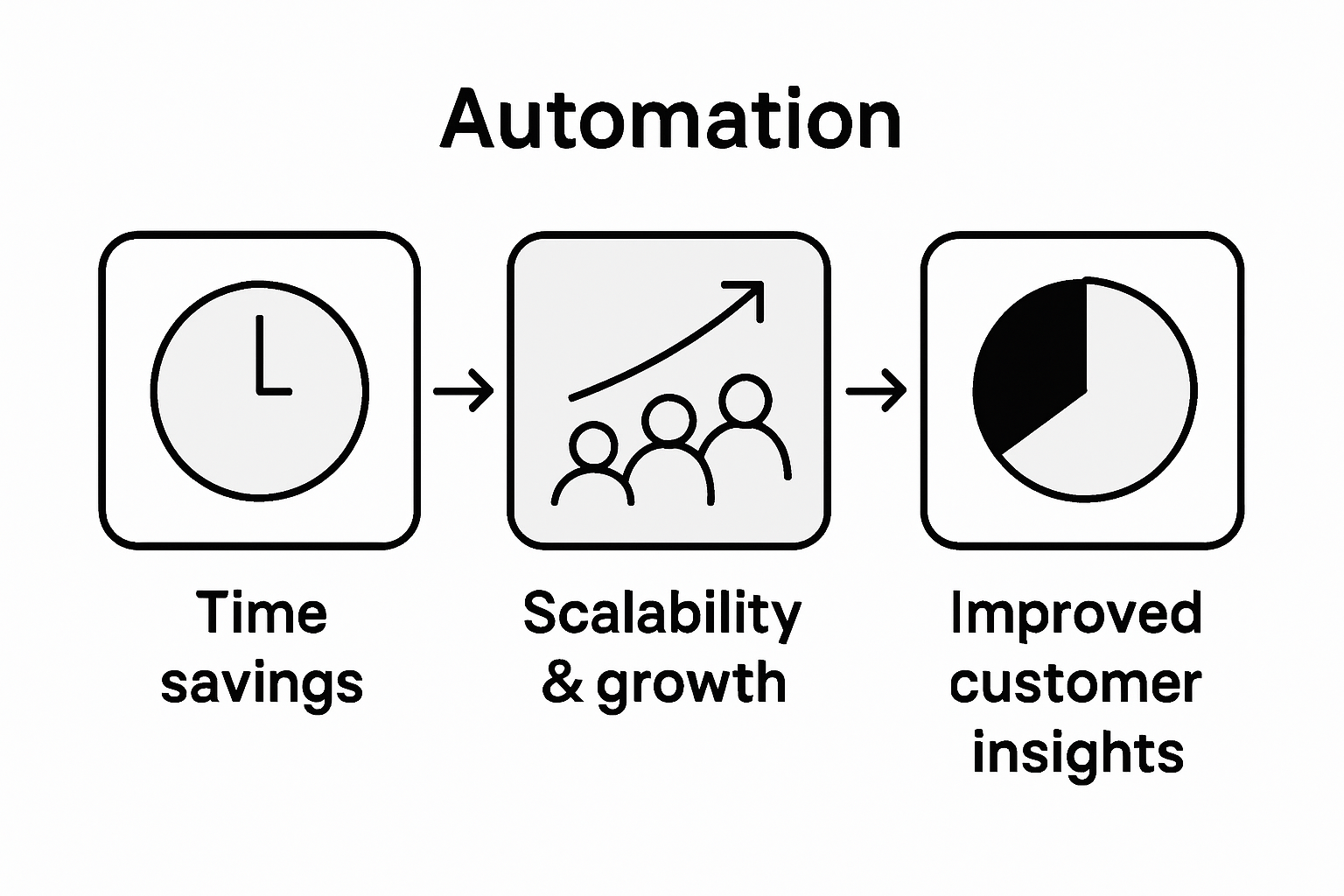
The strategic implementation of marketing automation provides comprehensive performance improvements across critical business functions. These intelligent systems enable precise audience segmentation, personalised customer journey mapping, and sophisticated lead nurturing mechanisms. By consolidating multi-channel interactions and implementing advanced tracking capabilities, businesses can develop more nuanced understanding of customer behaviours, preferences, and potential conversion pathways.
Key Benefits for Growing Businesses:
-
Operational Efficiency:
- Automated repetitive marketing tasks
- Reduced manual administrative workload
- Streamlined communication processes
- Consistent brand messaging
-
Enhanced Customer Insights:
- Comprehensive data tracking
- Detailed audience segmentation
- Personalised engagement strategies
- Real-time performance analytics
The technological ecosystem of marketing automation empowers businesses to implement sophisticated, data-driven marketing strategies with minimal manual intervention. By leveraging intelligent algorithms and integrated data platforms, organisations can create more responsive, targeted marketing approaches that adapt dynamically to changing customer interactions. The result is a more agile, efficient marketing infrastructure that supports sustainable business growth and improved customer relationship management.
Costs, Risks, and Common Mistakes
Marketing automation implementation requires strategic financial and operational considerations that businesses must carefully evaluate. Marketing automation risks and costs encompass significant investments in software acquisition, system integration, comprehensive staff training, and ongoing technological maintenance. Organisations must anticipate potential expenses ranging from initial platform subscriptions to customisation costs, which can vary dramatically depending on the complexity of their marketing ecosystem and specific business requirements.
The technological landscape of marketing automation presents nuanced risks that extend beyond financial investments. Potential pitfalls include over-reliance on automated processes, which can inadvertently create impersonal customer interactions and compromise the genuine human connection essential to effective marketing strategies. Data privacy compliance represents another critical risk area, with businesses needing robust frameworks to protect customer information and maintain transparency in their automated marketing approaches.
Common Mistakes to Avoid:
-
Strategic Implementation Errors:
- Inadequate initial strategy planning
- Misalignment with business objectives
- Insufficient staff training
- Poor integration with existing systems
-
Content and Engagement Challenges:
- Neglecting content quality
- Creating generic, non-personalised messaging
- Ignoring customer feedback loops
- Failing to adapt automation strategies
Successful marketing automation demands a holistic approach that balances technological capabilities with strategic human insight. Businesses must view automation as an enhancement of their marketing capabilities, not a replacement for thoughtful, personalised customer engagement. By developing comprehensive implementation strategies, investing in continuous learning, and maintaining a flexible approach to technological adaptation, organisations can mitigate risks and maximise the transformative potential of marketing automation technologies.
Harness Marketing Automation to Accelerate Your Business Growth
Marketing automation offers a powerful solution for service-based businesses struggling with repetitive tasks and inefficient lead nurturing as highlighted in the article. If you want to move beyond generic campaigns and deliver truly personalised experiences that convert faster, embracing intelligent automation is essential. Key challenges like maintaining consistent brand messaging and leveraging real-time analytics can be solved with the right strategy powered by proven methods such as the Marketing Vortex.
Business Warriors understands these specific pain points faced by ambitious entrepreneurs and small to medium businesses across sectors like beauty, wellness and professional services. Our expert team in Perth devises scalable, omnichannel marketing systems that combine SEO, Google Ads, email marketing and social media to seamlessly integrate automation into your customer journey.
Explore more strategies in our Uncategorized Archives – Jarrod Harman to see how others have succeeded.
Take control of your marketing efforts today with tailored automation solutions that reduce workload, boost client engagement and scale your sales. Visit Jarrod Harman and connect with Business Warriors to discover how our Marketing Vortex can transform your lead generation and client retention with transparent, results-driven systems you can trust.
Frequently Asked Questions
What is marketing automation and how does it benefit businesses?
Marketing automation is a strategic technological approach that allows businesses to automate and measure marketing tasks and workflows. It benefits businesses by increasing efficiency, enabling personalised customer experiences, and streamlining multi-channel interactions.
How do marketing automation systems work?
Marketing automation systems collect and analyse customer data to trigger automated marketing messages across multiple channels. They use advanced algorithms for user behaviour tracking and segmentation to create contextually relevant interactions.
What are the key differences between B2B and B2C marketing automation?
B2B marketing automation focuses on complex lead nurturing and long sales cycles with multiple stakeholders, while B2C marketing automation emphasises rapid consumer engagement and impulse purchase optimisation, targeting individual purchasing behaviours.
What are some common mistakes to avoid when implementing marketing automation?
Common mistakes include inadequate initial strategy planning, misalignment with business objectives, insufficient staff training, and neglecting content quality, leading to generic messaging that doesn’t resonate with customers.