


Over 60 percent of australian female business owners say inconsistent leads slow their growth more than any other challenge. Defining who your ideal customer is and creating tailored marketing funnels unlocks a more predictable path to steady sales. If you want practical strategies for attracting loyal customers and turning interest into lasting revenue, these steps offer clarity for australian service businesses ready to grow.
Table of Contents
- Step 1: Define Your Ideal Customer Profile
- Step 2: Map Your Customer Journey Stages
- Step 3: Craft Compelling Funnel Content
- Step 4: Set Up Automated Marketing Systems
- Step 5: Test And Optimise Funnel Performance
Quick Summary
| Key Point | Explanation |
|---|---|
| 1. Define Your Ideal Customer | Thoroughly analyse existing customers to isolate key traits that signify high-value prospects. |
| 2. Map Customer Journey Stages | Create a visual map detailing customer interactions at each stage from awareness to loyalty. |
| 3. Craft Targeted Funnel Content | Develop content that speaks to customer needs at each stage, driving them towards conversion. |
| 4. Automate Marketing Systems | Implement automation to streamline engagement and ensure personalisation in communications. |
| 5. Test and Optimise Performance | Regularly evaluate each funnel stage to enhance customer experience and improve conversion rates. |
Step 1: Define your ideal customer profile
Defining your ideal customer profile is about understanding precisely who will get the most value from your business. This strategic process helps you target marketing efforts and attract customers most likely to convert and become long-term advocates.
To build an accurate Ideal Customer Profile, start by analysing your existing customer base. Look for common characteristics such as industry type, company size, revenue range, geographic location, and specific challenges they face. Gather data through customer surveys, interviews, purchase history, and analytics tools. Pay attention to which customers generate the most revenue, have the lowest churn rates, and provide positive referrals.
Break down your research into clear categories including demographic details, firmographic information, behavioural patterns, and pain points. Create a comprehensive snapshot that goes beyond basic demographics to understand the deeper motivations and needs driving your target market. This nuanced approach ensures your marketing messages resonate precisely with the right audience.
Here’s a summary of key categories to consider when building an Ideal Customer Profile:
| Category | What It Includes | Business Impact |
|---|---|---|
| Demographics | Age, job title, decision-maker status | Shapes messaging and channel selection |
| Firmographics | Industry, company size, revenue range | Identifies highest-value market segments |
| Behavioural Data | Purchase frequency, engagement patterns | Reveals conversion triggers and retention |
| Pain Points | Specific challenges and needs | Enables tailored solutions and positioning |
Pro tip: Consider creating a visual representation of your Ideal Customer Profile to make it memorable and easily shareable across your marketing and sales teams.
Step 2: Map your customer journey stages
Mapping your customer journey stages involves creating a comprehensive visual representation of how potential clients interact with your business across different touchpoints. This strategic process helps you understand and optimise the path customers take from initial awareness to final purchase and ongoing loyalty.

To effectively map the customer journey, begin by identifying each critical stage a customer experiences. These typically include awareness, consideration, decision, purchase, and post purchase engagement. Research each stage meticulously tracking customer interactions including website visits, social media engagement, email communications, sales conversations, and support interactions. Pay close attention to customer motivations triggers and potential friction points that might prevent progression through the sales funnel.
Create a detailed visual map that breaks down each stage detailing specific customer actions expectations and potential emotional experiences. Analyse each touchpoint critically considering how you can improve communication personalisation and overall customer experience. This holistic approach ensures you understand not just what customers do but why they make specific decisions throughout their purchasing journey.
Pro tip: Use customer feedback and analytics data to continuously refine and update your customer journey map ensuring it remains accurate and responsive to changing customer needs.
Step 3: Craft compelling funnel content
Crafting compelling funnel content requires creating targeted messaging that resonates with potential customers at each stage of their buying journey. Your goal is to develop strategic content that guides prospects smoothly from initial awareness through to final purchase.
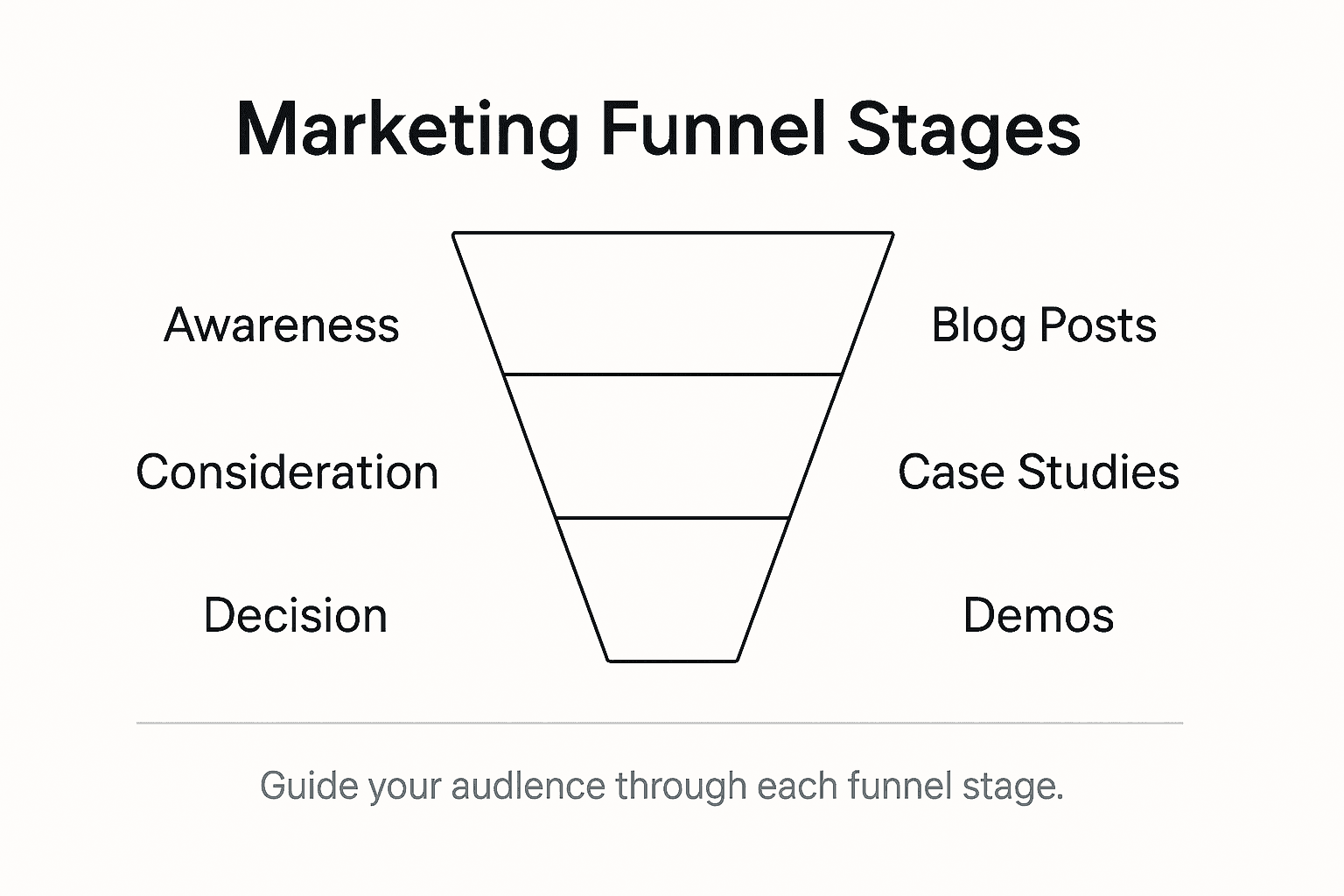
Content marketing strategies must be meticulously designed to address specific customer needs across different stages of engagement. At the top of the funnel focus on educational content that introduces your brand and addresses potential customer challenges. In the middle stages develop comparison content and solution oriented materials that demonstrate your unique value proposition. For bottom of funnel content concentrate on direct conversion focused materials that provide clear evidence of your product or service effectiveness.
Successful content creation involves understanding your audience deeply and tailoring your messaging to their specific pain points and motivations. Use storytelling techniques visual elements and clear value propositions to make your content engaging and persuasive. Integrate multiple content formats including blog posts videos podcasts infographics and case studies to provide comprehensive information that builds trust and moves potential customers through your marketing funnel.
Compare how different funnel content types support each stage of the customer journey:
| Funnel Stage | Content Focus | Primary Goal | Example Format |
|---|---|---|---|
| Awareness | Educate, build trust | Attract new prospects | Blog posts, infographics |
| Consideration | Comparison, address objections | Convince and build interest | Case studies, webinars |
| Decision | Demonstrate value, persuade | Drive conversions | Testimonials, product demos |
| Post-Purchase | Encourage loyalty, support | Retain and delight customers | Email series, follow-up calls |
Pro tip: Regularly analyse your content performance using analytics to continuously refine and optimise your funnel content strategy based on actual customer engagement metrics.
Step 4: Set up automated marketing systems
Setting up automated marketing systems transforms how your business engages with potential customers by streamlining repetitive tasks and creating personalised communication pathways. This strategic approach allows you to efficiently manage your marketing efforts while maintaining a highly targeted approach to customer interactions.
Marketing automation strategies involve implementing sophisticated software that handles complex communication workflows across multiple channels. Choose automation platforms that integrate seamlessly with your existing customer relationship management systems and can track interactions across email social media and website touchpoints. Design trigger based workflows that respond to specific customer actions such as downloading content signing up for newsletters or completing particular website interactions.
Implementing effective automation requires a nuanced approach that balances technological efficiency with genuine human connection. Configure your systems to segment audiences precisely using behavioural data demographic information and engagement levels. Develop personalised communication sequences that adapt dynamically based on individual customer interactions ensuring each prospect receives relevant targeted content that moves them progressively through your marketing funnel. Continuously monitor and refine your automation settings using detailed analytics to improve conversion rates and customer engagement.
Pro tip: Test your automated workflows extensively before full deployment to ensure smooth customer experiences and identify potential communication gaps.
Step 5: Test and optimise funnel performance
Testing and optimising your marketing funnel performance is crucial for ensuring consistent sales growth and understanding how potential customers interact with your business. This process involves systematically evaluating each stage of your marketing journey to identify areas of improvement and remove potential barriers to conversion.
Advanced funnel testing techniques require a comprehensive approach that goes beyond simple metrics. Start by implementing A/B testing across different funnel stages comparing variations in content design call to action messaging and user experience. Track key performance indicators such as click through rates conversion rates time spent on page and overall engagement levels. Utilise analytics tools that provide granular insights into customer behaviour allowing you to make data driven decisions about your marketing strategy.
Create a structured testing framework that allows for continuous improvement. Develop hypotheses about potential optimisations and systematically test these assumptions using controlled experiments. Monitor how changes impact your funnel performance paying close attention to customer drop off points and areas where prospects lose interest. Regularly review your analytics to understand customer behaviour patterns and adapt your marketing approach accordingly. Remember that funnel optimisation is an ongoing process requiring consistent attention and willingness to experiment and evolve your marketing strategies.
Pro tip: Implement a quarterly review process to comprehensively analyse your funnel performance and identify emerging opportunities for improvement.
Unlock Consistent Sales Growth with Proven Marketing Funnels
Struggling with turning leads into loyal customers is a common challenge that every business owner faces. This article outlines the essential steps to build marketing funnels that deliver consistent sales growth, from defining your ideal customer profile to optimising your funnel performance. If you want to move beyond theory and implement proven strategies, Business Warriors offers the expert support and scalable marketing systems you need. Our unique Marketing Vortex method integrates SEO, Google Ads, social media, and email marketing into one powerful engine designed for service-based businesses ready to accelerate growth.
Ready to stop guessing and start seeing real results? Visit Uncategorized Archives – Jarrod Harman to discover more insights or head straight to https://jarrodharman.com to explore how our tailored digital marketing solutions can transform your sales funnel. Take the next step with Business Warriors and turn your marketing funnel into a consistent client acquisition machine today.
Frequently Asked Questions
What is an Ideal Customer Profile and why is it important for building marketing funnels?
Creating an Ideal Customer Profile (ICP) involves identifying the key characteristics of your best customers. This understanding allows you to tailor your marketing funnels to attract prospects who are most likely to convert, ultimately enhancing sales growth. Start by analysing your current customers’ demographics and behaviours, and refine your targeting based on that data.
How can I map the customer journey stages for my marketing funnel?
To map your customer journey stages, identify each critical interaction point a customer has with your business, from awareness through to post-purchase engagement. Create a visual representation that details customer actions and emotions at each stage to optimise their experience. Begin by listing all the customer touchpoints and customer behaviours at these stages to ensure a comprehensive view.
What type of content should I create for each stage of the marketing funnel?
At the top of the funnel, focus on educational content that builds trust, such as blog posts or infographics. In the middle stages, develop comparison content and solutions that showcase your unique value. For the bottom of the funnel, create direct conversion-focused materials, such as testimonials and product demos, to encourage final purchasing decisions.
How can I set up automated marketing systems effectively?
To set up automated marketing systems, select a platform that integrates easily with your existing tools and allows you to design trigger-based workflows. Tailor your automated messages based on customer behaviours and demographics to create personalised communication. Start by identifying key customer actions that will trigger your automated responses, ensuring timely and relevant engagement.
What steps should I take to test and optimise my marketing funnel?
Begin testing your marketing funnel by implementing A/B tests to compare different versions of content, calls to action, and designs. Track key performance indicators like conversion rates and engagement levels to identify areas for improvement. Establish a routine to review your results and make data-driven adjustments consistently.
How often should I review my marketing funnel performance for optimal results?
You should conduct a comprehensive review of your marketing funnel performance at least quarterly. This allows you to evaluate the effectiveness of your strategies and identify emerging opportunities for growth. Set aside time every three months to analyse your data and refine your marketing efforts based on insights gained.
Recommended
- Complete Guide to Why Use Marketing Funnels – Jarrod Harman
- What Is a Marketing Funnel and Why It Matters – Jarrod Harman
- 7 Essential Types of Marketing Funnels for Business Growth – Jarrod Harman
- 10 Effective Lead Generation Strategies for Businesses – Jarrod Harman
- How to Create Supplement Schedule for Peak Fitness Results – MyGymSupplements