


Bold ideas and beautiful results often depend on how well your story reaches potential clients. For many australian beauty and wellness business owners, video marketing has become the fastest-growing way to build trust and attract steady leads. With over 80 percent of online users watching branded videos every week, integrating video into your strategy can set your business apart and drive real sales. Discover how to use video marketing to create genuine connections with your clients and maximise growth.
Table of Contents
- Video Marketing Explained For Business Owners
- Types Of Video Content And Their Impact
- Key Benefits For Service-Based Industries
- Costs, Risks And Performance Metrics
- Common Mistakes To Avoid In Video Marketing
Key Takeaways
| Point | Details |
|---|---|
| Video Marketing Engagement | Craft compelling visual stories to create genuine connections with your audience and demonstrate your brand’s personality. |
| Diverse Content Types | Utilize various video formats like testimonials and educational tutorials to effectively meet specific marketing objectives. |
| Performance Metrics | Track engagement rates and conversion metrics to refine strategies and enhance future video marketing efforts. |
| Avoid Common Pitfalls | Establish clear objectives and maintain consistent video production to prevent misalignment and ensure ongoing audience engagement. |
Video marketing explained for business owners
Video marketing represents a strategic approach that transforms how businesses communicate their value proposition through visual storytelling. By crafting compelling video content, companies can effectively showcase products, services, and brand personality in ways traditional marketing cannot match.
At its core, video marketing involves creating targeted visual content designed to engage specific audience segments. This approach goes beyond simple advertisements, focusing on building genuine connections through narratives that resonate with viewers’ emotions and interests. Businesses can leverage various video formats including explainer videos, testimonials, product demonstrations, behind-the-scenes glimpses, and educational content to communicate complex ideas quickly and memorably.
Successful video marketing requires understanding your target audience’s preferences, pain points, and communication styles. Marketing strategies must align video content with specific business objectives such as brand awareness, lead generation, customer education, or direct sales conversion. This means developing a nuanced approach that speaks directly to viewer needs while maintaining professional production quality.
Hot Tip: Invest in high-quality audio equipment alongside your video camera, as clear sound quality can dramatically improve viewer engagement and perceived professionalism.
Types of video content and their impact
Businesses have multiple video content types that serve distinct marketing objectives and engage audiences differently. Instructional video engagement demonstrates how strategic content selection can dramatically influence viewer interaction and brand perception.
The primary video content categories include explainer videos, product demonstrations, customer testimonials, brand story narratives, behind-the-scenes glimpses, and educational tutorials. Each type serves a unique purpose: explainer videos simplify complex concepts, product demonstrations showcase functionality, testimonials build social proof, brand stories create emotional connections, behind-the-scenes content humanises the brand, and educational tutorials provide genuine value to potential customers.

Understanding audience preferences is critical when selecting video content. Different demographics respond variously to video styles – younger audiences might prefer quick, dynamic content with high production values, while professional sectors may appreciate more structured, informative presentations. Engagement metrics like view duration, share rates, and conversion tracking help businesses refine their video marketing strategies and understand which content resonates most effectively.
To better understand how different video types align with business goals, see this comparison:
| Video Type | Primary Purpose | Typical Audience Reaction |
|---|---|---|
| Explainer | Simplifies complex concepts | Increased understanding and recall |
| Product Demonstration | Showcases features in action | Builds confidence in the product |
| Customer Testimonial | Offers social proof | Boosts trust and credibility |
| Brand Story Narrative | Creates emotional bond | Strengthens brand loyalty |
| Behind-the-Scenes Glimpse | Humanises the business | Fosters authenticity and relatability |
| Educational Tutorial | Provides practical value | Encourages repeat engagement |
Pro Tip: Develop a diverse video content strategy that rotates between different formats to maintain audience interest and prevent content fatigue.
Key benefits for service-based industries
Service-based businesses can leverage video marketing as a transformative strategy to differentiate themselves in competitive markets. Digital customer experiences have become critical for establishing trust, demonstrating expertise, and connecting emotionally with potential clients.
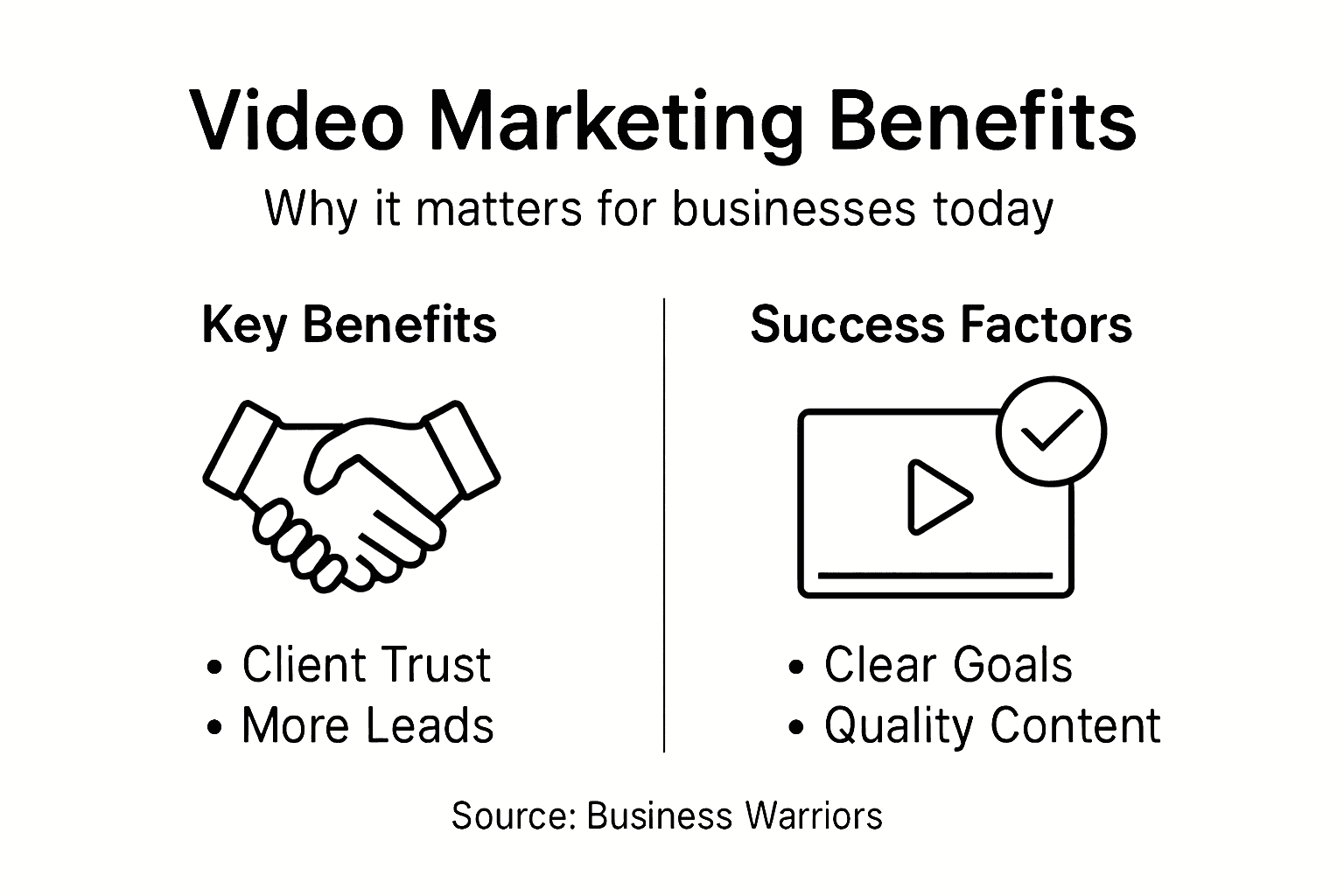
Key benefits for service industries include enhanced client education, improved trust-building, and more engaging communication channels. Videos allow professionals to showcase their expertise through tutorials, client testimonials, and behind-the-scenes glimpses that humanise their brand. For instance, a physiotherapy clinic can create rehabilitation technique videos, a legal firm can produce FAQ explainers, and a beauty salon can showcase treatment processes, all of which help potential clients understand services more comprehensively.
Video marketing significantly impacts customer acquisition and retention by providing transparent, accessible information. Unlike traditional marketing methods, videos enable service providers to communicate complex offerings quickly, address common client concerns, and demonstrate their unique value proposition. Engagement metrics reveal that businesses using strategic video content experience higher conversion rates, improved client understanding, and more meaningful connections with their target audience.
Pro Tip: Create a consistent video content calendar that balances educational, testimonial, and service demonstration videos to maintain audience interest and showcase your professional expertise.
Costs, risks and performance metrics
Video marketing investments require strategic planning and comprehensive performance tracking to ensure meaningful returns. Marketing performance assessment involves understanding both financial commitments and potential risks associated with digital content creation.
Cost considerations for video marketing include equipment investments, professional production services, editing software, and potential talent or voice-over expenses. Small businesses might spend between $500 to $5000 per video, depending on complexity and quality. Risks include potential content misalignment, low audience engagement, and ineffective messaging. Businesses must carefully evaluate their target demographic, content strategy, and production quality to mitigate these risks and maximise potential returns.
Performance metrics provide critical insights into video marketing effectiveness. Key indicators include view count, watch duration, engagement rates, click-through percentages, and conversion metrics. Tracking performance allows businesses to refine strategies, understand audience preferences, and allocate marketing resources more effectively. Advanced analytics can reveal audience demographics, viewing patterns, and the specific moments where viewers lose interest, enabling continuous improvement of video content.
Here’s a summary of key video marketing performance metrics and why each matters:
| Metric | What It Measures | Business Insight Provided |
|---|---|---|
| View Count | Number of views | Indicates audience interest level |
| Watch Duration | Average time watched | Reveals content engagement quality |
| Engagement Rate | Likes, shares, comments | Shows how interactive the content is |
| Click-Through Rate | % clicking on a call-to-action | Gauges effectiveness in prompting actions |
| Conversion Rate | Ratio of viewers to customers | Measures overall marketing success |
Pro Tip: Allocate approximately 10-15% of your marketing budget for initial video content experimentation, focusing on creating high-quality, targeted videos that directly address your audience’s needs.
Common mistakes to avoid in video marketing
Video marketing success hinges on strategic execution, with numerous potential pitfalls that can derail even well-intentioned campaigns. Understanding and navigating these challenges is crucial for businesses seeking to leverage video as an effective marketing tool.
Many businesses stumble by creating content without clear objectives, treating video marketing as a sporadic effort rather than a consistent strategy. Common mistakes include producing overly promotional videos that prioritise sales messaging over genuine value, neglecting audience preferences, and failing to optimise content for specific platforms. Businesses often create videos that are either too long, losing viewer attention, or too short to communicate meaningful information, ultimately reducing engagement and potential conversion rates.
Technical and strategic errors can significantly undermine video marketing effectiveness. These include poor production quality, inconsistent publishing schedules, ignoring video search engine optimisation (SEO), and neglecting critical analytics that provide insights into viewer behaviour. Successful video marketing requires a holistic approach that balances creative storytelling with data-driven strategy, ensuring each video serves a specific purpose within the broader marketing ecosystem. Audience targeting becomes paramount, necessitating deep understanding of viewer demographics, preferences, and content consumption habits.
Pro Tip: Develop a comprehensive video content calendar that maps specific objectives, target audiences, and performance metrics for each piece of video content, ensuring strategic alignment and measurable outcomes.
Unlock Real Growth with Video Marketing and the Marketing Vortex Method
If your business struggles to translate video marketing into consistent leads and sales, you are not alone. Many service-based businesses face challenges like unclear goals, low engagement, and missing the emotional connection video content can create. This article highlights the power of combining compelling video content with strategic marketing systems that address your audience’s pain points and preferences. By integrating varied video formats such as explainer videos, testimonials, and educational tutorials, you can build trust and showcase your expertise effectively.
At Business Warriors, we specialise in empowering service businesses to overcome these exact hurdles using our unique Marketing Vortex Method. This proven strategy blends SEO, paid ads, email marketing, and tailored video content to create an omnichannel approach that drives measurable growth and client acquisition. If you want to discover how to elevate your video marketing beyond sporadic efforts and consistently convert viewers into loyal customers, start with our insights in the Uncategorized Archives.

Ready to transform your video marketing into a reliable engine for business growth? Visit https://jarrodharman.com now to explore how our expert consulting and hands-on marketing support can help you generate consistent leads and scale your service business. Don’t let another video go unnoticed – let’s build your marketing strategy with clear objectives and measurable success.
Frequently Asked Questions
What is video marketing?
Video marketing is a strategic approach that uses visual storytelling to communicate a business’s value proposition. It involves creating targeted video content to engage specific audience segments and build emotional connections.
How can video marketing benefit my business?
Video marketing helps enhance client education, build trust, and create engaging communication channels. It enables businesses to showcase expertise, demonstrate services, and foster meaningful connections with potential customers, which can ultimately lead to increased conversion rates.
What types of video content should I consider for my marketing strategy?
Consider using a variety of video types such as explainer videos, product demonstrations, customer testimonials, brand stories, behind-the-scenes glimpses, and educational tutorials. Each type serves a unique purpose and appeals to different audience preferences.
What metrics should I track to measure the effectiveness of my video marketing?
Key metrics to track include view count, watch duration, engagement rate, click-through rate, and conversion rate. These metrics provide insights into audience interest, content engagement quality, and overall marketing success.