


Growing a service-based business in Australia often means figuring out how to turn online attention into real sales. For many female business owners, the biggest challenge is not just attracting visitors, but finding a proven way to guide the right prospects towards becoming loyal clients. By focusing on digital lead generation, you can create steady demand and build trust without relying solely on traditional word of mouth.
Table of Contents
- What Is Digital Lead Generation?
- Inbound, Outbound, And Hybrid Strategies
- Omnichannel Approaches For Consistent Growth
- Key Tools And Platforms For Lead Capture
- Legal, Data, And Privacy Pitfalls
- Real Costs And Common Mistakes
Key Takeaways
| Point | Details |
|---|---|
| Digital Lead Generation | Focus on creating compelling content to attract potential customers and nurture them through various digital channels. |
| Inbound vs. Outbound Strategies | Inbound strategies build long-term trust while outbound methods provide immediate outreach; hybrid strategies merge the two for optimal results. |
| Omnichannel Integration | Successful omnichannel approaches unify customer experiences across digital and physical channels to enhance engagement and personalisation. |
| Legal and Compliance Needs | Implement a proactive data privacy framework to ensure compliance with regulations and build consumer trust. |
What Is Digital Lead Generation?
Digital lead generation is the strategic process of attracting and converting potential customers through online channels and targeted digital marketing techniques. By leveraging systematic digital marketing strategies, businesses can identify, engage, and nurture prospective clients across multiple internet platforms.
The core objective of digital lead generation involves creating compelling digital content that draws potential customers organically. This approach goes beyond traditional advertising by focusing on inbound marketing techniques where consumers discover businesses through valuable, targeted content. Modern digital lead generation incorporates several key elements:
- Targeted content marketing
- Search engine optimisation (SEO)
- Social media engagement
- Email marketing campaigns
- Conversion-focused website design
- Strategic call-to-action mechanisms
Understanding digital lead generation requires recognising its dynamic nature. Unlike traditional marketing methods, digital strategies allow businesses to track, measure, and optimise their customer acquisition processes in real-time. Digital marketing tactics enable algorithmic optimization of lead generation efforts, helping companies scale their growth systematically.
The most successful digital lead generation strategies integrate multiple channels to create a comprehensive approach. This means combining organic search tactics, paid advertising, social media outreach, and sophisticated customer relationship management (CRM) technologies to create a seamless prospect identification and conversion ecosystem.
Digital lead generation transforms random website visitors into potential sales opportunities through strategic, data-driven engagement techniques.
Pro tip: Implement a multi-channel digital lead generation strategy that combines SEO, content marketing, and targeted advertising for maximum conversion potential.
Inbound, Outbound, and Hybrid Strategies
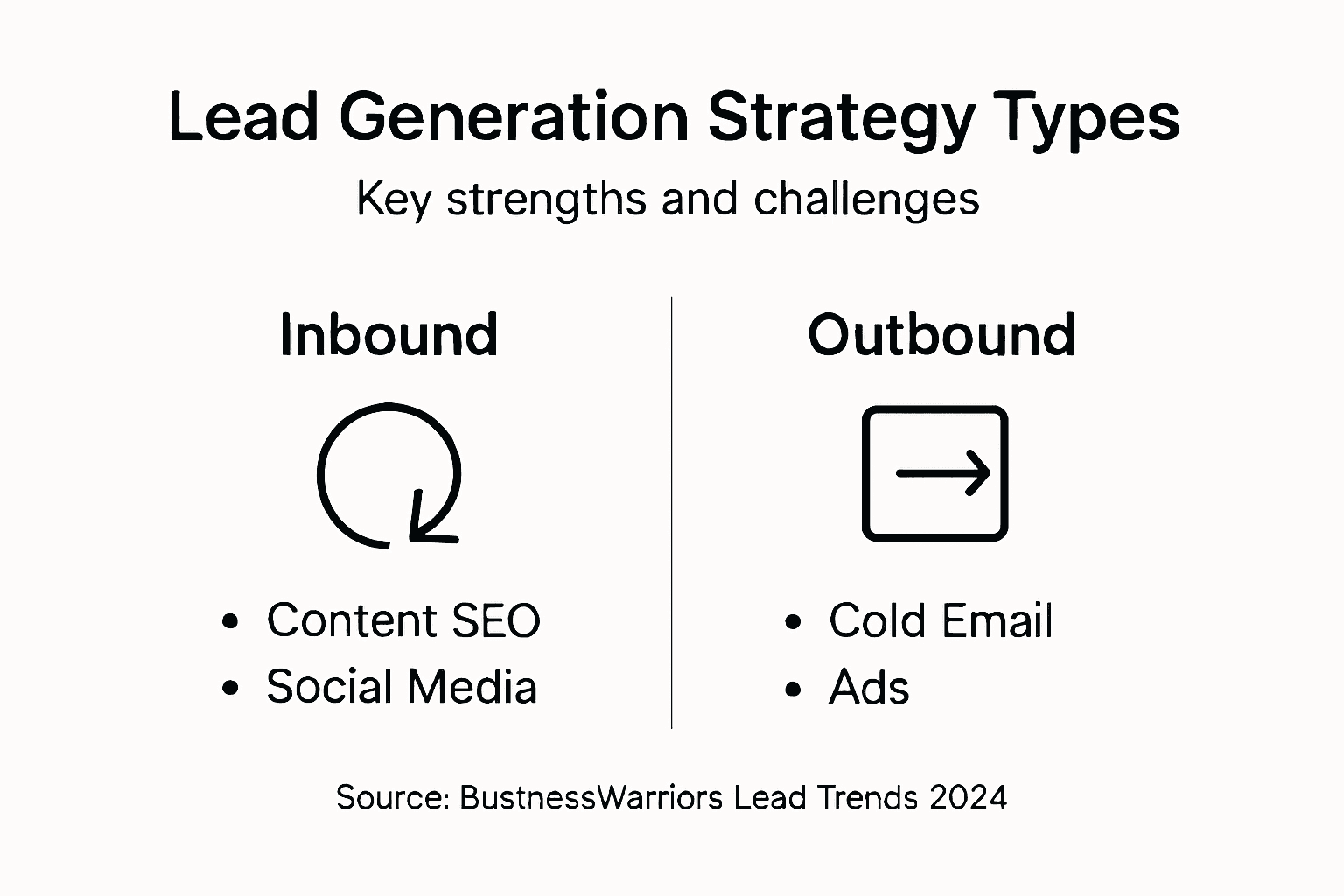
Lead generation strategies can be broadly categorised into three primary approaches: inbound, outbound, and hybrid methodologies. Inbound lead generation represents a pull strategy where potential customers are attracted through valuable content, strategic search engine optimisation, and engaging social media presence.
The characteristics of each lead generation strategy differ significantly:
Inbound Strategies:
- Content marketing
- Search engine optimisation
- Social media engagement
- Organic website traffic
- Educational blog posts
- Free downloadable resources
Outbound Strategies:
- Cold calling
- Targeted email campaigns
- Paid advertising
- Direct mail
- Trade show presentations
- LinkedIn prospecting
Hybrid Strategies:
- Combining organic and paid tactics
- Leveraging multiple communication channels
- Integrating automated and personalised outreach
- Using data-driven targeting techniques
Hybrid approaches offer the most comprehensive lead generation framework, blending the long-term brand-building benefits of inbound marketing with the immediate engagement potential of outbound techniques. This strategy allows businesses to create a more dynamic and responsive lead acquisition ecosystem.
Modern lead generation requires a sophisticated, multi-channel approach that adapts to evolving customer behaviour and technological capabilities.
Successful hybrid strategies typically involve carefully orchestrating digital touchpoints that guide potential customers through a seamless journey from initial awareness to conversion. By combining organic content development with strategic paid interventions, businesses can create a more predictable and scalable revenue generation system.
Here’s a comparison of digital lead generation strategies and their typical business impacts:
| Strategy Type | Main Strength | Limitation | Typical Business Impact |
|---|---|---|---|
| Inbound | Builds trust over time | Slower initial results | Increased long-term brand value |
| Outbound | Immediate outreach | Can feel intrusive | Rapid but less qualified leads |
| Hybrid | Balanced approach | Complex to coordinate | Improved pipeline consistency |
Pro tip: Design your lead generation strategy to balance immediate conversion opportunities with long-term brand credibility and trust-building efforts.
Omnichannel Approaches for Consistent Growth
Omnichannel marketing strategies represent a sophisticated approach to creating seamless, integrated customer experiences across multiple digital and physical touchpoints. By unifying communication channels, businesses can develop a more cohesive and responsive engagement framework that adapts to modern consumer behaviours.
Key components of effective omnichannel strategies include:
Digital Channel Integration:
- Website optimisation
- Social media platforms
- Mobile app experiences
- Email marketing
- Targeted digital advertising
- Retargeting campaigns
Physical Channel Coordination:
- In-store experiences
- Customer service interactions
- Offline event marketing
- Print marketing materials
- Telephonic support
- Direct mail communications
Technology Enablers:
- Customer relationship management (CRM) systems
- Marketing automation platforms
- Analytics and tracking tools
- Personalisation engines
- Integrated communication dashboards
- Cross-channel data synchronisation
Omnichannel approaches enhance customer journey flexibility by creating interconnected experiences that feel natural and intuitive. This strategy allows businesses to provide consistent messaging and personalised interactions regardless of the customer’s chosen engagement platform.
Successful omnichannel marketing transforms disconnected touchpoints into a unified, responsive customer experience ecosystem.
Implementing an effective omnichannel strategy requires sophisticated technological integration, data-driven insights, and a deep understanding of customer preferences. Businesses must invest in robust infrastructure that enables real-time communication and personalisation across all potential interaction points.

Pro tip: Develop a comprehensive customer data platform that tracks interactions across all channels, enabling more personalised and contextually relevant marketing engagements.
Key Tools and Platforms for Lead Capture
Contemporary lead capture technologies have revolutionised how businesses identify, attract, and convert potential customers through sophisticated digital platforms. These advanced tools leverage artificial intelligence, automation, and data-driven insights to streamline the lead generation process and enhance marketing efficiency.
Key platforms and tools for effective lead capture include:
Customer Relationship Management (CRM) Systems:
- HubSpot
- Salesforce
- Pipedrive
- Zoho CRM
- Microsoft Dynamics
- Freshsales
Lead Generation and Automation Platforms:
- Marketo
- ActiveCampaign
- Mailchimp
- Leadpages
- Unbounce
- GetResponse
AI-Powered Engagement Tools:
- Drift chatbots
- Intercom
- MobileMonkey
- Chatfuel
- ManyChat
- LiveChat
Advanced lead capture software combines multiple sophisticated features such as customisable web forms, behaviour-triggered popups, and intelligent lead scoring mechanisms. These tools not only collect contact information but also provide deep insights into potential customer interactions and preferences.
Modern lead capture platforms transform raw visitor data into actionable marketing intelligence, enabling businesses to personalise their approach and improve conversion rates.
Successful implementation requires selecting tools that integrate seamlessly with existing marketing infrastructure, provide robust analytics, and support multi-channel engagement strategies. Businesses must prioritise platforms offering real-time data synchronisation, advanced segmentation capabilities, and comprehensive reporting functionalities.
Pro tip: Select lead capture tools that offer comprehensive integration capabilities and provide detailed analytics to track and optimise your marketing performance.
Legal, Data, and Privacy Pitfalls
Ethics-driven lead generation requires navigating complex legal landscapes that demand rigorous compliance with evolving data protection regulations. Businesses must develop sophisticated approaches to data collection, consent management, and privacy protection to mitigate potential legal risks and maintain consumer trust.
Key legal and privacy considerations include:
Regulatory Compliance Frameworks:
- General Data Protection Regulation (GDPR)
- California Consumer Privacy Act (CCPA)
- Australian Privacy Principles (APPs)
- Personal Information Protection and Electronic Documents Act (PIPEDA)
- Digital Privacy Act
- European Union Data Protection Directive
Data Protection Best Practices:
- Explicit consent mechanisms
- Transparent data usage policies
- Secure data storage protocols
- Regular privacy impact assessments
- Data minimisation strategies
- Comprehensive user consent documentation
Risk Mitigation Strategies:
- Implementing robust data encryption
- Developing clear privacy policies
- Establishing user opt-out mechanisms
- Creating comprehensive data handling procedures
- Conducting regular compliance audits
- Training staff on privacy regulations
Modern organisations must adopt a proactive approach to data privacy, understanding that legal compliance is not just about avoiding penalties but building genuine trust with consumers. This involves implementing sophisticated consent management systems, utilising first-party and zero-party data collection methods, and maintaining absolute transparency about data usage.
Privacy compliance is no longer a legal obligation but a critical component of building long-term customer relationships and organisational credibility.
Technological solutions such as AI-powered consent management platforms and advanced data anonymisation techniques can help businesses navigate the complex landscape of data protection while maintaining effective lead generation strategies.
Pro tip: Develop a comprehensive privacy framework that prioritises user consent, data transparency, and proactive compliance management across all lead generation activities.
Real Costs and Common Mistakes
Lead generation mistakes can significantly impact business performance by wasting resources, damaging brand reputation, and reducing overall marketing effectiveness. Understanding these pitfalls is crucial for developing more strategic and cost-efficient lead acquisition approaches.
Common costly lead generation errors include:
Strategic Misalignments:
- Prioritising lead quantity over quality
- Treating all leads identically
- Ignoring lead source attribution
- Misaligned messaging across channels
- Inadequate lead scoring mechanisms
- Failing to segment target audiences
Financial Impact Areas:
- Wasted advertising spend
- Inefficient sales team resources
- High customer acquisition costs
- Reduced conversion rates
- Missed revenue opportunities
- Poor return on marketing investments
Performance Degradation Indicators:
- Low engagement rates
- High lead drop-off percentages
- Extended sales cycles
- Inconsistent pipeline performance
- Decreased marketing ROI
- Negative brand perception
Effective lead generation requires strategic audience targeting and sophisticated tracking mechanisms that align marketing efforts with precise buyer needs. Businesses must develop nuanced approaches that leverage data-driven insights and adaptive communication strategies.
Successful lead generation is not about capturing maximum contacts, but attracting genuinely interested potential customers who align with your value proposition.
Modern organisations must invest in advanced analytics, personalisation technologies, and continuous performance monitoring to create more intelligent and responsive lead generation ecosystems. This involves implementing sophisticated tracking, segmentation, and engagement strategies that adapt to evolving market dynamics.
Below is a summary of common digital lead generation mistakes and their potential consequences:
| Mistake | Potential Consequence | Preventive Action |
|---|---|---|
| Focusing on quantity not quality | High unqualified leads, wasted budget | Implement lead scoring criteria |
| Ignoring segmentation | Generic messaging, low engagement | Use tailored targeting strategies |
| Poor source attribution | Misallocation of spend | Regularly review channel performance |
| Inefficient follow-up | Lost sales opportunities | Automate and personalise responses |
Pro tip: Develop a comprehensive lead qualification framework that prioritises quality interactions over raw contact volume, focusing on meaningful engagement metrics.
Unlock Fast Online Sales Growth with Proven Lead Generation Strategies
If you are struggling to consistently attract high-quality leads or overwhelmed by the complexities of integrating inbound and outbound tactics, you are not alone. This article highlights the need for a balanced, multi-channel lead generation approach that combines SEO, content marketing, targeted advertising, and omnichannel engagement to build trust while driving immediate results. Common challenges include ineffective lead qualification, poor segmentation, and missed optimisation opportunities — all critical to solving your ongoing sales pipeline issues.
At Business Warriors, we specialise in accelerating online client acquisition for service-based businesses through our unique “Marketing Vortex” method. This comprehensive strategy combines SEO, Google Ads, Meta advertising, email marketing, social media, and web development into an integrated system that de-risks your marketing investment and guarantees measurable bookings growth. Our proven process empowers you to generate not just more leads but better leads with focused targeting and personalised engagement tailored to your industry and goals.

Are you ready to boost your online sales fast with an expert lead generation partner? Visit Uncategorized Archives – Jarrod Harman to explore insights and success stories that reveal how we help businesses like yours. Take the first step by connecting with us at https://jarrodharman.com to discover how our digital marketing agency can transform your lead strategies into consistent revenue. Don’t let complexity or poor results hold you back — act now and secure predictable growth.
Frequently Asked Questions
What is digital lead generation?
Digital lead generation is the process of attracting and converting potential customers using online channels and targeted digital marketing strategies. It focuses on creating valuable content that draws potential customers organically through methods like SEO, social media engagement, and content marketing.
What are the main types of lead generation strategies?
Lead generation strategies can be categorised into three main types: inbound, outbound, and hybrid. Inbound strategies focus on attracting customers through valuable content. Outbound strategies involve direct outreach, like cold calling and paid advertising, while hybrid strategies combine elements of both for a more comprehensive approach.
How can I improve my lead generation strategy?
To enhance your lead generation strategy, implement a multi-channel approach that includes SEO, content marketing, and targeted advertising. Ensure to segment your audience for more tailored messaging, and consider using automation tools for efficient lead capture and follow-up.
What mistakes should I avoid in lead generation?
Common mistakes to avoid include focusing on the quantity of leads over quality, neglecting audience segmentation, and failing to track lead sources properly. Implementing lead scoring criteria and personalised communication can greatly improve the effectiveness of your lead generation efforts.
Recommended
- 10 Effective Lead Generation Strategies for Businesses – Jarrod Harman
- Understanding Online Lead Generation: A Complete Guide – Jarrod Harman
- How to Generate Leads in Digital Marketing: Proven Strategies – Jarrod Harman
- How to Generate Leads Online for Business Growth – Jarrod Harman
- Content Marketing Strategy: Driving Local Growth Online