


Clients are searching online for their next favourite beauty or wellness service, but capturing their attention can feel like a constant challenge. For Australian business owners aiming to grow, mastering digital marketing strategies for lead generation is no longer a luxury. This guide simplifies the proven methods and essential tools that help you stand out, attract quality leads, and convert interest into loyal bookings—without wasting time or money on tactics that do not work.
Table of Contents
- Lead Generation For Small Business Explained
- Types Of Lead Generation Channels Today
- Key Elements Of A High-Converting Funnel
- Crucial Tools And Technology For Scaling Leads
- Common Pitfalls To Avoid In Lead Generation
Key Takeaways
| Point | Details |
|---|---|
| Understanding Modern Lead Generation | Small businesses must adapt to a digital marketplace where customers control their buying journey, focusing on building relationships through multiple online channels. |
| Utilising Multi-Channel Strategies | An effective lead generation strategy should integrate both inbound and outbound channels to maximise reach and engagement with potential customers. |
| Optimising Marketing Funnels | High-converting funnels must anticipate customer hesitations, providing value at each stage of the buyer’s journey to move prospects towards a purchase decision. |
| Leveraging Technology | Small businesses should utilise CRM systems, marketing automation, and analytics tools to streamline lead management and maintain effective customer engagement. |
Lead Generation for Small Business Explained
Lead generation represents the critical process of attracting and converting potential customers into interested prospects for your business. In today’s digital marketplace, digital marketing strategies are transforming lead acquisition for small businesses across Australia.
The landscape of lead generation has dramatically shifted from traditional outbound marketing techniques to more sophisticated digital approaches. Small businesses can now leverage multiple online channels to connect with potential customers, including:
- Search engine marketing
- Social media advertising
- Content marketing
- Email campaigns
- Professional networking platforms
Understanding modern lead generation requires recognising that customers now control their buying journey. Contemporary buying processes demand strategic relationship-building through targeted digital interactions. This means moving beyond simply attracting website visitors to developing comprehensive conversion strategies.
Successful lead generation for small businesses involves a multi-channel approach that integrates various digital touchpoints. Entrepreneurs must focus on creating valuable content, understanding customer pain points, and developing systems that consistently capture and nurture potential client interest.
Pro tip: Implement a customer relationship management (CRM) system to track and manage leads systematically, ensuring no potential opportunity falls through the cracks.
Types of Lead Generation Channels Today
Lead generation channels represent the strategic pathways businesses use to attract and convert potential customers. Channels are broadly categorised into inbound and outbound strategies that help small businesses connect with their target audience effectively.
Inbound lead generation channels focus on pulling potential customers through valuable content and organic engagement:
- Search engine optimisation (SEO)
- Content marketing
- Social media organic posts
- Blogs and educational resources
- Webinars and online workshops
- Email newsletter marketing
Outbound channels, by contrast, proactively push messages and directly reach out to potential customers through:
- Paid advertising
- Cold email campaigns
- LinkedIn prospecting
- Direct mail
- Telemarketing
- Trade show exhibitions
Effective lead generation strategies integrate multiple channels tailored to different stages of the customer journey. This approach ensures businesses can capture leads through diverse touchpoints, maximising their potential for conversion and growth.
Here’s a comparison of inbound and outbound lead generation channels relevant for Australian small businesses:
| Channel Type | Typical Examples | Best Use Cases | Potential Challenges |
|---|---|---|---|
| Inbound | SEO, blogs, webinars | Educating and attracting self-motivated customers | Longer ramp-up and trust-building required |
| Outbound | Telemarketing, paid ads, LinkedIn outreach | Quickly reaching and targeting decision-makers | May be perceived as intrusive, lower response rates |
Digital platforms have revolutionised lead generation, allowing small businesses to target specific demographics with unprecedented precision. By understanding their ideal customer profile, entrepreneurs can select and optimise channels that deliver the highest quality leads at the most cost-effective rates.

Pro tip: Regularly analyse your lead generation channel performance using analytics tools to continuously refine and improve your marketing strategy.
Key Elements of a High-Converting Funnel
Marketing funnels represent the strategic pathway that transforms potential leads into loyal customers. Effective funnels focus on seamless lead nurturing by mapping the precise customer journey and engaging prospects through targeted interactions.
The key elements of a high-converting funnel include:
- Awareness stage
- Targeted content marketing
- Social media engagement
- Search engine optimisation
- Interest stage
- Lead magnets
- Educational resources
- Webinar invitations
- Consideration stage
- Personalised email sequences
- Case studies
- Testimonial presentations
- Conversion stage
- Clear call-to-action buttons
- Compelling offers
- Low-risk initial commitment options
Successful funnels require meticulous design that anticipates and addresses potential customer hesitations. Each stage must provide value, build trust, and gradually move prospects closer to making a purchasing decision.
Small businesses can optimise their funnels by implementing multi-channel engagement tactics, creating personalised communication pathways, and continuously testing and refining their approach. The goal is to create a smooth, intuitive journey that feels natural and addresses the specific needs of your ideal customer.
Pro tip: Implement heat mapping and user behaviour tracking tools to identify and eliminate friction points in your marketing funnel.
Crucial Tools and Technology for Scaling Leads
Lead generation technologies are essential for small businesses looking to streamline their marketing efforts and accelerate growth. Small businesses leverage powerful tools to capture, manage, and nurture potential customers through sophisticated digital platforms.
Key technological tools for scaling lead generation include:
- Customer Relationship Management (CRM) Systems
- Contact management
- Sales pipeline tracking
- Interaction history logging
- Marketing Automation Platforms
- Automated email sequences
- Lead scoring mechanisms
- Workflow customisation
- Analytics and Tracking Tools
- Website visitor tracking
- Conversion rate analysis
- Campaign performance measurement
- Communication Technologies
- Chatbots
- Live chat integrations
- Automated scheduling systems
These technologies work synergistically to create a comprehensive lead generation ecosystem. By integrating multiple tools, businesses can automate repetitive tasks, personalise customer interactions, and develop more sophisticated marketing strategies.
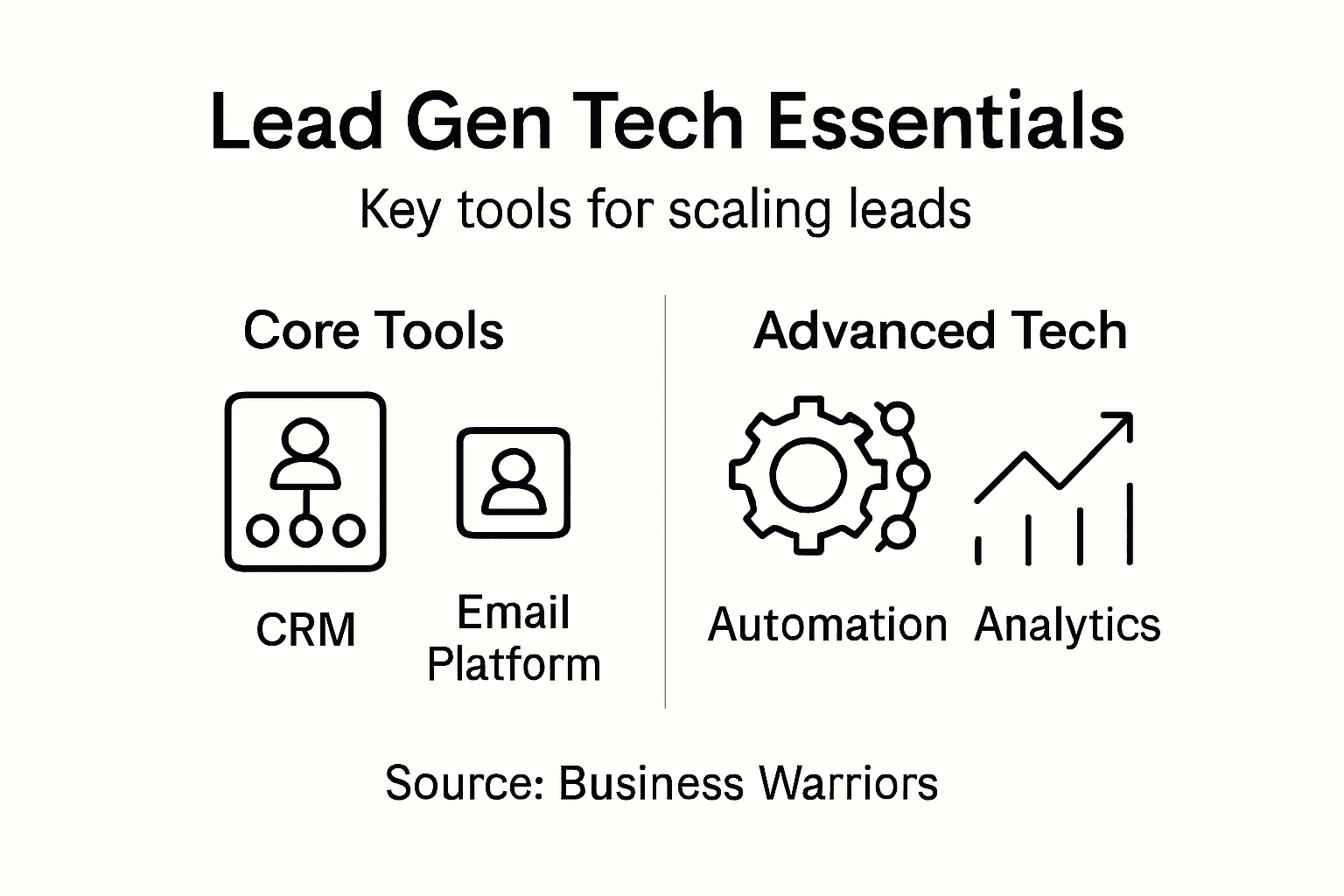
Advanced technological solutions help small businesses qualify and nurture leads more effectively by providing real-time insights and enabling targeted communication strategies. The key is selecting tools that seamlessly integrate and provide actionable intelligence about potential customers.
Reviewing key lead generation tools can help small businesses select optimal solutions:
| Tool Type | Core Benefit | Recommended For | Key Limitation |
|---|---|---|---|
| CRM System | Organises contacts and sales pipeline | Businesses with ongoing client relationships | Requires consistent data entry |
| Marketing Automation | Streamlines email and lead nurturing tasks | Businesses seeking efficiency with campaigns | Can be complex to set up |
| Analytics Platform | Measures campaign results and conversion rates | Those tracking multiple channels | Data overload if not managed |
| Chatbot/Live Chat | Provides real-time customer interaction | Service-based or e-commerce websites | May lack personal touch |
Pro tip: Conduct a quarterly audit of your lead generation tech stack to ensure all tools are delivering measurable value and aligned with your business objectives.
Common Pitfalls to Avoid in Lead Generation
Lead generation strategies can quickly become ineffective when businesses fail to understand critical success factors. Small businesses often encounter significant challenges that undermine their marketing efforts by making fundamental strategic mistakes.
Most common pitfalls in lead generation include:
- Poor Target Audience Definition
- Vague customer personas
- Undefined ideal client profile
- Scattered marketing messaging
- Ineffective Lead Qualification
- No systematic lead scoring
- Inconsistent follow-up processes
- Inability to distinguish high-value prospects
- Neglecting Customer Journey Stages
- One-size-fits-all communication
- Skipping crucial engagement touchpoints
- Lack of personalised content
- Measurement and Analytics Failures
- Absence of tracking mechanisms
- Not monitoring conversion rates
- Ignoring performance data insights
Successful lead generation demands a holistic approach that balances strategic targeting, consistent communication, and data-driven decision-making. Businesses must develop robust systems that continuously adapt and improve based on real-world performance metrics.
Digital marketing requires continuous learning and refinement. By recognising these common pitfalls, entrepreneurs can design more sophisticated lead generation strategies that deliver sustainable growth and meaningful customer connections.
Pro tip: Implement a comprehensive lead tracking dashboard that provides real-time insights into your marketing funnel’s performance and highlights potential improvement areas.
Unlock Consistent Leads with Proven Strategies Tailored for Small Businesses
Many small businesses struggle with generating a steady flow of qualified leads because they lack a clear, integrated approach to moving prospects through every stage of their marketing funnel. This article highlights the importance of understanding modern lead generation channels and designing high-converting funnels that nurture prospects systematically. If you are a service-based business owner looking to break through inconsistent lead flow and tired of generic marketing tactics, it is time to leverage a specialised methodology that targets your unique challenges.
At Jarrod Harman, we focus on delivering exactly that through our signature Marketing Vortex Method. This approach combines SEO, paid ads, email marketing and social media in an omnichannel system designed to not only attract but also convert and retain your ideal clients. Discover how our proven strategies and measurable results can help you capture and nurture leads effectively to grow your business sustainably. Learn more by exploring insights in our Uncategorized Archives or visit our homepage to get started.
Ready to stop chasing leads that go cold? Connect with Business Warriors and Jarrod Harman’s expert team today to implement tested, scalable marketing systems that turn browsers into loyal customers. Visit https://jarrodharman.com and take the first step towards transforming your online lead generation strategy now.
Frequently Asked Questions
What is lead generation for small businesses?
Lead generation for small businesses is the process of attracting and converting potential customers into interested prospects using various digital marketing strategies.
What are the main channels for lead generation?
The main channels for lead generation include inbound strategies like SEO, content marketing, and social media, as well as outbound methods such as paid advertising and cold email campaigns.
How can I create a high-converting marketing funnel?
A high-converting marketing funnel consists of stages including awareness, interest, consideration, and conversion, with each stage focusing on providing value and addressing customer needs.
What tools can help improve lead generation?
Essential tools for improving lead generation include Customer Relationship Management (CRM) systems, marketing automation platforms, analytics tools, and communication technologies such as chatbots.
Recommended
- 10 Effective Lead Generation Strategies for Businesses – Jarrod Harman
- Lead Generation Strategies – Boost Sales Online Fast – Jarrod Harman
- What Is Lead Generation? Complete Expert Breakdown – Jarrod Harman
- 7 Essential Steps to a Successful Lead Generation Checklist – Jarrod Harman
- Blog Business Signs Work | Promo Signs LTD