


Struggling to turn new faces into loyal regulars in your salon or clinic can feel daunting. As more Australian service brands rely on digital channels to win trust and drive bookings, knowing how to connect through each stage of content marketing has never been more important. This guide breaks down how strategic content at every phase keeps your business top of mind and helps you turn casual browsers into dedicated clients.
Table of Contents
- Defining The Content Marketing Stage
- Key Phases Of Content Marketing
- Stage-Specific Strategies For Service Brands
- Common Pitfalls At Each Stage
- Measuring Progress And Optimising Results
Key Takeaways
| Point | Details |
|---|---|
| Strategic Content Development | Focus on creating purposeful, informative content that builds trust and influences customer behaviour. |
| Phases of Content Marketing | Understand and implement key phases, including conceptualisation, creation, distribution, engagement, and optimisation for effective strategies. |
| Service Brand Specific Strategies | Tailor content marketing approaches to highlight intangible value and build long-term relationships through personalised experiences. |
| Data-Driven Measurement | Employ critical metrics to measure engagement, conversion rates, and revenue impact, refining strategies based on ongoing insights. |
Defining The Content Marketing Stage
Content marketing represents a strategic approach for businesses to create and distribute valuable, targeted content that attracts and engages specific audiences. Strategic content development has emerged as a critical digital marketing methodology focused on building trust and influencing customer behaviour.
This approach involves several key dimensions that transform traditional marketing strategies:
- Creating purposeful, informative content
- Targeting specific audience segments
- Establishing brand credibility
- Developing long-term customer relationships
- Generating measurable engagement metrics
Content marketing goes beyond simple advertising by focusing on delivering genuine value. Valuable information sharing serves multiple strategic objectives – educating potential customers, demonstrating expertise, and nurturing leads through meaningful interactions.
Successful content marketing requires understanding your target audience’s needs, preferences, and pain points. By developing content that directly addresses these elements, businesses can create meaningful connections that transcend traditional transactional marketing approaches.
Pro tip: Conduct thorough audience research to develop content that genuinely resonates with your target market’s specific challenges and interests.
Key Phases Of Content Marketing
Content marketing is a dynamic process that encompasses multiple strategic stages designed to create, distribute, and optimise valuable content for target audiences. Content marketing phases reflect the evolving digital landscape, requiring businesses to adopt a sophisticated, multi-dimensional approach.
The key phases of content marketing typically include:
- Conceptualisation: Defining strategic objectives and audience personas
- Content Creation: Developing targeted, high-quality content
- Distribution: Strategically sharing content across relevant channels
- Engagement: Interacting with audiences and measuring response
- Optimisation: Refining strategies based on performance metrics
Digital transformation in content marketing emphasises a holistic approach that integrates strategic planning with continuous improvement. This lifecycle model ensures that content remains responsive to changing customer behaviors and technological advancements.
Successful implementation requires understanding each phase’s unique requirements. Businesses must develop a systematic approach that balances creative content development with data-driven insights, ensuring each piece of content serves a specific strategic purpose and resonates with the intended audience.

Pro tip: Develop a comprehensive content calendar that maps out each phase of your content marketing strategy, allowing for flexible adaptation and consistent audience engagement.
Here’s how each content marketing phase supports business goals:
| Phase | Key Focus | Business Impact |
|---|---|---|
| Conceptualisation | Strategy and personas | Ensures relevant content |
| Creation | High-quality production | Builds initial credibility |
| Distribution | Channel selection | Expands brand reach |
| Engagement | Audience interaction | Increases loyalty |
| Optimisation | Data-driven refinement | Maximises performance |
Stage-Specific Strategies For Service Brands
Service brand marketing demands a nuanced approach that recognises the unique challenges of delivering intangible value propositions. Service marketing strategies require businesses to develop sophisticated content approaches that balance efficiency with personalised customer experiences.
Key strategies for service brands include:
- Audience Segmentation: Creating precise customer personas
- Trust Building: Developing transparent, authentic content
- Experience Mapping: Designing content that addresses specific customer journey stages
- Value Communication: Highlighting unique service differentiators
- Relationship Cultivation: Generating ongoing engagement mechanisms
Developing service marketing content involves creating comprehensive value propositions that communicate both core and supplementary service elements. This requires a strategic approach that goes beyond traditional marketing, focusing on building meaningful connections with potential clients.
Successful service brands understand that content marketing is not about selling, but about demonstrating expertise, building trust, and creating memorable experiences that differentiate them in competitive markets.
Pro tip: Develop a multi-stage content strategy that progressively reveals your service’s unique value, using storytelling and client testimonials to build credibility and emotional connection.
See how service and product brands differ in content marketing:
| Aspect | Service Brands | Product Brands |
|---|---|---|
| Value Proposition | Intangible, trust-based | Tangible, feature-driven |
| Buyer Decision | Relationship-focused | Price/benefit-focused |
| Content Focus | Storytelling, expertise | Demonstrations, benefits |
| Loyalty Drivers | Personalisation, support | Consistency, performance |
Common Pitfalls At Each Stage
Content marketing is fraught with challenges that can derail even the most well-intentioned strategies. Understanding these potential roadblocks helps service brands navigate their content marketing journey more effectively, minimising wasted resources and maximising impact.
Common pitfalls across different content marketing stages include:
-
Conceptualisation Stage:
- Lack of clear audience targeting
- Undefined content objectives
- Insufficient market research
-
Creation Stage:
- Generic, non-specific content
- Inconsistent brand voice
- Neglecting audience pain points
-
Distribution Stage:
- Random channel selection
- Inconsistent publishing frequency
- Ignoring platform-specific nuances
-
Engagement Stage:
- Minimal audience interaction
- Not tracking meaningful metrics
- Failing to adapt based on feedback
Many service brands struggle with content marketing complexity by treating content as a transactional tool rather than a relationship-building mechanism. This approach undermines the fundamental purpose of content marketing – creating genuine connections with potential clients.
Successful content marketing requires a holistic, strategic approach that views each stage as an interconnected ecosystem. Brands must remain agile, continuously learning and refining their approach based on audience response and evolving market dynamics.
Pro tip: Implement a robust content audit process that critically evaluates performance at each stage, allowing for data-driven refinements and strategic pivots.
Measuring Progress And Optimising Results
Content marketing measurement requires a strategic approach that goes beyond superficial metrics, focusing on meaningful insights that drive business growth. Content marketing measurement demands careful selection of key performance indicators that align directly with organisational objectives.
Critical metrics for service brands include:
-
Engagement Metrics:
- Time spent on content
- Social media interactions
- Comments and shares
-
Conversion-Related Metrics:
- Lead generation rate
- Conversion percentage
- Customer acquisition cost
-
Revenue Impact Metrics:
- Content-influenced sales
- Customer lifetime value
- Return on content investment
Digital marketing ROI evaluation requires integrated analytics platforms that capture multi-channel performance and provide comprehensive insights into content effectiveness.
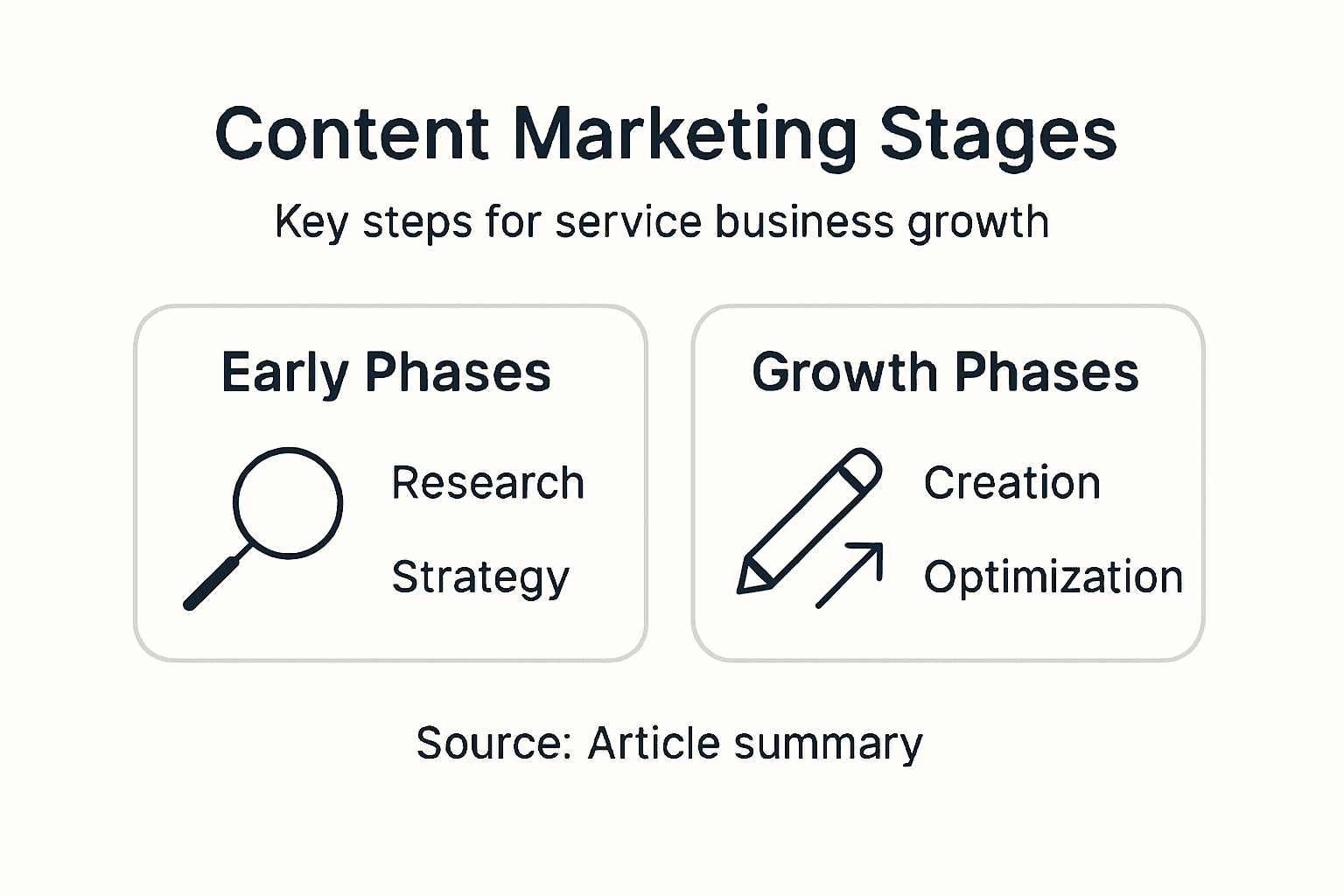
Successful optimization means continuously refining strategies based on data-driven insights, ensuring that content marketing efforts remain aligned with evolving business goals and customer expectations.
Pro tip: Implement a quarterly content performance review that critically examines both quantitative metrics and qualitative feedback, allowing for agile strategy adjustments.
Unlock Your Service Business Potential with Expert Content Marketing Strategies
Navigating the complex stages of content marketing can be overwhelming for service brands striving to build trust and foster long-term client relationships. This article highlights common challenges like unclear audience targeting, inconsistent distribution, and lack of data-driven optimisation. If you want to break through these barriers and harness the full power of strategic content marketing, Business Warriors offers proven solutions tailored specifically for service-based businesses.
Our unique Marketing Vortex approach integrates SEO, social media, email marketing, and paid ads into a seamless system designed to boost your online presence and generate consistent leads. We understand the importance of personalised storytelling and authentic engagement to build credibility and loyalty, exactly as emphasised in the article’s conceptualisation and engagement stages.

Are you ready to transform your content marketing stages into a powerful growth engine for your service business Let Business Warriors help you implement practical, results-driven strategies that align with your unique brand and customer journey. Don’t let fragmented marketing efforts hold you back Take the first step today by exploring the expert guidance at Jarrod Harman’s website and discover how our tailored services can boost your marketing impact and grow your client base.
Frequently Asked Questions
What are the key phases of content marketing?
The key phases of content marketing include conceptualisation, content creation, distribution, engagement, and optimisation. Each phase plays a vital role in ensuring that content serves its strategic purpose and resonates with the target audience.
How can I measure the effectiveness of my content marketing?
To measure the effectiveness of your content marketing, focus on critical metrics such as engagement rates, lead generation, conversion percentages, and content-influenced sales. Using integrated analytics tools can help provide comprehensive insights into your content performance.
What common pitfalls should I avoid in content marketing?
Common pitfalls in content marketing include unclear audience targeting during the conceptualisation stage, creating generic or inconsistent content during the creation stage, random channel selection in distribution, and minimal audience interaction in the engagement stage. Being aware of these challenges can help you navigate your content marketing efforts more effectively.
How do service brands differ in their content marketing strategies compared to product brands?
Service brands focus on building trust and personalisation, often emphasising storytelling and expertise to connect with customers. In contrast, product brands typically highlight tangible features and benefits, concentrating on price and performance to influence buyer decisions.
Recommended
- Stage Content Marketing: Driving Sales Growth – Jarrod Harman
- The Essential Guide to Why Content Marketing Matters – Jarrod Harman
- Content Marketing Best Practices: Complete Guide – Jarrod Harman
- Social Media Growth Strategies for Service Brands – Jarrod Harman
- Growing Your Business Online: Strategies for Logistics – Worldwide Express, Inc.