


TL;DR:
- Building an online business system requires integrating SEO, advertising, social media, and local content for growth. Focusing on Google profiles, reviews, and social consistency builds trust, leading to better local search results. Combining organic and paid strategies ensures faster growth and stability for small businesses.
Growing your business online means building a digital marketing system that generates consistent visibility, leads, and sales across multiple channels. The answer to “how do I grow my business online” is not a single tactic. It is a combination of SEO, paid advertising, social media, and content working together. Businesses that optimise their Google Business Profile, build verified reviews, and maintain local content outperform competitors in local search visibility. This guide covers every layer of that system, from foundational setup through to tracking and automation, in plain language built for Australian business owners ready to act.
What are the foundational digital marketing elements for online growth?
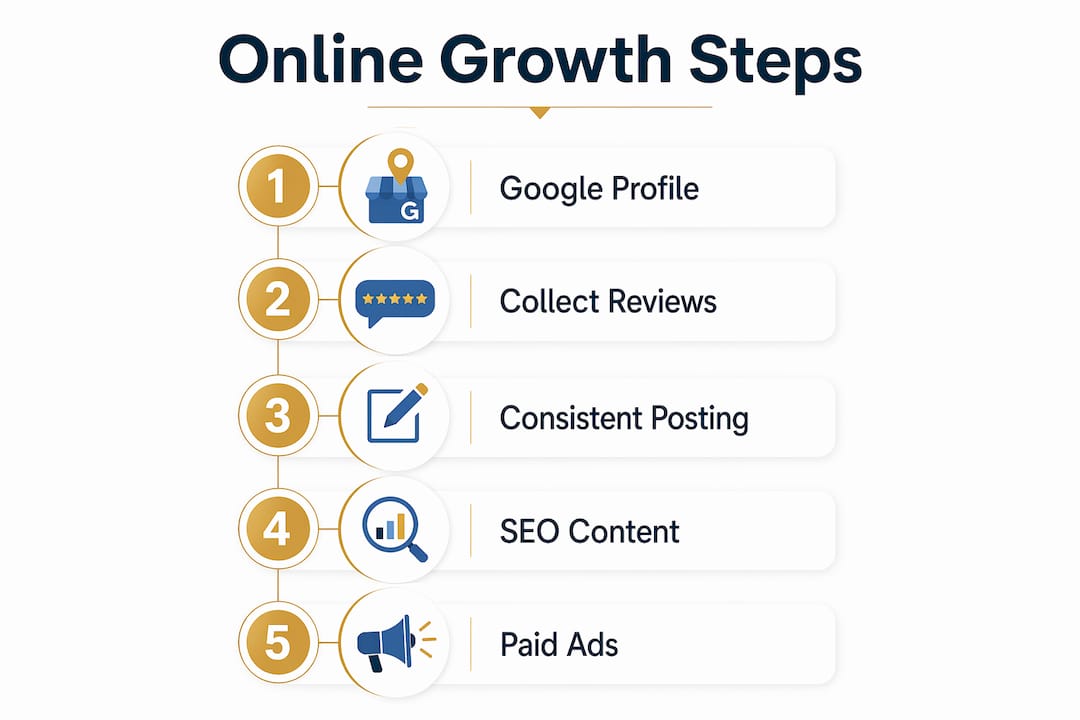
Every business that grows online starts with the same three building blocks: a verified Google Business Profile, a consistent social media presence, and a stream of genuine customer reviews. These three elements form what practitioners call the “trust triad,” and businesses using this approach consistently outperform competitors in local search lead generation. That matters because local search is often the first place a buyer looks before making a purchase decision.
Your Google Business Profile is free and directly affects whether you appear in Google Maps and the local pack results. Fill every field: business category, hours, photos, services, and a keyword-rich description. Update it monthly with posts and respond to every review, positive or negative.
Customer reviews are the most underused growth tool for small and medium businesses. Online reviews drive measurable revenue growth for SMBs by building the social proof that converts a browser into a buyer. Ask every satisfied client for a Google review within 24 hours of their experience, while the memory is fresh.
Social media rounds out the foundation. Posting regularly and responding quickly builds trust and keeps your business top of mind without requiring high production value. A phone video filmed in good light beats a polished post that never gets published.
| Foundation element | Primary purpose | Key action |
|---|---|---|
| Google Business Profile | Local search visibility | Complete all fields, post monthly |
| Customer reviews | Social proof and trust | Request within 24 hours of service |
| Social media presence | Engagement and brand recall | Post consistently, reply to comments |
| Email list | Direct customer retention | Capture emails at every touchpoint |
Pro Tip: Consistency beats perfection every time. Posting three times a week for six months will outperform a single polished campaign every time.
How do SEO and content marketing increase organic traffic?

SEO, or search engine optimisation, is the practice of making your website appear higher in unpaid search results. Integrated SEO strategies that combine keyword research, content creation, on-page optimisation, and technical performance improvements attract qualified leads without ongoing ad spend. That is the core appeal for business owners watching their budgets.
Keyword research for small businesses
Start with the questions your customers actually type into Google. Tools like Google Search Console and Google’s own autocomplete feature reveal real search terms at no cost. Focus on phrases with clear buying intent, such as “best laser clinic Perth” or “affordable bookkeeper Melbourne,” rather than broad terms like “accounting.”
Creating content that solves real problems
Every piece of content you publish should answer a specific question your ideal client is already asking. A salon owner might write “how long does a keratin treatment last” or “what to expect at your first facial.” This type of content attracts people who are already in buying mode. It also builds topical authority, which signals to Google that your site is a credible source in your niche.
On-page and technical SEO essentials
Your page title, meta description, and H1 heading should each contain your target keyword naturally. Your site must load quickly on mobile, since most local searches happen on a phone. Compress images, use a fast hosting provider, and fix any broken links. These are not optional extras. They are the baseline Google expects before ranking your pages.
AI-driven tools for SEO can now assist with keyword discovery, content briefs, and on-page recommendations at a fraction of the cost of traditional agency work. AI SEO tools also help you identify content gaps your competitors have missed, which is a genuine edge for a small team.
Common SEO mistakes to avoid:
- Targeting keywords that are too broad and too competitive for a new site
- Publishing thin content with fewer than 600 words and no real depth
- Ignoring mobile performance and page speed
- Skipping internal links between related pages on your own site
- Failing to update old content when information changes
Pro Tip: Write one detailed, well-researched article per week rather than five shallow posts. Google rewards depth and expertise, not volume alone.
How do paid advertising and multi-channel marketing accelerate growth?
Combining organic SEO with paid advertising drives faster business growth than either channel alone. Paid ads generate immediate visibility while SEO builds long-term authority. Together, they cover both ends of the buyer journey. Understanding why multi-channel marketing works is the difference between a business that grows steadily and one that stalls after a single campaign.
Google Ads targets people who are actively searching for what you sell. Facebook and Instagram ads target people based on demographics, interests, and behaviour. Use Google Ads when demand already exists, such as “emergency plumber Sydney.” Use Meta ads when you need to create demand or build awareness for a new service or product.
Steps to launch a simple paid campaign:
- Define one specific goal: bookings, enquiries, or product sales.
- Choose one platform that matches where your audience spends time.
- Set a daily budget of at least $50 to generate enough data to optimise.
- Write three ad variations with different headlines and test them simultaneously.
- Review results after seven days and pause the weakest performer.
- Reinvest the saved budget into the ad that is converting best.
Multi-channel marketing means your brand appears consistently across Google, Facebook, Instagram, email, and your website. Brand consistency across channels establishes your business as a leader in its niche and reduces the number of touchpoints needed before a prospect converts. Buyers who see your brand in multiple places trust it faster.
Pro Tip: Run your paid ads to a dedicated landing page, not your homepage. A page built around one offer converts at a significantly higher rate than a general website page.
What tools should small businesses use to manage online growth?
The right tools remove the manual work that kills consistency. Automation and AI-driven tools scale content creation and SEO work, improving efficiency without requiring a full marketing team. For most Australian SMBs, the goal is to do more with fewer people, not to hire a department.
| Tool category | What it does | Budget level |
|---|---|---|
| SEO platforms | Keyword research, rank tracking, site audits | Low to mid |
| Social media schedulers | Batch and schedule posts across platforms | Low |
| Google Ads and Meta Ads | Paid search and social advertising | Scales with budget |
| Email marketing platforms | Automated sequences, list management | Low |
| Analytics platforms | Traffic, conversions, audience behaviour | Free (Google Analytics) |
Building an email list early is one of the most cost-effective strategies available to a growing business. Email reaches your audience directly, without algorithm changes or ad costs affecting delivery. A list of 1,000 engaged subscribers is worth more than 10,000 social media followers you cannot contact directly.
Features to prioritise when selecting tools:
- Direct integration with Google Analytics and your website platform
- Automated reporting so you are not manually pulling data each week
- Mobile access so you can monitor campaigns from anywhere
- Clear, plain-language dashboards that do not require a technical background
- Reasonable pricing that scales with your business rather than locking you into enterprise contracts
How do you track and improve your online marketing results?
Tracking key metrics like website traffic, conversion rates, and engagement is the only way to know whether your marketing is working. Without measurement, you are spending money on guesswork. Google Analytics 4 is free and shows you exactly which pages attract visitors, how long they stay, and where they drop off.
Set up conversion tracking before you spend a dollar on paid ads. A conversion is any action that matters to your business: a phone call, a form submission, a product purchase, or a booking. Without this data, you cannot tell which ad or which keyword is generating real revenue.
Review your numbers weekly, not monthly. Look for pages with high traffic but low conversions. Those pages have an audience but a weak offer or confusing layout. Small changes to a headline, a button colour, or a call to action can lift conversions without increasing your ad spend. This iterative approach, testing one change at a time, is how experienced marketers improve results without wasting budget.
Social media insights on Facebook, Instagram, and LinkedIn show you which content formats your audience responds to. If video posts consistently outperform static images, that is a clear signal to produce more video. Let the data direct your creative decisions rather than personal preference.
Key takeaways
Growing your business online requires a connected system of SEO, paid advertising, social media, and measurement working together, not isolated tactics applied one at a time.
| Point | Details |
|---|---|
| Build the trust triad first | Optimise your Google Business Profile, collect reviews, and post consistently on social media. |
| SEO drives long-term organic traffic | Combine keyword research, quality content, and technical performance to attract qualified leads. |
| Paid ads accelerate results | Use Google Ads for active demand and Meta ads for awareness, with a minimum $50 daily budget. |
| Automation saves time and improves consistency | Use scheduling tools, email platforms, and AI SEO tools to maintain output without a large team. |
| Measure everything from day one | Set up Google Analytics 4 and conversion tracking before spending on paid campaigns. |
What I have learned after years of helping SMBs grow online
The biggest mistake I see business owners make is chasing the newest platform instead of mastering the fundamentals. Every month there is a new social media channel or AI tool promising overnight results. The businesses that actually grow are the ones that build a solid foundation first: a well-optimised website, a Google Business Profile that is updated regularly, and a content strategy they stick to for at least six months.
Paid advertising works, but only when the organic foundation is in place. I have seen businesses pour thousands of dollars into Google Ads while their website takes eight seconds to load on mobile. The ads bring traffic. The slow site sends it straight back to a competitor. Fix the foundation before you scale the spend.
The other thing I tell every client is to generate leads online through multiple channels simultaneously, not one at a time. Relying on a single source of leads is the fastest way to create fragility in your business. When that one channel changes its algorithm or increases its costs, your entire pipeline dries up overnight. Spread your presence across SEO, social media, email, and paid ads, and you build a business that can absorb those shocks.
Patience is not optional. SEO takes three to six months to show meaningful results. Social media audiences take time to build. The business owners who succeed online are the ones who commit to the process and measure progress in months, not weeks.
— Business Warriors | Digital Marketing Agency
Grow your business online with expert support
Building a connected digital marketing system takes time, knowledge, and consistent execution. Jarrodharman works with Australian business owners to build exactly that, combining SEO, Google Ads, Meta advertising, email marketing, and social media into one integrated approach called the Marketing Vortex Method.
Whether you are starting from scratch or looking to get more from an existing marketing budget, Jarrodharman offers practical, results-focused consulting tailored to service-based businesses across Australia. The focus is always on measurable outcomes: more leads, more bookings, and more revenue. Visit jarrodharman.com to learn how a structured digital marketing strategy can work for your business.
FAQ
How do I grow my business online without a big budget?
Start with your free Google Business Profile, post consistently on one or two social media platforms, and build an email list from day one. These three tactics cost nothing but time and deliver compounding returns.
How long does SEO take to show results?
SEO typically takes three to six months to produce meaningful improvements in rankings and organic traffic. Results depend on your niche, competition level, and the consistency of your content output.
What is the difference between Google Ads and Meta ads?
Google Ads targets people actively searching for your product or service, making it ideal for capturing existing demand. Meta ads (Facebook and Instagram) target people based on interests and behaviour, making them better for building awareness and reaching new audiences.
How do I know if my online marketing is working?
Set up Google Analytics 4 and conversion tracking on your website before running any paid campaigns. Track traffic, conversion rates, and cost per lead weekly to identify what is working and where to improve.
What is multi-channel marketing and why does it matter?
Multi-channel marketing means appearing consistently across SEO, paid ads, social media, and email at the same time. Businesses that use multiple channels convert prospects faster because repeated exposure builds trust more quickly than a single touchpoint.