8 August 2026
Digital marketing tips and tricks that actually grow your business
Explore essential digital marketing tips that effectively boost your Australian small business. Start implementing strategies today!
The most effective digital marketing tips and tricks for Australian small businesses come down to ten priorities: pick one search play, one email play and one social play (the SES framework); audit your site for on-page SEO and answer-engine optimisation (AEO); capture first-party data with a lead magnet; run two A/B tests on your highest-traffic pages; set three shared KPIs (customer acquisition cost, return on ad spend and lifetime value); claim and optimise your Google Business Profile; build a welcome email sequence; run a single Google Ads search test with a mapped landing page; update three key pages for AI citation readiness; and document every test with a hypothesis before you start. The prioritisation rule is simple: master one search play, one email play and one social play before you add anything else.
Your three measurable 30-day quick wins:
- Update three revenue-driving pages with definitive answers, FAQ schema and clear calls to action (AEO readiness)
- Set up a five-email welcome sequence in Mailchimp or HubSpot and measure open rate and click-to-conversion
- Run a single Google Ads search campaign with one tightly matched landing page and track cost per lead against your SMART goal
Key takeaways
The most durable digital marketing strategy for Australian small businesses combines SEO and AEO foundations, an owned email list and one focused social play, all measured against three shared KPIs before any budget scales.
| Point | Details |
|---|---|
| SES framework first | Pick one search play, one email play and one social play; master these before adding channels. |
| AEO alongside SEO | Structure pages with definitive answers, FAQ schema and semantic subheadings to earn AI citations and featured snippets. |
| Email as owned asset | Build a welcome sequence and segment by lifecycle stage; export first-party audiences to ad platforms for retargeting. |
| Test with a hypothesis | Document expected metric, uplift and reason before every test; use ICE scoring to prioritise. |
| AI with human oversight | Use AI for content variants and subject-line testing; keep a human review step before publishing or scaling any automated campaign. |
| Business Warriors | The Marketing Vortex method integrates SEO, paid media and email into one connected system for Australian service businesses. |
Table of Contents
- Why goals and customer clarity are the foundation of every effective strategy
- Digital marketing tips and tricks for SEO and answer-engine optimisation
- How to get your website converting before you spend on ads
- How the SES framework helps you choose the right channels
- Email marketing and first-party data: your most durable asset
- Paid advertising basics: what to test first with Google Ads and Meta
- How to build a testing programme that links experiments to revenue
- Google Business Profile: the fastest local SEO win available
- AI in digital marketing: where it helps and where you need a human in the loop
- Your 30/90-day action plan with clear ownership
- What actually works for Australian small businesses: a frank perspective
- Business Warriors can build your marketing system from the ground up
- Sources
Why goals and customer clarity are the foundation of every effective strategy
Every effective digital marketing strategy starts with one SMART goal tied to a revenue or lead outcome, not “get more traffic.” Something like: “Generate 40 qualified service enquiries per month by 30 September, at a cost per lead below $85.” That specificity tells you which channels to fund, which pages to fix and when to stop an experiment.
Buyer personas matter because they change where you show up, not just what you say. The minimal data worth collecting: what triggers the buying decision (a life event, a pain point, a competitor failure), which platforms they use to research, and the two or three objections that stall the sale. You can gather this from five customer interviews, a short post-purchase survey or a review-mining session on Google and Facebook. Skip the 40-field persona template; focus on behavioural triggers and channel habits.
A quick asset audit takes less than two hours. List every page, lead magnet, email flow and ad account you already have, then map each to a funnel stage: awareness, consideration, or decision. Those are the assets to optimise first, not the ones that feel exciting to build.
For shared KPIs, pick three to five cross-channel metrics and align your whole team to them. Customer acquisition cost (CAC), lifetime value (LTV), pipeline contribution, and return on ad spend (ROAS) are the four that matter most for service businesses. According to Adobe’s digital marketing strategy guide, mapping audience segments to channels and tying activity to revenue through omnichannel measurement is what separates businesses that grow from those that stay busy.
Digital marketing tips and tricks for SEO and answer-engine optimisation
Search engine optimisation is still the highest-leverage channel for most Australian service businesses, and it now has a second dimension: answer-engine optimisation (AEO), which determines whether your content gets cited by ChatGPT, Perplexity, Google’s AI Overviews and similar tools. The two goals reinforce each other when you structure content correctly.
Here is the sequence that works:
- Map intent first. Before touching a page, confirm the search intent behind the target keyword. Informational, navigational, commercial or transactional intent each requires a different page structure and call to action.
- Optimise the headline and first paragraph. The page title and H1 should contain the primary keyword. The opening paragraph should answer the query directly, in two to three sentences, before expanding.
- Use semantic subheadings. H2 and H3 tags should cover the related questions a searcher would ask next. This is how you capture featured snippets and AI citations simultaneously.
- Add FAQ schema markup. FAQ structured data helps Google surface your answers in zero-click results and signals to large language models that your page contains definitive, structured information.
- Build internal links with descriptive anchor text. Link from high-authority pages to the pages you want to rank. Descriptive anchors (not “click here”) carry topical context that helps both users and crawlers. For a deeper look at how SEO drives lead generation, the connection between organic rankings and qualified enquiries is direct.
- Repurpose strategically. Turn one long-form article into three social posts, a five-email nurture sequence and a 90-second video script. For a small team, the rule is: write the article first, then strip it for social and email. Video comes last because it takes the most production time.
For AI citation readiness specifically, the metrics to watch are branded search volume (does your business name appear in AI-generated answers?) and share of AI citations for your target queries. Both are early-stage metrics, but they are already influencing how service businesses get discovered. The HubSpot digital marketing optimisation guide frames AEO as a natural extension of on-page SEO, not a separate discipline.
How to get your website converting before you spend on ads
Speed, clarity and message match are the three levers that move conversion rates fastest, and none of them require a large budget. A page that loads in under three seconds, states its value proposition in the first viewport and matches the ad or search result that brought the visitor there will outperform a slow, beautiful page almost every time.
Three A/B tests worth running right now:
- Headline test: Write two versions of your hero headline, one benefit-led (“Book a consult in 60 seconds”) and one problem-led (“Tired of chasing leads that go cold?”). Run equal traffic for two weeks and measure form submissions, not clicks.
- Form length test: Reduce a five-field form to two fields (name and phone or email). Measure completion rate. You can collect the rest progressively after the first conversion.
- CTA copy test: Compare “Get a free quote” against “See how it works” for a top-of-funnel offer. The softer CTA often wins at the awareness stage because it lowers perceived commitment.
For page speed, the highest-impact fixes are image compression (use WebP format and serve images at display size, not full resolution), deferring non-critical JavaScript and inlining critical CSS. On mobile, check that tap targets are at least 48px, that text is readable without zooming and that forms have appropriate input types so the right keyboard appears.
Pro Tip: Use progressive profiling for top-of-funnel offers. Ask for a name and email on the first conversion, then use a second touchpoint (a follow-up email or a second form on a thank-you page) to collect phone number, business type or budget range. Each additional field you remove from the first form typically lifts completion rates, and you still get the full picture over two or three interactions.
How the SES framework helps you choose the right channels
The SES framework (Search, Email, Social) gives small teams a clear answer to the most common marketing mistake: being on every platform at 20% effort instead of three channels at full effort. Pick one search play, one email play and one social play. Make them feed each other. Search and social bring in new contacts; email converts and retains them.
Choosing your search play depends on business type and buyer intent:
- Local service business (salon, clinic, trades): Local SEO is the priority. Optimise your Google Business Profile, build local citations and target suburb-level keywords before spending on Google Ads.
- E-commerce or product business: Paid search (Google Shopping and Performance Max) delivers faster results than organic for transactional queries. Pair it with retargeting.
- B2B or professional services: Content SEO and LinkedIn organic are the stronger plays. Buyers research extensively before contacting; long-form content and thought leadership build the trust that converts.
For social, platform choice should follow where your audience actually spends time, not where you feel comfortable. Research on social media platform habits consistently shows that audience concentration varies significantly by age group and interest category. Pick the one platform where your buyer persona is most active and post there consistently before adding a second.
| Channel type | Best fit | Effort required | Expected time to results |
|---|---|---|---|
| Local SEO (organic) | Local service businesses | Medium | 60–90 days |
| Paid search (Google Ads) | E-commerce, high-intent services | Medium–High | 2–4 weeks |
| Email nurture | All business types | Low–Medium | Immediate on list |
| Platform social (organic) | B2B, community-driven brands | Medium | 90+ days |
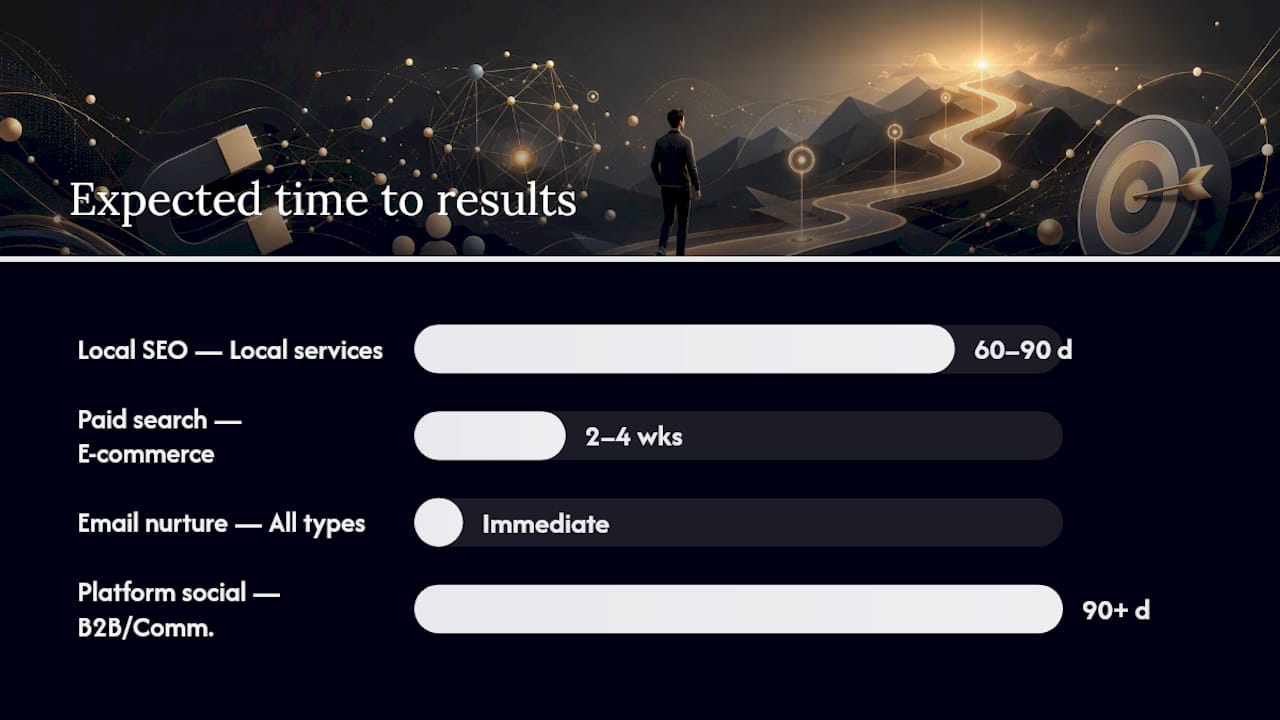
For a detailed look at channel prioritisation for early-stage businesses, the channel-priority matrix approach helps you weigh effort against expected return before committing budget.
Email marketing and first-party data: your most durable asset
Email is the one channel you own outright. Algorithm changes, platform policy shifts and ad cost inflation cannot touch a well-maintained email list. That makes it the most durable asset in your marketing mix, and the one most small businesses underinvest in.
A minimal email flow for a service business:
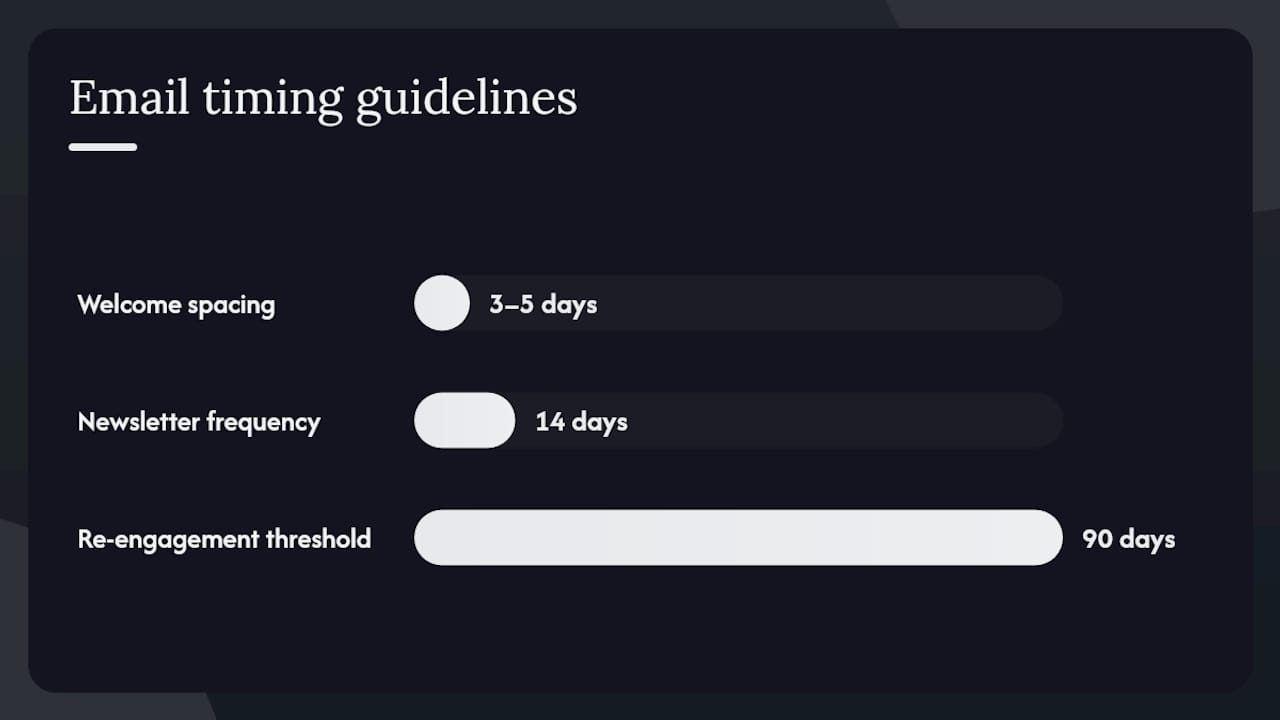
- Welcome sequence (emails 1–3): Deliver the lead magnet or promised value in email 1. Share a credibility signal (case study, result, process overview) in email 2. Make a soft offer or invite a conversation in email 3. Space these three to five days apart.
- Value-driven newsletter: One email per fortnight with a useful tip, a behind-the-scenes insight or a client result. Keep it short. The goal is staying top of mind, not selling every time.
- Re-engagement campaign: Tag subscribers who have not opened in 90 days and send a two-email sequence asking if they want to stay on the list. Remove those who do not respond. A smaller, engaged list outperforms a large, cold one for deliverability and conversion.
For first-party data, the key actions are: collect consent at every touchpoint (forms, events, in-store), tag subscribers by lifecycle stage (new lead, active client, lapsed), and flag behavioural signals (clicked a pricing page, watched a video, downloaded a resource). These flags let you export warm audiences to Meta or Google Ads for retargeting without relying on third-party cookies.
Emotive’s research on digital marketing channels notes that SMS marketing can produce materially higher response rates than email for time-sensitive offers. For Australian service businesses running promotions or appointment reminders, adding SMS alongside email is worth testing once your email flow is stable.
HubSpot suits businesses that want CRM, email and pipeline reporting in one place. It has a free tier that covers most small-business needs. Mailchimp is the faster starting point if you just need email automation and basic segmentation without a full CRM. Both integrate with Google Ads and Meta for audience syncing.
Paid advertising basics: what to test first with Google Ads and Meta
Start with one Google Ads search campaign and one Meta prospecting campaign. Measure cost per lead and conversion rate against your SMART goal before scaling either. That is the whole framework for a first paid test.
For a small business running an initial test, a budget of $1,000–$3,000 over four weeks split roughly 60/40 between search and retargeting gives you enough data to make a decision. Search captures existing demand; retargeting converts the visitors who did not enquire on the first visit. Running both together means you are not leaving warm traffic on the table while you wait for search volume to build.
Tracking is non-negotiable before you spend a dollar. Install the Google Ads conversion tag and the Meta Pixel, set up GA4 with key events (form submission, phone click, purchase), and where possible use server-side tagging to improve data accuracy. Without accurate attribution, you cannot tell which campaign is generating leads and which is burning budget.
Three quick ad tests to run in the first four weeks:
- Headline variants: Write three Google Ads headlines with different angles (benefit, urgency, social proof). Let the algorithm rotate them and pause the weakest after two weeks. Judge by click-through rate and conversion rate, not impressions.
- Landing page match: Send half your traffic to your homepage and half to a dedicated landing page that mirrors the ad’s message. The dedicated page almost always wins. The metric is cost per conversion.
- Creative format swap on Meta: Test a static image against a short video (15–30 seconds) for the same offer. Video tends to outperform for awareness; static tends to win for retargeting. Confirm this for your own audience before assuming.
How to build a testing programme that links experiments to revenue
One-off tests produce one-off insights. A testing programme produces compounding improvement. The difference is documentation and prioritisation.
Prioritise tests using the ICE framework: score each hypothesis on Impact (how much will it move the needle?), Confidence (how sure are you the change will work?) and Ease (how long will it take to implement?). Run the highest-scoring tests first.
For attribution, start with a multi-touch baseline in GA4. Understand which channels appear at the start, middle and end of the customer journey. Then, for your top one or two channels, run an incrementality test: either a holdout group (withhold ads from a matched segment and compare conversion rates) or a geo-test (run the campaign in one region and not another). This tells you whether the channel is actually causing conversions or just taking credit for them.
Reporting cadences that work for small teams:
- Weekly: Paid media performance (ROAS, CPA, conversion rate by campaign). Flag anything more than 20% off target and adjust.
- Monthly: SEO performance (rankings, organic traffic, leads from organic), email metrics (open rate, click rate, revenue per email) and overall CAC by channel.
- Quarterly: Budget reallocation based on LTV and pipeline contribution by channel. Kill what is not working; double what is.
The HubSpot optimisation guide is clear that shared KPIs and a formal test-and-learn workflow matter more than any individual channel tactic. The Coursera Advanced Digital Marketing Specialisation covers applied analytics and capstone-style projects that connect acquisition, retention and measurement into a single outcome-focused plan, worth bookmarking for anyone building this capability in-house.
Google Business Profile: the fastest local SEO win available
Claim and fully optimise your Google Business Profile (GBP). For most local service businesses in Australia, it is the single fastest route to appearing in front of buyers who are ready to act. A complete, active GBP listing appears in the local pack, Google Maps and increasingly in AI-generated local recommendations.
The optimisation checklist:
- Select the most specific primary category available (not just “Business” or “Service”)
- Add all relevant secondary categories
- List every service with a description and price range where applicable
- Upload at least ten photos (exterior, interior, team, work examples)
- Keep hours accurate, including public holidays
- Publish a Google Post at least once a fortnight (offer, event or update)
- Answer every question in the Q&A section before a stranger does
For reviews, the most effective approach is a simple, direct request sent within 24 hours of a positive interaction. A short message works: “Thanks for coming in today. If you have a moment, a Google review would mean a lot to us. Here’s the direct link: [your GBP review link].” Send it via SMS or email. Do not wait a week; the experience is freshest immediately after.
Reviews feed local SEO in two ways: review volume and recency are ranking signals, and the language customers use in reviews often matches the search queries you want to rank for. A monthly check of new reviews, a response to every one (positive and negative), and a flag for any pattern of complaints is the minimal monitoring workflow.
FutureLearn’s small business digital marketing guide lists GBP optimisation and focusing on one social channel as two of the most reliable quick wins for local operators, which aligns with what works in practice for Australian service businesses.
AI in digital marketing: where it helps and where you need a human in the loop
Use AI to scale asset production and personalise at volume. Keep a human in the loop for brand decisions, compliance review and anything that touches a customer relationship directly. That is the practical boundary.
Salesforce’s guide to AI in digital marketing describes agentic AI as capable of running autonomous, multi-step marketing actions: generating content variants, adjusting bids, personalising landing page copy and triggering follow-up sequences without manual input. That capability is real and growing. The risk is deploying it without guardrails.
Practical AI use cases for small teams:
- Content variants: Use AI to generate three to five headline or subject-line options, then select and edit the best one. Faster than writing from scratch; better than publishing the raw output.
- Subject-line testing: AI tools can predict open-rate performance based on historical patterns. Use them to shortlist candidates before an A/B test.
- Dynamic landing page content: Personalise headline copy based on the ad source or audience segment. Most email platforms and some CMS tools support this natively.
- Predictive lead scoring: Flag high-intent leads based on behavioural signals (page visits, email engagement, form interactions) so your sales team contacts the right people first.
For AEO and AI-driven answer engines, the goal is to get your brand mentioned in responses from ChatGPT, Perplexity, Google AI Overviews and similar tools. The tactics that help: publish definitive, well-structured content that directly answers common questions in your category; earn mentions and links from authoritative Australian sources; and use FAQ schema so your answers are machine-readable. Brand mentions in large language models tend to follow the same authority signals as traditional SEO, but the feedback loop is slower and harder to measure directly.
BCG’s research on next-best-action programmes describes a three-layer architecture for advanced automation: propensity scoring, contextual bandits and agent-based reasoning, each requiring separate infrastructure for batch retraining and real-time serving. For most small businesses, this is a future-state reference point, not a week-one priority.
Ethical checklist for AI use:
- Confirm your AI tools comply with Australian Privacy Act requirements for data handling
- Review AI-generated content for bias before publishing, particularly for health, legal or financial topics
- Disclose AI involvement where your audience would reasonably expect to know
- Never use AI to fabricate reviews, testimonials or case study results
Pro Tip: Build a human-in-the-loop step into every AI workflow. For content, the rule is: AI drafts, human edits for brand voice and accuracy, human approves before publish. For automated campaigns, set spend caps and performance thresholds that trigger a human review before the system scales. This catches errors before they compound.
Your 30/90-day action plan with clear ownership
Follow this timeline and you will have baseline metrics to judge channel performance or pivot within 90 days. The phased framework from Chandraprabhudev’s digital marketing guide and the online marketing tips for Australian small businesses both support a pillarised rollout that sequences technical foundations before paid scale.
| Week | Task | Owner | Success criteria |
|---|---|---|---|
| 1 | Set one SMART goal; define buyer persona; audit existing assets | Founder / Marketing lead | Goal documented; persona one-pager complete |
| 1–2 | Claim and fully optimise Google Business Profile | Marketing lead | All fields complete; first post published |
| 2 | Install GA4, Google Ads tag and Meta Pixel; verify conversion events | Developer / Marketing lead | All events firing in GA4 debug view |
| 2–3 | Update three key pages for AEO (FAQ schema, definitive answers, internal links) | Content lead | Pages re-indexed; FAQ schema validated in Search Console |
| 3 | Set up five-email welcome sequence in Mailchimp or HubSpot | Marketing lead | Sequence live; open rate baseline recorded |
| 4 | Launch one Google Ads search campaign with a dedicated landing page | Marketing lead / Agency | Campaign live; cost per lead tracked daily |
| 5 | Run first A/B test (headline or form length); document hypothesis and result | Marketing lead | Test concluded; winner implemented |
| 6 | Publish four pieces of long-form content mapped to target keywords | Content lead | Pages indexed; rankings tracked in Google Search Console |
| 8 | Launch Meta prospecting campaign; build retargeting audience from site visitors | Marketing lead / Agency | Retargeting audience over 1,000 users; CPA tracked |
| 10 | Review CAC, ROAS and LTV by channel; reallocate budget to top performer | Founder / Marketing lead | Budget reallocation decision documented |
For low-cost tools in the first 30 days: Google Search Console and GA4 (free), Mailchimp free tier (up to 500 contacts), Google Business Profile (free), Canva for creative assets, and AnswerThePublic or Google’s “People also ask” for content ideation. Paid tools like HubSpot’s Starter tier or Semrush become worth the investment once you have baseline data to act on.
What actually works for Australian small businesses: a frank perspective
The single practice worth starting with for any Australian service business is this: fix your Google Business Profile and your three most-visited website pages before you spend a dollar on ads. Most businesses I see are running Google Ads to a homepage that does not match the ad’s promise, with a GBP that has not been updated in two years. The ads amplify the problem, not the solution.
The common pitfalls that consistently hold small businesses back:
- Chasing vanity metrics. Follower counts and impressions feel like progress but rarely correlate with revenue. Track CAC and LTV from week one.
- Spreading thin across platforms. Being mediocre on five channels is worse than being excellent on two. The SES framework exists precisely because focus compounds.
- Neglecting attribution. If you cannot tell which channel generated a lead, you cannot make a rational budget decision. Set up tracking before you spend.
- Treating AI as a shortcut. AI tools accelerate production; they do not replace strategy or brand judgement. The businesses that use AI well treat it as a capable assistant with a human editor, not an autonomous publisher.
For resource-limited teams, the hire order that makes sense: first, a part-time content person who can write and repurpose; second, a paid media specialist (in-house or fractional) once you have budget to manage; third, an SEO specialist once organic is a meaningful channel. An agency like Business Warriors makes sense when you need all three capabilities without the overhead of three separate hires, particularly for service businesses that need integrated SEO, ads and email working together from day one. The advantages of social media for business growth are real, but only when the social play is connected to a broader system, not run in isolation.
Business Warriors can build your marketing system from the ground up
If you have read this far and the honest answer is “I know what to do but I do not have the time or team to do it,” that is exactly the gap Business Warriors fills. The Marketing Vortex method integrates SEO, Google Ads, Meta advertising, email marketing and social media into a single, connected system where each channel feeds the next. It is built specifically for service businesses that need consistent leads without managing five separate agencies or tools.
Engagements are structured around three options: a 30-day audit that maps your current assets, identifies the highest-leverage gaps and delivers a prioritised action plan; a 90-day implementation sprint that builds the core system (tracking, SEO foundations, one paid channel, email flow); and ongoing account management for businesses ready to scale. Every engagement includes transparent reporting against the KPIs that matter: CAC, ROAS and pipeline contribution.
If you are an Australian service business ready to move from scattered tactics to a system that compounds, explore the client acquisition strategies that Business Warriors uses to generate consistent, measurable results for clients across Australia.
Sources
- AI in Digital Marketing: The Complete Guide | Salesforce
- Digital marketing optimisation guide | HubSpot
- 11 Essential Digital Marketing Tips | Emotive
- Advanced Digital Marketing Specialization | Coursera
- Crafting a digital marketing strategy that delivers results. | Adobe