18 July 2026
Engagement social media posts: your 2026 strategy guide
Unlock your brand's potential with effective engagement social media posts. Discover strategies, formats, and AI tactics to boost interaction in 2026.
TL;DR:
- Engagement social media posts are designed to encourage active participation like comments, shares, and reactions. These interactions influence reach and help brands expand their organic presence. Effective post types include polls, open questions, behind-the-scenes content, user-generated content, educational material, and opinion pieces.
Engagement social media posts are content specifically designed to drive active participation, including comments, shares, saves, and reactions, that signal value to platform algorithms and expand your brand’s organic reach. Over 60% of product discovery now happens on platforms like TikTok, Instagram, and YouTube, which means meaningful interaction is no longer optional. It directly shapes who sees your content and whether your brand gets found. The standard industry term for this discipline is social media engagement, and it covers every measurable action a person takes beyond a passive scroll. This guide covers the post types that work, the workflow to sustain them, and the AI-driven SEO tactics that compound your results over time.
What types of engagement social media posts get the most interaction?
The highest-performing post formats share one quality: they reduce the effort required to respond while making the response feel personally relevant. Polls and questions work only when they present focused choices that feel identity-affirming, not generic. “Which treatment do you book first: facial or massage?” outperforms “What do you think about self-care?” every time.
The post types with the strongest track record across platforms are:
- Polls and voting posts. Fast to answer, easy to share results from, and they generate comment threads naturally.
- Open questions. Ask for an opinion or a recommendation. “Best local café in Perth?” pulls replies from people who never comment on promotional content.
- Behind-the-scenes content. Show the process, the team, or the workspace. Authenticity builds trust faster than polished brand imagery.
- User-generated content (UGC). Brands like GoPro built entire communities by reposting customer content, which increases social proof and sharing simultaneously.
- Educational posts. Step-by-step tips, myth-busting facts, and how-to carousels consistently earn saves, which algorithms weight heavily.
- Opinion and hot-take posts. A clear stance invites agreement and disagreement. Both drive comments.
Relevance to your specific audience matters more than the format itself. A poll about treatment preferences lands differently for a med spa audience than for a law firm. Match the format to the community you are building, not the platform trend of the week.
Pro Tip: Make participation feel rewarding. When someone answers your poll, follow up in the comments with a genuine response. That single action turns a passive vote into a real conversation.

For a deeper look at which formats suit different industries, the creative social media ideas resource at Jarrodharman covers platform-specific examples worth bookmarking.
How do you build a workflow to sustain social media engagement?
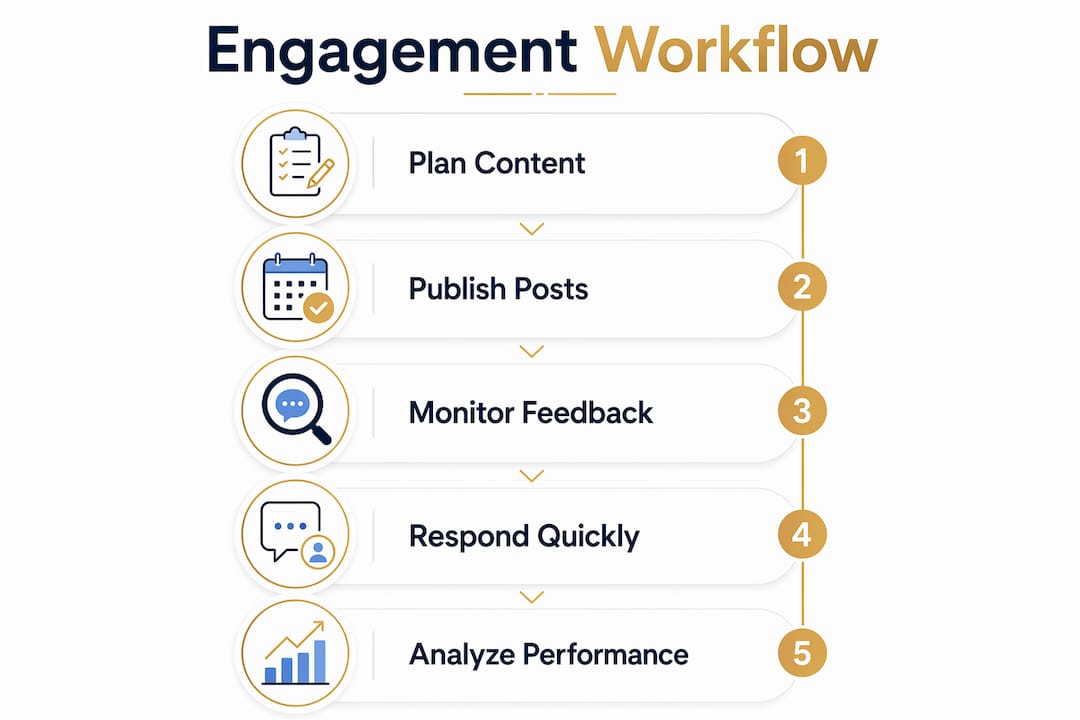
Posting good content once is not a strategy. Sustained social media engagement requires a repeatable system, and the most effective model is the two-way engagement loop. Successful engagement strategies treat interactions as a loop: publish content to provoke interaction, respond promptly to deepen it, analyse what worked, and refine the next post accordingly.
Here is how to operationalise that loop:
- Rank your platforms by audience fit. Put your time where your actual customers spend theirs. A beauty clinic in Perth will see better returns on Instagram and TikTok than on LinkedIn.
- Set a posting cadence based on quality, not volume. Organic engagement declines when brands post frequently with low-intent content. Three strong posts per week outperform seven average ones.
- Write response rules and stick to them. Decide in advance how you handle negative comments, questions about pricing, and compliments. Consistency protects your brand voice.
- Reply within 24 hours. Replying to comments quickly is the highest-leverage action to turn a post into an engagement flywheel. Platforms reward accounts that generate ongoing conversation threads.
- Review performance monthly. Pull your top five and bottom five posts. Identify the pattern. Double down on what earned saves and shares, and cut what earned only passive likes.
The social media engagement workflow guide at Jarrodharman walks through this loop in detail, including how to structure your weekly reply schedule without it consuming your whole day.
Pro Tip: Block 15 minutes each morning to proactively comment on posts from your followers, local businesses, and industry accounts. This outbound engagement drives profile visits and follower growth faster than most paid tactics.
How do platform features and AI-driven SEO boost your reach?
Every major platform now offers interactive features built specifically to lift engagement metrics. Using them correctly connects your content to both human audiences and search algorithms.
Key features by platform:
- Instagram and Facebook: Polls, question stickers, and countdown timers in Stories drive quick interactions. Live streams generate real-time comments that algorithms treat as high-value signals.
- TikTok: Duets, stitches, and Q&A replies turn your content into conversation starters. Short-form video under 60 seconds currently leads interaction metrics on Facebook, Instagram, and YouTube, favouring authenticity over production polish.
- LinkedIn: Document carousels and native polls consistently outperform link-share posts for professional audiences.
- YouTube: Community posts, polls, and pinned comment questions extend engagement beyond the video itself.
Beyond native features, social SEO is now a core part of any engagement strategy. Social search behaviour, including profile visits, hashtag browsing, and search clicks, represents a deep form of engagement that influences purchase intent. Brands that treat social platforms as search and discovery engines, and optimise their captions and bios with keywords their audience actually uses, consistently outperform those that do not.
| Platform feature | Primary engagement benefit |
|---|---|
| Instagram Stories polls | Fast, low-effort responses that feed algorithm signals |
| TikTok Duet/Stitch | Extends content reach through community participation |
| LinkedIn document carousel | High save rates among professional audiences |
| YouTube Community posts | Sustains channel engagement between video uploads |
| Facebook Live | Real-time comments weighted heavily by the algorithm |
AI-assisted content planning and caption optimisation complement human creativity by improving consistency and reducing production friction. Tools that generate caption drafts, suggest hashtag clusters, and schedule posts at peak times free up your attention for the high-value work: responding to your community and refining your content mix. For a broader view of how AI SEO and social media intersect, the social media organic growth guide at Jarrodharman covers the 2026 algorithm shifts in detail.
Pairing these tactics with social proof strategies amplifies results further, particularly for service businesses where trust is the primary purchase driver.
How do you measure and improve social media engagement post performance?
Engagement rate is the primary metric for evaluating post performance, and the most reliable formula is Engagement Rate by Reach (ERR). ERR divides total engagements (likes, comments, shares, saves) by reach, then multiplies by 100. It tells you what percentage of people who actually saw your post chose to interact with it.
A good engagement rate falls between 1% and 5%, though this varies by industry and platform. A rate above 3% on Instagram for a service business is strong. A rate below 1% signals that your content is not connecting with the audience seeing it.
The metrics that matter most go beyond likes:
- Comments show that your content sparked a genuine reaction worth typing out.
- Saves signal that your content has lasting value. Algorithms on Instagram and TikTok weight saves heavily.
- Shares extend your reach to new audiences organically.
- Profile visits and search clicks indicate purchase intent, not just passive interest.
| Metric | What it measures | Best used for |
|---|---|---|
| Engagement Rate by Reach | Interaction relative to content visibility | Benchmarking post quality |
| Comments | Depth of audience reaction | Assessing content relevance |
| Saves | Perceived long-term value | Identifying evergreen content |
| Shares | Organic amplification potential | Measuring virality likelihood |
| Profile visits | Purchase intent signals | Tracking conversion readiness |
Engagement signals tell platform algorithms which content to boost organically. Comments, saves, and shares carry more weight than likes alone. Review your top and bottom performing posts every month. The pattern across your best posts will tell you more about your audience than any demographic report.
For a complete breakdown of how to apply these metrics to your content calendar, the complete engagement guide at Jarrodharman covers benchmarks across industries.
Key takeaways
Effective social media engagement requires a consistent two-way loop of quality content, prompt responses, and data-driven refinement across every platform your audience uses.
| Point | Details |
|---|---|
| Post types that work | Polls, UGC, educational posts, and behind-the-scenes content consistently earn the highest interaction rates. |
| The two-way engagement loop | Publish, respond within 24 hours, analyse results, and refine your next post based on what earned saves and shares. |
| Platform SEO matters | Optimise captions and bios with real search terms to capture social search traffic and influence purchase intent. |
| AI tools reduce friction | Use AI for caption drafts, hashtag research, and scheduling so your time goes toward community responses. |
| Measure ERR, not just likes | Engagement Rate by Reach between 1% and 5% is the benchmark; saves and comments carry more algorithmic weight than likes. |
What most businesses get wrong about social media engagement
The most common mistake I see is treating social media as a broadcast channel. Businesses spend hours crafting a post, publish it, and then disappear. They check the likes the next morning and wonder why nothing is growing. That approach misses the entire point.
Engagement is a relationship, not a one-off event. The accounts that grow consistently are the ones that show up in the comments, ask follow-up questions, and make their followers feel seen. That behaviour is what builds community through authenticity, and it cannot be faked or automated entirely.
The second mistake is using generic prompts. “Tell us your thoughts below!” generates almost nothing. A specific, low-effort question tied to something your audience genuinely cares about generates threads. The difference is knowing your audience well enough to ask the right question.
AI tools and SEO optimisation are genuinely useful here, but only as support for human creativity. I have seen businesses hand their entire content calendar to an AI tool and wonder why their engagement dropped. AI handles consistency and research well. It does not replace the specific, personal voice that makes people stop scrolling.
The businesses that win at social media engagement in 2026 are the ones that integrate it into their broader digital marketing strategy, not treat it as a separate task someone handles on their phone between meetings. Engagement feeds SEO, SEO feeds paid advertising performance, and paid advertising amplifies the organic community you have already built. That compound effect is what separates brands that grow from brands that plateau.
, Business Warriors | Digital Marketing Agency
How Jarrodharman can help you build a real engagement strategy
Building consistent social media engagement takes more than good content ideas. It requires a system that connects your posts to your SEO, your paid advertising, and your broader client acquisition goals.
Jarrodharman’s Marketing Vortex method integrates social media, SEO, Google Ads, and Meta advertising into one connected system. Rather than managing each channel in isolation, the approach builds compound growth where each element reinforces the others. If you are a service-based business owner ready to turn your social media presence into a consistent source of leads, explore Jarrod’s approach and see how the strategy applies to your industry. You can also review audience engagement strategies that complement the organic work with proven growth frameworks.
FAQ
What is social media engagement?
Social media engagement is defined as any measurable action a person takes on your content beyond a passive view, including likes, comments, shares, saves, and profile visits. It signals to platform algorithms that your content is worth distributing to a wider audience.
What is a good engagement rate for social media posts?
A good engagement rate falls between 1% and 5%, measured by Engagement Rate by Reach (ERR). Rates above 3% are considered strong for most service-based businesses on Instagram and TikTok.
Which post types drive the most engagement on social media?
Polls, user-generated content, educational carousels, and behind-the-scenes posts consistently generate the highest interaction rates. These formats reduce participation effort while making responses feel personally relevant to the audience.
How does social media engagement affect SEO?
Social media engagement influences SEO indirectly by driving profile visits, search clicks, and brand mentions that signal authority to search engines. Optimising captions and bios with targeted keywords also improves discoverability within platform search functions.
How often should you post to maintain strong engagement?
Quality outperforms volume. Three to four well-crafted posts per week with prompt replies to comments will outperform daily posting with no follow-up interaction, because platform algorithms reward sustained conversation threads over raw posting frequency.