


Over 65 percent of australian service-based businesses cite inconsistent client acquisition as their biggest barrier to growth. As a female business owner, you know how vital it is to cut through the noise and attract clients who truly value your expertise. This guide explains practical steps for building a sales funnel that brings the right clients seamlessly to your door, freeing you to focus on growing a sustainable business.
Table of Contents
- Step 1: Define Your Ideal Client Profile For Targeting
- Step 2: Build A Compelling Offer And Lead Magnet
- Step 3: Develop Funnel Stages Using Omnichannel Tactics
- Step 4: Set Up Automation And Capture Systems
- Step 5: Test Your Funnel Performance And Optimise Results
Quick Summary
| Key Point | Explanation |
|---|---|
| 1. Define Your Ideal Client Profile | Create a detailed profile to understand your target market, aligning your marketing strategies effectively. |
| 2. Craft a Compelling Lead Magnet | Develop an irresistible offer that addresses specific client needs to attract and convert leads. |
| 3. Implement Omnichannel Tactics | Create a seamless sales funnel by integrating multiple marketing channels for a cohesive client journey. |
| 4. Set Up Automation Systems | Develop automated processes for lead capture and nurturing to streamline your marketing efforts. |
| 5. Regularly Test and Optimize | Consistently monitor your sales funnel performance and make data-driven improvements for better conversions. |
Step 1: Define your ideal client profile for targeting
Creating a detailed ideal client profile is your strategic roadmap for attracting precisely the right customers for your business. Understanding who your perfect client is allows you to craft targeted marketing messages that resonate deeply and cut through the noise.
To develop your ideal client profile, start by gathering comprehensive data about your most successful current clients. Segmentation involves defining specific customer groups based on multiple dimensions: demographic details, geographic location, psychographic characteristics, behavioural patterns, and specific service needs. Look beyond basic demographics and dive into their motivations, challenges, aspirations, and purchasing behaviours.
Here’s a quick summary of customer segmentation dimensions and their impact on client targeting:
| Segmentation Dimension | Description | Business Impact |
|---|---|---|
| Demographic | Age, income, education, occupation | Refines audience characteristics |
| Geographic | Location, region, climate | Adapts offers for local relevance |
| Psychographic | Values, interests, lifestyle | Increases message resonance |
| Behavioural | Purchase history, brand interactions | Enhances targeting accuracy |
| Service Needs | Specific client requirements | Aligns solutions with objectives |
Begin by creating a detailed customer persona document that captures critical information. Include specifics like age range, income level, professional background, personal interests, pain points, and specific goals they want to achieve. Analyse your existing client database to identify patterns among your most profitable and satisfying client relationships. Pay attention to which clients generate the most revenue, require the least friction, and align best with your business values and service offerings.
Hot Tip: Create a living document for your ideal client profile that you update quarterly based on new insights and market changes.
Step 2: Build a compelling offer and lead magnet
Crafting a compelling offer and lead magnet is your strategic gateway to attracting potential clients and converting them into loyal customers. Your goal is to create an irresistible value proposition that speaks directly to your ideal client’s deepest needs and desires.
Start by developing a targeted recruitment strategy that aligns with client aspirations through a carefully designed lead magnet. This means creating a free resource that provides genuine value while demonstrating your expertise. The lead magnet could be an in depth guide, video training, checklist, template, or mini course that solves a specific problem for your target audience. When designing this resource, focus on solving one precise challenge your ideal client experiences rather than trying to cover everything.
Ensure your offer stands out by making it highly specific and actionable. Research your target market thoroughly to understand their pain points and craft a lead magnet that provides an immediate solution. The key is to deliver such high quality content that prospects naturally want to learn more about working with you. Your lead magnet should showcase your unique approach and expertise while giving potential clients a tangible result they can achieve quickly.
Below is a comparison of common lead magnet types and their strategic benefits:
| Lead Magnet Type | Description | Strategic Benefit |
|---|---|---|
| In depth guide | Detailed problem-solving content | Builds authority and trust |
| Video training | Engaging, visual educational resource | Accelerates expertise showcase |
| Checklist | Step-by-step actionable list | Drives immediate value delivery |
| Template | Ready-to-use actionable file | Promotes quick implementation |
| Mini course | Short instructional series | Deepens audience engagement |
Clever Tip: Create multiple lead magnets targeting different segments of your ideal client profile to increase overall conversion rates and engagement.
Step 3: Develop funnel stages using omnichannel tactics
Creating a robust sales funnel requires a strategic approach that seamlessly connects multiple marketing channels to guide potential clients through their purchasing journey. Your objective is to design a cohesive system that captures attention, nurtures interest, and drives conversions across different platforms.

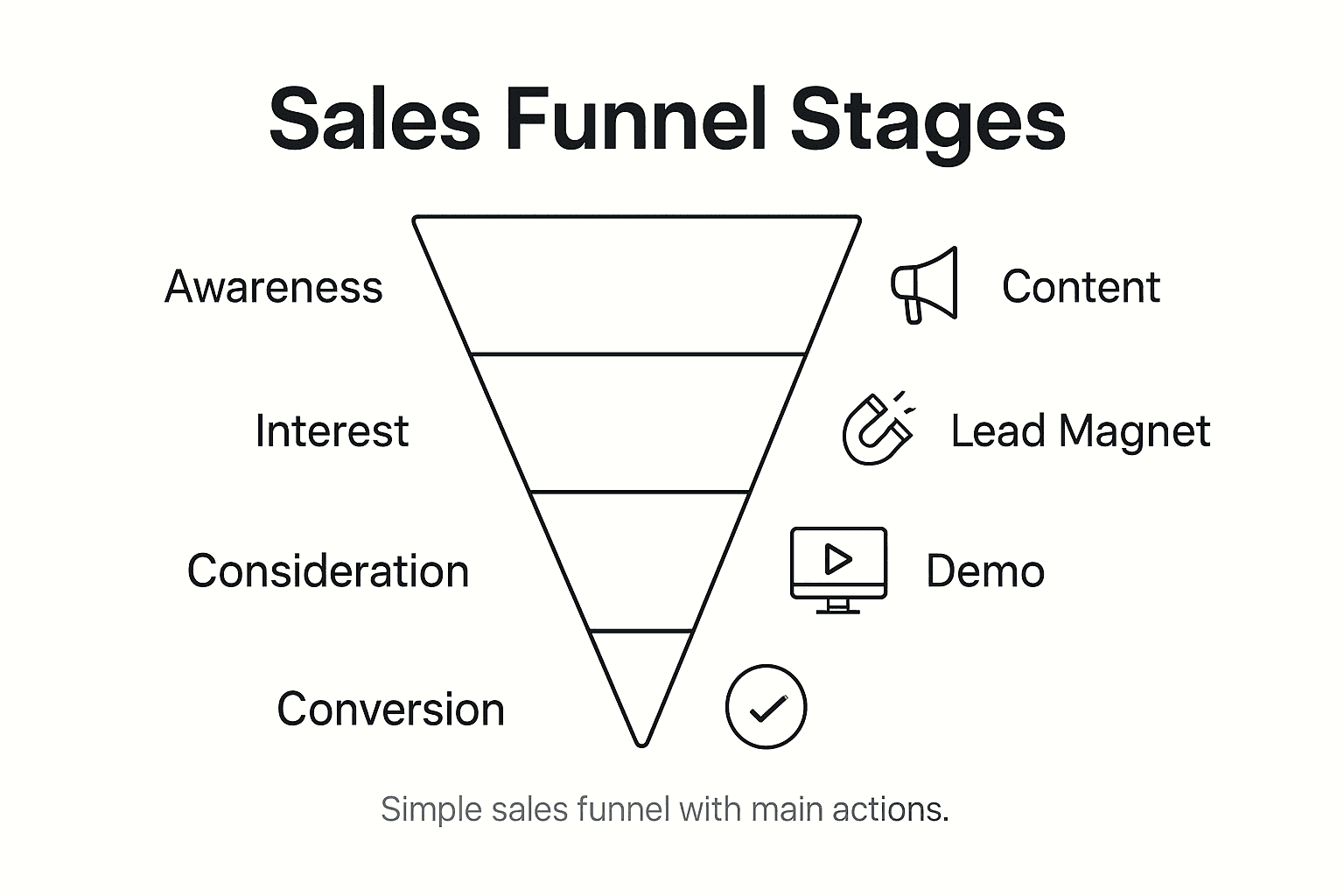
An effective sales funnel integrates omnichannel tactics that synchronise online and offline channels to guide leads through critical stages awareness, interest, decision, and action. This means developing a comprehensive strategy that ensures consistent messaging and user experience across websites, social media, email marketing, and direct interactions. Start by mapping out each stage of your funnel and identifying the specific touchpoints where potential clients interact with your brand. Consider how you can create a smooth transition between channels that feels natural and provides value at every step.
Implement targeted content and communication strategies for each funnel stage. In the awareness phase, focus on broad reach through social media, search engine optimisation, and content marketing. During the interest stage, use more personalised email communications and retargeting ads. The decision stage requires more direct engagement like personalised consultations or detailed product demonstrations. Finally, in the action stage, streamline your conversion process with clear calls to action and simplified purchasing mechanisms.
Clever Tip: Regularly audit and update your omnichannel strategy to ensure each touchpoint is optimised for maximum engagement and seamless user experience.
Step 4: Set up automation and capture systems
Creating powerful automation and capture systems transforms your sales funnel from a manual process into a sophisticated lead generation machine. Your goal is to design intelligent systems that seamlessly capture potential clients and nurture them through your marketing ecosystem without constant manual intervention.
Setting up automation requires a strategic approach that aligns technological implementation with business goals by integrating systems that operate across multiple channels and collect data for real-time monitoring. Start by identifying key touchpoints in your customer journey where automation can streamline interactions such as lead capture forms, email sequences, social media engagement tracking, and customer relationship management platforms. Choose tools that can communicate with each other creating a unified system that tracks and responds to potential client interactions automatically.
Implement a multi-layered automation strategy that captures leads from various sources and guides them through personalised communication pathways. This includes setting up automated welcome emails, segmentation based on user behaviour, retargeting ads, and intelligent routing of leads to appropriate sales team members. Ensure your automation systems provide detailed analytics that help you understand user interactions and continuously optimise your capture mechanisms. The key is creating a fluid system that feels personalised and responsive while reducing manual workload.
Clever Tip: Test and refine your automation systems regularly by creating multiple variations and tracking performance metrics to ensure maximum efficiency and engagement.
Step 5: Test your funnel performance and optimise results
Testing and optimising your sales funnel is crucial for transforming potential leads into consistent conversions. Your mission is to develop a systematic approach that allows you to understand precisely how your marketing efforts are performing and where improvements can be made.
Performance management methodologies provide frameworks for evaluating the effectiveness of processes by setting measurable goals and collecting strategic data. Begin by establishing clear key performance indicators for each stage of your funnel such as visitor to lead conversion rates, lead to opportunity rates, and final sale completion percentages. Use analytics tools that offer comprehensive tracking across multiple channels enabling you to see exactly where potential clients are dropping off or experiencing friction in their journey.
Implement a continuous testing strategy that involves multiple optimisation techniques. This includes A/B testing different landing pages, email subject lines, ad copy, and call to action buttons to understand what resonates most with your target audience. Track micro conversions and engagement metrics alongside major conversion points to get a holistic view of your funnel performance. Pay close attention to user behaviour data such as time spent on pages, click through rates, and interaction patterns to identify potential improvements. Remember that funnel optimisation is an ongoing process requiring consistent monitoring and incremental refinements.
Clever Tip: Create a quarterly review process where you comprehensively analyse your funnel performance and implement at least three strategic improvements based on your data insights.
Boost Your Sales Funnel with Proven Strategies from Business Warriors
Struggling to create a sales funnel that consistently generates high-quality leads is a common challenge for many service-based businesses. This article highlights key pain points such as ideal client profiling, omnichannel funnel development, and automation setup — all crucial elements for capturing and nurturing prospects effectively. At Business Warriors, we specialise in crafting tailored, results-driven sales and marketing systems that align perfectly with your unique business needs and goals.
With our innovative Marketing Vortex strategy, we integrate SEO, Google Ads, Meta advertising, email marketing, social media, and funnel development into a seamless, omnichannel approach. Our deep expertise in service-based sectors ensures your marketing efforts focus on proven tactics like targeted lead magnets and automation that convert curious visitors into loyal clients.
Discover how to turn insights from the Uncategorized Archives – Jarrod Harman into actionable growth strategies tailored for your business.
Ready to transform your sales funnel and achieve consistent lead generation today Visit https://jarrodharman.com and connect with the Business Warriors team to explore how our unique methods can elevate your online marketing. Check out the full range of solutions and start the journey to scalable growth now by exploring our homepage and uncovering expert insights in the Uncategorized Archives.
Frequently Asked Questions
How do I define my ideal client profile for my sales funnel?
To define your ideal client profile, analyse your most successful current clients and gather data on their demographics, geographic location, psychographics, behaviour patterns, and service needs. Create a detailed customer persona document that outlines their age, income level, interests, and pain points to tailor your marketing efforts effectively.
What types of lead magnets can I create for my sales funnel?
You can create various types of lead magnets such as in-depth guides, video trainings, checklists, templates, or mini courses that provide instant solutions to your ideal client’s problems. Focus on developing at least one lead magnet that addresses a specific challenge your target audience faces to enhance engagement and conversions.
How do I optimise my sales funnel stages using omnichannel tactics?
Optimise your sales funnel by crafting a cohesive strategy that integrates multiple channels, such as social media, email marketing, and direct interactions. Map out each funnel stage and ensure messaging is consistent across platforms while providing value at every touchpoint to improve user experience and conversions.
What automation systems should I set up for my sales funnel?
You should set up automation systems that streamline lead capture through forms, email sequences, and customer interactions. Identify key points in your customer journey and implement automated responses and analytics tracking to nurture leads without requiring constant manual effort.
How can I test and improve my sales funnel performance?
To test and improve your sales funnel, establish clear key performance indicators for each stage and utilise analytics tools to track conversion rates and user behaviour. Conduct A/B testing on different elements like landing pages and email content to identify what resonates best and refine your strategy accordingly.
Recommended
- 10 Effective Lead Generation Strategies for Businesses – Jarrod Harman
- What Is Lead Generation? Complete Expert Breakdown – Jarrod Harman
- 7 Essential Types of Marketing Funnels for Business Growth – Jarrod Harman
- Complete Guide to Why Use Marketing Funnels – Jarrod Harman
- 8 Essential Steps for a Winning Brochure Design Checklist – www.printcafeusa.com