


Turning inquiries from Perth clients into booked business often hinges on how well your website guides visitors to take action. For many female business owners, everyday distractions and inconsistent online results can stall growth. Focusing on a bold concept like strategic website optimisation unlocks new pathways for converting casual browsers into engaged leads. This guide reveals proven steps, from analysing user behaviour to crafting irresistible lead magnets, tailored specifically for service-based businesses.
Table of Contents
- Step 1: Assess And Optimise Your Website For Conversions
- Step 2: Integrate Compelling Lead Magnets And Opt-In Offers
- Step 3: Leverage Targeted Social Proof And Case Studies
- Step 4: Enhance Visibility With Omnichannel Traffic Strategies
- Step 5: Track, Test And Refine Lead Generation Performance
Quick Summary
| Key Point | Explanation |
|---|---|
| 1. Optimize User Experience | Simplify navigation and streamline design to improve lead conversion rates and enhance overall user behaviour on your site. |
| 2. Create Valuable Lead Magnets | Develop targeted resources that address specific audience pain points, encouraging visitors to share their contact details in exchange for valuable content. |
| 3. Showcase Social Proof Effectively | Use client testimonials and case studies to build trust and credibility, demonstrating your effectiveness to potential clients through authentic success stories. |
| 4. Implement Omnichannel Strategies | Create a consistent brand experience across different platforms to engage potential clients and increase visibility in their decision-making processes. |
| 5. Regularly Track and Refine Performance | Establish robust tracking mechanisms to analyse data, allowing for continuous improvement in your lead generation strategies and conversion rates. |
Step 1: Assess and optimise your website for conversions
Transforming your website from a digital brochure into a powerful lead generation machine requires strategic assessment and targeted optimisation. By systematically evaluating your current website performance and user experience, you’ll uncover valuable opportunities to dramatically improve your conversion rates.
Begin by thoroughly analysing website performance metrics to understand how visitors interact with your site. Key areas to investigate include:
- Visitor behaviour tracking using analytics tools
- Conversion funnel analysis to identify drop-off points
- User experience (UX) assessment
- Page load speed performance
- Mobile responsiveness evaluation
Your goal is to create a frictionless journey that guides potential clients seamlessly towards taking action. This means examining every element of your website through the lens of conversion – from navigation structure to call-to-action placement.
The most successful websites transform casual browsers into committed leads by understanding and anticipating user needs.
Prioritise simplifying your website’s user experience by reducing unnecessary complexity. Remove distracting elements, streamline navigation, and ensure each page has a clear, compelling purpose that aligns with your target audience’s desires.

Here’s a concise comparison of website optimisation focus areas and their direct impact:
| Optimisation Focus Area | What It Improves | Business Impact |
|---|---|---|
| User Experience Design | Ease of navigation | Higher lead conversion rate |
| Mobile Responsiveness | Accessibility across devices | Broader audience reach |
| Page Load Speed | Faster access to content | Reduced visitor drop-off |
| CTA Placement | Clear conversion paths | Increased enquiry submissions |
| Content Clarity | Message comprehension | Better client trust & retention |
Pro tip: Conduct regular user testing and gather direct feedback to continuously refine your website’s conversion potential.
Step 2: Integrate compelling lead magnets and opt-in offers
Transforming website visitors into potential leads requires strategic and irresistible opt-in offers that provide genuine value to your target audience. By creating targeted lead magnets that solve specific problems, you’ll dramatically increase the likelihood of capturing contact information from potential clients.
Start by identifying effective lead generation tools that automate and streamline your capture process. Effective lead magnets should be tailored to your specific audience and include:
- Downloadable resources like industry reports or whitepapers
- Exclusive video training addressing key client challenges
- Free webinars offering actionable insights
- Detailed checklists and workflow templates
- Calculator or assessment tools relevant to your industry
Each lead magnet must offer immediate and tangible value that demonstrates your expertise and understanding of your audience’s pain points. The goal is to create an exchange where potential clients willingly share their contact details in return for high-quality, relevant content.
Your lead magnet should solve a specific problem so precisely that prospects can’t resist providing their email address.
Design your opt-in forms strategically across your website – consider placement on high-traffic pages, using exit-intent popups, and creating dedicated landing pages that highlight the unique benefits of your lead magnet.
This table shows how different lead magnet formats attract and qualify prospective clients:
| Lead Magnet Format | Ideal Audience Pain-Points | Conversion Advantages |
|---|---|---|
| Downloadable Resource | Information gaps or research needs | Builds authority rapidly |
| Webinar | Need for live interaction | Nurtures warm leads |
| Assessment Tool | Desire for personalised insights | Identifies targeted prospects |
| Checklist/Template | Process confusion or inefficiency | Eases immediate adoption |
| Video Training | Preference for visual learning | Engages and educates deeply |
Pro tip: Test multiple lead magnet variations and track conversion rates to continuously refine your most effective client attraction strategies.
Step 3: Leverage targeted social proof and case studies
Powerful social proof can transform your website from a generic sales page into a compelling conversion engine that builds trust and credibility with potential clients. By strategically showcasing real-world success stories and client experiences, you’ll create a psychological nudge that encourages visitors to take action.
Understanding social proof psychology reveals how potential clients make decisions based on social validation. Your social proof elements should include:
- Client testimonials with specific, measurable results
- Video case studies highlighting transformation stories
- Quantifiable success metrics demonstrating your impact
- Industry awards and recognitions
- Logos of prominent clients or partnerships
- Third-party reviews and endorsements
Each social proof element must be authentic, specific, and relevant to your target audience’s specific challenges and aspirations. The goal is to show potential clients that others like them have successfully solved their problems by working with you.
Social proof acts as a powerful psychological trigger that reduces uncertainty and guides potential clients towards taking action.
Position your social proof strategically throughout your website – on homepage sections, landing pages, service descriptions, and near call-to-action buttons. Use real names, specific results, and compelling visuals to make these stories come alive.
Pro tip: Update your social proof regularly and prioritise recent, highly specific client success stories that closely match your ideal client profile.
Step 4: Enhance visibility with omnichannel traffic strategies
Transforming your digital marketing approach requires a strategic multichannel presence that connects with potential clients across multiple platforms. By implementing a cohesive omnichannel strategy, you’ll create multiple touchpoints that dramatically increase your website’s visibility and lead generation potential.
Integrating seamless marketing channels involves creating a consistent brand experience that guides potential clients through their decision-making journey. Your omnichannel strategy should include:
- Website content optimisation
- Targeted social media campaigns
- Google Ads and search engine marketing
- Email marketing sequences
- Retargeting advertising
- LinkedIn and professional network engagement
- Content marketing across multiple platforms
Each channel must communicate a unified brand message while tailoring the approach to that platform’s specific audience and engagement style. The goal is to create a seamless customer journey that feels natural and compelling across all touchpoints.
Your omnichannel strategy should feel like a conversation, not a sales pitch – connecting with potential clients where they already are.
Track and analyse performance across each channel, using data insights to continuously refine your approach and eliminate underperforming tactics. Prioritise channels that demonstrate the highest engagement and conversion rates for your specific target audience.
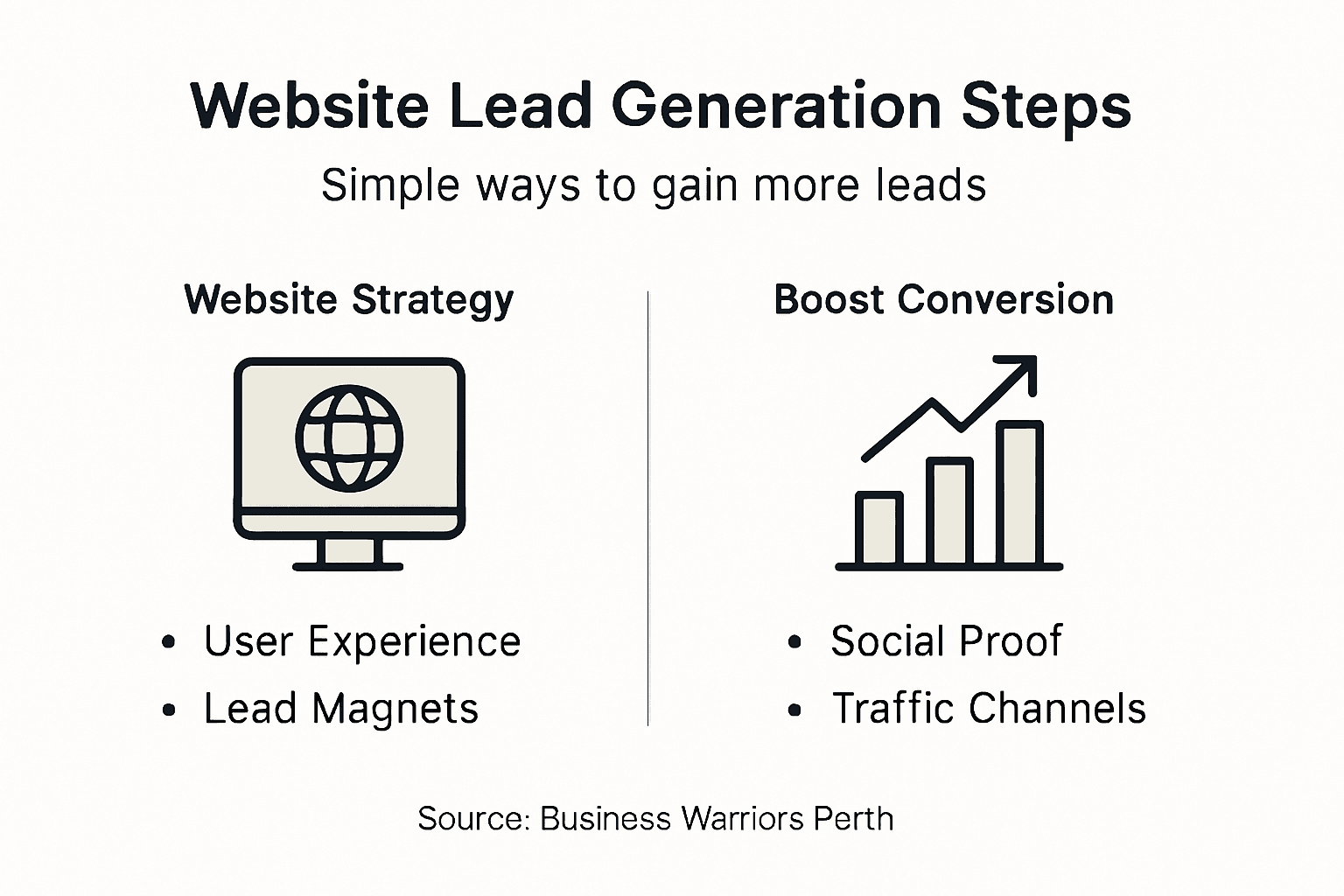
Pro tip: Invest in marketing automation tools that help you coordinate and track interactions across different channels, ensuring a consistent and personalised experience.
Step 5: Track, test and refine lead generation performance
Continuous improvement is the cornerstone of successful lead generation strategies. By implementing a systematic approach to performance tracking, you’ll transform raw data into actionable insights that progressively enhance your website’s conversion capabilities.
Implementing iterative performance refinement requires establishing robust tracking mechanisms and creating a culture of ongoing optimization. Your performance tracking strategy should encompass:
- Key performance indicator (KPI) identification
- Conversion rate analysis
- Traffic source evaluation
- User behaviour tracking
- A/B testing of landing pages
- Conversion funnel diagnostics
- ROI measurement for marketing channels
Each metric you track should provide clear, actionable intelligence about your lead generation ecosystem. Focus on understanding not just what is happening, but why it’s happening and how you can systematically improve performance.
Data without interpretation is just noise – your goal is to transform metrics into meaningful strategic insights.
Utilise advanced analytics tools that provide deep, granular insights into user interactions. Pay special attention to drop-off points, engagement patterns, and the specific pathways that lead to successful conversions.
Pro tip: Schedule monthly performance review sessions to critically analyse your metrics, ensuring you’re continuously adapting and improving your lead generation approach.
Unlock More Leads With Proven Strategies Tailored for Your Business
Struggling to turn your website traffic into real, quality leads? This article reveals the challenges of optimising user experience, crafting compelling lead magnets, leveraging social proof, and building omnichannel visibility. If you want to overcome these barriers and achieve consistent client acquisition, you need a strategic partner who understands your industry and marketing goals.
At Business Warriors, based in Perth, we specialise in transforming service-based websites into high-converting lead generation machines using our unique Marketing Vortex method. With expertise in SEO, Google Ads, email marketing, social media, and website development, we help you create frictionless customer journeys that speak directly to your ideal audience. Learn how to apply targeted, measurable strategies that increase enquiry submissions and expand your reach.

Ready to convert more visitors into loyal clients now? Visit Uncategorized Archives – Jarrod Harman to explore more insights or connect directly through https://jarrodharman.com. Let Business Warriors be your strategic marketing ally that delivers transparent, results-oriented growth designed for your business to scale effectively.
Frequently Asked Questions
How can I assess my website’s current performance for lead generation?
To assess your website’s current performance, analyse key website metrics such as visitor behaviour, conversion funnels, and page load speed. Start by using analytics tools to gather data and identify areas that need improvement within 30 days.
What are effective lead magnets I can use to capture visitor information?
Effective lead magnets include downloadable resources, exclusive webinars, and practical checklists tailored to your audience’s needs. Create and prominently feature one or two lead magnets on your website to enhance conversion rates immediately.
How can I use social proof to enhance my website’s credibility?
You can enhance your website’s credibility by displaying client testimonials, case studies, and industry awards. Incorporate these elements near call-to-action buttons to encourage conversions and build trust with potential clients.
What strategies can I implement to increase my website’s visibility?
To increase your website’s visibility, adopt an omnichannel strategy that includes social media campaigns, email marketing, and content marketing across multiple platforms. Begin by selecting two or three channels to focus on and monitor results over the next few months.
How do I track and refine my lead generation performance?
To track and refine your lead generation performance, identify key performance indicators (KPIs) and conduct regular analyses of conversion rates and traffic sources. Set aside dedicated time each month to review this information and implement changes based on your findings for continuous improvement.
Recommended
- 10 Effective Lead Generation Strategies for Businesses – Jarrod Harman
- How to Generate Leads in Digital Marketing: Proven Strategies – Jarrod Harman
- How to Increase Website Leads with Omnichannel Marketing – Jarrod Harman
- 7 Essential Steps to a Successful Lead Generation Checklist – Jarrod Harman
- Hoe bouw je een goede salesfunnel – Ondernemers Plaza Online