


Every Australian business owner knows the challenge of turning social media attention into actual sales. Ambitious sales goals and a clear understanding of your ideal customer set the stage for lasting online growth. By focusing on defining detailed audience personas and establishing precise objectives, you lay the groundwork for a strategy that attracts and converts the right clients. This guide shares practical steps for building a results-driven social media plan tailored to service-based businesses.
Table of Contents
- Step 1: Define Your Sales Goals And Audience
- Step 2: Optimise Your Social Media Profiles
- Step 3: Craft Compelling Content For Engagement
- Step 4: Implement Targeted Advertising Campaigns
- Step 5: Monitor Results And Refine Your Approach
Quick Summary
| Key Point | Explanation |
|---|---|
| 1. Set Clear Sales Objectives | Establish SMART goals to create measurable sales targets in a defined timeframe and identify platforms for tracking performance. |
| 2. Optimise Social Media Profiles | Create professional profiles with a clear bio and consistent branding to enhance visibility and credibility. |
| 3. Develop Engaging Content | Craft content that resonates emotionally, encourages interaction, and serves various purposes to maximise audience engagement. |
| 4. Implement Precise Targeted Advertising | Use detailed audience segmentation and behaviour-based filtering to connect effectively with potential customers through ads. |
| 5. Monitor Performance and Adjust | Regularly analyse performance metrics and adapt strategies based on insights to improve marketing effectiveness and achieve goals. |
Step 1: Define your sales goals and audience
To successfully scale your online sales through social media, you must first establish crystal clear objectives and understand exactly who will be purchasing your products or services. Developing detailed audience personas provides the strategic foundation for targeted marketing campaigns.
Starting with your sales goals means creating SMART objectives that transform vague aspirations into measurable targets. These goals should specify:
- The exact revenue amount you want to generate
- The timeframe for achieving those sales
- The specific social media platforms you’ll use
- Key performance indicators (KPIs) to track progress
Understanding your target audience requires deep research and strategic segmentation. You’ll want to map out precise demographic details including:
Here’s a comparison of typical audience segments and their impact on sales strategy:
| Audience Segment | Influence on Messaging | Platform Suitability |
|---|---|---|
| Young Professionals | Emphasise career growth and convenience | LinkedIn, Instagram |
| Retirees | Focus on trust and reliability | Facebook, YouTube |
| Small Business Owners | Value business solutions and efficiency | LinkedIn, Facebook |
| Students | Highlight affordability and trends | Instagram, TikTok |
- Age range
- Income level
- Professional background
- Pain points and challenges
- Online behaviour and platform preferences
Your marketing success depends on how precisely you can articulate both your sales goals and audience characteristics.
By using strategic social media channels, you can connect directly with potential customers who are most likely to purchase from you. This targeted approach dramatically increases conversion potential and reduces wasted marketing spend.
Pro tip: Create a detailed customer avatar document that you can reference consistently across all your marketing efforts to maintain laser-focused targeting.
Step 2: Optimise your social media profiles
Optimising your social media profiles is crucial for attracting potential customers and establishing a professional online presence. Techniques for effective profile optimization can dramatically improve your brand’s visibility and credibility.
To create a powerful social media profile, focus on these key elements:
- Professional profile picture that represents your brand
- Compelling and clear bio explaining your business value
- Complete contact information
- Consistent branding across all platforms
- High-quality cover images that reflect your business
A well-crafted social media profile acts as your digital business card, communicating your brand’s essence in seconds.
Strategic keyword integration is essential for making your profile discoverable. Tailoring profile content helps potential customers find you more easily and understand your unique value proposition. This means incorporating industry-specific terms, describing your services precisely, and using language that resonates with your target audience.

Remember that each social media platform has unique optimization strategies. LinkedIn requires a more professional approach, while Instagram allows for more creative and visually driven profiles. Adapt your strategy to match each platform’s strengths and audience expectations.
Pro tip: Review and update your social media profiles quarterly to ensure they remain current, reflecting your latest business offerings and achievements.
Step 3: Craft compelling content for engagement
Creating content that stops scrollers in their tracks and drives meaningful engagement is an art form that can significantly boost your online sales. Designing eye-catching social media content requires a strategic approach that speaks directly to your audience’s interests and desires.
To develop truly compelling content, consider these essential elements:
- Authentic storytelling that connects emotionally
- High-quality visual assets
- Clear and concise messaging
- Timely and relevant topics
- Interactive elements that encourage participation
- Unique perspectives that differentiate your brand
Your content should spark conversation, not just consume attention.
Building a targeted content strategy means understanding your audience’s pain points and presenting solutions in a way that feels personal and immediate. This involves deep research into your target demographic’s preferences, challenges, and online behaviour.
Each piece of content should serve a specific purpose – whether that’s educating, entertaining, or solving a problem. Mix your content types between educational posts, behind-the-scenes glimpses, client testimonials, and interactive polls to keep your audience engaged and interested.
Pro tip: Create a content calendar that balances different content types and aligns with your audience’s consumption patterns, ensuring consistent and strategic posting.
Step 4: Implement targeted advertising campaigns
Targeting the right audience with precision is the cornerstone of successful social media advertising that drives rapid online sales growth. Strategic audience targeting techniques enable businesses to connect with potential customers more effectively than traditional broad-spectrum marketing approaches.
To create a powerful targeted advertising strategy, focus on these critical components:
- Detailed audience segmentation
- Precise demographic targeting
- Behavioural and interest-based filtering
- Custom audience creation
- Retargeting campaign development
- Lookalike audience exploration
The most successful advertising campaigns speak directly to specific audience segments, not everyone.
Credibility and authenticity in advertising are crucial for converting potential customers. This means crafting ads that not only reach the right people but also resonate with their specific needs, challenges, and aspirations.
Understand that each social media platform offers unique targeting capabilities. Facebook allows incredibly granular demographic targeting, while LinkedIn excels in professional and industry-specific audience selection. Google Ads provides intent-based targeting that can capture users actively searching for solutions in your industry.
Pro tip: Start with a small budget and run multiple ad variations to test and refine your targeting before scaling up your most successful campaigns.
Step 5: Monitor results and refine your approach
Navigating the complex landscape of social media marketing requires continuous performance analysis and strategic adaptation. Effective social media analytics provide the critical insights needed to transform your marketing efforts from guesswork to precision targeting.
To monitor and refine your social media strategy, implement these key tracking mechanisms:
- Detailed performance metrics
- Conversion rate analysis
- Audience engagement tracking
- Cost per acquisition calculation
- Campaign comparative reporting
- Platform-specific performance insights
Data-driven decisions separate successful marketers from those merely experimenting.
Strategic reporting and interpretation are fundamental to understanding your marketing performance. This involves not just collecting data, but transforming raw numbers into actionable insights that can drive real business growth.
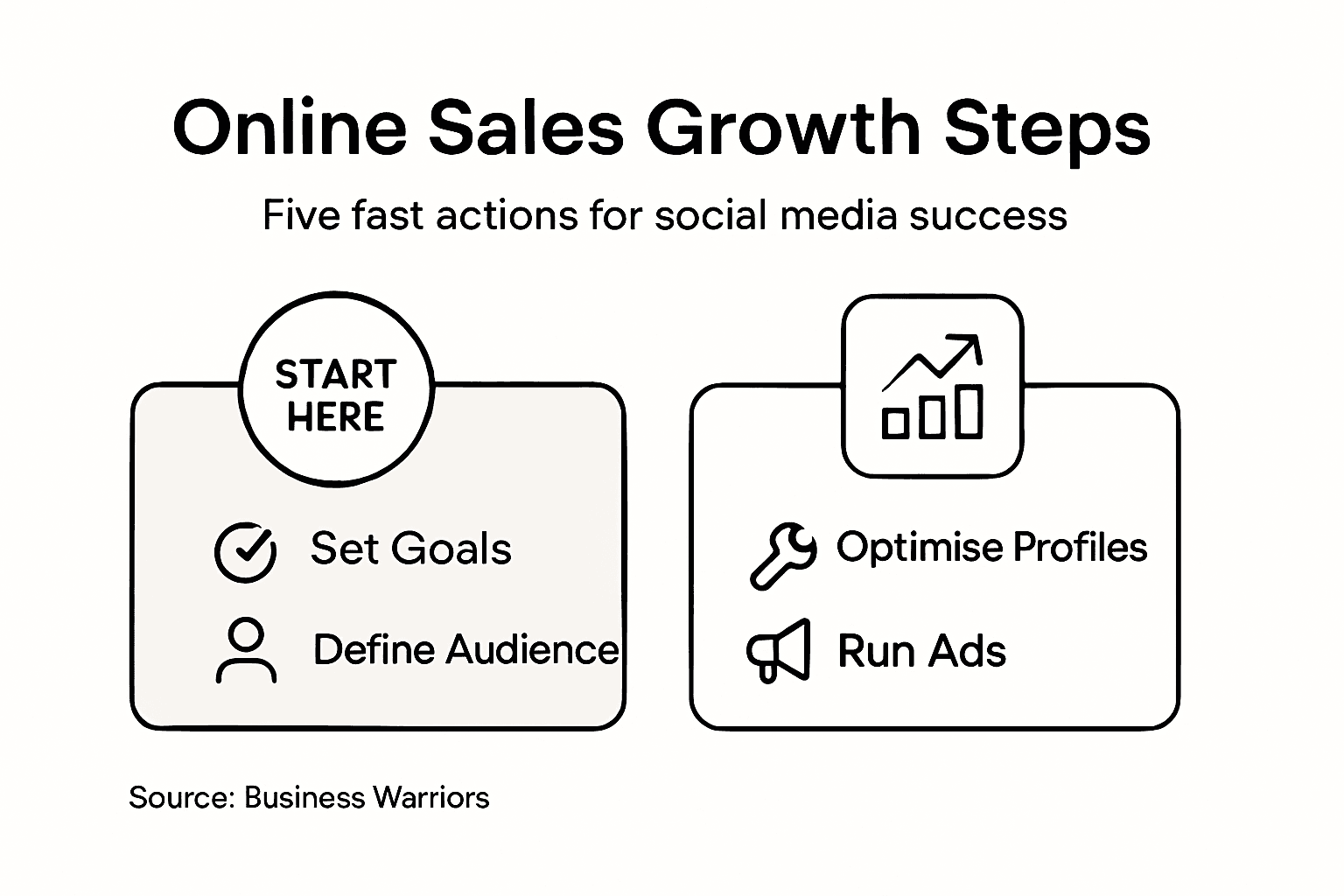
Each social media platform offers unique analytics tools. Facebook provides comprehensive demographic insights, while Instagram offers engagement rate metrics. Google Analytics can help track how social media traffic translates into website conversions, giving you a holistic view of your marketing effectiveness.
To help you choose the best analytics tools, here’s a summary of platform-specific strengths:
| Platform | Analytics Focus | Unique Advantage |
|---|---|---|
| Demographic insights | Granular age/gender breakdown | |
| Engagement rates | Visual content metrics | |
| Google Analytics | Conversion tracking | Website traffic sources |
| Professional segmentation | Job role and industry data |
Pro tip: Schedule monthly review sessions to deep-dive into your analytics, comparing current performance against your original goals and market benchmarks.
Accelerate Your Online Sales with Proven Social Media Strategies
If you are striving to increase online sales quickly through effective social media marketing you already understand the importance of clear goals and targeted content. This article highlights the challenge of defining your sales objectives and audience across platforms like Facebook Instagram LinkedIn and TikTok While many businesses struggle to convert engagement into consistent leads the key is a tailored marketing system that integrates strategic audience targeting optimised profiles and compelling content.
Business Warriors | Digital Marketing Agency specialises in helping service-based businesses apply the very principles discussed here with precision and measurable impact. Our unique Marketing Vortex approach brings together SEO Google Ads Meta advertising email marketing and stunning social media management so your business can easily cut through the noise and consistently attract ready-to-buy customers. If you want to move beyond trial-and-error and start scaling with a proven method then this is your opportunity.
Ready to stop guessing and start growing? Explore insights and success stories in our Uncategorized Archives then connect with us at jarrodharman.com to discover how the Marketing Vortex can fast-track your sales growth through powerful social media marketing. Take control now by partnering with experts who turn social strategies into tangible sales.
Frequently Asked Questions
How can I define my sales goals for social media?
To define your sales goals for social media, create SMART objectives that are specific, measurable, achievable, relevant, and time-bound. For example, aim to generate $10,000 in sales within the next 90 days using targeted social media ads.
What are effective ways to identify my target audience on social media?
Effective ways to identify your target audience include developing detailed audience personas based on demographics, interests, and online behaviour. Conduct surveys and use social media analytics to gather data on what resonates with your audience.
How should I optimise my social media profiles for sales?
To optimise your social media profiles, ensure your profile picture and bio clearly represent your brand and include relevant keywords. Update your profiles regularly, and aim to reflect your latest products and customer offerings to enhance discoverability.
What type of content should I create to engage potential customers?
Create content that tells authentic stories, includes high-quality visuals, and addresses your audience’s pain points. Aim for a mix of educational posts, behind-the-scenes content, and interactive elements to keep your audience engaged.
How can I implement targeted advertising campaigns on social media?
To implement targeted advertising campaigns, focus on detailed audience segmentation by demographics, interests, and behaviour. Start with a modest budget to test different ad variations, tweaking your targeting based on what works best to increase conversions.
How do I monitor the performance of my social media sales strategy?
Monitor the performance of your social media sales strategy by tracking key metrics such as engagement rates and conversion rates. Schedule monthly reviews to analyse your data and adjust your approach to ensure continuous improvement.
Recommended
- Social Selling Explained: Strategies, Tools, and Benefits – Jarrod Harman
- How to Grow Online Business Through Social Media Effectively – Jarrod Harman
- Create a Social Media Marketing Plan Template for Success – Jarrod Harman
- Understanding Social Selling: Building Relationships Online – Jarrod Harman
- how to increase restaurant sales with proven tactics | BonusQR