11 August 2026
How to launch a marketing campaign that drives results
Learn to launch a marketing campaign effectively and drive measurable results in lead generation, bookings, and revenue growth.
A well-executed marketing campaign moves a business from invisible to in-demand. Done right, it delivers a measurable lift in leads, bookings, or revenue within a defined window. The steps are: set one clear objective, build your audience personas, choose 1–3 channels that match buyer behaviour, create and QA your assets, launch with a day-of checklist, then optimise against leading indicators before final conversions arrive. That sequence, applied consistently, is how Australian businesses from solo operators to national franchises generate predictable pipeline.
What a successful campaign launch looks like in practice:
- Define a single primary objective (awareness, lead generation, sales, or activation)
- Audit readiness: tracking, CRM, creative assets, approvals, and privacy compliance
- Build buyer personas with channel habits and behavioural segments
- Run a competitive teardown and lock in your positioning
- Set a full budget including creative, media, tech, and contingency
- Select channels and map activations across pre-launch, launch, and post-launch phases
- Produce assets, write the creative brief, and complete QA
- Launch with a day-of checklist and 72-hour monitoring plan
- Optimise against leading indicators in the first 7–14 days
Typical timelines for Australian campaigns:
Small business campaigns (under $10,000 total budget) typically need 2–4 weeks from brief to launch. Medium campaigns ($10,000–$50,000) run 4–8 weeks. Enterprise or multi-channel campaigns above $50,000 generally require 8–16 weeks to plan, produce, and activate properly.
Indicative budget ranges and main cost drivers:
Budget splits vary by objective, but creative production, paid media (Google Ads, Meta, LinkedIn Ads), platform subscriptions, and agency or freelancer fees are the four primary cost drivers. A small service business might spend a few thousand dollars on a focused lead-generation campaign. A mid-market brand running omnichannel activity across SEO, paid social, and email marketing platforms typically invests a substantial budget per campaign cycle. The Office of the Australian Information Commissioner (OAIC) sets the privacy framework your campaign must comply with from day one, so compliance is a cost line, not an afterthought.
Key takeaways
Launching a marketing campaign that delivers measurable results requires one clear objective, the right 1–3 channels for your audience, a QA-verified asset set, and a committed optimisation window in the first 7–14 days post-launch.
| Point | Details |
|---|---|
| Rule of One | One campaign, one primary objective , separate awareness and conversion into distinct campaigns with separate budgets. |
| Readiness before creative | Set up tracking, CRM, approvals, and privacy compliance before briefing a single asset. |
| Channel concentration | Choose 1–3 channels that match your buyer’s actual behaviour; Google Ads for intent, Meta for desire, email for retention. |
| Optimise leading indicators | Use CTR, landing page conversion rate, and email open rates in the first 7 days , do not wait for final conversions to make decisions. |
| Business Warriors | Business Warriors’ Marketing Vortex integrates SEO, paid media, and email into a single managed system for Australian service businesses. |
Table of Contents
- Are you actually ready to launch? A pre-launch diagnostic
- How to set campaign goals and KPIs that actually tell you something
- How to build buyer personas that predict real channel behaviour
- How to find competitor gaps and turn them into your positioning advantage
- How to budget a campaign end-to-end and prevent scope creep
- Which channels should you activate, and in what order?
- How to write a creative brief, produce assets, and QA them before launch
- Your campaign plan, timeline, and launch-day checklist
- How to measure performance, attribute conversions, and run an optimisation loop
- Who does what? Defining team roles and governance for campaign execution
- Post-launch reporting, learnings, and setting up the next campaign
- How the Marketing Vortex methodology maps onto this launch playbook
- What most campaign guides get wrong (and what actually works)
- Business Warriors can build and run this campaign for you
- Sources
Are you actually ready to launch? A pre-launch diagnostic
Most campaigns that miss their targets were never ready to launch. The problem is rarely the creative. It is almost always an operational gap: a pixel that was never verified, a CRM that was not connected, or an approval process that nobody agreed on before the brief went out. Operational stability , a central campaign workspace, naming conventions, and clear approval roles , is a primary reason campaigns succeed or fail, and it needs to be in place before creative work begins.
Run this readiness checklist before you brief a single asset:
Objective and measurement:
- One primary objective is written down and agreed by all stakeholders
- A single primary KPI is named (e.g. cost per lead, booking rate, email click-through rate)
- Google Analytics 4 (GA4) or equivalent is installed and firing correctly on all landing pages
- Conversion events are configured and tested in Google Tag Manager
- UTM parameters are documented in a shared naming convention
Privacy and compliance (Australia-specific):
- Email lists are permission-based and compliant with the Spam Act 2003 (Cth)
- Privacy collection notices are in place on all lead capture forms, consistent with the Privacy Act 1988 (Cth) and the Australian Privacy Principles
- Any retargeting audiences are built from consented first-party data
- Promotional claims comply with Australian Consumer Law (ACL) , no misleading pricing or unsubstantiated superlatives
Operational stability:
- A central campaign workspace exists (a shared project management tool, shared drive, or campaign brief document)
- File naming conventions are documented (e.g.
CampaignName_Channel_AssetType_Version_Date) - Approval SLAs are agreed: who reviews, who approves, and how long each stage takes
- A stakeholder sign-off document is ready for final go/no-go
Tech and data:
- CRM is connected and lead source tracking is active
- Ad accounts (Google Ads, Meta Business Manager, LinkedIn Campaign Manager) are set up and billing is verified
- Email platform (Mailchimp, Campaign Monitor, or equivalent) is configured with sender authentication (SPF, DKIM)
- Asset repository is set up with version control
Quick diagnostic scoring: Mark each item green (done), amber (in progress), or red (not started). Any red item in the privacy, tracking, or approval category is a hard stop. Amber items in creative or tech can proceed with a named owner and a deadline. If you have more than three amber items across the board, delay launch by one week and resolve them first.
Pro Tip: Avoid the common mistake of checking tracking after creative is built. Set up GA4, Tag Manager, and ad pixel events on day one of campaign planning. Fixing a broken pixel after launch costs you data you can never recover.
See the digital marketing mistakes to avoid guide for a deeper look at the operational errors that most commonly derail Australian campaigns.
How to set campaign goals and KPIs that actually tell you something
The single most common reason campaigns waste budget is measuring the wrong thing. A brand-awareness campaign judged on immediate sales conversions will always look like a failure. An Adobe guide on marketing campaigns makes the point clearly: the most persuasive campaigns sell solutions to problems, and measuring them against irrelevant KPIs dilutes the budget and confuses the team.
Start with the Rule of One. One campaign equals one primary objective. If you need both awareness and direct response, treat them as two separate campaigns with separate budgets, separate creative, and separate measurement. Trying to do both in one campaign is how you end up with creative that says nothing clearly and a dashboard that tells you nothing useful.
Primary objectives and their leading indicators:
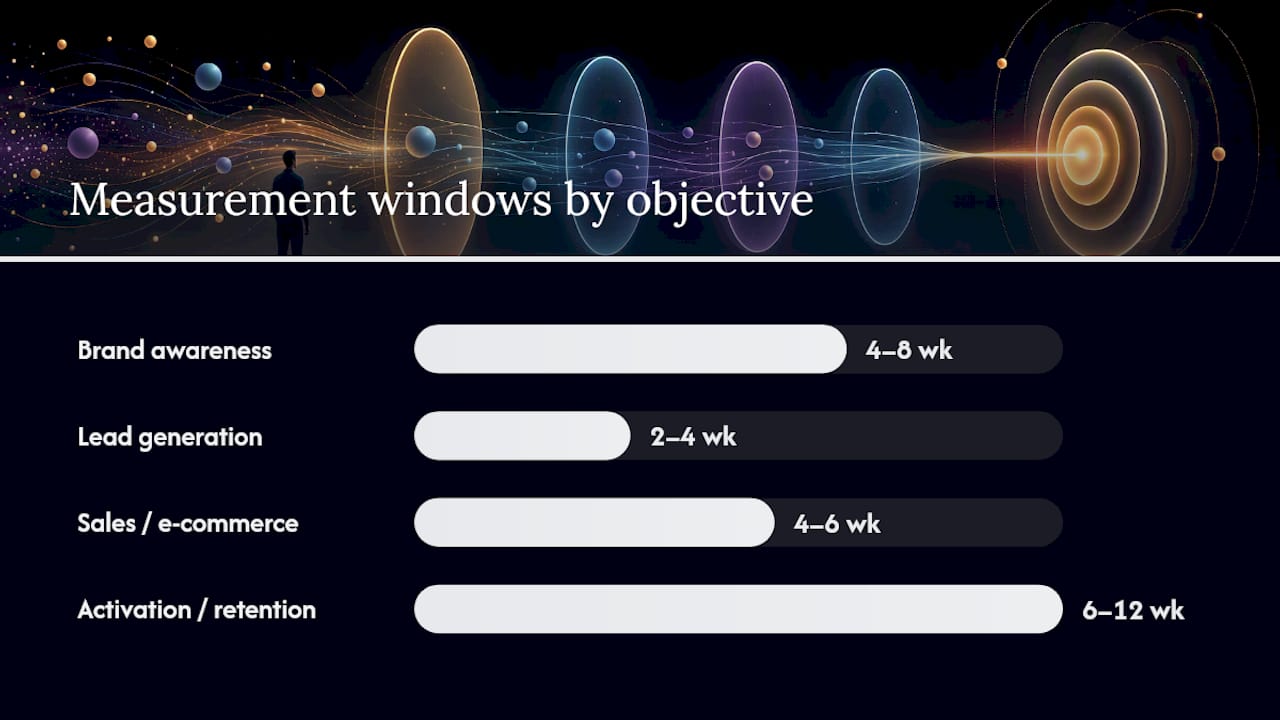
| Primary objective | Primary KPI | Leading indicators | Measurement window | Data sources |
|---|---|---|---|---|
| Brand awareness | Reach / frequency | Video view rate, time on page, branded search lift | 4–8 weeks | GA4, Meta Ads Manager, Google Search Console |
| Lead generation | Cost per lead (CPL) | CTR, landing page conversion rate, form start rate | 2–4 weeks | GA4, CRM, Google Ads |
| Sales / e-commerce | Return on ad spend (ROAS) | Add-to-cart rate, checkout initiation, email open rate | 4–6 weeks | GA4, Shopify, email platform |
| Activation / retention | Repeat booking rate | Email CTR, session frequency, loyalty redemption rate | 6–12 weeks | CRM, email platform, booking system |
Industry benchmarks for Australian campaigns (use conservatively):
Meta (Facebook and Instagram) feed ads generally deliver CPMs that shift with auction pressure and audience size. LinkedIn Ads carry higher CPMs than Meta but tend to deliver stronger lead quality for B2B service businesses.
Use these as sanity checks, not targets.
Map KPIs to your dashboard from day one. Build a live dashboard in GA4, Looker Studio, or your preferred reporting tool before launch. Alerts replace gut-feel decisions with decision rules.
How to build buyer personas that predict real channel behaviour
A persona that lives in a slide deck and never informs a media brief is decoration. The personas that actually improve campaign performance are built around three things: what the buyer is trying to get done (job-to-be-done), where they spend attention, and what objection stops them from converting.
Persona template fields that matter for campaign planning:
- Job-to-be-done: What specific outcome is this person trying to achieve? Not “wants more leads” but “needs to fill her clinic’s Tuesday and Wednesday appointment slots without relying on word-of-mouth.”
- Urgency level: Is this a planned purchase or a triggered one? Urgency changes channel mix and creative tone entirely.
- Channel habits: Where does this person actually spend time? Instagram at 7pm, Google when they have a specific problem, LinkedIn during work hours. This directly informs your media plan.
- Primary objections: What stops them from booking or buying? Price, trust, timing, or a competitor they already use?
- Lifetime value estimate: A client worth $8,000 over 12 months justifies a very different CPL ceiling than a one-time $200 transaction.
Behavioural segmentation techniques:
Site behavioural data from GA4 (pages visited, session depth, scroll depth) tells you which content topics attract your highest-converting visitors. CRM cohort analysis shows which lead sources produce the best lifetime value. Lookalike audiences in Meta and Google Ads let you scale from your best existing customers. First-party signals , email engagement, booking history, loyalty programme data , are the most reliable segments you have, especially as third-party cookie deprecation continues.
Validation before you spend:
Run micro-tests before committing full budget. A $500–$1,000 paid social test across two audience segments will tell you which persona responds faster. Short surveys (5 questions, sent to your email list via Mailchimp or Campaign Monitor) surface objections you did not anticipate. Landing-page A/B tests with different value propositions confirm which message resonates before you scale.

SEO and search intent alignment:
Your personas directly inform keyword strategy. A persona with high urgency and specific intent (“laser hair removal Perth price”) maps to transactional keywords and Google Ads. A persona in research mode (“how to choose a med spa”) maps to informational SEO content. Matching search intent to persona stage is how organic and paid efforts compound rather than compete.
Pro Tip: Build one “anti-persona” alongside your primary personas. Define who you do not want to attract , the low-value, high-churn customer , and use that profile to add negative keywords in Google Ads and exclusion audiences in Meta. It saves budget and improves lead quality faster than any bid adjustment.
How to find competitor gaps and turn them into your positioning advantage
You do not need to name competitors to learn from them. The public signals they leave , search ads, social ad libraries, landing page copy, offer structures , tell you exactly where the category is crowded and where it is thin.
A simple teardown template:
- Creative: What visual style and tone does the category default to? (Clinical and white? Lifestyle and warm? Discount-led?)
- Offers: What is the standard entry offer? (Free consultation, percentage discount, money-back guarantee?)
- Channels: Where is the category spending? (Heavy on Meta, thin on Google, absent from LinkedIn?)
- Landing experience: Do competitors send paid traffic to a homepage or a dedicated landing page? How long is the form?
- CTA: What action are they asking for? (Book now, get a quote, download a guide?)
- Creative cadence: How frequently are they refreshing ads? (Stale creative running for 6+ months is a gap you can exploit.)
Differentiation using generic positioning labels:
| Positioning type | Typical campaign approach | Where the gap usually is |
|---|---|---|
| Category incumbent | Broad reach, brand-led creative, low urgency CTAs | Specific problem-solution messaging for high-intent segments |
| Value challenger | Price-led, discount-heavy, high frequency | Trust signals, proof, and quality narrative |
| Niche specialist | Narrow audience, deep expertise messaging | Scale and reach beyond the core niche |
| New entrant | Awareness-first, education-led | Direct response and conversion-focused assets |
SEO gap analysis feeds creative strategy. Use Google Search Console and keyword research tools to identify search queries your category ranks for but your site does not. Topics with decent search volume and weak existing content are both an SEO opportunity and a signal that the market has an unanswered question. Build campaign content around those gaps and you are solving a real problem rather than adding to the noise.
Quick experiments to test differentiated propositions:
Run two versions of a landing page with different headline propositions for 7–10 days on a small paid budget. The version with the higher conversion rate tells you which positioning the market actually responds to. Do not run this test for less than 200 sessions per variant or the data is not reliable.
How to budget a campaign end-to-end and prevent scope creep
Budget conversations that happen after creative is briefed always end badly. The budget needs to be set before the brief, not after, because the brief scope should be determined by what the budget can actually fund.
Full campaign budget template:
Hidden costs that most campaign budgets miss:
- Bid volatility in Google Ads and Meta auctions, particularly around seasonal peaks (Christmas, EOFY, school holidays)
- Creative rework cycles when approvals are slow or briefs are unclear
- Localisation costs if the campaign runs across multiple Australian states with different offers or compliance requirements
- Platform fees and minimum spends (LinkedIn Ads has a minimum daily budget that catches new advertisers off-guard)
- SEO and content costs, which are often one-time for asset creation but ongoing for distribution and link building
Governance model to prevent scope creep:
Assign a budget owner who has final sign-off on any spend above the approved line. Review pacing weekly, not monthly. Paid media budgets that are not reviewed weekly tend to overspend in the first half of the campaign and underspend in the second.

For SEO and content, separate the one-time production cost (writing, design, technical setup) from the ongoing distribution cost (link building, social amplification, email promotion). Both belong in the campaign budget, but they have different payment timing and different owners.
Which channels should you activate, and in what order?
The most common channel mistake is trying to be everywhere. Concentrating budget on 1–3 primary channels that match your buyer’s actual behaviour consistently outperforms a thin spread across six platforms. The channel mix follows the objective and the persona, not the other way around.
Channel matrix: objective to channel to primary KPI:
Activation phases:
- Pre-launch (2–4 weeks before): Publish teaser content on organic social. Build and warm your email list. Set up retargeting pixel audiences so they have time to populate. Publish SEO landing pages and submit them for indexing. Brief customer-facing staff on the campaign message and offer.
- Launch week: Activate paid campaigns in Google Ads and Meta simultaneously. Send the launch email to your full list. Publish the primary campaign content piece (blog, video, or guide) and promote it across channels. Monitor delivery, spend pacing, and early CTR every 24 hours.
- Post-launch (weeks 2–8): Run nurture email sequences for leads who did not convert. Activate retargeting for site visitors who did not complete the desired action. Begin SEO amplification (internal linking, outreach for backlinks to campaign content). Review leading indicators at day 7 and reallocate budget to the best-performing ad sets.
Platform selection logic:
Google Ads captures buyers who already know what they want. If someone searches “med spa Botox Perth,” they are ready to book. That is where Google Ads earns its cost. Meta (Facebook and Instagram) is where you build desire before the search happens. LinkedIn Ads is the right call for B2B service businesses targeting marketing managers, directors, or business owners by industry and seniority. Email marketing via Mailchimp or Campaign Monitor is your highest-ROI channel for an existing list, full stop.
For a social media campaign plan that maps these phases in detail, the Jarrodharman guide covers platform-specific activation steps for Australian service businesses.
Sequencing paid and organic to compound results:
Publish your SEO content hub before the paid campaign launches. When paid traffic arrives on a landing page that already has organic authority, conversion rates tend to be higher because the page has social proof (existing traffic, indexed content, backlinks). Internal links from the content hub to the campaign landing page also pass authority and support ranking. This is the core logic behind an SEO-first campaign architecture.
How to write a creative brief, produce assets, and QA them before launch
Creative that ships without a brief is the single biggest source of rework in campaign production. A brief is not bureaucracy. It is the document that means everyone builds the same thing.
Creative brief template:
- Objective: One sentence. What should this creative make the audience do?
- Single message: One core claim. What is the one thing the audience must remember?
- Target persona: Name the persona. Include their primary objection and their channel context.
- Proof points: Three specific, verifiable reasons the claim is true (client results, credentials, guarantees).
- CTA: The exact action. “Book a free consultation” is a CTA. “Learn more” is not.
- Placement specs: Every channel has different size, duration, and copy length requirements. List them all.
Asset checklist by channel:
- Google Ads: 3–5 headlines (30 characters each), 2 descriptions (90 characters each), sitelink extensions, call extensions
- Meta (Facebook/Instagram): 1:1 image (1080×1080px), 4:5 image (1080×1350px), 9:16 Story/Reel video (15–30 seconds), primary text (125 characters visible), headline, CTA button
- LinkedIn Ads: 1200×627px image, headline (150 characters), introductory text (150 characters), sponsored content copy
- Email (Mailchimp / Campaign Monitor): HTML email (600px wide), subject line (40–50 characters), preview text (85–100 characters), plain-text version
- Landing page: Hero headline, subheadline, 3 benefit points, social proof element, form or booking widget, mobile-optimised layout
QA checklist before any asset goes live:
- All tracking codes (UTM parameters, pixels, conversion events) are firing correctly
- Every URL in ads and emails resolves to the correct landing page
- All images are compressed and load under 3 seconds on mobile
- Copy has been proofread for spelling, grammar, and ACL compliance (no unsubstantiated claims)
- Accessibility: alt text on all images, sufficient colour contrast, captions on video
- File naming follows the agreed convention
- Final creative has received written sign-off from the campaign owner
Using SEO and AI tools to speed production:
AI writing tools can accelerate first-draft copy for ad headlines, email subject lines, and landing page variations. The discipline is to brief the AI with your single message and persona before generating, then edit for brand voice and ACL compliance. For SEO content, use tools like Google Search Console and keyword research platforms to confirm that landing page copy addresses the search queries your personas actually use. Consistent messaging across channels , the same core claim in the Google Ad, the landing page, and the email , is what sustains personalisation and testing at scale.
Pro Tip: Build a “master asset file” in a shared drive with every approved creative element, including logos, brand colours, approved photography, and legal disclaimers. Every campaign draws from this file. It eliminates the “which version of the logo is current?” conversation and cuts production time on every subsequent campaign.
Your campaign plan, timeline, and launch-day checklist
A launch checklist is not the same as a campaign plan. The plan covers the full arc from brief to post-launch. The launch checklist covers the specific tasks that must be completed in the 48 hours before and after go-live. Both are necessary.
Timeline examples by campaign scale:
| Phase | Small campaign (2–4 weeks) | Medium campaign (4–8 weeks) | Enterprise campaign (8–16 weeks) |
|---|---|---|---|
| Strategy and brief | Days 1–3 | Week 1 | Weeks 1–2 |
| Audience and channel planning | Days 3–5 | Week 2 | Weeks 2–3 |
| Creative production | Days 5–12 | Weeks 2–4 | Weeks 3–7 |
| Tech setup and QA | Days 10–14 | Weeks 4–5 | Weeks 6–8 |
| Pre-launch activation | Days 12–14 | Week 5–6 | Weeks 8–10 |
| Launch | Day 14 | Week 7 | Week 11 |
| Optimisation window | Days 7–14 | Weeks 7–12 | Weeks 11–20 |
Launch-day checklist (numbered for execution order):
- Confirm all ad accounts are out of review and delivering in Google Ads, Meta Business Manager, and LinkedIn Campaign Manager
- Verify all conversion events are firing in GA4 and Google Tag Manager using real test clicks
- Send a test email through Mailchimp or Campaign Monitor and confirm rendering on mobile and desktop
- Check all landing page URLs resolve correctly and forms submit to the correct CRM destination
- Confirm UTM parameters are consistent across all channels and populating in GA4
- Publish the primary campaign content piece and verify it is indexed (submit to Google Search Console)
- Activate organic social posts per the publishing schedule
- Brief customer-facing staff (reception, sales, support) on the campaign offer and expected enquiry volume
- Set up a shared Slack channel or equivalent for the first 72-hour monitoring window
- Confirm the campaign owner is available for the first 4 hours post-launch to approve any urgent changes
Responsibility matrix for launch and first 72 hours:
Setting the optimisation window:
Plan a formal review at day 3, day 7, and day 14. Day 3 is a sanity check: is everything delivering? Day 7 is the first real optimisation decision: which ad sets, audiences, or channels are performing above or below the leading-indicator thresholds you set? Day 14 is the first budget reallocation decision. Do not make budget reallocation decisions before day 7 unless a channel is spending with zero conversions.
For a ready-to-use campaign launch checklist adapted for Australian businesses, the Jarrodharman resource covers the key steps from brief to go-live.
How to measure performance, attribute conversions, and run an optimisation loop
The eight-step campaign framework that guides most professional launches puts monitoring and measurement as the final two steps. That framing is slightly misleading because measurement setup must happen before launch. What you do post-launch is interpret and act on the data you prepared to collect.
Dashboard structure by time horizon:
- Launch to day 3: Delivery metrics only. Is spend pacing correctly? Are ads approved and running? Is the email delivered and opened? Are conversion events firing? Fix operational issues before drawing any performance conclusions.
- Day 3 to week 1: Leading indicators. CTR on paid ads, landing page conversion rate, email open and click-through rates, time on page for SEO content. These tell you whether the message is resonating before final conversions accumulate.
- Week 1 to month 1: Outcome metrics. Cost per lead, ROAS, booking rate, revenue attributed to the campaign. Compare against the KPI targets set in the planning phase.
Attribution: what to trust and when:
Last-click attribution overstates the value of the final touchpoint (usually a branded search or direct visit) and understates the role of awareness channels (Meta, YouTube, SEO content). Data-driven attribution models in GA4 distribute credit more accurately across the full path. For campaigns with short sales cycles (under 7 days), last-click is a reasonable proxy. For longer cycles, use data-driven or position-based models and cross-reference with CRM source data.
Optimisation decision rules:
- CPL above 150% of target at day 7: pause the lowest-performing ad set and reallocate budget to the best performer
- CTR below 0.5% on Google Ads search after 72 hours: review keyword match types and ad copy; add negative keywords
- Email open rate below 15%: test a new subject line on a 20% holdout segment before resending to the full list
- Landing page conversion rate below 1% after 200 sessions: test a new headline or simplify the form
Common measurement pitfalls in Australian campaigns:
Pixel fires blocked by ad blockers and iOS privacy changes mean Meta-reported conversions are typically understated. Cross-domain tracking breaks when a campaign sends traffic from a landing page on one domain to a checkout on another. Cookie consent banners, required under Australian privacy obligations, reduce the volume of consented tracking data. Mitigate these by using server-side tracking where possible, importing offline conversions from your CRM into Google Ads, and using GA4’s modelled conversions to fill gaps.
Folding AI and SEO signals into optimisation:
AI-powered creative variant testing in Meta Advantage+ and Google’s Performance Max can surface winning creative combinations faster than manual A/B testing. Feed those winning headlines back into your SEO content and email subject lines. Google Search Console shows which organic queries are driving traffic to your campaign landing pages , if a query you did not target is sending traffic, create a supporting content piece to capture that intent properly. This is how a campaign builds long-term SEO equity rather than disappearing the moment the paid budget stops.
Pro Tip: Set up a weekly “signal review” meeting of no more than 30 minutes. Review three numbers: CPL vs target, leading indicator trend (up or down), and top-performing creative. Make one decision. Document it. This cadence prevents the two failure modes: ignoring data entirely, and over-optimising every day based on noise.
Who does what? Defining team roles and governance for campaign execution
Campaigns stall when nobody knows who has final say. The approval matrix is not a bureaucratic formality. It is the document that stops a campaign from sitting in someone’s inbox for three days waiting for a sign-off that was never formally requested.
Role map for a campaign team:
- Campaign owner: Accountable for the campaign objective, budget, and timeline. Makes the final go/no-go call. Approves all budget changes above the agreed threshold.
- Creative lead: Owns the creative brief, asset production, and brand consistency. Approves final creative before it goes to the campaign owner.
- Paid media specialist: Manages Google Ads, Meta, and LinkedIn Ads accounts. Responsible for daily delivery monitoring and bid management.
- SEO and content lead: Owns landing page optimisation, content hub publishing, internal linking, and organic amplification. Coordinates with the paid team to avoid keyword cannibalisation.
- Analytics owner: Owns tracking setup, dashboard maintenance, and reporting. The first person called when a pixel is broken or a conversion event stops firing.
- Customer-facing representatives: Reception, sales, and support staff who handle enquiries generated by the campaign. Must be briefed on the offer, the expected volume, and the correct response process before launch.
Approval SLA samples:
Creative reviews: 48 hours from submission to feedback. Ad copy approvals: 24 hours. Legal or compliance reviews: 72 hours minimum.
Escalation and contingency for live incidents:
A broken landing page on launch day, an ad disapproval from Meta, or a sudden spike in negative social comments each require a different response. Document a one-page incident response plan before launch: who is notified, who has authority to pause spend, and what the communication protocol is for stakeholders. The campaign owner should have direct access to pause all paid campaigns without requiring a second approval in a genuine emergency.
Preventing SEO and paid cannibalisation:
When paid search and organic search both target the same high-intent keywords, they can compete in the same auction and inflate your own costs. The SEO and content lead should review the paid keyword list before launch and flag any terms where organic rankings are already strong. In those cases, consider pausing paid on those specific terms and redirecting that budget to keywords where organic coverage is weak.
Pro Tip: Run a 30-minute cross-functional handover meeting the day before launch. Every role confirms their tasks are complete, their tools are working, and they know who to call if something breaks. This single meeting catches more launch-day problems than any checklist.
Post-launch reporting, learnings, and setting up the next campaign
A campaign that ends without a post-mortem is a campaign that teaches you nothing. The step-by-step approach from audience analysis through to measurement only creates compounding value when the learnings from each cycle feed the next one.
Post-mortem template fields:
- Objective vs outcome: What was the primary KPI target? What did you achieve?
- Wins: Which channels, audiences, or creative executions outperformed expectations?
- Misses: Where did performance fall short? What was the most likely cause?
- Experiments run: What did you test? What was the result? Was the sample size sufficient for confidence?
- Backlog items: What would you do differently next time? What hypotheses are worth testing in the next campaign?
Reporting cadence:
| Report type | Frequency | Metrics covered | Audience |
|---|---|---|---|
| Delivery check | Daily (first 2 weeks) | Spend pacing, delivery, pixel fires | Paid media specialist, analytics owner |
| Performance report | Weekly | CPL, CTR, conversion rate, leading indicators | Campaign owner, marketing manager |
| Executive summary | Monthly | Revenue impact, cost per lead, LTV implications | Business owner, board, senior leadership |
| Post-mortem | End of campaign | Full objective vs outcome, wins, misses, backlog | Full campaign team |
Building a reusable playbook:
Document the creative hooks that worked (specific headlines, visual styles, offer structures) in a shared asset library. Tag SEO content pieces that drove organic traffic to campaign landing pages and add them to an internal linking map for future campaigns. Save landing page templates that converted above benchmark. This library compounds in value with every campaign cycle.
Communicating results to commercial stakeholders:
Marketing directors speak in CPL and ROAS. Business owners speak in revenue and profit. Translate your results: “We generated 87 leads at a CPL of $62, of which 23 converted to clients at an average transaction value of $1,400, producing $32,200 in attributed revenue against a total campaign spend of $18,500.” That sentence lands in a board meeting.
How the Marketing Vortex methodology maps onto this launch playbook
Business Warriors’ Marketing Vortex is a structured, omnichannel methodology that operationalises the same steps covered in this guide. Rather than treating SEO, paid media, email, and social as separate channels with separate strategies, the Marketing Vortex integrates them into a single funnel where each channel reinforces the others.
Marketing Vortex stages mapped to the campaign playbook:
| Marketing Vortex stage | Playbook equivalent | Channels activated | Primary output |
|---|---|---|---|
| Foundation | Prerequisites diagnostic, goals, personas | SEO, web development, CRM setup | Campaign-ready infrastructure |
| Attraction | Channel selection, pre-launch activation | Google Ads, Meta, SEO/content, PR | Qualified traffic and awareness |
| Conversion | Creative brief, landing pages, offers | Google Ads, Meta, LinkedIn Ads, email | Leads and bookings |
| Nurture | Post-launch email sequences, retargeting | Email (Mailchimp / Campaign Monitor), Meta retargeting | Repeat bookings, upsells |
| Scale | Optimisation loop, reporting, iteration | All channels, AI-assisted testing | Reduced CPL, increased ROAS |
The methodology is specifically built for service-based businesses , salons, clinics, med spas, law firms, and similar operators , where the sales cycle is short but the lifetime value of a retained client is high. For a detailed breakdown of how the Marketing Vortex method works in practice, the Jarrodharman resource covers each stage with channel-specific guidance.
Why integration matters more than channel selection:
A business running Google Ads without SEO-optimised landing pages pays for traffic that bounces. A business running Meta ads without an email nurture sequence loses leads who were interested but not ready to book. The Marketing Vortex prevents these gaps by treating the full funnel as a single system. SEO builds the organic foundation that reduces paid media costs over time. Paid media generates immediate traffic while SEO compounds. Email converts and retains. Each channel does its specific job, and the system is designed so no single channel failure collapses the whole campaign.
The businesses that generate consistent, predictable leads are not the ones with the biggest budgets. They are the ones with the most coherent systems , where every channel knows its job, every lead is followed up, and every campaign teaches the next one something useful. That is what the Marketing Vortex is built to deliver.
What most campaign guides get wrong (and what actually works)
Most campaign guides treat the launch as the destination. The launch is actually the beginning of the most important phase: the optimisation window. The planning, the brief, the creative , all of that is preparation. The real work starts when real people interact with real ads and real landing pages, and the data tells you what the planning got right and what it missed.
The Rule of One is the single most underused principle in Australian marketing. Businesses consistently try to run awareness and conversion in the same campaign, with the same budget, and measured against the same KPI. The result is creative that is neither compelling enough to build brand nor specific enough to convert. Separate the objectives, separate the budgets, and measure each against its own purpose.
SEO is still treated as a long-term play that sits outside the campaign. That framing costs businesses money. An SEO-optimised landing page built for a campaign continues to generate organic traffic after the paid budget stops. A content hub built around campaign themes builds topical authority that reduces CPL on future campaigns. AI-assisted content tools have made it faster to produce SEO-quality content at campaign pace, which removes the excuse that SEO takes too long to be useful within a campaign window.
The other thing most guides miss is the AI and large language model (LLM) dimension of modern SEO. Getting your brand mentioned in AI-generated answers from tools like ChatGPT, Perplexity, and Google’s AI Overviews is now a meaningful traffic and credibility driver. This is sometimes called GEO (Generative Engine Optimisation) or AEO (Answer Engine Optimisation). The way you earn those mentions is the same way you earn traditional SEO authority: publish specific, well-structured, expert content that answers real questions. Campaigns that produce genuine thought leadership content , not just ad copy , build the kind of brand signal that LLMs draw on when generating answers.
Three pro tips from agency practice:
Pro Tip: Set your optimisation window before you launch, not after. Decide in advance: at day 7, if CPL is above X, you will pause Y and increase Z. Pre-committed decision rules prevent the two most expensive campaign behaviours: panicking and changing everything after 48 hours, or ignoring underperformance for three weeks because nobody wants to admit the creative is not working.
Pro Tip: The first campaign with a new client or a new channel is a learning campaign. Budget for it accordingly. Expect to pay more per lead than you will in campaign three or four, because you are buying data as much as you are buying leads. Teams that understand this do not pull the plug on a channel after two weeks of above-target CPL.
Pro Tip: Brief your customer-facing team as thoroughly as you brief your media team. A campaign that generates 50 enquiries and converts 3 because reception did not know the offer exists is not a marketing failure. It is a handover failure. The campaign checklist must include a staff briefing item.
Business Warriors can build and run this campaign for you
If this playbook describes what you want to achieve but your team does not have the bandwidth or the specialist skills to execute it, Business Warriors is the agency that operationalises exactly this approach for Australian service businesses.
Business Warriors is a Perth-based, full-service digital marketing agency serving clients across Australia. The Marketing Vortex methodology integrates SEO, Google Ads, Meta advertising, email marketing, and web development into a single, managed system , so every channel works together rather than in isolation. Clients typically receive a discovery and strategy session, a full campaign plan with channel-specific budgets, hands-on execution across all agreed channels, weekly reporting, and an ongoing optimisation loop that improves results with every campaign cycle.
The agency works with service businesses, e-commerce brands, franchise networks, and enterprises that are serious about growth and have a real marketing budget to invest. If you want a campaign built on the same principles in this guide, with a team that has run this process across dozens of Australian businesses, get in touch with Business Warriors to start the conversation.
Sources
These references are worth bookmarking if you are building or refining your campaign process:
- Marketing Campaigns: How to Create and Benefits
- Marketing Campaign Guide: Types, Steps, And Best Practices
- Marketing Campaign Launch Checklist: Essential Steps
- How to Launch a Marketing Campaign: 8 Essential Steps | Breef
- How to Create and Launch an Amazing Marketing Campaign
Recommended
- Step-by-step guide to launching marketing campaigns in 2026 – Jarrod Harman
- Advertising tips for social media that drive real results – Jarrod Harman
- How to plan a digital marketing campaign: step-by-step guide – Jarrod Harman
- Response marketing strategies that drive real conversions – Jarrod Harman