6 February 2026
Lead Generation Content Marketing That Fuels Growth
Lead generation content marketing for service businesses—explore proven strategies, content types, success metrics and common pitfalls to avoid.
Juggling client management and building your Australian business can leave little time to attract steady, high-quality leads. Without a targeted plan, finding new clients often feels uncertain and drains energy from your core services. Discover how content marketing for lead generation helps you win trust, showcase expertise, and nurture relationships that fill your bookings, all through content formats designed to meet your audience’s real needs.
Table of Contents
- What Is Lead Generation Content Marketing?
- Key Content Types For Lead Generation Success
- How Content Nurtures Prospects Into Clients
- Vital Metrics To Measure Lead Generation Impact
- Common Pitfalls And How To Avoid Them
Key Takeaways
| Point | Details |
|---|---|
| Lead Generation Content Marketing | Focus on creating valuable, targeted content to build connections and attract potential customers without aggressive sales tactics. |
| Diverse Content Types | Utilise various content formats tailored to each stage of the buyer journey to effectively engage and nurture leads. |
| Metrics for Success | Measure lead generation efforts through key metrics such as lead volume, conversion rates, and lead quality to refine strategies. |
| Avoid Common Pitfalls | Stay clear of generic targeting, inconsistent quality, and neglecting SEO to maintain a strong lead generation strategy. |
What Is Lead Generation Content Marketing?
Lead generation content marketing represents a strategic approach to attracting and converting potential customers by creating valuable, targeted content that addresses their specific needs and challenges. At its core, this methodology transforms traditional marketing by building meaningful audience connections through carefully crafted digital materials designed to generate genuine interest.
In practical terms, lead generation content marketing involves developing high-quality resources that solve problems, answer questions, and provide actionable insights for your ideal customer base. These resources might include:
- Detailed blog posts exploring industry challenges
- Informative video tutorials demonstrating solutions
- Downloadable research reports and whitepapers
- Engaging podcast episodes addressing client pain points
- Interactive webinars with expert insights
- Comprehensive email newsletter series
The fundamental goal is establishing trust and credibility by demonstrating expertise without overtly selling. By creating content that genuinely helps potential clients, businesses can naturally attract leads who are actively seeking solutions to their specific problems.

Successful lead generation content marketing requires understanding your target audience’s precise needs, pain points, and informational preferences. This means conducting thorough market research, developing detailed customer personas, and creating content that speaks directly to their challenges and aspirations.
Pro tip: Develop a consistent content strategy that focuses on providing genuine value rather than aggressive sales tactics, allowing potential leads to naturally gravitate towards your solutions.
Key Content Types For Lead Generation Success
Lead generation content encompasses a diverse range of strategic materials designed to attract, engage, and convert potential customers. Successful content marketing approaches leverage multiple content types that serve different stages of the customer journey, each with unique capabilities for nurturing leads and building meaningful connections.
The most effective content types for lead generation include:
- Blog Posts: In-depth articles addressing industry challenges and solutions
- Case Studies: Real-world examples demonstrating problem-solving capabilities
- Webinars: Interactive educational sessions providing expert insights
- E-books: Comprehensive guides offering deep-dive industry knowledge
- Infographics: Visual representations of complex data and concepts
- Podcasts: Audio content exploring industry trends and expert perspectives
- Video Tutorials: Step-by-step visual guides solving specific problems
Each content type serves a strategic purpose in the lead generation ecosystem. Thought leadership content establishes credibility, while educational resources help potential clients understand their challenges and potential solutions. By creating diverse, high-quality content, businesses can effectively address different learning preferences and engagement styles.
The key is developing content that genuinely provides value, answers critical questions, and demonstrates expertise without being overly promotional. Content marketing strategies that prioritise educational and evergreen materials tend to generate more qualified leads and sustain long-term audience engagement.
Pro tip: Create a content matrix mapping different content types to specific customer journey stages, ensuring you have targeted materials for awareness, consideration, and decision-making phases.
Here’s how different content types support various stages of the buyer journey:
| Content Type | Buyer Journey Stage | Main Objective |
|---|---|---|
| Blog Posts | Awareness | Educate on industry challenges |
| E-books | Consideration | Provide comprehensive guidance |
| Case Studies | Decision | Showcase real-world success |
| Webinars | Consideration | Deepen expertise and interaction |
| Infographics | Awareness | Simplify complex concepts visually |
| Video Tutorials | Consideration | Demonstrate solutions step-by-step |
| Podcasts | Awareness | Explore trends and insights audibly |
How Content Nurtures Prospects Into Clients
Content marketing operates as a strategic pathway for transforming potential prospects into committed clients through carefully crafted, targeted communication. Marketing qualified leads progress through distinct stages, with each content piece designed to address specific buyer journey challenges and emotional needs.
The lead nurturing process typically involves three critical stages:
- Awareness Stage: Educational content introducing industry challenges
- Consideration Stage: Comparative resources demonstrating potential solutions
- Decision Stage: Detailed case studies and testimonial-driven materials
Successful content nurturing requires understanding your audience’s psychological triggers and information requirements. Different content formats serve unique purposes in guiding prospects closer to conversion. Webinars might introduce complex concepts, while detailed whitepapers provide in-depth technical insights that build credibility and trust.
Personalized content strategies help maintain consistent engagement by addressing specific pain points and demonstrating genuine understanding of potential client challenges. By creating a seamless narrative that evolves with the prospect’s knowledge and interest, businesses can effectively transform casual interactions into meaningful business relationships.
Pro tip: Develop a sophisticated content mapping strategy that assigns specific content types to each buyer journey stage, ensuring prospects receive precisely targeted information that moves them closer to conversion.
Vital Metrics To Measure Lead Generation Impact
Lead generation metrics provide critical insights into the effectiveness of marketing strategies, revealing how content transforms potential prospects into valuable customers. Tracking comprehensive performance indicators allows businesses to understand their marketing investment’s true impact and refine their approach continuously.
Key performance metrics for evaluating lead generation include:
- Lead Volume: Total number of new contacts generated
- Conversion Rates: Percentage of visitors becoming leads
- Cost Per Lead (CPL): Financial investment required to acquire each lead
- Lead Quality Score: Potential of leads to become paying customers
- Marketing Qualified Leads (MQLs): Prospects meeting initial engagement criteria
- Sales Qualified Leads (SQLs): High-potential leads ready for direct sales engagement
Understanding these metrics requires a holistic view of the customer acquisition process. Strategic metric analysis helps businesses identify which content types and channels generate the most qualified leads, enabling precise targeting and resource allocation.
Effective lead generation measurement goes beyond simple numerical tracking. By examining granular data points such as engagement duration, content interaction patterns, and conversion pathways, marketers can develop increasingly sophisticated strategies that adapt to evolving audience behaviors.
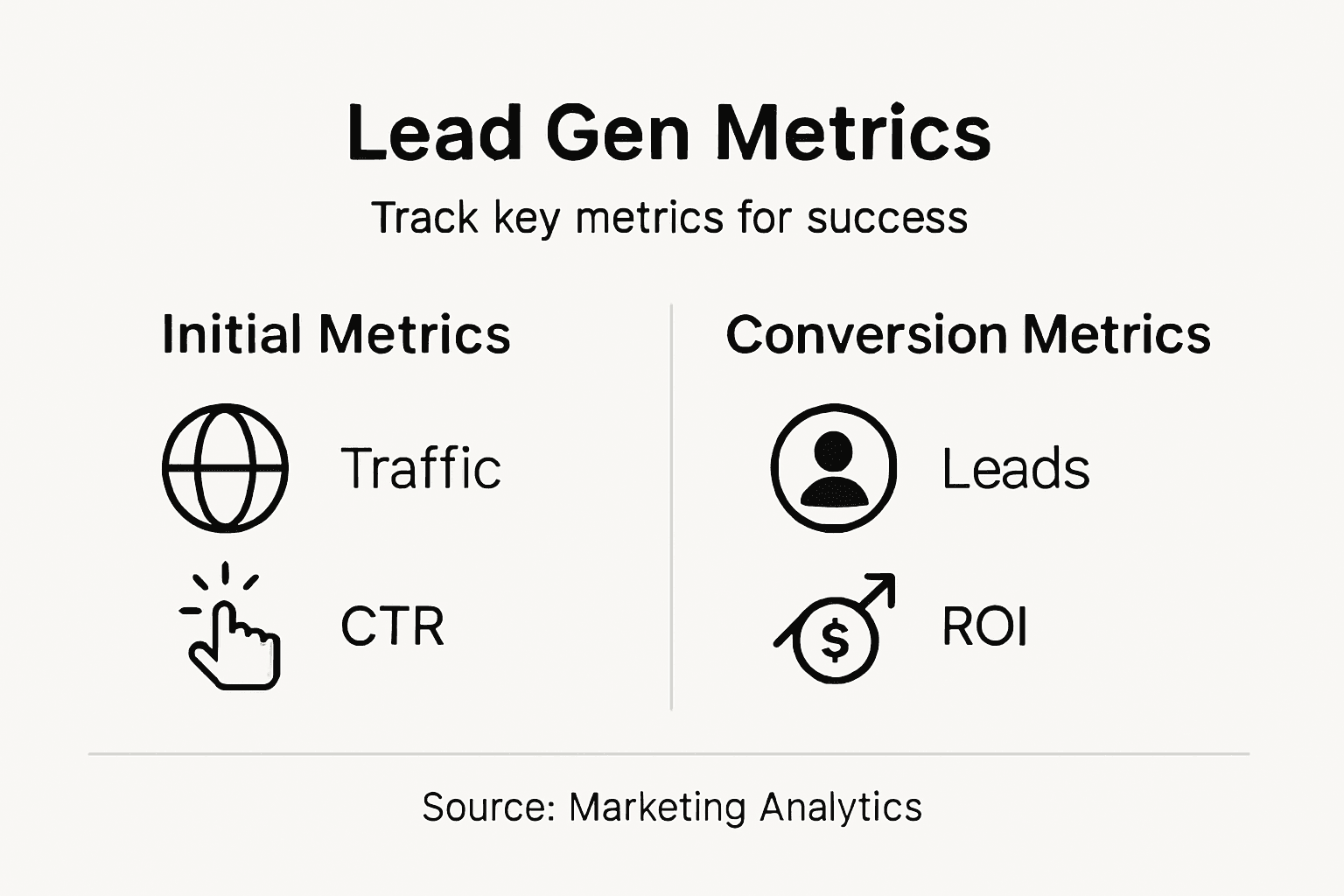
Pro tip: Implement a robust analytics dashboard that tracks multiple metrics simultaneously, enabling real-time performance assessment and rapid strategic adjustments.
Below is a summary of key lead generation metrics and what each reveals about your strategy:
| Metric | What It Measures | Why It Matters |
|---|---|---|
| Lead Volume | Number of new contacts | Indicates overall reach |
| Conversion Rate | Visitor-to-lead percentage | Shows content’s effectiveness |
| Cost Per Lead (CPL) | Spend per new lead | Assesses marketing efficiency |
| Lead Quality Score | Likelihood to become a client | Prioritises high-value prospects |
| MQLs | Engaged and viable prospects | Guides nurturing focus |
| SQLs | Ready for sales conversation | Streamlines sales workflow |
Common Pitfalls And How To Avoid Them
Lead generation content marketing requires strategic navigation to prevent common mistakes that can derail marketing efforts. Identifying potential challenges early helps businesses develop robust strategies that consistently attract and convert high-quality leads.
Key pitfalls to watch for include:
- Unclear Audience Targeting: Creating generic content without specific persona insights
- Inconsistent Content Quality: Producing sporadic or low-value materials
- SEO Neglect: Failing to optimise content for search engine visibility
- Weak Lead Nurturing: Lack of structured follow-up and engagement workflows
- Overly Promotional Messaging: Prioritising sales pitch over genuine value
- Inadequate Performance Tracking: Not measuring lead generation effectiveness
Strategic content alignment demands a nuanced approach that balances educational value with subtle promotional elements. Successful marketers understand that building trust requires consistent, high-quality content that directly addresses audience challenges and demonstrates genuine expertise.
Avoiding these pitfalls means developing a holistic content strategy that prioritises audience needs, maintains rigorous quality standards, and continuously adapts based on performance metrics and evolving market dynamics. This requires ongoing research, flexible content planning, and a commitment to delivering genuine value.
Pro tip: Conduct quarterly content audits to systematically review and refine your lead generation approach, ensuring your strategy remains aligned with audience expectations and market trends.
Transform Your Lead Generation with Proven Marketing Strategies
If you’ve recognised the challenge of creating consistent, high-quality leads through content marketing but feel stuck navigating complex tactics like SEO optimisation, nurturing workflows, and multi-channel engagement then you are not alone. This article highlights the importance of a strategic, value-driven approach to lead generation content marketing that genuinely connects with your ideal audience and nurtures prospects through every stage of the buyer journey.
At Business Warriors, we specialise in crafting integrated marketing systems that implement Jarrod Harman’s unique Marketing Vortex method. Our deep expertise in service-based industries empowers you to overcome common pitfalls such as inconsistent content quality and unclear audience targeting. By partnering with us, you gain access to customised strategies combining SEO, Google Ads, Meta advertising, email marketing and bespoke content designed to drive measurable growth.

Take control of your lead generation and convert prospects into loyal clients with professional guidance tailored for your business needs. Start your journey today by exploring insights and success stories available in the blog or connect directly at our website to learn how to implement scalable, results-driven marketing systems that fuel your growth.
Frequently Asked Questions
What is lead generation content marketing?
Lead generation content marketing is a strategic approach that focuses on creating valuable, targeted content to attract and convert potential customers by addressing their specific needs and challenges.
What types of content are effective for lead generation?
Effective content types for lead generation include blog posts, case studies, webinars, e-books, infographics, podcasts, and video tutorials, each serving different purposes throughout the customer journey.
How does content nurture prospects into clients?
Content nurtures prospects by guiding them through the awareness, consideration, and decision stages, delivering tailored information to address their challenges and needs while building trust and credibility.
What metrics should I track for lead generation success?
Key metrics to track include lead volume, conversion rates, cost per lead (CPL), lead quality score, marketing qualified leads (MQLs), and sales qualified leads (SQLs) to measure the effectiveness of lead generation strategies.
Recommended
- What Is Lead Generation? Complete Expert Breakdown – Jarrod Harman
- 10 Effective Lead Generation Strategies for Businesses – Jarrod Harman
- Lead Generation Strategies – Boost Sales Online Fast – Jarrod Harman
- How to Generate Leads in Digital Marketing: Proven Strategies – Jarrod Harman
- How to Use Content for Lead Generation Successfully