


Many australian businesses underestimate the power of a thorough marketing audit, yet research shows that companies conducting regular evaluations can see up to 25 percent higher growth. With digital competition intensifying across Australia, understanding your true marketing strengths and blind spots is more important than ever. This guide dispels myths about marketing audits and explains how every australian business, from startups to established brands, can use them to unlock smarter strategies and long-term success.
Table of Contents
- Marketing Audit Defined And Common Misconceptions
- Types Of Marketing Audits And Their Differences
- The Marketing Audit Process Explained
- Key Benefits For Business Performance
- Common Pitfalls And How To Avoid Them
Key Takeaways
| Point | Details |
|---|---|
| Importance of Marketing Audits | A marketing audit provides a systematic analysis of a business’s marketing strategies, uncovering hidden opportunities and weaknesses. |
| Types of Marketing Audits | There are three main types: comprehensive, functional, and specific performance audits, each serving different strategic needs. |
| Structured Audit Process | A rigorous process involving objective setting, data collection, and analysis is essential for effective marketing audits. |
| Avoiding Common Pitfalls | Businesses should avoid superficial assessments and incomplete data collection to ensure comprehensive and insightful audits. |
Marketing audit defined and common misconceptions
A marketing audit is a comprehensive, systematic examination of a business’s marketing environment, strategies, and performance. Unlike casual reviews, this strategic process involves a deep, structured analysis that uncovers hidden opportunities and potential weaknesses in an organisation’s marketing approach. Marketing research journals highlight that these audits are crucial for detecting market opportunities and threats while helping organisations understand their internal and external landscapes.
Common misconceptions often derail businesses from conducting effective marketing audits. Many entrepreneurs mistakenly believe these assessments are only for large corporations or require extensive financial investment. In reality, marketing audits are scalable tools applicable to businesses of all sizes. They provide critical insights into SEO performance, social media engagement, paid advertising effectiveness, and overall digital marketing strategies. AI-powered analytics now make these audits more accessible and precise, enabling businesses to leverage machine learning algorithms for deeper market understanding.
The core components of a comprehensive marketing audit typically encompass multiple strategic domains:
- Digital marketing performance analysis
- Search engine optimisation (SEO) strategy evaluation
- Social media channel effectiveness
- Paid advertising ROI assessment
- Website and conversion funnel analysis
- Competitive landscape benchmarking
Pro Tip for Marketing Success: Conduct a quarterly mini marketing audit to track your digital performance metrics, identifying trends and potential improvement areas before they become significant challenges.
By systematically examining these elements, businesses can develop data-driven strategies that optimise their marketing investments and drive sustainable growth across digital channels.
Types of marketing audits and their differences
Marketing audits are not one-size-fits-all processes, and contemporary research models underscore the importance of selecting appropriate audit approaches based on specific organisational needs and marketing activity characteristics. Understanding the diverse types of marketing audits enables businesses to choose strategic evaluation methods that align with their unique objectives and challenges.
The primary categories of marketing audits include comprehensive strategic audits, functional audits, and specific performance audits. Comprehensive strategic audits provide a holistic examination of an entire marketing ecosystem, investigating everything from brand positioning to digital marketing strategies. Functional audits focus on specific marketing domains such as search engine optimisation (SEO), social media marketing, paid advertising performance, and conversion rate optimisation. Specific performance audits drill down into narrow metrics like Google Ads campaign effectiveness, email marketing engagement rates, or AI-driven marketing analytics.

Each marketing audit type offers distinct advantages and insights:
Here’s a side-by-side comparison of the main types of marketing audits:
| Audit Type | Scope of Assessment | Ideal For |
|---|---|---|
| Comprehensive Strategic | Entire marketing ecosystem | Long-term strategy alignment |
| Functional | Specific marketing channels | Detailed channel performance improvement |
| Specific Performance | Individual campaign/metric | Rapid tactical adjustments |
- Comprehensive Strategic Audits
- Full organisational marketing landscape review
- Identifies macro-level strategic opportunities
- Evaluates long-term marketing vision and alignment
- Functional Audits
- Targeted analysis of specific marketing channels
- Provides granular performance insights
- Enables precise strategic adjustments
- Specific Performance Audits
- Micro-level metric assessment
- Rapid identification of tactical improvements
- Data-driven optimisation recommendations
Pro Tip for Strategic Marketing Analysis: Rotate between comprehensive and functional audits quarterly to maintain a dynamic, adaptive marketing approach that balances strategic oversight with tactical precision.
By understanding these audit variations, businesses can create a nuanced, multi-layered marketing evaluation strategy that captures both broad organisational trends and granular performance metrics, ultimately driving more intelligent, responsive marketing investments.
The marketing audit process explained
Systematic marketing audit approaches represent a structured methodology for comprehensively evaluating an organisation’s marketing strategy, environment, and performance. This process involves a meticulous examination of both internal capabilities and external market conditions, enabling businesses to identify strategic opportunities, potential weaknesses, and actionable insights for improved marketing effectiveness.
The marketing audit process typically unfolds through several critical stages. First, businesses must define clear audit objectives and scope, determining whether the focus will be on comprehensive strategic review or targeted functional assessment. Next, data collection becomes paramount, involving gathering information from diverse sources including digital analytics, customer feedback, competitive intelligence, and internal performance metrics. Modern marketing audits leverage AI-powered tools and machine learning algorithms to streamline data aggregation and provide deeper, more nuanced analytical insights across search engine optimisation (SEO), social media engagement, paid advertising performance, and overall digital marketing strategies.
Key steps in the marketing audit process include:
- Preliminary preparation and objective setting
- Comprehensive data collection
- Internal marketing environment analysis
- Review of marketing strategies
- Assessment of existing marketing channels
- Evaluation of resource allocation
- External market environment scanning
- Competitive landscape analysis
- Industry trend identification
- Emerging technology and platform assessment
- Detailed performance metric analysis
- Strategic recommendations development
Pro Tip for Audit Implementation: Approach your marketing audit as an ongoing, iterative process rather than a one-time event, scheduling quarterly mini-audits to maintain continuous strategic adaptability.
By embracing a structured, data-driven marketing audit methodology, organisations can transform complex market insights into actionable strategies that drive sustainable business growth and competitive advantage.
Key benefits for business performance
Marketing audits deliver transformative advantages by providing organisations with comprehensive insights into earnings quality and marketing effectiveness. These strategic assessments go beyond surface-level analysis, enabling businesses to uncover hidden performance opportunities across digital marketing channels, search engine optimisation (SEO), paid advertising, and overall marketing infrastructure.
The primary benefits encompass multiple strategic dimensions. Financially, marketing audits help organisations optimise resource allocation, identify inefficient spending patterns, and develop more targeted marketing strategies that directly improve return on investment (ROI). Strategically, these audits provide a holistic view of competitive positioning, revealing untapped market opportunities and potential competitive advantages. AI-powered analytical tools now enhance these insights, offering unprecedented depth in understanding customer behaviour, engagement patterns, and emerging market trends across digital platforms.
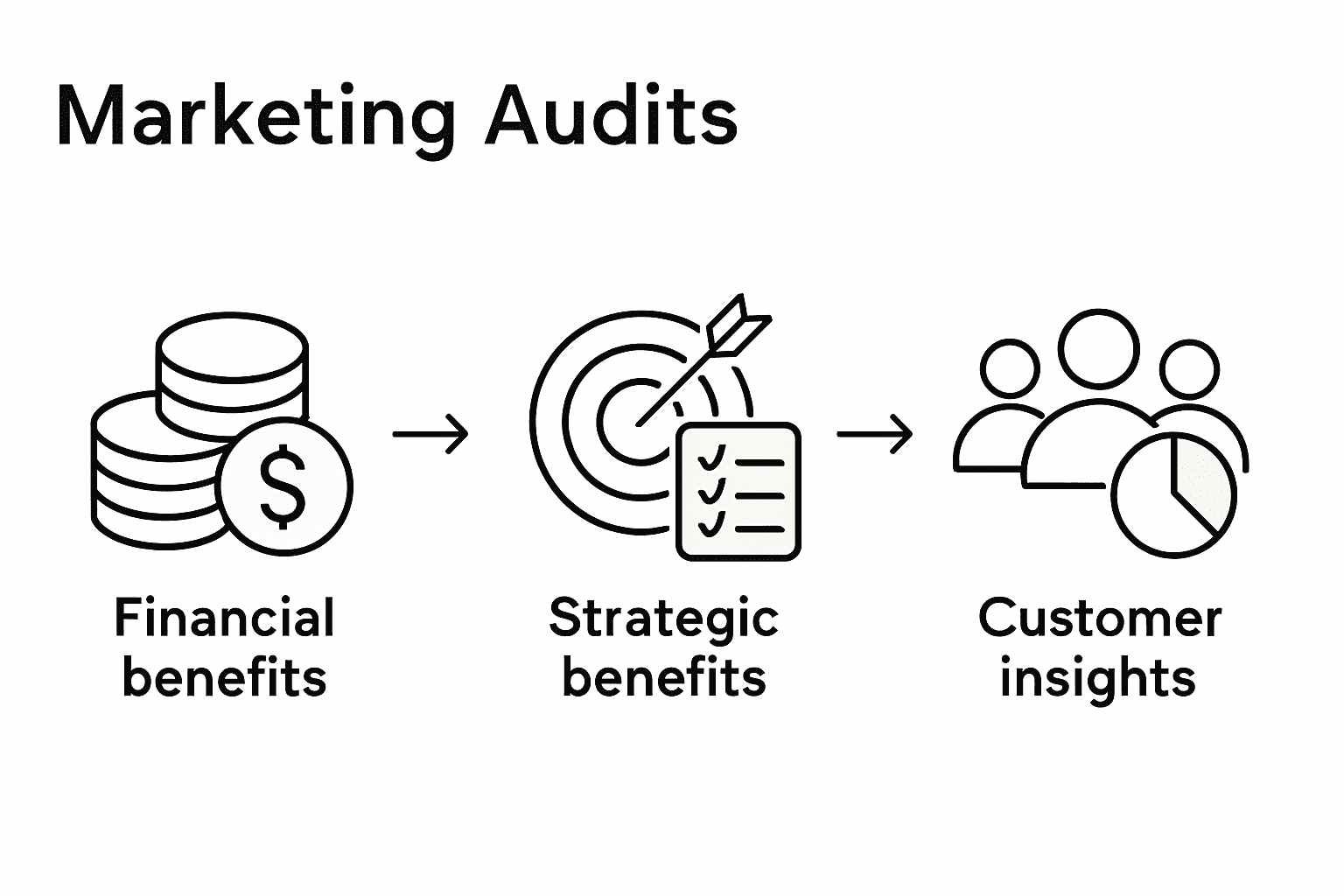
Key performance benefits include:
Below is a summary of how marketing audits influence business performance dimensions:
| Performance Area | How Audits Help | Example Outcome |
|---|---|---|
| Financial | Improve spend allocation, reduce waste | Higher ROI on marketing budget |
| Strategic | Reveal competitive position, trends | Sharper market differentiation |
| Operational | Streamline processes, boost agility | Faster campaign optimisation |
- Enhanced financial performance
- Precise marketing spend optimisation
- Improved conversion rate tracking
- Reduced wasteful advertising expenditure
- Strategic competitive intelligence
- Comprehensive market positioning analysis
- Identification of emerging market trends
- Competitive benchmarking
- Operational marketing efficiency
- Streamlined marketing processes
- Data-driven decision making
- Continuous performance improvement mechanisms
Pro Tip for Performance Maximisation: Integrate marketing audit insights into quarterly strategic planning sessions, using data-driven recommendations to continuously refine and adapt your marketing approach.
By leveraging marketing audits as a strategic tool, businesses can transform complex performance data into actionable strategies that drive sustainable growth and competitive differentiation.
Common pitfalls and how to avoid them
Marketing audit approaches require careful consideration to prevent common strategic errors that can undermine their effectiveness. Businesses frequently encounter significant challenges when conducting marketing audits, ranging from data misinterpretation to incomplete analytical frameworks that fail to capture the full complexity of modern digital marketing ecosystems.
The most prevalent pitfalls emerge from narrow perspectives and insufficient analytical depth. Many organisations mistakenly approach marketing audits as superficial checklist exercises, overlooking critical nuances in search engine optimisation (SEO), paid advertising performance, social media engagement, and emerging AI-driven marketing technologies. These limited assessments often result in missed opportunities, inefficient resource allocation, and strategic blind spots that can significantly impede business growth. Modern marketing audits demand a holistic, multi-dimensional approach that integrates advanced analytical tools, machine learning insights, and comprehensive performance metrics across digital platforms.
Key pitfalls to avoid include:
- Incomplete data collection
- Neglecting multiple marketing channel insights
- Overlooking qualitative customer feedback
- Relying on outdated or fragmented data sources
- Narrow analytical perspectives
- Focusing exclusively on historical performance
- Ignoring emerging market trends
- Failing to integrate cross-channel insights
- Technical implementation errors
- Inadequate SEO performance tracking
- Poor conversion rate analysis
- Insufficient competitive benchmarking
Pro Tip for Audit Excellence: Develop a comprehensive, adaptable audit framework that embraces technological diversity, integrating AI-powered analytics with human strategic insights to create a nuanced, forward-looking marketing assessment.
By recognising and proactively addressing these common pitfalls, businesses can transform marketing audits from routine administrative exercises into powerful strategic tools that drive meaningful organisational growth and competitive advantage.
Unlock Your Business Growth with a Proven Marketing Audit Strategy
Struggling to make sense of your marketing data or unsure if your digital efforts are truly driving results These challenges are exactly what a well-executed marketing audit addresses by providing a clear, comprehensive picture of your business’s marketing ecosystem. The article highlights the power of strategic audits to optimise SEO, paid advertising, social media channels, and overall performance for sustainable growth. If you are a service-based business owner wanting to stop wasting your marketing budget and start seeing real, measurable returns the Business Warriors’ Marketing Vortex Method offers exactly the tactical edge you need.

Join forces with Business Warriors at https://jarrodharman.com and experience a tailored approach that integrates innovative SEO packages, Google Ads, Meta advertising, and conversion-focused funnel development. Our specialised marketing audits go beyond generic checklists using AI-powered analytics combined with expert insights to uncover hidden opportunities and fix underlying weaknesses. Don’t let incomplete data or fragmented strategies hold you back Gain clarity and stay agile with quarterly audit frameworks designed to outpace competitors and increase bookings. Ready to transform your marketing performance into outstanding business growth Start your journey with Business Warriors today and harness the full potential of a comprehensive marketing audit.
Frequently Asked Questions
What is a marketing audit?
A marketing audit is a comprehensive analysis of a business’s marketing environment, strategies, and performance that identifies opportunities and weaknesses within its marketing approach.
Why are marketing audits important for businesses?
Marketing audits provide valuable insights into marketing effectiveness, help optimise resource allocation, uncover untapped market opportunities, and enhance overall return on investment (ROI).
How often should a marketing audit be conducted?
It is recommended to conduct marketing audits regularly, such as quarterly mini-audits, to track digital performance metrics and identify improvements before they evolve into significant challenges.
What are the different types of marketing audits?
The main types of marketing audits include comprehensive strategic audits, functional audits, and specific performance audits, each tailored to assess different aspects of a business’s marketing activities.
Recommended
- 7 Steps to a Winning Digital Marketing Checklist for Growth – Jarrod Harman
- Complete Guide to Scaling Online Marketing – Jarrod Harman
- Content Marketing Checklist for Business Owners: Step-by-Step Success – Jarrod Harman
- 7 Essential Marketing Metrics Every Business Owner Must Track – Jarrod Harman
- Role of Accountancy for Growth – Impact on Business Success
- Understanding Brand Launch Videos and Their Impact