


More than 60 percent of Australian businesses now rely on social listening to shape their digital strategies. With online conversations happening every second, understanding what customers are saying can give organisations in Australia a critical edge. Whether it is tracking brand mentions, monitoring customer sentiment, or keeping an eye on competitors, the right approach to social listening can reveal powerful trends and hidden opportunities that simple analytics often miss.
Table of Contents
- Defining Social Listening For Businesses
- Types Of Social Listening Methods
- How Social Listening Tools Work
- Real-World Applications In Marketing
- Common Mistakes And Risk Factors
Key Takeaways
| Point | Details |
|---|---|
| Understanding Social Listening | Social listening is crucial for businesses to track and analyse online conversations, providing insights into customer sentiment and market trends. |
| Advanced Technologies | Utilising AI-powered tools allows organisations to transform unstructured data into actionable business intelligence, enhancing their marketing strategies. |
| Importance of Real-Time Monitoring | Continuous tracking of digital conversations is essential for effective brand reputation management and proactive communication. |
| Ethical Considerations | Strategic and ethical implementation of social listening is vital to maintain customer trust and avoid potential privacy issues. |
Defining Social Listening for Businesses
Social listening is a strategic digital intelligence technique that enables businesses to track, analyse, and understand online conversations happening across various social media platforms. At its core, social listening involves monitoring digital channels to gather insights about brand mentions, customer sentiments, industry trends, and competitor activities.
The process goes far beyond simple social media monitoring by transforming raw digital conversations into actionable business intelligence. Social listening involves comprehensive tracking of specific keywords, brand names, industry terms, and relevant hashtags across multiple digital networks including social platforms, review sites, forums, and discussion boards. By systematically collecting and analysing these digital interactions, businesses can gain deep understanding of customer perceptions, emerging market trends, and potential opportunities for improvement.
Key components of effective social listening include:
- Real-time brand mention tracking
- Sentiment analysis of online discussions
- Competitor performance evaluation
- Customer feedback aggregation
- Trend identification and prediction
Businesses utilise advanced social listening tools and AI-powered analytics platforms to transform unstructured digital conversations into structured insights. These sophisticated technologies enable organisations to move beyond reactive customer service and proactively shape their marketing strategies, product development, and overall brand positioning based on genuine customer experiences and emerging market dynamics.
Types of Social Listening Methods
Social listening encompasses several sophisticated methodologies that enable businesses to capture and analyse digital conversations across multiple platforms. Social media scraping techniques represent a primary approach, allowing organisations to extract and process vast amounts of user-generated content from various digital networks.
The primary types of social listening methods include:
- Sentiment Analysis: Evaluating emotional tone and customer perceptions
- Keyword Tracking: Monitoring specific brand, industry, or competitor terms
- Trend Detection: Identifying emerging topics and conversation patterns
- Competitive Intelligence: Tracking competitor mentions and brand positioning
- Demographic Insights: Understanding audience characteristics and behaviours
Automated Analytics play a critical role in modern social listening strategies. Advanced AI-powered platforms can now process complex multi-dimensional opinion data, including nuanced elements like subjectivity, emotional context, sarcasm, and sentiment polarity. These technologies transform raw digital interactions into structured, actionable business intelligence.
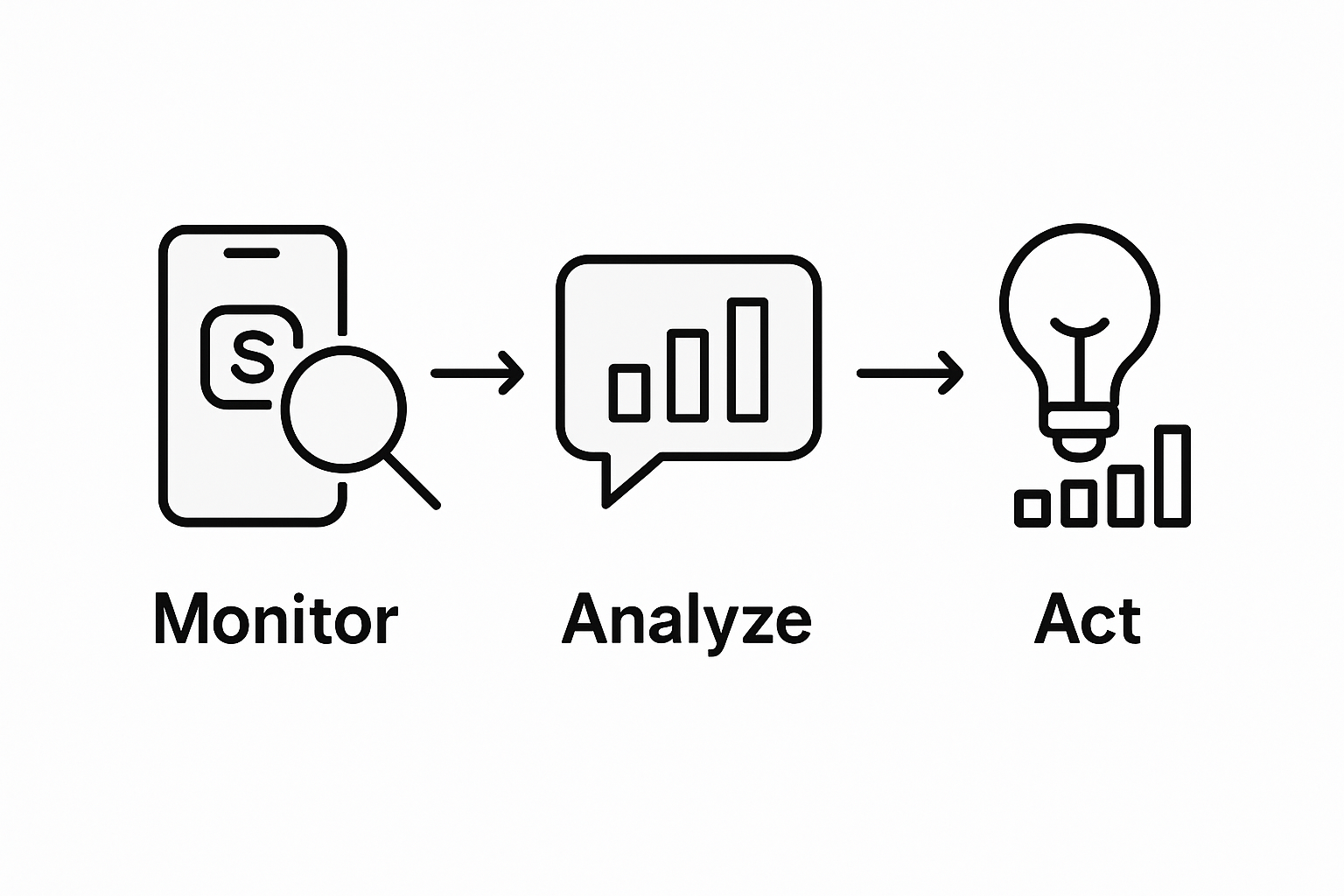
Professional social listening methods integrate multiple data sources, combining insights from social media platforms, review sites, forums, blogs, and professional networks. By leveraging sophisticated machine learning algorithms and natural language processing, businesses can gain unprecedented visibility into customer sentiments, market dynamics, and emerging trends that traditional market research methods could never capture.
How Social Listening Tools Work
Social listening tools operate through sophisticated technological frameworks designed to capture, process, and analyse digital conversations across multiple online platforms. Advanced systems mine online conversations by implementing complex algorithms that can systematically extract meaningful insights from vast amounts of unstructured digital data.
The typical workflow of social listening tools involves several critical stages:
- Data Collection: Automated web crawlers and API integrations retrieve content from social media platforms, forums, blogs, and review sites
- Content Filtering: Intelligent algorithms segregate relevant mentions from noise
- Language Processing: Natural language processing techniques decode context, sentiment, and nuanced meanings
- Sentiment Analysis: Machine learning models categorise emotional tones and customer perceptions
- Visualisation and Reporting: Interactive dashboards transform raw data into actionable business intelligence
Aspect-based sentiment analysis technologies enable these tools to go beyond simple keyword tracking, providing deep contextual understanding of digital conversations. By leveraging advanced machine learning models, social listening platforms can now interpret complex linguistic nuances, detect emerging trends, and provide businesses with unprecedented insights into customer experiences and market dynamics.
Modern social listening tools integrate multiple data sources, combining sophisticated analytics with real-time processing capabilities. These intelligent systems continuously learn and adapt, using advanced algorithms to identify patterns, predict trends, and offer strategic recommendations that help businesses make data-driven decisions in an increasingly complex digital landscape.

Real-World Applications in Marketing
Social listening has transformed marketing strategies across diverse industries, enabling businesses to gain unprecedented insights into customer behaviours, preferences, and emerging market trends. Hospitality companies have pioneered personalised customer experiences by systematically monitoring and responding to digital conversations, creating more targeted and engaging interactions.
Key real-world marketing applications of social listening include:
- Brand Reputation Management: Tracking and responding to online mentions
- Product Development: Understanding customer feedback and pain points
- Competitive Intelligence: Monitoring competitor strategies and customer perceptions
- Crisis Communication: Identifying and addressing potential reputation issues
- Campaign Performance Tracking: Measuring audience engagement and sentiment
Social media platforms offer remarkable opportunities for businesses to expand their online presence and significantly increase return on investment. By leveraging sophisticated social listening tools, organisations can transform raw digital interactions into strategic marketing insights, enabling more precise targeting, improved customer understanding, and more effective communication strategies.
Modern marketing professionals utilise social listening as a critical intelligence gathering mechanism, integrating real-time digital conversations into comprehensive strategic planning. These tools provide nuanced insights that traditional market research methods could never capture, allowing businesses to be proactive rather than reactive in their marketing approaches, ultimately driving more meaningful and impactful customer engagement.
Common Mistakes and Risk Factors
Social listening presents complex challenges that demand strategic and ethical implementation. Organisations must navigate intricate ethical considerations when deploying social listening technologies, understanding that responsible data collection and interpretation are fundamental to maintaining customer trust and corporate reputation.
Common mistakes in social listening include:
- Over-collecting Personal Data: Breaching privacy boundaries
- Misinterpreting Context: Failing to understand nuanced digital conversations
- Algorithmic Bias: Relying too heavily on automated sentiment analysis
- Reactive Instead of Proactive: Responding without strategic planning
- Inconsistent Monitoring: Neglecting continuous digital conversation tracking
Automated need identification from social media platforms introduces significant risk factors that businesses must carefully manage. These risks encompass potential misinterpretation of complex user-generated content, potential privacy violations, and the challenge of distinguishing genuine customer insights from noise and misinformation.
Successful social listening requires a balanced approach that combines advanced technological capabilities with human insight and ethical considerations. Businesses must invest in sophisticated training, develop robust data governance frameworks, and maintain transparency about their digital intelligence gathering methods to mitigate potential risks and maintain customer confidence in their marketing strategies.
Unlock the Full Power of Social Listening for Your Business Growth
Understanding and implementing social listening can transform how your business responds to customer needs and market trends. This article highlights key challenges such as misinterpreting context, algorithmic bias, and inconsistent monitoring that often prevent businesses from fully benefiting from social listening insights. If you want to move beyond basic digital chatter to proactive strategies that truly drive leads and sales then harnessing expert marketing support is essential.
At Business Warriors | Digital Marketing Agency, we specialise in integrating social listening insights into the proven “Marketing Vortex” method. We help business owners like you decode customer sentiment, track competitor moves, and identify emerging trends with precision. Our tailored approach combines SEO, Google Ads, Meta advertising, social media management and more to deliver measurable results that scale your business. Discover how expert guidance can eliminate guesswork and empower you to make confident, data-driven marketing decisions.

Ready to transform social listening insights into consistent leads and sales for your service-based business? Visit Jarrod Harman’s website to explore proven marketing strategies and success stories. Connect today to learn how our holistic marketing systems can help you dominate your market with clarity and confidence.
Frequently Asked Questions
What is social listening in a business context?
Social listening refers to the practice of monitoring and analysing online conversations about a brand, industry, or competitors across social media and digital platforms to gather actionable insights.
How can social listening benefit my marketing strategy?
Social listening helps businesses understand customer sentiments, identify emerging trends, and optimise marketing strategies based on real feedback, ultimately enhancing customer engagement and brand reputation.
What tools are commonly used for social listening?
Businesses utilise advanced social listening tools that incorporate AI and machine learning to track brand mentions, perform sentiment analysis, and deliver insights from multiple online sources.
What are the common mistakes to avoid in social listening?
Common mistakes include over-collecting personal data, misinterpreting context of conversations, and failing to maintain consistent monitoring, which can result in inaccurate insights and damaged customer trust.
Recommended
- Understanding the Role of Social Media in Business Communication – Jarrod Harman
- Understanding the Role of Social Media in Modern Business – Jarrod Harman
- Understanding the Advantage of Social Media for Businesses – Jarrod Harman
- Understanding the Benefits of Social Media for Business – Jarrod Harman
- Data Science Archives – Ambeone