


Most service-based business websites are quietly leaking leads every single day. Visitors land on your pages, look around, and leave without booking, calling, or filling in a form. The frustrating part? Lead magnets boost conversions by 50% and many of the fixes that drive that kind of result are not complicated. They just require the right approach, applied in the right order. This guide walks you through exactly how to audit, optimise, and monitor your website so it works as a genuine lead generation engine rather than a digital brochure that nobody acts on.
Table of Contents
- Understanding the lead generation challenge for service businesses
- What you need before you get started
- How to audit your current website for lead opportunities
- Optimisation strategies: Practical changes that get results
- Monitoring, testing, and refining for sustainable lead growth
- Get expert help to multiply your website leads
- Frequently asked questions
Key Takeaways
| Point | Details |
|---|---|
| Simple changes, big lifts | Optimising your website with targeted tweaks can double your leads. |
| Audit before you act | Systematic reviews pinpoint where your website loses the most leads. |
| Use lead magnets | Lead magnets alone can boost conversions by 50 percent or more. |
| Test and refine | Ongoing testing ensures your lead growth continues instead of plateauing. |
Understanding the lead generation challenge for service businesses
Service businesses face a specific problem online that product-based businesses do not. You cannot put your service in a shopping cart. You cannot show a price tag and expect someone to click “buy now.” Instead, your website needs to build enough trust, fast enough, that a stranger decides to reach out. That is a much harder job than most people realise.
The gap between a brochure website and a lead generation engine comes down to intent. A brochure site tells people what you do. A lead generation engine guides visitors toward a specific action, whether that is booking a consultation, downloading a resource, or calling your team. Most service websites sit firmly in the brochure category, which is why optimised sites see 30 to 60% lead lifts when focused changes are made.
The core barriers Australian service businesses face online include:
- Traffic without conversion: Spending on ads or SEO but sending visitors to pages that do not convert
- Unclear value propositions: Visitors cannot quickly understand what you do, who you help, or why you are the right choice
- No lead capture mechanism: No forms, no offers, no reason for a visitor to hand over their contact details
- Poor mobile experience: A large portion of local service searches happen on mobile, and clunky mobile sites kill conversions
“The biggest mistake service businesses make is assuming that more traffic will solve a conversion problem. It rarely does. Fix the leaks first, then turn up the tap.”
Understanding leads in digital marketing and how they differ from raw website traffic is the foundation of everything that follows.

What you need before you get started
Before you touch a single page on your website, you need the right tools and a clear picture of your goals. Jumping straight into changes without data is like renovating a house without a floor plan. You might improve something, but you will likely miss the rooms that matter most.
Here is what you need to have in place:
- Analytics platform: Google Analytics 4 is free and gives you traffic sources, page performance, and user behaviour data
- Heatmap tool: Hotjar or Microsoft Clarity shows you where visitors click, scroll, and drop off
- Form builder: A reliable form tool integrated with your CRM or inbox so no lead slips through
- CRM or tracking spreadsheet: Even a simple spreadsheet works at first, as long as you are recording every enquiry and its source
- Clear goal: Know exactly what action you want visitors to take on each page before you optimise anything
| Tool | Cost | Primary use |
|---|---|---|
| Google Analytics 4 | Free | Traffic and behaviour data |
| Microsoft Clarity | Free | Heatmaps and session recordings |
| Hotjar | Free or paid | Advanced heatmaps and surveys |
| HubSpot CRM | Free tier available | Lead tracking and follow-up |
| Typeform or Gravity Forms | Low cost | Conversion-focused form building |
Pro Tip: Before you start optimising, write down your top three highest-margin services. These are the pages you optimise first. Spreading your effort across every page at once dilutes your results and makes it harder to measure what is actually working. A solid lead generation checklist can help you stay focused and avoid missing critical steps.
It is also worth reviewing examples of lead magnets at this stage so you can plan what offers you will use to capture contact details once your pages are ready.
How to audit your current website for lead opportunities
With your tools set up and your goals defined, it is time to look honestly at what your current site is doing. Most business owners are surprised by what they find. Pages they thought were performing well turn out to have high exit rates, and pages they ignored are quietly attracting qualified visitors.
Follow these steps to complete a basic lead audit:
- Check your top traffic pages: In Google Analytics, find the pages that receive the most visitors. These are your highest-priority optimisation targets because small improvements here have the biggest impact.
- Review your calls-to-action: On each high-traffic page, is there a clear, visible CTA above the fold? If a visitor has to scroll to find out what to do next, you are losing leads.
- Test your forms: Fill in every form on your site. Are they short and simple? Do they work on mobile? Does a confirmation message appear? Broken or confusing forms are a silent lead killer.
- Assess mobile performance: Open your site on your phone. Does it load quickly? Are buttons easy to tap? Is text readable without zooming? Google’s free PageSpeed Insights tool gives you a score and specific fixes.
- Map your navigation: Can a first-time visitor find your contact page or booking form within two clicks? If not, your navigation is working against you.
Pro Tip: Install Microsoft Clarity (it is free) and watch real session recordings of visitors on your site. You will quickly see where people get confused, where they stop scrolling, and which CTAs they ignore entirely. This is far more revealing than any spreadsheet.
The results from this kind of focused audit can be dramatic. Case studies show 352 to 700% lead growth when businesses systematically address the gaps uncovered in a proper website lead audit. Those numbers are not outliers. They reflect what happens when you stop guessing and start fixing real problems.
Optimisation strategies: Practical changes that get results
Once you know where your site is underperforming, you can apply targeted changes. Not all optimisations are equal. Some take ten minutes and deliver immediate results. Others require more effort but compound over time.
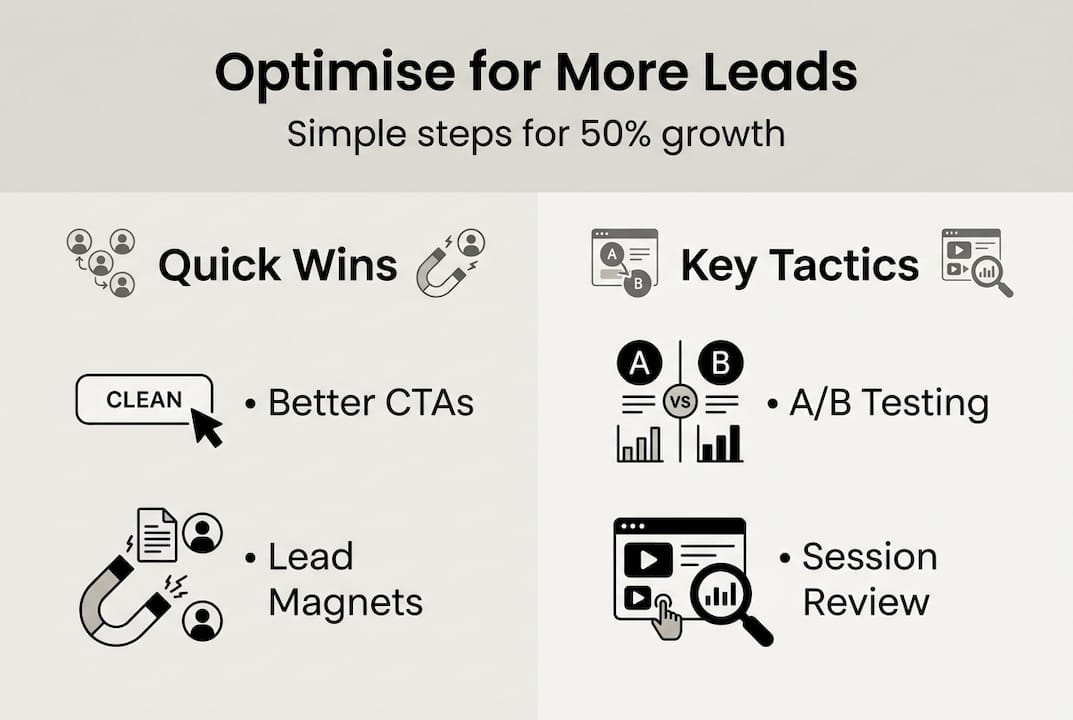
Here is a comparison of quick wins versus more resource-intensive changes:
| Quick wins (under 2 hours) | Resource-intensive changes |
|---|---|
| Rewrite headline to focus on the customer outcome | Rebuild landing pages with new copy and design |
| Add a contrasting CTA button above the fold | Develop and launch a lead magnet |
| Reduce form fields to three or fewer | Implement full CRM and email automation |
| Add trust signals (reviews, logos, guarantees) | Commission professional photography or video |
| Improve page load speed with image compression | Restructure site navigation and information architecture |
The highest-impact individual changes for service businesses include:
- Lead magnets: Offering a free guide, checklist, or consultation in exchange for an email address. Lead magnets boost conversions by 50% and are one of the fastest ways to grow your enquiry list. Explore lead magnet strategies that work specifically for service businesses.
- CTA placement and contrast: Your call-to-action button needs to stand out visually. Use a colour that contrasts with your background and place it where the eye naturally lands.
- Headline rewrites: Most service website headlines describe the business. The best headlines describe the outcome for the customer. “We offer massage therapy” becomes “Feel better in 60 minutes or your next session is free.”
- Trust signals: Client testimonials, Google review counts, industry certifications, and before-and-after results all reduce the perceived risk of reaching out.
- Form simplification: Every extra field in a form reduces completion rates. Ask only for what you genuinely need at the first point of contact.
Combining these on-page changes with omnichannel lead tactics and broader lead generation strategies is where the real compounding effect kicks in. According to conversion rate benchmarks, optimised sites see 30 to 60% uplifts in lead volume, and when SEO is layered on top, results can reach 352% or more.
Monitoring, testing, and refining for sustainable lead growth
Making changes to your website is not a one-time event. The businesses that see the biggest long-term gains treat optimisation as an ongoing process, not a project with a finish line.
Here is how to build a sustainable review cycle:
- Set up conversion tracking: In Google Analytics, create goals for form submissions, phone call clicks, and booking completions. Without this, you are flying blind.
- Establish a monthly review: Once a month, check your conversion rates on key pages, compare them to the previous month, and identify the biggest drop-off points.
- Run one test at a time: Change one element, measure the result for at least two weeks, then decide whether to keep or revert it. Changing multiple things at once makes it impossible to know what worked.
- Document everything: Keep a simple log of what you changed, when, and what happened to your conversion rate. This becomes an invaluable reference over time.
- Revisit your lead nurturing process: Getting the enquiry is only half the job. Make sure you have a system for nurturing leads so they convert into paying clients.
“Ongoing refinement is where the real money is made. The businesses that commit to monthly testing and review are the ones that see compounding returns year after year.”
The proof is in real-world outcomes. A local concreter generated an additional $100k in revenue through sustained, lead-focused website optimisation. That result did not come from a single change. It came from a consistent process of testing, measuring, and improving over time. The same approach is available to any service business willing to commit to it.
Common mistakes to avoid include testing too many changes at once, ignoring mobile users entirely, and failing to set up proper conversion tracking before making changes. Each of these mistakes makes it impossible to know whether your optimisation efforts are actually working.
Get expert help to multiply your website leads
If you have worked through this guide and want faster results, or if you would rather have an expert identify the highest-impact changes for your specific business, that is exactly what Business Warriors does. We have helped Australian service businesses across a wide range of industries turn underperforming websites into consistent lead generation machines.
Our marketing vortex method combines website optimisation with SEO, paid advertising, and email marketing into a single, integrated system. If you want to see what is possible, start by exploring how we help businesses generate more leads from their website and how SEO lead generation drives sales growth for service businesses just like yours. Reach out to our team for a tailored review and a clear plan to grow your enquiries.
Frequently asked questions
What quick wins deliver the biggest uplift in website leads?
Adding targeted lead magnets and refining your CTAs can lift conversions by 50% or more. These are the fastest changes to implement and often deliver results within days.
How often should I review my optimisation strategy?
Review your lead generation performance and test improvements monthly. Ongoing optimisation delivers sustained uplift that compounds over time rather than plateauing after a single round of changes.
Does SEO also help with lead optimisation?
Absolutely. Combining conversion rate optimisation with SEO tactics can boost leads by 30 to 60% and in some cases significantly more when both are applied consistently.
Which analytics tools do most Australian service businesses use?
Google Analytics 4 is the most widely used platform, often paired with Hotjar or Microsoft Clarity for heatmaps and session recordings that reveal real visitor behaviour.
What makes a lead magnet effective for service businesses?
The most effective magnets solve an urgent, specific problem your ideal client is already searching for a solution to. Lead magnet effectiveness increases significantly when the offer is directly tied to your highest-value service and exchanged for contact details.
Recommended
- How to Generate More Leads from Your Website Easily – Jarrod Harman
- How to Generate Leads Online for Business Growth – Jarrod Harman
- How to Generate Leads Online for Free: Step-by-Step Guide – Jarrod Harman
- How to Increase Website Leads with Omnichannel Marketing – Jarrod Harman
- Webteksten laten schrijven: kosten, aanpak, seo en conversie – Bogaers Taleninstituut Tilburg