


TL;DR:
- Most service businesses lack organized social media plans that link content to revenue goals. Using a structured, goal-driven template and conducting regular audits improves consistency, engagement, and lead generation. Effective plans require preparation, targeted platform selection, measurable objectives, and ongoing analysis to ensure tangible business growth.
Most service-based business owners know they should be posting on social media. They just never feel organised enough to make it work. Without a social media marketing plan template free to grab and use today, it stays a good intention rather than a lead generation machine. This guide gives you that template framework plus a step-by-step method to build a plan that actually connects your daily posts to bookings, enquiries, and growth.
Table of Contents
- Why a social media marketing plan matters for service businesses
- What you need to prepare before using a free social media marketing plan template
- Step-by-step guide to using a free social media marketing plan template
- How to verify, report and refine your social media marketing plan
- Why most free social media plan templates fall short and how to make yours work
- How Jarrod Harman can help you create a winning social media marketing plan
- Frequently asked questions
Key Takeaways
| Point | Details |
|---|---|
| Structured planning matters | A clear social media marketing plan connects your efforts directly to business goals and improves campaign consistency. |
| Preparation is essential | Auditing current performance and understanding your audience are critical before starting your social media plan. |
| Use effective templates | Select templates that integrate strategy, scheduling, and reporting for seamless social marketing execution. |
| Measure and adjust | Regular reporting and audits enable you to identify successful content and refine your approach for better results. |
| Avoid common pitfalls | Ensure measurement checkpoints are included and synchronise scheduling with posting to prevent plan execution failures. |
Why a social media marketing plan matters for service businesses
Posting without a plan is the same as running a clinic without an appointment book. You might see some clients, but you will miss far more than you capture. A structured social media marketing plan links every piece of content you publish to a specific business outcome, whether that is generating enquiries, building trust with a warm audience, or converting followers into paying clients.
Service businesses, in particular, suffer without one. A salon owner posting three times one week and going silent for two more is not building momentum. Consistency is not just about frequency either. It is about knowing why you are posting on a given day, who you are speaking to, and what action you want them to take. Without that clarity, social media becomes a time drain rather than a revenue driver.
A good plan covers four interconnected areas:
- Goal setting tied directly to business outcomes like bookings and enquiries
- Content planning that maps posts to audience stages (awareness, consideration, decision)
- Scheduling and execution so posts go out on time without last-minute scrambling
- Reporting checkpoints to measure what is working and cut what is not
Templates accelerate execution because they organise strategy, content planning, scheduling, and reporting into one workflow rather than four separate headaches. When you already know the structure, you spend your energy filling it with quality content rather than rebuilding the wheel each month.
Pro Tip: Before you touch any template, write down one business goal your social media must support this quarter. Every section of your plan should trace back to that goal. If a post cannot be linked to it, question whether it belongs in the calendar.
The good news is that you do not need to invent this structure yourself. Proven social media marketing strategies already exist for service businesses, and a free template gives you the scaffolding to apply them quickly. The key is understanding what to prepare before you open that template.
What you need to prepare before using a free social media marketing plan template
Grabbing a free social media planner and immediately filling in content ideas is one of the most common mistakes business owners make. The template is only as useful as the thinking you bring to it. Without preparation, you end up with a beautifully formatted document full of generic posts that do not speak to anyone specific.
Here is what to do before you populate a single cell of your social media strategy template:
-
Define your objectives. Be specific. “Grow Instagram” is not an objective. “Generate 20 enquiries per month from social media by June 2026” is. Your goals should connect directly to revenue and be measurable within 30 to 90 days.
-
Audit your existing social media presence. Look at which platforms you are already on, which posts performed best in the last 90 days, and what your competitors are doing that seems to be working. A structured social media audit checklist makes this faster and more accurate than guessing from memory.
-
Research your target audience. Know the demographics, pain points, and platform preferences of your ideal client. A 42-year-old woman looking for a med spa in Perth searches and scrolls differently to a 28-year-old looking for a hairdresser. Platform behaviour shapes everything from post timing to content format.
-
Choose your primary platforms. You do not need to be everywhere. Pick two platforms where your audience is most active and do them well. Spreading yourself thin across five platforms guarantees mediocre results on all of them.
A workflow that genuinely works, according to campaign template research, starts with a campaign brief or a 30-day plan, runs a social media audit to identify top content themes, and then populates the content calendar with proven ideas. That sequence matters because each step informs the next.
Use our social media checklist as a companion to this preparation phase. It walks you through each audit step so nothing gets missed.
Pro Tip: Pull your top five posts from the last three months before building your new plan. The themes those posts share will tell you more about what your audience wants than any amount of guessing. Let your data lead the content direction.
Learning how to develop a marketing strategy from the ground up also helps you understand why each template element exists, which makes you far better at using it.
Step-by-step guide to using a free social media marketing plan template
Now that your preparation is done, you are ready to build. A social media campaign template free of charge is widely available, but knowing how to use it properly is what separates entrepreneurs who see results from those who give up after a month.
Follow this sequence:
-
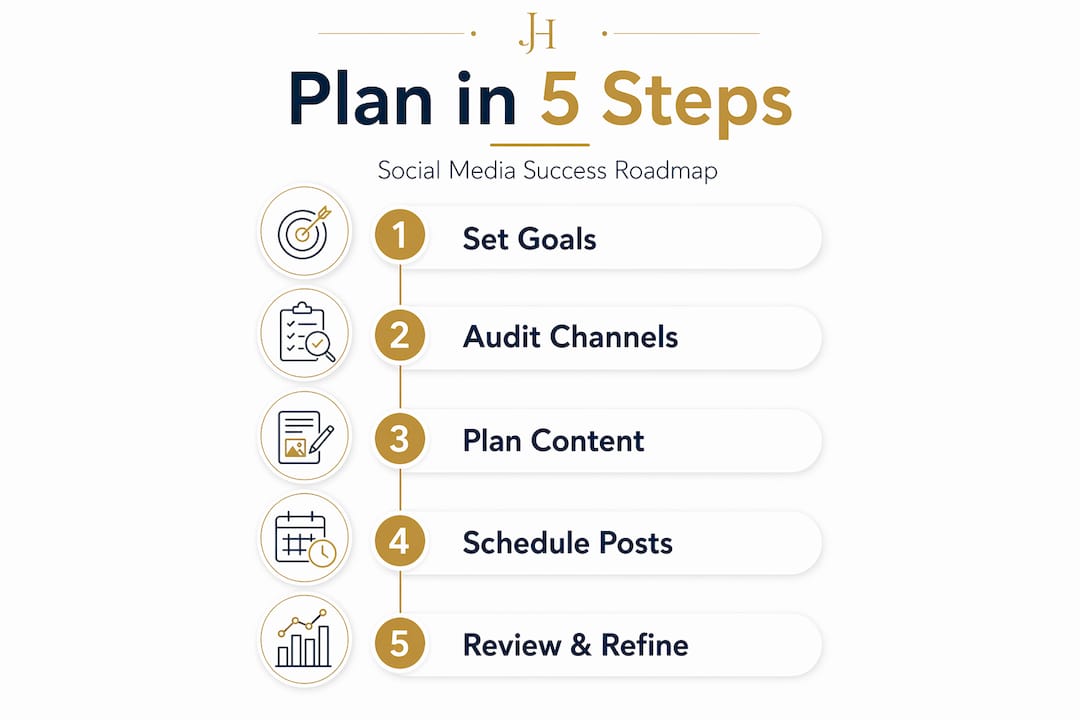
Set your social media goals. Use a simple table inside your template that lists each goal, the metric attached to it, and the target number. Be ruthless about limiting yourself to three goals maximum per quarter.
-
Choose platforms and content mix. Decide which two or three platforms you will focus on, and what percentage of your content will be educational, promotional, and social proof-based. A commonly effective split for service businesses is 60% educational, 20% testimonials and case studies, and 20% direct offers.
-
Build your content calendar. This is the heart of any downloadable social media plan. Populate each week with specific post types, captions themes, visual formats (video, graphic, photo), and the call to action for each post.
-
Create a campaign brief for each major campaign. A campaign brief acts as a single source of truth for your team or for yourself. It names the campaign goal, the audience being targeted, the messaging, the platforms involved, and the success metrics. Monday.com’s six-step process includes defining objectives, selecting platforms and content mix, building a content calendar, and establishing metrics and reporting cadence, all within one connected workflow.
-
Schedule posts using available tools. Many free tools let you plan posts visually. If auto-publishing is unavailable on your chosen platform, build a manual posting reminder system into your workflow so nothing falls through.
-
Set your reporting cadence. Weekly check-ins for post-level metrics, monthly reviews for campaign performance, and quarterly audits for big-picture strategy adjustments give you the feedback loops needed to improve continuously.
Here is a simple content mix reference for service businesses:
| Content type | Purpose | Posting frequency |
|---|---|---|
| Educational tips | Build authority and trust | 2 to 3 times per week |
| Client testimonials | Social proof and credibility | Once per week |
| Behind the scenes | Humanise the brand | Once per week |
| Direct offers | Drive enquiries and bookings | Once per fortnight |
| Community engagement | Grow reach and relationships | As needed |
Pro Tip: Build your content calendar in 30-day blocks, not weekly. Planning a full month at once gives you sight of campaign pacing, ensures variety across post types, and eliminates the weekly panic of “what do I post today?”
Once you know how to create a social media marketing plan template that fits your business, you will also find it far easier to think about social media campaign planning at a higher level.

How to verify, report and refine your social media marketing plan
Building the plan is step one. Knowing whether it is actually working is where most entrepreneurs fall down. Without measurement, you cannot tell whether you are growing your business or just keeping yourself busy.
The metrics worth tracking in a service business are not followers or likes. They are:
- Reach and impressions on key campaign posts to measure visibility
- Click-through rate on posts that drive traffic to your booking page or website
- Enquiry or lead volume attributed to social media activity each month
- Engagement rate (comments, shares, saves) as a signal of content relevance
- Cost per lead if you are running paid social alongside organic
Audit templates help review content performance and identify improvements, including engagement rate and brand voice alignment, which keeps your plan accountable to real standards rather than gut feelings.
Set a monthly reporting habit. Pull the numbers, compare against your targets from the content calendar, and identify the two to three posts that drove the most meaningful results. Ask yourself what those posts had in common. That answer shapes the next month’s content plan.
Use this simple comparison to understand how different review cycles work:
| Review type | Frequency | Focus area |
|---|---|---|
| Post-level check-in | Weekly | Engagement, reach, and timing |
| Campaign review | Monthly | Leads generated, click-through, conversions |
| Full strategy audit | Quarterly | Platform performance, audience growth, ROI |
Refining your plan quickly within each cycle is more valuable than waiting for a “perfect” time to overhaul it. Small, regular adjustments compound into significantly better results over a six-month period. Your social media audit and checklist resource gives you a structured way to run these reviews without spending hours pulling everything apart.
Pro Tip: Create a simple one-page monthly summary that shows three things: what you planned, what actually happened, and what you will change next month. Sharing this with your team (or reviewing it yourself) builds the discipline that separates consistent growth from inconsistent guessing.
Why most free social media plan templates fall short and how to make yours work
Here is an uncomfortable truth. Most free templates do not fail because of bad design. They fail because of how people use them. Or more accurately, how they stop using them after week two.
The templates we see businesses abandon almost always share the same flaw: they treat social media as a content production problem rather than a lead generation problem. The template gets filled with post ideas, the calendar looks full, and the entrepreneur feels organised. But three months later, bookings have not moved. That is because no one built measurement, lead tracking, or a feedback loop into the workflow.
The difference between a successful month and a wasted one is whether you can tell within a 30-day cycle which content produced clicks and leads. Most free templates do not prompt you to answer that question. So you end up with beautiful content and no idea whether it is generating revenue.
The second pitfall is the gap between scheduled and posted. Tools that do not auto-publish create silent execution failures. You plan 20 posts for the month, manually publish 12, and wonder why the results are underwhelming. Build your posting workflow into the template itself, including confirmation columns that show what was actually published versus what was planned.
The fix is simple but requires discipline. Treat your free social media planner as a living document, not a one-time setup. Review it weekly, update it based on actual performance, and connect every campaign back to one measurable business outcome. If you do that, even a basic template becomes genuinely powerful.
For more practical guidance, these consistent social media growth tips show you how to maintain momentum without burning out or reverting to ad hoc posting.
How Jarrod Harman can help you create a winning social media marketing plan
A free template gives you the structure, but knowing how to fill it with campaigns that actually generate leads is a different skill. Jarrod Harman and the Business Warriors team work with service-based entrepreneurs across Australia to build social media plans that connect directly to bookings and revenue, not just content volume.
Whether you need help creating social media marketing plans from scratch or want a clear digital marketing step by step system to follow, the support is there. The Marketing Vortex method integrates your social media activity into a broader lead generation system so every post works harder. If you are serious about turning followers into clients, explore these client acquisition tips and see how a tailored approach changes your results.
Frequently asked questions
Where can I find a free social media marketing plan template?
You can download free templates from reputable sources including TeamGantt, whose free strategy template helps you build your plan and content calendar in one place, as well as Hootsuite, Sprout Social, and Monday.com.
How do I choose the right social media platforms for my business?
Select platforms based on where your target audience spends the most time and which formats suit your content strengths. Platform selection involves aligning your content mix and audience preferences to boost engagement and results, rather than chasing the newest platform.
Why is reporting and measurement important in a social media plan?
Reporting tells you which content drives leads so you can do more of what works and cut what does not. Measurement checkpoints are key to distinguishing successful content from ineffective posts within a 30-day cycle.
Can I use free social media planning tools for scheduling posts?
Yes, tools like FlickTool support scheduling through a visual calendar, but require manual posting or pairing with automation software to publish automatically to some platforms.
How often should I audit my social media performance?
Perform audits at least quarterly. Audit templates provide structured reviews that inform strategy adjustments and are typically conducted quarterly or annually depending on business size.