


Every service-based business owner in Australia has faced that moment of wondering if social media efforts are actually delivering steady leads and sales. The right campaign strategy is not just about posting; it begins with strategic objectives and truly understanding your audience’s needs. This guide shows how clear goal setting, targeted audience research, and platform analysis pave the way for results-driven social media campaigns tailored for Australian women ready to grow their business.
Table of Contents
- Step 1: Define Campaign Goals And Target Audience
- Step 2: Research Competitors And Select Platforms
- Step 3: Create Engaging Content And Schedule Posts
- Step 4: Set Budget And Deploy Campaign Assets
- Step 5: Monitor Results And Refine Your Strategy
Quick Summary
| Key Point | Explanation |
|---|---|
| 1. Define clear campaign goals | Establish specific, measurable objectives for your campaign to ensure focused efforts and track progress effectively. |
| 2. Research your target audience | Understand demographics, behaviours, and preferences to tailor your messaging and engage potential clients effectively. |
| 3. Analyse competitors and select platforms | Assess competitors’ strategies and choose the most suitable social media platforms based on audience alignment and engagement potential. |
| 4. Create diverse, engaging content | Develop varied content types that resonate with your audience, telling authentic stories and providing real value. |
| 5. Monitor results and adjust strategy | Regularly track performance metrics to identify areas for improvement and refine your strategy for continuous growth. |
Step 1: Define Campaign Goals and Target Audience
Planning a successful social media campaign begins with crystal-clear strategic objectives and a deep understanding of your ideal audience. Your campaign needs laser-focused goals that translate into measurable outcomes, whether that’s generating leads, increasing brand awareness, or driving sales conversions.
To nail down your campaign goals, start by asking yourself critical questions. What specific business outcome are you targeting? Are you looking to attract new clients, boost engagement, or establish thought leadership in your industry? The CDC’s campaign strategy research emphasises the importance of defining precise, actionable objectives that can be tracked and evaluated.
Defining your target audience requires a strategic approach. Break down your ideal client profile using these key dimensions:
- Demographic segmentation: Age, gender, income level, location
- Behavioural characteristics: Online browsing habits, purchasing patterns
- Psychographic insights: Professional interests, pain points, aspirational goals
- Communication preferences: Preferred social media platforms, content consumption styles
Research your audience meticulously. Use tools like Facebook Audience Insights, Google Analytics, and customer surveys to build a comprehensive profile. The more granular your understanding, the more precisely you can tailor your messaging and creative approach.
Effective campaigns start with knowing exactly who you’re talking to and what they genuinely care about.
Pro tip: Create a detailed customer avatar document that includes not just demographics, but your ideal client’s motivations, challenges, and dreams to guide your entire campaign strategy.
Step 2: Research Competitors and Select Platforms
Successful social media campaigns require strategic competitive research and intelligent platform selection. By thoroughly understanding your competitors’ digital strategies and audience engagement, you’ll be able to identify unique opportunities and choose the most effective platforms for your campaign.

Start by conducting a comprehensive competitive landscape analysis. The Small Business Administration recommends systematic market research to uncover insights about your industry’s social media performance. Map out your top 3-5 competitors and analyse their social media presence across different channels.
When evaluating platforms, consider these critical assessment criteria:
- Audience demographics: Match platform user base with your target market
- Engagement metrics: Average likes, comments, shares per post
- Content performance: Types of content generating highest interaction
- Platform relevance: Industry-specific platform preferences
- Advertising capabilities: Targeting options and ad formats
Academic research on influencer marketing highlights the importance of platform selection aligned with specific campaign objectives. Different platforms serve different purposes – LinkedIn for professional networking, Instagram for visual storytelling, TikTok for short-form video content.
Here’s a structured overview comparing major social media platforms for campaign planning:
| Platform | Audience Focus | Content Strength | Advertising Options |
|---|---|---|---|
| Broad age range | Community, video, news | Advanced targeting tools | |
| Youth, creatives | Visual posts, stories | Influencer partnerships | |
| Professionals | Career, insights | B2B ad formats, job ads | |
| TikTok | Gen Z, millennials | Short-form video | Viral challenges, paid ads |
Effective platform selection isn’t about being everywhere, but being strategic and visible where your ideal clients actually spend their time.
Pro tip: Create a detailed spreadsheet comparing platform performance, tracking metrics like engagement rate, audience overlap, and conversion potential to make data-driven platform choices.
Step 3: Create Engaging Content and Schedule Posts
Crafting compelling social media content requires a strategic approach that combines creativity, audience understanding, and consistent delivery. Your goal is to develop content that resonates with your target audience while maintaining a regular posting schedule that keeps your followers engaged and anticipating your next update.
Digital communication strategies emphasise the importance of tailoring content to specific platform dynamics. Each social media channel has unique audience expectations and content preferences, so you’ll need to adapt your messaging accordingly. Instagram might demand visually stunning graphics, while LinkedIn requires more professional, insight-driven posts.
Consider these essential content creation guidelines:
- Tell authentic stories: Share real experiences and client transformations
- Use diverse content formats: Mix videos, images, carousels, and text posts
- Provide genuine value: Offer actionable insights, not just promotional material
- Maintain consistent branding: Use similar colour schemes, fonts, and tone
- Incorporate strong calls-to-action: Guide followers toward meaningful engagement
The CDC’s communication playbook recommends developing a content calendar to streamline your posting strategy. This approach helps you plan themes, track content diversity, and ensure consistent messaging across platforms.
Successful social media content isn’t about posting frequently, but about posting strategically and meaningfully.
Pro tip: Invest in a robust social media scheduling tool that allows batch content creation and provides analytics to track post performance and audience engagement.
Step 4: Set Budget and Deploy Campaign Assets
Allocating your social media campaign budget requires strategic precision and a nuanced understanding of resource distribution. Your goal is to maximise marketing investment while ensuring each dollar contributes directly to campaign performance and business growth.
Campaign budget planning involves careful consideration of multiple financial dimensions. You’ll need to break down your budget across different asset types, platforms, and potential contingencies to create a robust financial strategy that supports your marketing objectives.
When setting your campaign budget, consider these critical allocation strategies:
- Platform-specific spending: Allocate funds proportionally based on audience engagement
- Content creation costs: Budget for professional design, copywriting, and multimedia production
- Advertising expenditure: Set aside funds for paid promotions and targeted ads
- Analytics and tracking tools: Invest in software for measuring campaign performance
- Contingency reserves: Maintain 10-15% of budget for unexpected opportunities or adjustments
The Park University marketing approach emphasises the importance of strategic asset deployment. This means not just spending money, but investing it intelligently across channels that offer the most promising return on investment.
Effective budget management transforms marketing expenses from costs into strategic investments.
Pro tip: Use percentage-based budgeting rather than fixed amounts, allowing flexibility to reallocate resources as campaign performance data emerges.
Step 5: Monitor Results and Refine Your Strategy
Tracking and analysing your social media campaign’s performance is crucial for sustainable growth. Your objective is to transform raw data into actionable insights that continuously improve marketing effectiveness and drive meaningful business outcomes.
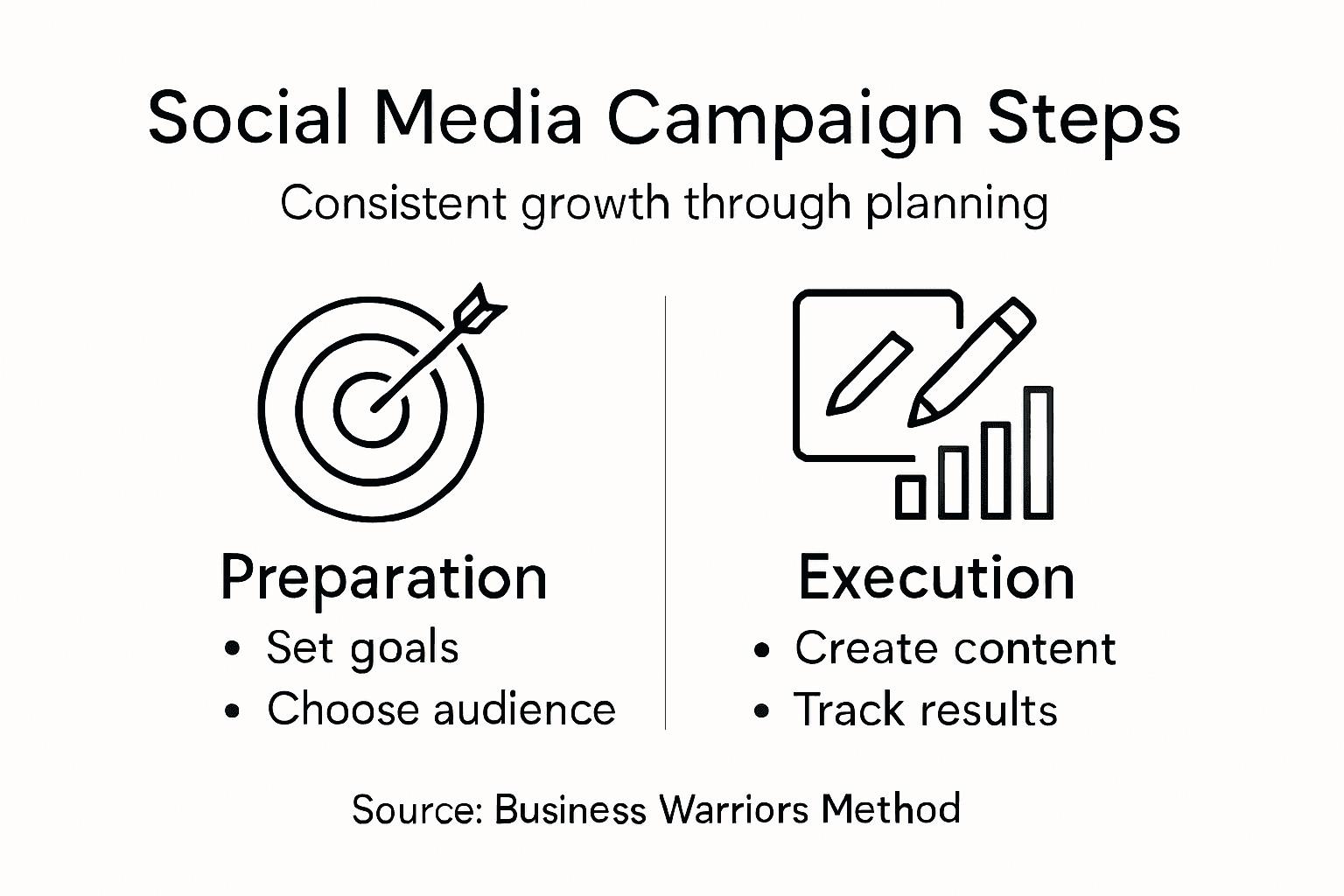
Marketing performance metrics provide the roadmap for understanding campaign success. By establishing clear key performance indicators (KPIs), you’ll create a systematic approach to measuring results across different stages of your marketing funnel.
Consider tracking these essential performance metrics:
- Engagement rates: Likes, comments, shares, and overall interaction
- Conversion metrics: Lead generation, sign-ups, and direct sales
- Reach and impressions: Total audience exposure and potential visibility
- Click-through rates: Effectiveness of calls-to-action and content
- Cost per acquisition: Financial efficiency of your marketing efforts
The MIT Sloan Management approach emphasises strategic learning from campaign outcomes. This means not just collecting data, but critically analysing performance to identify what’s working and what needs adjustment.
For reference, here’s a summary of key campaign performance metrics and what each reveals:
| Metric | What It Measures | Business Impact |
|---|---|---|
| Engagement Rate | Audience interaction | Brand awareness, loyalty |
| Conversion Rate | Leads or sales outcomes | Direct revenue, growth |
| Reach & Impressions | Content visibility | Market exposure |
| Cost per Acquisition | Resource efficiency | Budget optimisation |
Continuous improvement is the hallmark of successful social media marketing.
Pro tip: Schedule monthly review sessions to deep-dive into your analytics, comparing performance against initial campaign objectives and making data-driven refinements.
Elevate Your Social Media Campaigns With Proven Marketing Strategies
Planning a social media campaign that delivers consistent growth takes more than just posting regularly. You need clear goals, deep audience insight, smart platform selection, engaging content, and a strategic budget. If you find yourself struggling to align these crucial elements or want to transform your campaign into a powerful client acquisition machine, you are not alone. Many business owners face challenges turning social media effort into measurable results and qualified leads.
At Business Warriors, led by Jarrod Harman, we specialise in helping service-based businesses like yours master the art of online client acquisition using the innovative ‘Marketing Vortex’ Method. This unique, integrated system covers everything from SEO to social media ads, content creation, and analytics — precisely the strategies outlined in this comprehensive guide. By partnering with us, you gain access to expert support that translates strategy into rapid growth, predictable lead flow, and a competitive edge.
Ready to leave uncertainty behind and start growing your social media impact with proven tactics? Visit Jarrod Harman’s website to explore how we can help you streamline your marketing efforts. Discover how our tailored approach turns marketing budgets into long-term business success. Begin your transformation today by browsing insights and success stories in the Uncategorized Archives or get in touch for a personalised consultation at Jarrod Harman. Your consistent growth journey starts now.
Frequently Asked Questions
How can I define clear campaign goals for my social media campaign?
To define clear campaign goals, start by identifying specific business outcomes you want to achieve, such as generating leads or increasing brand awareness. Use measurable objectives like aiming for a 15% increase in engagement within the first month to guide your strategy.
What steps should I take to research my target audience effectively?
Begin effective audience research by breaking down your ideal client profile into demographics, behavioural characteristics, psychographics, and communication preferences. Invest time in using surveys and online analytics tools to build a comprehensive profile, enabling you to reach the right audience with tailored messaging.
How do I analyse competitors when planning my social media campaign?
Conduct a competitive landscape analysis by mapping out your top competitors and evaluating their social media presence. Focus on their engagement rates and content performance to find opportunities that differentiate your campaign and target your audience more effectively.
What types of content should I create for my social media posts?
Create a mix of content types that include authentic storytelling, visual posts, and actionable insights to engage your audience. For example, aim to post varied formats such as videos and images at least three times a week to keep your followers interested.
How can I track the success of my social media campaign?
Track success by establishing key performance indicators (KPIs) like engagement rates and conversion metrics. Regularly analyse these metrics, aiming to review your campaign performance at least once a month to make informed adjustments and improvements.
What budget considerations should I keep in mind when planning a social media campaign?
When planning your budget, allocate funds specifically for content creation, advertising, and analytics tools based on your campaign goals. Ensure to reserve 10-15% of your budget for unexpected opportunities or adjustments to optimise your campaign’s performance.