


TL;DR:
- Most agents fail to respond quickly enough, with half never replying to leads and responses averaging over 15 hours. AI-powered automation improves contact rates by 40-60%, responding within seconds to generate more qualified leads. A comprehensive, multi-channel follow-up system, combined with compliance and layered digital strategies, builds sustainable client pipelines and boosts real estate success.
Most real estate agents lose clients before the conversation even starts. Research shows that 48% of leads never receive a response, and the average response time sits at 15.3 hours, which is catastrophic in a market where buyers make decisions fast. If you are serious about growing your client base, the right real estate lead generation programs do far more than deliver contact details. They automate your response, nurture prospects over months, and keep you compliant while your competitors sleep. This guide covers the full picture, from AI-powered tools and SEO to paid ads and follow-up systems that actually close.
Table of Contents
- Key takeaways
- Speed-to-lead and AI automation in real estate
- Digital channels for online lead generation in real estate
- Multi-stage follow-up and lead nurturing
- Compliance and permission-based marketing
- My honest take on lead generation for agents
- Build a lead pipeline that actually grows
- FAQ
Key takeaways
| Point | Details |
|---|---|
| Speed decides everything | Responding within 5 minutes makes leads 21 times more likely to qualify than waiting 30 minutes. |
| Channels must work together | Combining SEO, paid ads, and social media creates redundancy and reduces reliance on any single source. |
| Follow-up is where deals are won | Most agents stop at 1-2 attempts; 80% of deals require 5 or more follow-up contacts. |
| Compliance protects your pipeline | Respecting TCPA and CAN-SPAM rules builds sender reputation and keeps your email marketing working long-term. |
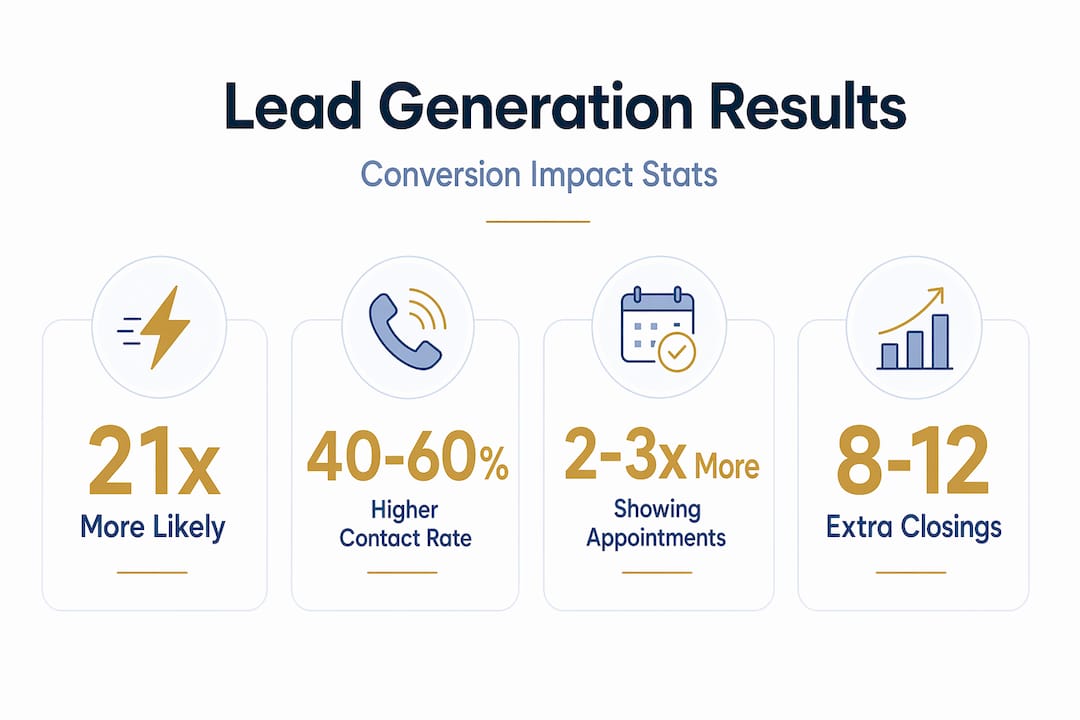
| AI multiplies your output | Agents using AI response tools see 40-60% higher contact rates from the same lead volume. |
Speed-to-lead and AI automation in real estate
The 5-minute rule is not a suggestion. Leads contacted within 5 minutes are 21 times more likely to qualify than those reached after 30 minutes, and 78% of buyers work with the first agent who responds. Every hour you wait, that probability collapses.
The gap between what agents do and what they should do is staggering. Most agents are running appointments, driving between suburbs, or simply offline when a new enquiry lands. Manual response is not a scalable solution. This is exactly where AI-driven automation earns its place in your technology stack.
What AI lead response actually does
AI chatbots and automated response systems send a personalised reply within 60 seconds of a new enquiry, regardless of the time of day. They ask qualifying questions, capture property preferences and budget ranges, and route the lead into your CRM with a priority score already attached. You arrive to a warm conversation instead of a cold name on a list.
The commercial impact is measurable. Agents using AI tools see 40-60% higher contact rates and 2-3 times more showing appointments from the same lead volume. That is not a marginal improvement. It is the difference between a pipeline that grows and one that leaks.
Platforms like kvCORE and CINC combine IDX websites, CRM, and marketing automation into a single system. These platforms start from $499 per month, with brokerage-level plans exceeding $5,000 per month including setup fees between $1,000 and $3,000. For high-volume teams, the return on that investment is straightforward. For solo agents, lighter tools with AI response modules provide a cost-effective entry point.
Key benefits of AI-integrated lead generation programs include:
- Instant, personalised responses at any hour without manual input
- Automatic lead scoring and CRM routing based on behaviour and responses
- Consistent follow-up sequences triggered by lead actions
- Freed-up time for agents to focus on warm conversations and closings
- Reduced lead fall-through from slow or missed responses
Pro Tip: Set up a multi-channel immediate response sequence. The moment a lead enquires, fire an automated SMS, a personalised email, and a task notification to call within the hour. This three-touch approach covers the bases if one channel goes unanswered.
Speed-to-lead automation can increase annual closed transactions by 8-12 units per team when response happens within 60 seconds rather than the average 47 minutes. That is a serious number to consider when evaluating whether to invest in automation tools.
Digital channels for online lead generation in real estate
There is no single channel that solves real estate lead generation on its own. Top producers build redundant systems combining organic SEO, local farming, and paid acceleration to create sustainable, diversified pipelines. Here is how each channel contributes and how to think about combining them.
| Channel | Strength | Best use case | Typical timeframe |
|---|---|---|---|
| Organic SEO | Long-term authority and compounding traffic | Suburb pages, buyer/seller guides, blog content | 3-12 months to rank |
| Google Ads | Immediate visibility for high-intent searches | “Homes for sale in [suburb]” buyer queries | Instant, ongoing spend |
| Facebook/Meta Ads | Audience targeting and retargeting at scale | Seller leads, open home promotion, remarketing | Days to weeks |
| Social media (organic) | Trust, engagement, and referral network | Video content, market updates, community posts | Ongoing brand building |
| IDX website | Lead capture hub with property search tools | Converting search traffic to database entries | Integrated with SEO/Ads |
| Email marketing | Nurturing and conversion of existing leads | Market reports, new listings, follow-up sequences | Immediate to 18 months |
SEO as a long-term real estate asset
Organic SEO builds compounding authority. A well-optimised suburb page ranking for “houses for sale in [suburb]” attracts enquiries month after month without ongoing spend. Pair that with AI-enhanced SEO strategies that target local intent and you create a lead source that grows over time. The downside is patience. SEO takes months to gain traction, which is why it works best as a foundation rather than your only source.
Paid advertising as a volume lever
Google Ads captures buyers actively searching right now. Facebook and Meta Ads reach homeowners who are not yet searching but match the profile of likely sellers or buyers. Both platforms require budget discipline and conversion tracking to avoid wasted spend. Without a proper real estate sales funnel to receive that traffic, paid ads produce clicks rather than clients.
Social media is the number one lead-generating technology for agents, with video marketing generating 66% more qualified leads annually. Automated email campaigns increase lead conversion by 30%, and email converts 40% better than social media overall. Those two statistics together make a strong case for combining social content with a well-managed email list.
Pro Tip: Connect your Google Analytics, Facebook Pixel, and CRM from day one. Without unified tracking, you cannot tell which channel is producing closings versus just producing clicks. Cost per lead is useful, but cost per closed transaction is the number that matters.
You can explore a breakdown of effective digital tactics to see how these channels interact in practice across different markets.
Multi-stage follow-up and lead nurturing
Generating a lead is step one. Converting that lead into a client is where the real work happens, and where most agents fall apart. Lead conversion requires 8-12 follow-up attempts across multiple channels over months, with genuine value at each touchpoint rather than a repeated sales pitch.

The reality is that most agents abandon leads after just 1 or 2 attempts, while 80% of deals require five or more. If you stop at two, you are handing your pipeline to the agent who did not.
Here is a structured follow-up cadence that works for real estate lead generation programs:
- Day 1. Automated SMS and email response within 60 seconds of enquiry. Personal call attempt within the first hour.
- Day 2. Second call attempt plus a text with a relevant property match or market insight for their target area.
- Day 4. Email with a local market update or recent comparable sales. No pitch, just value.
- Day 7. Third call with a specific reason to connect, such as a new listing that fits their criteria.
- Week 2 to 4. Two to three contacts per week alternating between calls, texts, and emails with market data, property suggestions, and community insights.
- Month 2 to 6. Weekly email nurture sequence with suburb reports, case studies, and buying or selling guides.
- Month 6 to 18. Monthly touchpoints to stay top of mind as their timeline matures.
The content you send matters as much as the frequency. Buyers and sellers receive dozens of agent communications. What cuts through is specificity. A market update for the exact suburb they are considering, a recently sold result for a comparable property, or an insight about interest rate impacts on local pricing. That kind of targeted value is what a structured lead nurturing approach delivers at scale.
CRM hygiene is non-negotiable in this process. Every call gets logged. Every follow-up gets scheduled. If your real estate CRM for leads does not automatically prompt your next action, you will forget. The best agents treat their CRM as the single source of truth for every prospect relationship.
Pro Tip: Tag your leads by timeframe and motivation in your CRM. A buyer with a 30-day settlement need gets a different sequence from someone browsing for 12 months. Personalised cadences outperform generic ones every time.
Explore more detail on converting leads to clients if you want to see how specific follow-up sequences perform across different property segments.
Compliance and permission-based marketing
Compliance is not the boring part of lead generation. It is the part that determines whether your marketing keeps working. Regulations around commercial messaging exist to protect consumers, and agents who ignore them face penalties, deliverability problems, and damaged reputations.
The CAN-SPAM Act (relevant to email marketing used by Australian agents targeting or operating across international platforms) requires every commercial email to include:
- A physical mailing address
- A clear, functional unsubscribe link
- Honour of unsubscribe requests within 10 business days
- No deceptive subject lines or sender information
- Separation between transactional and commercial messages
CAN-SPAM violations carry significant penalties, and mailbox providers like Google and Microsoft enforce sender reputation proactively. An agent with a high spam complaint rate finds their emails landing in junk folders across their entire database, destroying their nurture programme before it can convert.
TCPA compliance governs text and phone outreach. Getting express written consent before adding a contact to an automated SMS sequence is not optional. Common mistakes include adding purchased lead lists to text campaigns without consent, sending commercial texts at restricted hours, and failing to honour opt-out requests immediately.
Compliance is increasingly a competitive advantage as regulations tighten. The agents who build clean, permission-based databases now will have lists that actually deliver results in two years, while agents cutting corners face inbox placement problems and legal exposure. Automation platforms like those integrated into quality real estate lead generation programs handle much of this systematically, flagging non-compliant contacts and managing opt-out lists automatically.
My honest take on lead generation for agents
I have worked with businesses across Australia on scaling their marketing systems, and real estate is one of the sectors where I see the sharpest divide between agents who succeed and those who struggle. The difference is rarely about access to leads. It is about what happens after the lead arrives.
The speed-to-lead problem genuinely changed how I think about automation. When I saw data showing that the average agent response time is over 15 hours in a world where the first responder wins 78% of the time, it became clear that technology is not a nice-to-have. It is the entire game.
What I find frustrating is agents chasing quantity, spending thousands on lead generation programmes and portal listings, without the systems to handle what comes in. You can generate 200 leads a month and close fewer deals than an agent generating 50 with a proper follow-up cadence and AI response in place.
The other pattern I see repeatedly is channel isolation. An agent runs Facebook Ads for three months, does not see immediate results, drops it, and moves to something else. Real estate sales funnels do not work that way. Organic SEO builds the trust layer. Paid ads bring volume. Email nurtures the consideration period. Social content keeps you visible. These channels reinforce each other. Pulling one out weakens the rest.
My recommendation for any agent serious about building a sustainable practice is to start with your response infrastructure before spending more on lead volume. Get AI automation working. Build your CRM hygiene. Then scale your online lead generation in real estate with the confidence that your system will handle the inflow properly.
— Business Warriors | Digital Marketing Agency
Build a lead pipeline that actually grows
If you have read this far, you already understand that effective lead generation for realtors is a system, not a tactic. At Jarrodharman, we work with agents and service-based businesses across Australia to build the full stack: SEO that ranks, paid advertising that converts, and automated funnels that nurture leads without constant manual effort.
Whether you need an SEO and lead generation strategy built from scratch or want to supercharge your existing paid campaigns, our team at Business Warriors has the frameworks to make it happen. We also have a detailed resource comparing the best lead generation software on the market if you want to evaluate your technology options first. When you are ready to build something that compounds, reach out to our team for a strategy conversation.
FAQ
How fast should a real estate agent respond to a new lead?
Within 5 minutes. Leads contacted in under 5 minutes are 21 times more likely to qualify than those reached after 30 minutes, and AI automation tools can achieve responses in under 60 seconds.
What are the best online lead generation methods for real estate agents?
The most effective approach combines organic SEO for long-term traffic, paid Google and Facebook Ads for volume, and an IDX website to capture enquiries. Top producers use all three together rather than relying on any single source.
How many follow-up attempts does it take to close a real estate lead?
Most leads require 8 to 12 follow-up attempts across calls, texts, and emails before converting. The majority of agents stop at one or two, which is why consistent follow-up is one of the most underused advantages in the industry.
Do real estate agents need to follow CAN-SPAM and TCPA rules in Australia?
Agents using email marketing platforms and SMS campaigns, particularly those on international platforms or targeting buyers from overseas, need to understand both regulations. Australian agents are primarily governed by the Spam Act 2003, but many platforms default to CAN-SPAM compliance standards, and adherence protects deliverability regardless of jurisdiction.
What does a real estate CRM for leads actually need to do?
A quality CRM must log every contact attempt, schedule follow-up tasks automatically, score and segment leads by timeframe and motivation, and integrate with your email and SMS tools. Without that structure, even the best lead generation campaigns produce contacts that never convert.