


TL;DR:
- Lead nurturing involves building ongoing relationships with prospects through relevant content until they are ready to purchase. It differs from lead generation by focusing on follow-up and personalization across multiple channels. Effective nurturing combines automation, AI, and SEO to maintain engagement and improve conversion rates over the long term.
Lead nurturing is defined as the ongoing process of building relationships with potential customers by delivering timely, relevant content that guides them through the sales funnel until they are ready to buy. IBM, Salesforce, and HubSpot all recognise this as a multi-step campaign rather than a single outreach effort. The distinction matters because most prospects are not ready to purchase the moment they first engage with your business. Understanding the definition of lead nurturing, and applying it correctly, is what separates businesses that grow predictably from those that rely on luck.
What is lead nurturing and why does it matter for conversions?
Lead nurturing is the structured practice of staying relevant to a prospect across multiple touchpoints until they are sales-ready. Nurturing builds trust through education and personalised communication, not through pressure. This is the core reason it outperforms one-off campaigns for conversion.

The importance of lead nurturing becomes clear when you look at pipeline reality. Most leads captured through Google Ads, Meta advertising, or SEO content are not ready to buy on day one. Prospects may convert after several weeks or months of consistent engagement. Businesses that stop communicating after the first touchpoint lose those prospects to competitors who keep showing up.
Consistent, personalised follow-up increases trust and shortens the sales cycle. HubSpot’s research confirms that persistent, relevant engagement directly improves conversion rates. For service-based businesses in Australia, this means every lead you capture through your website, social media, or paid ads deserves a structured follow-up sequence, not a single email and silence.
How does lead nurturing differ from lead generation?
Lead generation and lead nurturing are complementary but distinct stages in your marketing system. Understanding where one ends and the other begins helps you allocate budget and effort correctly.
| Stage | Lead generation | Lead nurturing |
|---|---|---|
| Primary goal | Capture contact information | Build relationship until sales-ready |
| Timing | One-time or campaign-based | Ongoing, multi-touch sequence |
| Channels | Google Ads, SEO, social media, events | Email, retargeting, content, SMS |
| Success metric | Number of leads captured | Conversion rate, pipeline quality |
| Tools | Landing pages, lead magnets, forms | CRM, marketing automation, email platforms |
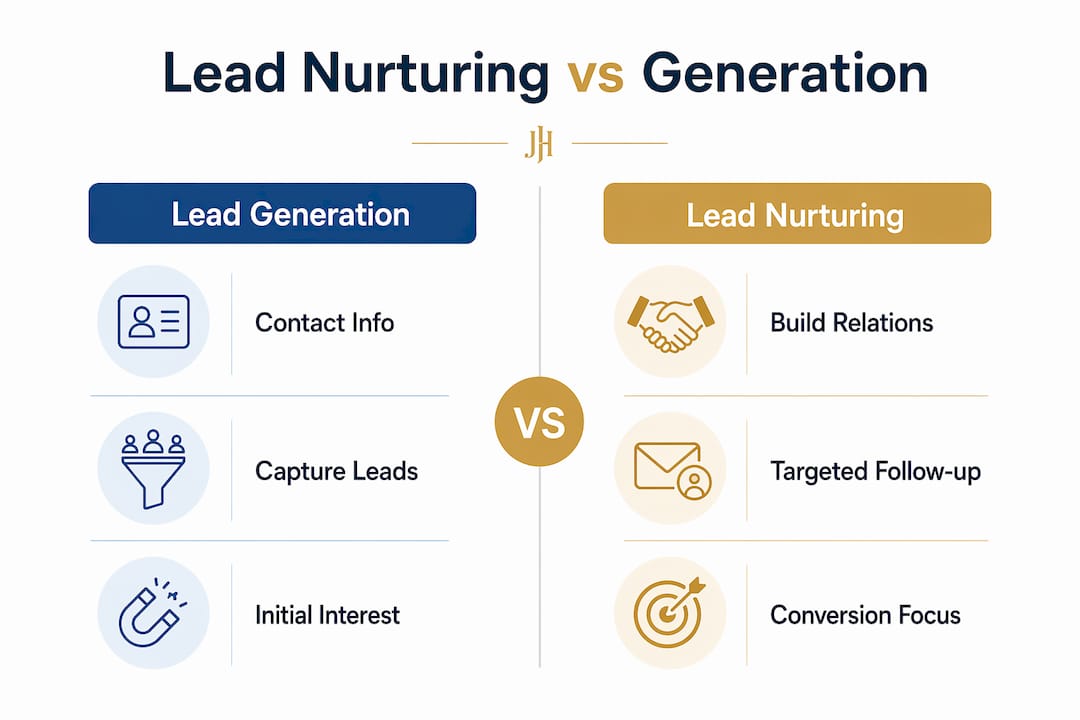
Lead generation captures contact info; nurturing builds the relationship from that point forward. Pipedrive describes effective programmes as those that coordinate both stages to maintain pipeline health. Running lead generation without nurturing is like filling a bucket with a hole in it. You keep spending on ads and SEO to attract new leads, but without nurturing, those leads go cold before they ever speak to your sales team.
Key differences to keep in mind:
- Lead generation is the top of funnel activity. It uses SEO content, Google Ads, Facebook and Instagram ads, and social media to attract and capture prospects.
- Lead nurturing takes over after capture. It uses email sequences, retargeting ads, personalised content, and CRM workflows to move prospects toward a buying decision.
- Resource allocation shifts when you understand this split. Generation requires ad spend and content creation. Nurturing requires automation, segmentation, and consistent messaging.
Businesses that treat both stages as one undifferentiated activity tend to overspend on acquisition and underinvest in follow-up. The result is a leaky pipeline that never reaches its potential.
What are the best lead nurturing strategies and workflow structures?
The most effective lead nurturing process is a multi-touch, multi-channel sequence designed around where your prospect sits in the buyer journey. A single email sequence is not a nurturing strategy. A coordinated workflow across email, retargeting, social media, and direct outreach is.
Here is a practical workflow structure for service-based businesses:
- Capture and tag. When a lead enters your CRM through a Google Ads landing page, SEO blog post, or social media lead form, tag them by source and interest. This is the foundation of segmentation.
- Send an immediate value email. Within the first hour, deliver something useful. A guide, a case study, or a short video that addresses their specific problem. Automation tools and CRM workflows enable this at scale without manual effort.
- Score the lead. Assign points based on behaviour. Opening emails, clicking links, visiting your pricing page, and watching videos all indicate buying intent. Salesforce and Zoho CRM both use this scoring logic to prioritise follow-up.
- Trigger behaviour-based content. Unlike fixed email drip campaigns, behaviour-triggered content responds to what the prospect actually does. If they visit your services page three times, trigger a case study email. If they download a guide, follow up with a related video.
- Retarget across paid channels. Use Meta and Google retargeting ads to stay visible to prospects who have not yet converted. Paid advertising amplifies your nurturing sequence beyond the inbox.
- Define the handoff point. Set a lead score threshold at which a prospect moves from marketing to sales. This prevents your sales team from chasing cold leads and missing hot ones.
Pro Tip: Clean CRM data is the single biggest factor in automation success. Salesforce notes that accurate segmentation prevents irrelevant messaging, which is the fastest way to lose a prospect’s trust. Audit your CRM data quarterly.
Personalised content aligned to prospect behaviour consistently outperforms generic broadcast messaging. You can explore marketing automation examples for service businesses to see how this plays out in practice across different industries.
How do AI and SEO impact lead nurturing effectiveness in 2026?
Artificial intelligence and SEO strategy are now central to how effective lead nurturing works. They are not optional add-ons. They are the infrastructure that makes personalisation at scale possible.
AI-driven personalisation and SEO-aligned content attract and retain leads by improving segmentation and targeting precision. Machine learning models analyse prospect behaviour across your website, email sequences, and paid ad interactions to predict the best time and message for each individual. This is a significant shift from the manual segmentation that dominated marketing five years ago.
Key ways AI and SEO are reshaping the lead nurturing process in 2026:
- AI-powered lead scoring analyses dozens of behavioural signals simultaneously, producing more accurate readiness scores than rule-based systems.
- SEO content strategy ensures your nurturing content ranks organically for the questions your prospects are asking at each funnel stage. A prospect researching “best med spa treatments Perth” should find your educational content, not a competitor’s.
- Generative AI for content personalisation allows businesses to produce variations of emails, landing pages, and ad copy tailored to different audience segments without multiplying production costs.
- Google Ads and Meta advertising automation use AI bidding and audience targeting to serve retargeting ads to prospects at the precise moment they are most likely to re-engage.
- GEO (Generative Engine Optimisation) is the emerging practice of optimising content to appear in AI-generated answers from ChatGPT, Perplexity, and Google’s AI Overviews. Getting your brand mentioned in large language model outputs is now a legitimate lead nurturing channel, as prospects increasingly use AI tools to research service providers.
- Social media algorithms on Instagram, TikTok, and LinkedIn use AI to surface your content to warm audiences. Consistent posting keeps your brand visible to prospects who are in the consideration phase.
The businesses winning in 2026 are those that treat SEO, paid advertising, social media, and AI automation as one connected system rather than separate tactics. This is precisely the logic behind the Marketing Vortex method, which integrates all channels into a single, reinforcing loop.
How can businesses measure and improve their lead nurturing programmes?
Measuring lead nurturing success requires looking beyond open rates and click rates. Those metrics tell you about engagement. They do not tell you about revenue.
Measuring success means tracking conversion rates between funnel stages, sales cycle length, and revenue contribution. NetSuite warns that optimising engagement metrics alone misses the actual sales impact of your nurturing programme. A sequence with a 40% open rate that produces zero sales-qualified leads is not performing.
| Metric | What it measures | Why it matters |
|---|---|---|
| MQL to SQL conversion rate | How many marketing leads become sales-ready | Shows whether nurturing is qualifying leads effectively |
| Sales cycle length | Time from first contact to closed deal | Shorter cycles indicate nurturing is accelerating decisions |
| Pipeline contribution | Revenue attributed to nurtured leads | Proves the commercial value of your nurturing investment |
| Lead score accuracy | How well scores predict buying intent | Validates your segmentation and scoring model |
Lead nurturing improves pipeline quality by moving leads from marketing-qualified to sales-qualified through targeted follow-ups. The key is setting explicit handoff criteria. When a lead reaches a defined score threshold, they move to sales. This prevents your sales team from wasting time on prospects who are not ready, and prevents marketing from holding onto leads who are.
Pro Tip: Run A/B tests on your nurturing email subject lines and content formats every 90 days. Small improvements in click-through rates compound significantly over a 12-month period. Track results inside your CRM so you can connect email behaviour to actual sales outcomes.
Continuous testing and technology adaptation are non-negotiable. CRM platforms like Salesforce and Zoho CRM provide the reporting infrastructure to connect nurturing activity to closed revenue. If your current setup cannot make that connection, it is time to upgrade your lead nurturing process.
Key takeaways
Lead nurturing is the structured, multi-touch process that converts captured leads into paying customers by delivering relevant content at each stage of the buyer journey.
| Point | Details |
|---|---|
| Definition is the starting point | Lead nurturing builds ongoing relationships after lead capture, not one-off campaigns. |
| Generation and nurturing are distinct | Lead generation captures contacts; nurturing converts them through consistent, relevant follow-up. |
| Automation requires clean data | CRM segmentation and accurate lead scoring are the foundation of any effective nurturing workflow. |
| AI and SEO are now core infrastructure | AI personalisation, SEO content, and GEO optimisation work together to attract and retain leads in 2026. |
| Measure revenue, not just engagement | Track MQL to SQL conversion rates, sales cycle length, and pipeline contribution to prove real impact. |
What I have learned about lead nurturing after working with Australian service businesses
Most business owners I speak with have heard of lead nurturing. Very few are actually doing it. What they have is a single welcome email and a hope that the prospect calls back. That is not a nurturing strategy. That is wishful thinking.
The pattern I see repeatedly is this: a business invests in Google Ads or SEO, generates a solid volume of leads, and then watches most of them go cold because there is no follow-up system. The leads were not bad. The process was missing.
The other mistake I see is treating nurturing as purely an email function. In 2026, your prospects are on Instagram, watching YouTube, searching Google, and asking AI tools for recommendations. If your nurturing only lives in the inbox, you are invisible everywhere else. The businesses I have seen grow fastest are those that build a connected system where SEO content, paid retargeting, social media, and email all reinforce the same message to the same prospect.
There is also a mindset shift required. Effective nurturing matches communication to the buyer’s readiness, not to your sales targets. Pushing for a sale before a prospect is ready destroys trust and kills the relationship. The businesses that play the long game, staying relevant and helpful across weeks or months, are the ones that win the sale when the prospect is finally ready to act.
One more thing worth saying directly: lead nurturing prevents leads from going stale after capture. Every lead you generate through paid advertising or organic SEO has a shelf life. Without a nurturing system, that investment decays. With one, it compounds.
— Business Warriors | Digital Marketing Agency
Ready to build a lead nurturing system that actually converts?
At Jarrodharman, we build integrated marketing systems for Australian service businesses that combine SEO, Google Ads, Meta advertising, email marketing, and automation into one connected engine. Lead nurturing is not a standalone tactic in our approach. It is woven into every channel so your prospects stay engaged from first click to booked appointment.
If you are generating leads but watching them go cold before they convert, the problem is not your product. It is the gap between capture and conversion. Explore Jarrod’s digital marketing expertise to see how a structured nurturing system can change your conversion numbers. You can also review proven client acquisition strategies to understand what results look like in practice.
FAQ
What is the definition of lead nurturing?
Lead nurturing is the process of building ongoing relationships with potential customers through timely, relevant content after initial lead capture. Its goal is to guide prospects through the sales funnel until they are ready to buy.
How does lead nurturing improve sales conversion rates?
Lead nurturing moves prospects from marketing-qualified to sales-qualified by delivering targeted follow-up at each funnel stage. Consistent engagement shortens the sales cycle and improves the quality of leads passed to your sales team.
What tools are used for lead nurturing?
CRM platforms like Salesforce and Zoho CRM, combined with marketing automation tools, are the standard infrastructure for lead nurturing. They enable segmentation, lead scoring, and behaviour-triggered communication at scale.
How is lead nurturing different from a drip email campaign?
A drip campaign sends content on a fixed schedule regardless of prospect behaviour. Lead nurturing triggers content based on what a prospect actually does, such as visiting a pricing page or downloading a guide, making it far more relevant and effective.
How do SEO and paid advertising support lead nurturing?
SEO content attracts prospects organically at each stage of the buyer journey, while paid advertising channels like Google Ads and Meta ads retarget warm prospects who have not yet converted. Together, they extend your nurturing reach beyond the inbox and keep your brand visible across multiple touchpoints.