


Companies that implement lead nurturing strategies generate 50% more sales-ready leads, yet many business owners remain unclear about what online lead nurturing actually involves. This confusion costs you potential clients and revenue. Online lead nurturing is the systematic process of building relationships with prospects through timely, relevant communication across multiple channels, guiding them from initial interest to becoming paying clients. For service-based businesses in 2026, mastering this approach means converting more leads at lower costs while building lasting client relationships. This guide defines online lead nurturing, explains its proven benefits, and provides actionable strategies you can implement immediately to increase your client acquisition and sales.
Table of Contents
- Understanding Online Lead Nurturing And Its Benefits
- How Personalised, Multi-Channel Nurturing Boosts Conversions
- Segmenting Leads And Technology’s Role In Effective Nurturing
- Creating And Optimising Your Online Lead Nurturing Strategy
- How Jarrod Harman Can Help You Master Online Lead Nurturing
- Frequently Asked Questions
Key takeaways
| Point | Details |
|---|---|
| Lead nurturing drives results | Generates 50% more sales-ready leads whilst reducing acquisition costs by 30% through strategic relationship building. |
| Personalisation matters | Tailored messaging across multiple channels increases conversion rates and transaction values significantly. |
| Segmentation is critical | Grouping leads by behaviour, demographics, and engagement enables targeted communication that resonates. |
| Technology enhances efficiency | AI chatbots and automation tools improve response times and qualification whilst maintaining personal touch. |
| Continuous optimisation required | Regular testing, analytics review, and strategy adjustments ensure sustained performance improvement. |
Understanding online lead nurturing and its benefits
Online lead nurturing is the systematic process of developing and strengthening relationships with potential clients throughout their buying journey using digital channels. It involves delivering valuable, relevant content and communication at strategic touchpoints to guide prospects from awareness to purchase decision. Think of it as cultivating a garden rather than hunting for immediate wins. You plant seeds, provide consistent care, and harvest results over time.
Many business owners mistakenly believe lead nurturing means blasting generic emails to their database. That approach fails because it ignores individual needs and preferences. True lead nurturing requires understanding where each prospect sits in their journey and providing information that moves them forward naturally. Research from Forrester confirms that lead nurturing focuses on providing value and guiding leads through their buying journey, not just sending emails.
The business impact is substantial. Beyond the 50% increase in sales-ready leads, companies implementing proper nurturing strategies see 30% lower costs per lead compared to those who don’t nurture. For service-based businesses operating on tight margins, this cost reduction directly improves profitability whilst simultaneously increasing conversion rates.
Key benefits include:
- Higher quality leads entering your sales pipeline ready to convert
- Reduced marketing spend per acquisition through improved efficiency
- Stronger client relationships built on trust and demonstrated expertise
- Increased lifetime value as nurtured clients become repeat buyers and referrers
- Better alignment between marketing efforts and actual buyer needs
Lead nurturing is about providing value and guiding leads through their buying journey, not just sending emails.
The lead nurturing process guide breaks down each stage systematically, helping you map content and touchpoints to specific buyer journey phases. This structured approach ensures no prospect falls through the cracks whilst maintaining efficiency at scale.
How personalised, multi-channel nurturing boosts conversions
Personalisation transforms lead nurturing from background noise into compelling conversation. When you address specific pain points, reference previous interactions, or tailor recommendations based on behaviour, prospects pay attention. The data proves this convincingly. Personalised lead nurturing emails achieve a 6x higher transaction rate compared to generic messages, demonstrating that relevance directly impacts revenue.

Multi-channel approaches amplify this effect by meeting prospects where they spend time. Your ideal client might prefer email, whilst another engages more on social media or through webinars. Covering multiple touchpoints ensures consistent presence without overwhelming any single channel. Research shows nurtured leads convert twice as well as non-nurtured leads, with multi-channel strategies driving even stronger results.
| Lead Type | Email Conversion | Social Media Conversion | Combined Channels Conversion |
|---|---|---|---|
| Non-nurtured | 2.1% | 1.8% | 2.3% |
| Nurtured (single channel) | 4.3% | 3.6% | 4.8% |
| Nurtured (multi-channel) | 5.7% | 5.2% | 8.9% |
Effective personalisation and multi-channel tactics include:
- Segmenting audiences by industry, company size, or specific service interests
- Timing communications based on engagement patterns and time zones
- Varying content formats between educational articles, case studies, video tutorials, and interactive tools
- Referencing previous downloads, page visits, or webinar attendance in follow-up messages
- Adjusting messaging tone and complexity based on prospect’s familiarity with your services
Pro Tip: Balance automation with human interaction by having your team personally reach out to high-value leads who show strong engagement signals. Automated sequences handle efficiency, but strategic personal touches build relationships that close deals.
The how to nurture leads online resource provides channel-specific tactics for email, social media, and content marketing. Meanwhile, nurture leads for business growth explores how different service industries can adapt these principles to their unique client acquisition challenges.
Avoid the trap of over-automation where every interaction feels robotic. Technology enables scale, but your prospects are humans making significant business decisions. They need to feel understood, not processed. Strategic personalisation combined with genuine helpfulness creates the trust required for conversion.
Segmenting leads and technology’s role in effective nurturing
Lead segmentation divides your prospect database into distinct groups based on shared characteristics, enabling targeted communication that resonates with each group’s specific needs. The three primary segmentation criteria are demographics (industry, company size, location), behaviour (website pages visited, content downloaded, email engagement), and engagement level (hot, warm, cold based on recent activity). Bizsage research confirms that segmentation directly increases engagement and conversion rates by ensuring relevance.
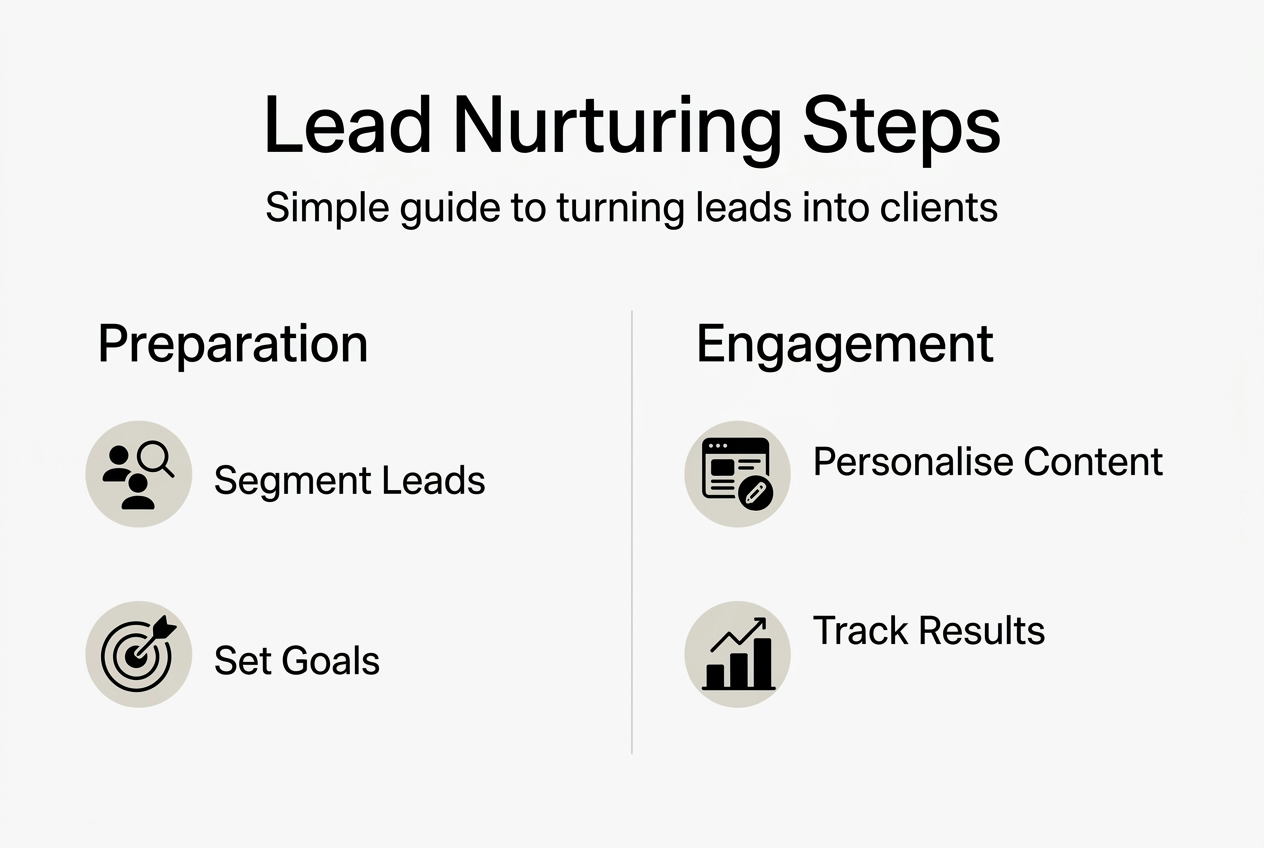
Demographic segmentation helps you speak the right language. A medical spa owner faces different challenges than a law firm partner, requiring distinct messaging and case studies. Behavioural segmentation reveals intent. Someone who downloaded your pricing guide and visited your booking page three times shows stronger buying signals than someone who read one blog post. Engagement level segmentation prevents wasting effort on cold leads whilst ensuring hot prospects receive immediate attention.
| Approach | Pros | Cons |
|---|---|---|
| Automated nurturing | Scales efficiently, maintains consistency, operates 24/7, reduces manual workload | Can feel impersonal, may miss nuanced signals, requires initial setup investment |
| Manual nurturing | Highly personalised, adapts to unique situations, builds stronger relationships | Time-intensive, difficult to scale, inconsistent execution |
| Hybrid approach | Combines efficiency with personal touch, optimises resource allocation | Requires clear triggers and handoff processes |
Technology amplifies segmentation effectiveness. AI chatbots provide immediate responses to website visitors, qualifying leads through conversational interactions before they leave your site. ServiceForm data shows that AI chatbots significantly improve lead generation and engagement by providing immediate responses and qualifying leads, reducing the lag time that causes prospect interest to fade.
Key technology applications include:
- CRM automation that triggers email sequences based on specific actions or time intervals
- Chatbots that answer common questions, book appointments, and collect qualification information
- Analytics platforms tracking engagement across channels to identify patterns and opportunities
- Marketing automation tools managing multi-touch campaigns without manual intervention
Pro Tip: Personalise your chatbot interactions by using actual team member names and photos rather than generic bot avatars. This small detail significantly increases trust and engagement rates. For businesses serving diverse communities, consider bilingual chatbot capabilities to accommodate all potential clients comfortably.
Common pitfalls include over-automation that removes all human elements and inconsistent messaging across channels that confuses prospects. Miss Pepper’s research on common mistakes in lead nurturing highlights these issues as primary reasons nurturing campaigns underperform. The lead nurturing process guide provides frameworks for avoiding these mistakes whilst implementing technology effectively.
Creating and optimising your online lead nurturing strategy
Building an effective lead nurturing strategy requires systematic planning and continuous refinement. Follow these steps to create your foundation:
- Identify your buyer personas by analysing existing clients to understand common characteristics, challenges, and decision-making processes.
- Segment your lead database using the demographic, behavioural, and engagement criteria discussed earlier.
- Map your buyer’s journey from awareness through consideration to decision, identifying questions and concerns at each stage.
- Create content aligned to each journey stage, ensuring you provide value before asking for commitment.
- Select your primary nurturing channels based on where your target audience spends time and engages most actively.
- Set up automation triggers that deliver the right message at the right time based on specific actions or timeframes.
- Establish clear handoff points where marketing-qualified leads transition to your sales team for direct conversation.
Strategy creation is just the starting point. Optimisation separates good results from exceptional ones. Track key metrics including email open rates, click-through rates, conversion rates by segment, time to conversion, and cost per acquisition. These numbers reveal what’s working and what needs adjustment.
Miss Pepper’s analysis confirms that failing to analyse and optimise campaigns is a missed opportunity, with A/B testing and leveraging analytics tools critical for continuous improvement. Test subject lines, email send times, content formats, and call-to-action placement systematically. Small improvements compound over time into significant performance gains.
Pro Tip: Schedule monthly strategy reviews where you analyse performance data, identify underperforming segments or channels, and implement specific improvements. This regular cadence prevents stagnation and ensures your nurturing stays aligned with evolving customer behaviour and market conditions.
Maintain consistent brand voice and messaging across all channels to avoid confusing prospects. Your email tone, social media presence, and website content should feel cohesively like the same business. Disjointed experiences erode trust and reduce conversion likelihood.
Reassess your strategy quarterly as customer preferences shift and new channels emerge. What worked brilliantly in early 2026 might need adjustment by year end as your market evolves. The nurture leads for business growth guide explores how to adapt strategies as your business scales, whilst lead generation campaigns explained shows how nurturing integrates with broader acquisition efforts.
How Jarrod Harman can help you master online lead nurturing
Implementing effective lead nurturing requires expertise, time, and ongoing optimisation. Jarrod Harman specialises in helping service-based businesses build systematic client acquisition processes that generate consistent, qualified leads. His proven Marketing Vortex method integrates lead nurturing with SEO, paid advertising, and conversion optimisation for maximum impact.
Access step-by-step guidance through the digital marketing step by step growth programme, designed specifically for business owners who need practical implementation support. Explore detailed frameworks in how to nurture leads for business growth and understand campaign structure through lead generation campaigns explained. Whether you’re starting from scratch or optimising existing efforts, these resources provide the strategic foundation and tactical execution plans needed to transform your client acquisition results in 2026.
Frequently asked questions
How long does lead nurturing typically take?
Lead nurturing timelines vary by industry and purchase complexity, typically ranging from two weeks to six months. Service-based businesses with higher-value offerings generally require longer nurturing periods as prospects conduct thorough research and comparison. Track your average sales cycle length to set realistic expectations and design appropriately paced sequences.
What are the best channels for lead nurturing in service businesses?
Email remains the foundation due to its direct access and measurability, complemented by social media for ongoing visibility and engagement. LinkedIn works exceptionally well for B2B services, whilst Facebook and Instagram suit consumer-focused businesses. Video content through YouTube or personalised messages adds powerful personal connection that builds trust faster than text alone.
How do I measure the success of lead nurturing?
Track conversion rate from lead to client, cost per acquisition, time to conversion, email engagement metrics, and customer lifetime value. Compare nurtured versus non-nurtured lead performance to quantify impact. Monitor lead scoring progression to identify which content and touchpoints move prospects forward most effectively, then optimise accordingly.
Can small teams manage lead nurturing effectively with automation?
Absolutely. Automation handles repetitive tasks like email sequences and lead scoring, freeing your team to focus on high-value personal interactions. Start with basic automated workflows for common scenarios, then expand as you identify patterns. The key is setting up smart triggers and maintaining quality content that serves prospects genuinely.
What common mistakes should I avoid in lead nurturing?
Avoid over-emailing which causes unsubscribes, sending irrelevant content that ignores segmentation, neglecting mobile optimisation, and failing to test and refine your approach. Don’t rely solely on automation without any personal touch for qualified leads. Inconsistent messaging across channels confuses prospects, whilst ignoring analytics means missing obvious improvement opportunities.