12 June 2026
The role of digital marketing in e-commerce: 2026 guide
Discover the role of digital marketing in e-commerce in 2026. Learn how strategies like SEO and ads drive growth and boost customer retention.
TL;DR:
- Digital marketing in e-commerce encompasses SEO, paid advertising, social media, email, and content to attract and retain customers while driving revenue growth. Integrating analytics and CRM platforms offers a strategic competitive advantage, enabling real-time optimizations and personalized customer experiences. Focusing on fewer channels, adopting long-term SEO strategies, and leveraging AI for personalization ensures sustainable business growth over time.
Digital marketing in e-commerce is defined as the strategic use of online channels, including SEO, paid advertising, social media, email, and content, to attract, engage, and convert shoppers into repeat customers. The role of digital marketing in e-commerce has expanded well beyond promotion. It now functions as the core operating system for online revenue growth, brand visibility, and customer retention. Tools like Google Ads, Mailchimp, and SAP Engagement Cloud give e-commerce brands the precision targeting and real-time optimisation that no traditional channel can match. Understanding how these capabilities work together is what separates stores that scale from those that stall.
How digital marketing drives innovation and competitive advantage in e-commerce
Digital marketing is not simply a communications function. Analytics and CRM integration have become core innovation drivers for e-commerce businesses, increasing agility and brand differentiation in ways that product development alone cannot achieve. A systematic review of 38 studies confirms these competencies are essential for survival and competitiveness in fast-moving markets. That finding matters because it reframes the budget conversation: marketing technology is infrastructure, not overhead.
The brands winning in 2026 treat their data stack the way a manufacturer treats its production line. When Google Analytics 4, a CRM like HubSpot or Salesforce, and a paid media platform like Meta Ads Manager share data in real time, the business can identify which customer segments are most profitable and redirect spend within hours, not quarters. That speed of response is a structural advantage that slower competitors cannot easily replicate.
“Digital marketing should be regarded as a strategic innovation capability that transforms business models beyond simple communications.” This framing, drawn from peer-reviewed research, is the lens every e-commerce operator should apply when allocating marketing resources.
Pro Tip: Map your customer data sources before choosing new marketing tools. If your CRM, email platform, and ad accounts cannot share audience data, you are paying for three separate views of the same customer and making decisions on incomplete information.
Modern consumers interact with multiple digital touchpoints before purchasing, which means real-time campaign refinement is not optional. An e-commerce brand selling skincare, for example, might see a customer click a Google Shopping ad, read a blog post, open a Mailchimp email, and then convert via an Instagram retargeting ad. Without connected analytics, that journey is invisible and the budget allocation is guesswork.

Which digital marketing channels have the biggest impact on e-commerce?
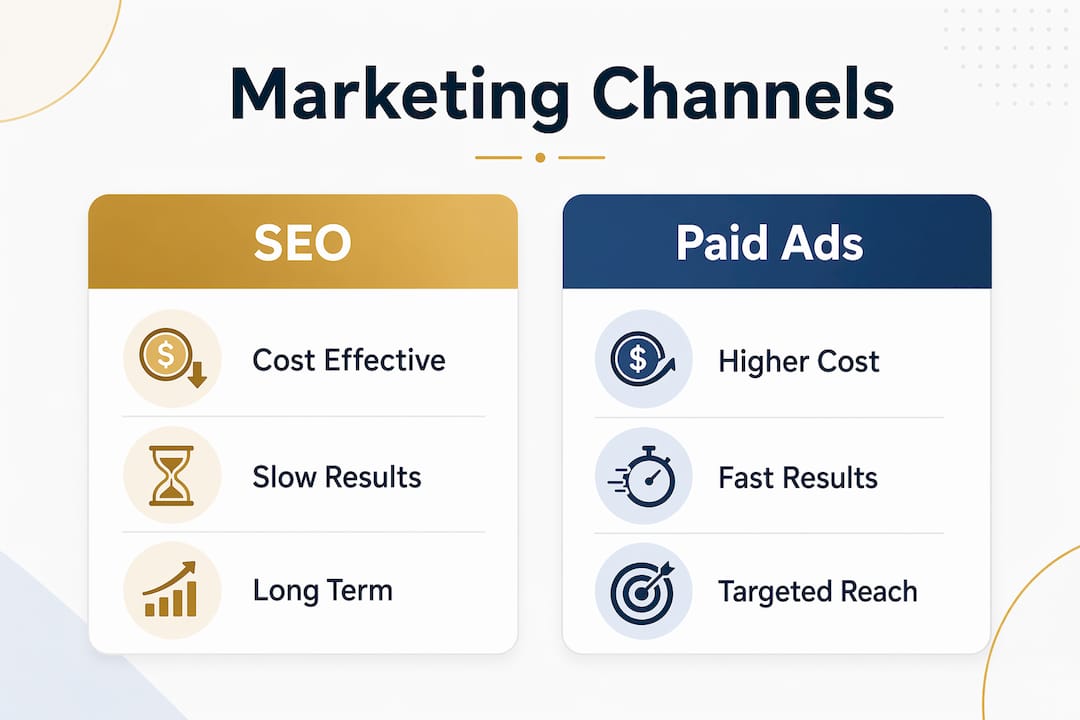
Not every channel delivers the same return at every stage of business growth. The table below compares the five primary channels by cost model, speed to results, and best-fit business stage.
| Channel | Cost model | Speed to results | Best fit |
|---|---|---|---|
| SEO | Time and content investment | 3 to 12 months | Established stores with content resources |
| Google Ads | Pay per click | Immediate | Any stage with sufficient margin |
| Meta and social ads | Pay per impression or click | Immediate to 2 weeks | Product discovery and retargeting |
| Email marketing | Platform subscription | Days to weeks | Retention and repeat purchase |
| Content marketing | Time and production cost | 6 to 18 months | Authority building and organic traffic |
The importance of SEO for e-commerce is often underestimated because the results are slow. However, organic search traffic compounds over time and carries no per-click cost, making it the highest-margin channel for stores that invest consistently. A well-structured product category page ranking on page one of Google generates revenue every day without additional spend.
Paid advertising via Google Ads and Meta fills the gap while SEO matures. The critical discipline is margin awareness. If your average order value is $80 and your gross margin is 40%, your maximum allowable cost per acquisition is $32. Running Google Shopping campaigns without that number front of mind is how e-commerce stores burn budget without building a business.
Social commerce via TikTok Shop and Instagram Shopping integrates discovery and purchase in a single session, shortening the funnel dramatically. Younger shoppers research via short-form video before buying, which makes a TikTok presence a genuine revenue channel rather than a brand awareness exercise. Brands selling fashion, beauty, and homewares are seeing direct attribution from TikTok Shop that rivals their Google Ads performance.
Key considerations when selecting your channel mix:
- Margin first. Paid channels only work when your product margin supports the cost per acquisition.
- Stage matters. Early-stage stores need immediate traffic from paid ads. Mature stores need the compounding returns of SEO and email.
- Mobile is non-negotiable. The majority of social and email traffic lands on mobile devices. A site that loads slowly or converts poorly on mobile wastes every dollar spent on traffic acquisition.
- Email drives retention better than any other channel. When treated as a conversation rather than a broadcast, email outperforms SMS, push notifications, and social for repeat purchase rate.
Digital marketing strategies that combine social media, content, and search engine marketing positively impact financial performance, customer relations, and new product development. Research evidence confirms that using multiple channels in a coordinated way produces better outcomes than relying on any single tactic.
How AI and analytics optimise digital marketing for e-commerce growth
Artificial intelligence has moved from a marketing buzzword to a measurable performance lever. SAP’s 2025 report found that 60% of marketers report increased engagement from AI use, and 58% see higher customer loyalty. Those numbers reflect a real shift: AI-powered tools like SAP Engagement Cloud now predict churn before it happens, optimise email send times per individual subscriber, and personalise product recommendations at scale.
The mechanism is straightforward. When unified customer data from your e-commerce platform, CRM, and ad accounts feeds a single analytics layer, AI models can identify which customers are at risk of lapsing and trigger a win-back sequence automatically. Without that unified data foundation, the AI has nothing useful to work with and the personalisation falls flat.
Pro Tip: Start AI personalisation with your email channel before expanding to on-site recommendations. Email gives you a controlled environment to test subject lines, send times, and offer types before you commit to more complex on-site personalisation infrastructure.
The risk with AI-driven personalisation is over-targeting. Customers who receive product recommendations that feel intrusive or irrelevant disengage faster than customers who receive no personalisation at all. The discipline is to use analytics across platforms to build complete customer views, then apply personalisation where it adds genuine relevance rather than everywhere it is technically possible.
For e-commerce brands running Google Ads, AI-powered bidding strategies like Target ROAS and Performance Max use real-time signals to allocate budget toward the highest-converting audiences. The catch is that these systems need sufficient conversion data to function well. Campaigns with fewer than 30 conversions per month should use manual or enhanced CPC bidding until the data volume supports automated strategies.
Practical ecommerce marketing tactics that maximise sales and loyalty
Knowing which channels exist is not the same as knowing how to deploy them. The following sequence gives e-commerce businesses a structured approach to building a marketing system that compounds over time.
-
Define your three core messages. Every campaign, ad, and email should connect back to three brand-level claims: what you sell, why it is better, and who it is for. Brands that cannot articulate these three points consistently produce fragmented messaging that confuses rather than converts.
-
Choose three channels and commit. The 3-3-3 rule prescribes three core messages, three channels, and three measurable outcomes to prevent resource sprawl. Trying to maintain a presence on Google, Meta, TikTok, Pinterest, YouTube, and email simultaneously with a small team produces mediocre results everywhere. Depth on three channels beats shallow presence on six.
-
Set three measurable outcomes per channel. For Google Ads, that might be cost per acquisition, return on ad spend, and conversion rate. For email, it might be open rate, click-to-purchase rate, and revenue per send. Without channel-specific metrics, you cannot identify what is working or where to invest more.
-
Build your retention engine before scaling acquisition. Email automation sequences for post-purchase, win-back, and loyalty rewards cost a fraction of paid acquisition and generate repeat revenue without incremental ad spend. Mailchimp, Klaviyo, and Omnisend all offer pre-built e-commerce automation flows that can be live within a week.
-
Audit omnichannel consistency quarterly. Omnichannel marketing requires a unified data foundation synchronising transaction history, customer behaviour, and marketing interactions. A customer who buys in-store should not receive a first-purchase welcome email the next day. Those mismatches erode trust and signal to customers that your business does not know them.
-
Invest in SEO as a long-term asset. An ecommerce SEO package that covers technical site health, category page optimisation, and link building creates a traffic asset that appreciates over time. Paid ads stop the moment you stop paying. Organic rankings, once earned, continue delivering traffic and revenue.
Key takeaways
Digital marketing in e-commerce works because SEO, paid advertising, email, and AI-driven personalisation each address a different stage of the customer journey, and their combined effect compounds over time.
| Point | Details |
|---|---|
| Digital marketing as innovation driver | Analytics and CRM integration build competitive agility that product development alone cannot achieve. |
| Channel selection by business stage | Paid ads deliver immediate traffic; SEO and email deliver compounding returns for mature stores. |
| AI personalisation requires unified data | AI tools like SAP Engagement Cloud only perform when customer data from all platforms is connected. |
| The 3-3-3 rule prevents sprawl | Three messages, three channels, and three metrics keep campaigns focused and measurable. |
| Retention beats acquisition on margin | Email automation and loyalty programmes generate repeat revenue at a fraction of paid acquisition cost. |
What I have learned about digital marketing’s real role in e-commerce
Most e-commerce businesses I work with come to us having spent heavily on paid ads and seen diminishing returns. The pattern is consistent: they treated digital advertising as the entire strategy rather than one component of a larger system. The shift that changes everything is when a business starts treating its marketing data as a strategic asset rather than a reporting afterthought.
The brands that grow sustainably in 2026 are not the ones chasing every new platform. They are the ones that have disciplined channel strategies, clean data infrastructure, and a genuine understanding of their customer lifetime value. When you know what a customer is worth over 12 months, every acquisition cost decision becomes straightforward.
I have also seen the damage that AI hype causes when it is applied without a data foundation. Personalisation that misfires because the underlying customer data is fragmented does more harm than a generic email. The technology is only as good as the data feeding it.
The digital marketing channels guide we publish at Jarrodharman reflects this philosophy: choose fewer channels, go deeper, and measure everything. That approach is less exciting than chasing the latest trend, but it is the one that builds a business rather than just a marketing programme.
, Business Warriors | Digital Marketing Agency
Ready to build a digital marketing system that actually scales?
If your e-commerce store is generating traffic but not the revenue to match, the issue is almost always structural. At Jarrodharman, we build integrated marketing systems that connect SEO, Google Ads, Meta advertising, email automation, and CRM data into a single growth engine. Our Marketing Vortex approach is designed specifically for businesses that are serious about measurable outcomes, not vanity metrics.
Whether you need an SEO audit, a paid media overhaul, or a full omnichannel strategy, our team at Business Warriors has the experience to deliver results with full transparency. Explore our digital advertising solutions or connect directly to discuss what your store needs to reach the next level.
FAQ
What is the role of digital marketing in e-commerce?
Digital marketing in e-commerce is the strategic use of SEO, paid advertising, social media, email, and content to attract, convert, and retain online shoppers. It functions as the primary growth engine for online stores, replacing the foot traffic and word-of-mouth that physical retail relies on.
Which digital marketing channel has the highest ROI for e-commerce?
Email marketing delivers the highest ROI for e-commerce when used as a retention tool, outperforming SMS, push notifications, and social media for repeat purchase rate. SEO follows closely as a long-term compounding asset with no per-click cost once rankings are established.
How does AI improve e-commerce marketing performance?
AI tools like SAP Engagement Cloud predict customer churn, optimise email send times, and personalise product recommendations at scale. SAP’s 2025 report found 60% of marketers using AI report higher customer engagement and 58% see improved loyalty.
What is the 3-3-3 rule in digital marketing?
The 3-3-3 rule prescribes three core brand messages, three marketing channels, and three measurable outcomes per campaign. This framework prevents resource sprawl and keeps small-to-medium e-commerce teams focused on depth over breadth.
How important is SEO for an e-commerce store?
SEO is the highest-margin traffic channel for e-commerce because organic rankings generate revenue without per-click costs. A well-optimised product category page can deliver consistent traffic and sales for years after the initial investment in content and technical site health.