25 May 2026
Digital content marketing manager: 2026 role guide
Discover the true impact of a digital content marketing manager in 2026. Learn how this hybrid role drives brand visibility and conversions.
TL;DR:
- A digital content marketing manager now combines content strategy, SEO, paid distribution, and analytics rather than just creating content. They utilize AI tools for research and optimisation, focusing on measurable outcomes like leads and conversions across multiple channels. Successful managers integrate data-driven insights with brand voice to effectively drive revenue and growth.
Most business owners picture a digital content marketing manager as someone who writes blog posts and captions. That picture is about twenty years out of date. Today, the role sits at the intersection of content strategy, SEO, paid advertising, AI-assisted optimisation, and attribution analytics. The title signals a hybrid role combining editorial ownership with performance distribution responsibilities. If you want to build brand visibility that actually converts, understanding what this role truly demands is the first move.
Table of Contents
- Key takeaways
- What a digital content marketing manager actually does
- Skills and tools you need in 2026
- AI integration in content marketing management
- Multi-channel distribution and paid advertising
- Analytics, measurement, and proving ROI
- My honest take on what separates great from average
- Take your content marketing further with Jarrodharman
- FAQ
Key takeaways
| Point | Details |
|---|---|
| Hybrid role, not just content creation | A digital content marketing manager owns strategy, SEO, paid distribution, and analytics together. |
| AI is reshaping the work | Large language models now assist with keyword research, copy optimisation, and content personalisation at scale. |
| Vanity metrics are the enemy | Leads, pipeline influence, and conversion events matter far more than raw page views or follower counts. |
| Multi-channel distribution is non-negotiable | Effective managers align content with audience segments across SEO, paid social, Google Ads, and email. |
| Analytics integration separates good from great | Connecting web, email, paid, and CRM data removes attribution blind spots and proves real ROI. |
What a digital content marketing manager actually does
There is a common misconception that a content and marketing manager spends most of their time writing. In reality, content ownership spans topics to campaigns and hands-on distribution across multiple channels. Writing is one input into a much larger system.
The core responsibilities break down like this:
- Content strategy development. This means audience segmentation, keyword targeting, topic cluster planning, and aligning content themes to business objectives at each funnel stage. A content strategy expert does not pick topics based on gut feel. Every piece maps to a search intent, a buyer persona, or a specific conversion goal.
- Content production management. This covers briefing writers, editing for SEO and brand voice, managing video scripts, podcast outlines, and social formats. Specialists produce content across formats including video, podcasts, and social posts while collaborating with sales, design, and product teams.
- Multi-channel distribution. An online content manager owns the publishing workflow across organic search, email sequences, paid social campaigns, and Google Ads. Distribution is not an afterthought. It is half the job.
- Performance tracking and optimisation. Digital marketing roles blend content with lifecycle and performance marketing, involving regular reporting through tools like GA4, HubSpot, and Search Console.
- Cross-team collaboration. Alignment with sales on lead quality, with product on messaging, and with paid media on budget allocation is a weekly requirement, not an occasional meeting.
Pro Tip: If you are hiring for this role, ask candidates how they have previously used Search Console data to improve a content piece. The answer tells you immediately whether they think like a strategist or just a writer.
Skills and tools you need in 2026
The technology stack a skilled SEO content manager uses has grown considerably. You need to know which tools matter and why, rather than collecting software licences that gather dust.
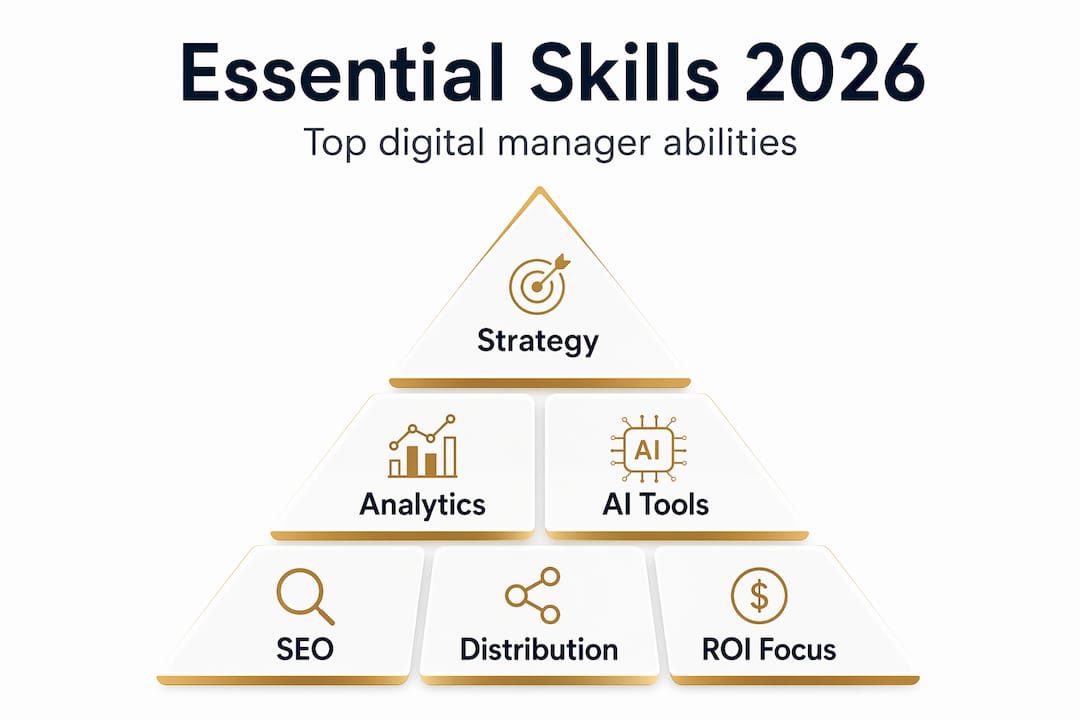
Full-funnel content planning paired with SEO and analytics capability forms the foundation of the role. Without it, you are producing content that ranks for nothing and converts no one.
Here is what the core toolkit looks like for a capable content marketing strategist:
- SEO and content planning tools. Keyword research platforms, competitor gap analysis tools, and Google Search Console for monitoring indexation, ranking movements, and click-through rates. Understanding topical authority and entity-based SEO is now expected, not advanced.
- Marketing automation and CRM. HubSpot, Mailchimp, and Marketo sit at the centre of lead nurturing. A content marketing executive who cannot build a basic email sequence or segment a contact list is operating with a significant gap.
- CMS and web publishing. WordPress remains the dominant platform. Understanding on-page SEO settings, schema markup, and page speed basics is part of the job.
- Paid advertising platforms. Facebook Ads Manager, LinkedIn Campaign Manager, and Google Ads are no longer optional. Content managers increasingly own or co-own paid promotion budgets.
- Data analytics. GA4, attribution modelling, and UTM tracking discipline are baseline requirements. You need to connect content performance to business revenue, not just traffic numbers.
- AI writing and optimisation tools. Large language models are now used for generating content briefs, rewriting copy variations, personalising email subject lines, and identifying content gaps. Understanding how these AI content tools work in practice is a genuine competitive advantage heading into 2026.
AI integration in content marketing management
AI is not replacing content managers. It is, however, making the gap between capable and average managers much wider. Those who understand how to use AI tools thoughtfully are producing more output with better targeting and faster iteration cycles.
Practically, AI-powered SEO tools now assist with keyword clustering, SERP feature targeting, and identifying content gaps your competitors have missed. Large language models can generate multiple headline variations, rewrite sections for different audience segments, and produce first drafts that a skilled editor shapes into finished pieces.
There is also the emerging territory of GEO, generative engine optimisation, which focuses on getting your brand mentioned and cited within AI-generated responses. As more users get answers directly from tools like ChatGPT, Gemini, and Perplexity rather than clicking through search results, appearing in those AI outputs becomes a meaningful traffic and brand visibility channel. A forward-thinking digital content strategy must account for this.
Pro Tip: Structure your content with clear definitions, authoritative statistics, and named methodologies. Large language models favour well-structured, credible sources when generating answers, which increases the chance your content earns a brand mention inside AI responses.
The ethical side matters too. AI-generated content that lacks genuine expertise or brand voice will damage trust over time. The best managers use AI to accelerate production while keeping human judgement at the centre of every final decision.
Multi-channel distribution and paid advertising
Content without distribution is just publishing into the void. Effective distribution requires tight alignment between content topics, audience segments, and specific conversion events at each funnel stage.
Here is a practical approach to multi-channel distribution:
- Map content to funnel stages. Awareness content (SEO blog posts, social videos, paid reach campaigns) feeds the top of the funnel. Consideration content (case studies, comparison articles, email sequences) moves prospects forward. Conversion content (landing pages, Google Ads, retargeting ads) closes them.
- Run paid social with purpose. Facebook and Instagram campaigns work best when you are retargeting engaged audiences with specific content rather than blasting cold audiences with generic brand messaging. LinkedIn works well for B2B content promotion and lead generation campaigns.
- Use Google Ads for intent-rich traffic. Someone searching a specific service phrase is far closer to buying than someone scrolling a social feed. Pair your paid advertising approach with landing pages built around a single conversion action.
- A/B test everything. Headlines, images, CTAs, and send times all affect performance. Never run a paid campaign without at least two creative variations and a clear hypothesis.
- Measure channel-specific outcomes. Each channel has its own performance signals. Email open and click rates, Google Ads conversion rates, and organic ranking movements all tell different parts of the same story.
Here is a quick comparison of primary distribution channels:
| Channel | Best use case | Primary metric |
|---|---|---|
| SEO content | Long-term organic traffic and authority building | Rankings and organic sessions |
| Google Ads | Capturing high-intent, ready-to-buy traffic | Conversion rate and cost per lead |
| Paid social (Meta) | Awareness, retargeting, and community building | Reach, CPM, and lead form submissions |
| Email marketing | Nurturing leads and re-engaging past customers | Click-through rate and pipeline contribution |
| LinkedIn Ads | B2B lead generation and professional brand visibility | Lead quality and cost per lead |
Analytics, measurement, and proving ROI
This is where most content managers fall short. Producing good content is satisfying. Sitting inside GA4 and working out why a campaign underperformed is not. But it is exactly this work that separates an average online content manager from one who genuinely moves the needle.

Measuring content performance effectively means focusing on conversion-oriented signals rather than vanity metrics. A spike in page views means nothing if none of those visitors converted. Track leads generated, assisted conversions, and pipeline influenced by specific pieces of content.
Pro Tip: Set up GA4 custom events to track micro-conversions like form starts, scroll depth, and video play completions. These signals tell you far more about content quality than bounce rate ever did.
The real skill is integrating measurement across web, email, paid, and CRM to reduce attribution blind spots. When your email platform, ad accounts, and CRM all speak the same UTM language, you can trace a lead from their first blog visit all the way to a signed contract.
One area that does not get enough attention is privacy compliance. Analytics in regulated industries must align with privacy and governance requirements, which directly shapes what data you can collect and how you can use it. For healthcare, finance, and legal businesses in particular, this is not a detail you can skip. Analytics drives significantly better ROI when done correctly, but only if the data underlying your decisions is both accurate and legally sound.
My honest take on what separates great from average
I have worked with enough businesses to see a clear pattern. The content managers and marketing leads who actually move revenue share one trait: they never treat content creation and distribution as separate jobs. They think about where a piece will live, how it will be promoted, and what conversion it supports before they write a single word.
What I have also seen is that the data-versus-creativity tension is mostly false. Great content without distribution data is a gamble. Analytics without good content is just optimising mediocrity. The two have to work together from day one.
The AI conversation comes up constantly. My take is straightforward. AI tools are genuinely useful for research, ideation, and first drafts. But the managers who let AI make every creative decision end up with content that sounds like everyone else. Brand voice is a differentiator. Protect it.
If you are figuring out how to become a content marketing manager or looking to sharpen your current approach, start with the analytics. Understand what content already works, why it works, and what it is missing. Build from evidence, not assumption.
, Business Warriors | Digital Marketing Agency
Take your content marketing further with Jarrodharman
Managing content across SEO, paid advertising, social media, email, and analytics is a serious undertaking. The good news is you do not need to figure it all out from scratch.

Jarrodharman’s Marketing Vortex method is built specifically for this challenge. It integrates SEO, Google Ads, Meta advertising, email marketing, and social content into one connected system, so every channel reinforces the others rather than competing for attention. Business owners and marketing managers working with this framework stop guessing which channel is working and start making decisions based on real attribution data.
If you want a step-by-step digital marketing approach that ties content directly to leads and revenue, explore the resources at Jarrodharman. There is practical guidance available for every stage of the content and distribution process, built for Australian businesses that are serious about growth.
FAQ
What does a digital content marketing manager do?
A digital content marketing manager owns content strategy, production, SEO optimisation, multi-channel distribution, and performance analytics. The role combines editorial and performance responsibilities rather than focusing on content creation alone.
What skills are needed for a content marketing manager?
You need full-funnel content planning, SEO expertise, proficiency with analytics tools like GA4 and Search Console, and working knowledge of paid advertising platforms. Familiarity with marketing automation tools such as HubSpot and Marketo is also expected in most roles.
How is AI changing content marketing management?
AI tools now assist with keyword research, content brief generation, copy optimisation, and personalisation at scale. Managers who understand how to use large language models effectively produce more targeted content faster, while maintaining human oversight over brand voice and strategy.
What metrics should a content marketing manager track?
Focus on leads generated, assisted conversions, pipeline influenced, and cost per acquisition rather than raw traffic or follower counts. Connecting content performance to revenue outcomes through integrated analytics across web, email, paid, and CRM gives you the clearest picture.
How does SEO fit into a digital content strategy?
SEO is central to a digital content strategy, shaping topic selection, content structure, internal linking, and technical publishing decisions. A capable SEO content manager uses keyword research, competitor gap analysis, and Search Console data to make every piece of content work harder for organic visibility.