

Scaling a service-based business across Australia can feel like a juggling act when your leads are unpredictable and budgets stretch thin. Digital advertising now offers business owners more control and precision than ever before, with targeted media channels designed to increase engagement and connect with your ideal clients. Understanding how these advertising platforms work lets you invest smarter, using data-driven strategies to build steady growth and consistent pipeline opportunities.
Table of Contents
- Digital Advertising Media Explained
- Types Of Digital Advertising Channels
- How Targeting And Campaigns Work
- Measuring Performance And Roi
- Risks, Costs, And Common Pitfalls
Key Takeaways
| Point | Details |
|---|---|
| Digital Advertising Transformation | Digital advertising has revolutionised marketing by enabling precise audience targeting and engagement across online platforms. |
| Diverse Advertising Channels | Key channels include Search Engine Marketing, Social Media Advertising, and Video Advertising, each offering unique targeting capabilities. |
| Data-Driven Strategies | Modern approaches focus on metrics such as click-through rates and conversion percentages to maximise return on investment. |
| Risks and Ethical Considerations | Businesses must be aware of common pitfalls like budget overruns and audience misalignment, balancing marketing goals with ethical practices. |
Digital Advertising Media Explained
Digital advertising has emerged as a transformative force in modern marketing, revolutionising how businesses connect with potential customers across online platforms. Strategic advertising platforms now enable precise targeting and engagement that traditional media could never achieve.
The landscape of digital advertising encompasses multiple powerful channels:
- Social Media Advertising: Platforms like Facebook, Instagram, and LinkedIn
- Search Engine Marketing: Google Ads and Bing Advertising
- Display Network Advertising: Banner ads across websites
- Video Advertising: YouTube and streaming platform promotions
- Native Advertising: Sponsored content matching platform aesthetics
Understanding digital advertising requires recognising its core mechanics. Digital media’s economic impact reveals that these platforms maintain a steady economic contribution, representing approximately 2% of GDP while delivering unprecedented consumer targeting.
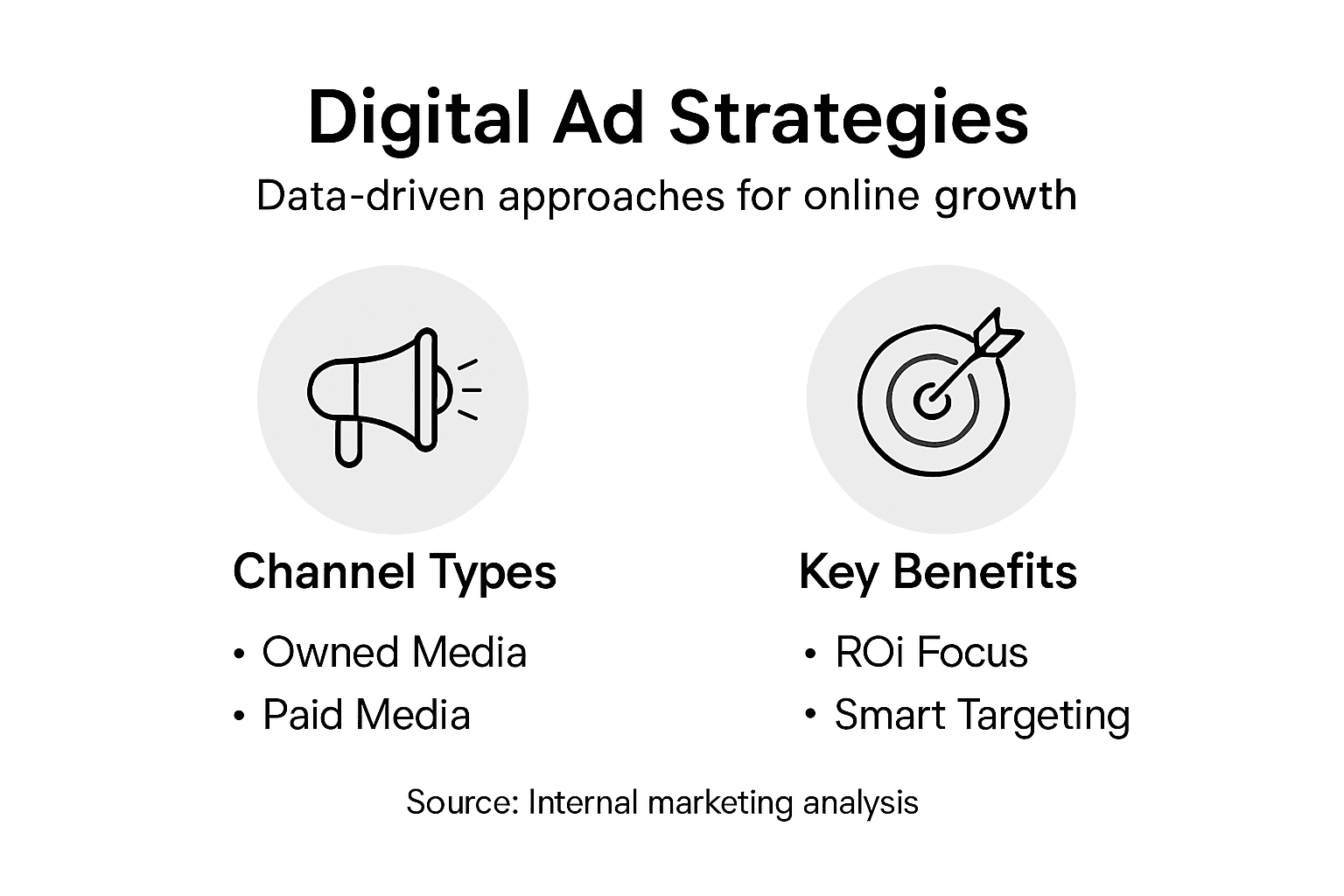
Modern digital advertising strategies focus on data-driven approaches that maximise return on investment. Businesses can now track precise metrics like click-through rates, conversion percentages, and audience engagement in real-time, allowing rapid optimisation of marketing campaigns.
Pro tip: Start with smaller advertising budgets and progressively scale your digital marketing efforts as you understand which channels deliver the best results for your specific business.
Types Of Digital Advertising Channels
Digital advertising channels represent a sophisticated ecosystem of marketing opportunities across multiple platforms and formats. Digital marketing channels encompass diverse strategies that enable businesses to reach and engage their target audiences with unprecedented precision and effectiveness.
The primary digital advertising channels can be categorised into several key types:
- Search Engine Marketing: Targeting users through Google, Bing, and other search platforms
- Social Media Advertising: Leveraging platforms like Facebook, Instagram, LinkedIn, and Twitter
- Display Network Advertising: Utilising banner ads and visual advertisements across websites
- Email Marketing: Sending targeted campaigns directly to potential customer inboxes
- Content Marketing: Creating valuable, informative content to attract and retain audiences
- Video Advertising: Promoting through YouTube, streaming platforms, and social media video channels
Digital media formats are strategically classified into three primary categories: owned media (company-controlled channels), paid media (sponsored advertising), and earned media (organic mentions and recommendations). This classification helps businesses understand and optimise their digital marketing approaches.
Each digital advertising channel offers unique targeting capabilities, allowing marketers to create highly personalised campaigns. Modern businesses can track real-time metrics, analyse audience behaviours, and continuously refine their strategies to maximise return on investment and engagement.

The table below summarises three types of digital media and how they support marketing goals:
| Media Type | Control Level | Role in Digital Marketing |
|---|---|---|
| Owned Media | Full business control | Platform for consistent messaging |
| Paid Media | Limited (budget-driven) | Extended reach to new audiences |
| Earned Media | No direct control | Builds credibility through advocacy |
Here is a comparison of the main digital advertising channels, their typical uses, and business benefits:
| Channel Type | Common Application | Key Business Benefit |
|---|---|---|
| Search Engine Marketing | Capture high-intent search traffic | Immediate lead generation |
| Social Media Advertising | Build brand awareness and engagement | Rapid audience growth |
| Display Network Ads | Retarget website visitors | Boost return visits |
| Email Marketing | Nurture prospects with direct contact | Improved customer retention |
| Video Advertising | Explain products with visuals | Higher engagement rates |
| Content Marketing | Educate and inform target segments | Authority and trust building |
Pro tip: Experiment with multiple digital advertising channels and allocate smaller budgets to test performance before scaling up your most successful platforms.
How Targeting And Campaigns Work
Digital advertising targeting transforms marketing by enabling businesses to reach precise audience segments with unprecedented accuracy. Social media marketing strategies help firms strategically allocate budgets to enhance competitive positioning and product awareness.
The key components of effective digital advertising targeting include:
- Demographic Targeting: Age, gender, income, education level
- Geographic Targeting: Location-based advertising
- Behavioural Targeting: User interests, online browsing history
- Psychographic Targeting: Lifestyle, values, personality traits
- Technographic Targeting: Device usage, platform preferences
Digital advertising campaigns leverage sophisticated data analysis techniques to maximise consumer engagement. By utilising recommendation algorithms and sentiment insights, businesses can create highly personalised content that resonates with specific audience segments.
Successful targeting requires a multi-dimensional approach. Marketers must continuously analyse performance metrics, adjust audience parameters, and refine messaging to maintain campaign effectiveness. The most advanced strategies integrate multiple targeting dimensions to create laser-focused advertising experiences.
Pro tip: Create detailed audience personas before launching campaigns, and continuously test and refine your targeting parameters to improve overall marketing performance.
Measuring Performance And ROI
Digital marketing performance measurement is crucial for understanding the effectiveness of advertising investments. Digital advertising analytics provide businesses with sophisticated tools to evaluate campaign success through comprehensive metrics and data-driven insights.
Key performance indicators (KPIs) for digital advertising include:
- Conversion Rate: Percentage of users taking desired actions
- Click-Through Rate (CTR): Proportion of users clicking on advertisements
- Cost Per Acquisition (CPA): Total cost of acquiring a new customer
- Return on Ad Spend (ROAS): Revenue generated per advertising dollar
- Engagement Rate: Level of audience interaction with content
- Customer Lifetime Value (CLV): Predicted total revenue from a customer
Performance measurement techniques integrate quantitative analytics with consumer behaviour studies to create comprehensive evaluation frameworks. These methods help marketers understand how advertising investments translate into tangible business outcomes.
Successful ROI tracking requires consistent monitoring, advanced analytics tools, and a willingness to adapt strategies based on data insights. Businesses must develop a holistic approach that considers both immediate campaign performance and long-term growth potential.
Pro tip: Implement a monthly review process that systematically compares your advertising metrics against established benchmarks and business objectives.
Risks, Costs, And Common Pitfalls
Digital advertising risks represent complex challenges for modern businesses navigating online marketing landscapes. Digital advertising presents significant risks that extend beyond simple financial considerations, encompassing broader social and ethical implications.
Common digital advertising pitfalls include:
- Budget Overruns: Uncontrolled spending without clear ROI
- Audience Misalignment: Targeting incorrect demographic segments
- Privacy Concerns: Potential data collection and usage violations
- Ad Fatigue: Diminishing audience engagement over time
- Platform Dependency: Over-reliance on single advertising channels
- Ethical Challenges: Potential manipulation of consumer behaviours
Advertising’s negative external impacts reveal deeper concerns about consumer manipulation and societal influence. Businesses must carefully balance marketing objectives with ethical considerations, ensuring transparent and responsible advertising practices.
Successful digital advertising requires a nuanced approach that acknowledges potential risks while maintaining strategic flexibility. Companies must develop robust monitoring systems, maintain ethical standards, and remain adaptable to changing technological and regulatory landscapes.
Pro tip: Conduct quarterly ethical and performance audits of your digital advertising strategies to identify potential risks and maintain alignment with best practices.
Unlock Your Business Growth with Expert Digital Advertising Strategies
Digital advertising offers incredible opportunities, but it can also be overwhelming to know where to start or how to best target your ideal audience while maximising ROI. This article highlights common challenges such as audience misalignment, budget overruns, and ineffective campaign measurement. If you want to avoid these pitfalls and leverage advanced targeting, omnichannel marketing, and measurable results, Business Warriors can help.

Discover how Jarrod Harman’s unique Marketing Vortex Method integrates SEO, Google Ads, Meta advertising, email marketing, social media, and more into a seamless growth engine designed for service-based businesses and beyond. Don’t wait until ad fatigue or poor ROI slows your progress. Visit https://jarrodharman.com to explore proven strategies and client success stories. Jumpstart your online growth today and overcome the risks of digital advertising with expert guidance from a trusted marketing ally.
Ready for practical insights and customised marketing solutions? Check out the Uncategorized Archives – Jarrod Harman for relevant resources or visit our homepage now to connect with Business Warriors and start turning clicks into clients.
Frequently Asked Questions
What are the main types of digital advertising channels?
Digital advertising channels include search engine marketing, social media advertising, display network advertising, email marketing, content marketing, and video advertising, each offering unique advantages for reaching target audiences.
How can businesses measure the effectiveness of their digital advertising campaigns?
Businesses can measure effectiveness through key performance indicators (KPIs) such as conversion rate, click-through rate (CTR), cost per acquisition (CPA), return on ad spend (ROAS), engagement rate, and customer lifetime value (CLV).
What targeting options are available in digital advertising?
Digital advertising offers various targeting options, including demographic targeting (age, gender), geographic targeting (location), behavioural targeting (user interests), psychographic targeting (lifestyle values), and technographic targeting (device usage).
What are common pitfalls to avoid in digital advertising?
Common pitfalls include budget overruns, audience misalignment, privacy concerns, ad fatigue, over-reliance on single channels, and ethical challenges. Businesses should monitor their strategies and maintain flexibility to mitigate these risks.