


Trying to stand out among competitors on Facebook or Instagram can feel overwhelming for many female business owners in Western Australia. The fast-moving world of social media is full of new tools and opportunities, but it is hard to know what truly delivers results. Understanding precision targeting and how social platforms create real connections makes it possible to attract steady leads and sales without wasted effort or guesswork.
Table of Contents
- Social Media Advertising Explained Simply
- Core Types and Features of Social Platforms
- Powerful Targeting and Audience Reach
- Driving Brand Awareness and Engagement
- Cost, Measurement, and ROI Implications
Key Takeaways
| Point | Details |
|---|---|
| Powerful Targeting | Social media advertising enables precise audience targeting based on demographic, behavioural, and psychographic data, enhancing engagement and conversion rates. |
| Enhanced Brand Engagement | Interactive capabilities on social platforms create emotional connections and boost consumer loyalty through ongoing brand communication. |
| Cost-Effectiveness | Social media advertising offers superior cost efficiency compared to traditional methods, allowing businesses to maximise ROI with measured spending. |
| Real-Time Analytics | Comprehensive analytics dashboards provide businesses with real-time insights, enabling immediate campaign adjustments for optimisation. |
Social Media Advertising Explained Simply
Social media advertising represents a powerful digital marketing strategy that allows businesses to reach targeted audiences through precise demographic and behavioural targeting on platforms like Facebook, Instagram, LinkedIn and Twitter. Social media marketing research demonstrates how these platforms enable unprecedented communication between brands and consumers, transforming traditional advertising approaches.
The core mechanism of social media advertising involves leveraging platform algorithms and user data to display sponsored content directly to individuals most likely to engage with a specific product or service. These advanced targeting capabilities mean businesses can move beyond broad, expensive mass media campaigns towards highly efficient, measurable digital strategies. Precision targeting allows advertisers to select audiences based on interests, behaviours, location, age, income level, and even past purchasing patterns.
Modern social media advertising platforms offer sophisticated tools that go well beyond simple image and text promotions. With features like retargeting, businesses can re-engage users who have previously interacted with their website or digital content, creating multiple touchpoints that increase conversion probability. Comprehensive digital advertising studies highlight how artificial intelligence and machine learning are continuously improving these targeting mechanisms, making social media advertising increasingly intelligent and responsive.
Expert Tip: Start with smaller budget experiments to test different audience segments and ad creative before scaling your social media advertising investments.
Core Types and Features of Social Platforms
Social media platforms offer diverse marketing capabilities that extend far beyond simple advertising channels. Social media marketing research categorises these platforms into five critical functional areas: promotion and selling, communication and branding, monitoring intelligence, customer relationship management, and strategic marketing tools. Each category represents a unique approach to digital engagement that businesses can leverage for targeted marketing objectives.
The primary social platforms like Facebook, Instagram, LinkedIn, Twitter, and TikTok each provide distinct advertising features tailored to specific audience demographics and marketing goals. Facebook offers comprehensive audience targeting with detailed demographic filters, Instagram excels in visual storytelling and product showcasing, LinkedIn specialises in professional and B2B marketing, Twitter enables real-time engagement and trending topic marketing, while TikTok provides immersive short-form video advertising opportunities. Platform advertising capabilities highlight how these unique characteristics allow marketers to create highly customised campaign strategies.
Modern social media platforms integrate sophisticated tools that go beyond basic advertising. Advanced features include pixel tracking, retargeting capabilities, custom audience creation, lookalike audience generation, and detailed analytics dashboards. These technologies enable businesses to create complex, multi-touchpoint marketing campaigns that can track user interactions across different digital environments, providing unprecedented insights into consumer behaviour and campaign performance.
This summary highlights the most impactful business benefits enabled by advanced social media ad tools:
| Feature | Marketing Benefit | Impact on Results |
|---|---|---|
| Retargeting | Re-engage interested users | Boosts conversion rates |
| Pixel tracking | Tracks website actions | Improves attribution |
| Lookalike audiences | Expands reach cost-effectively | Acquires new customers |
| Analytics dashboard | Real-time campaign insights | Rapid strategy optimisation |
Here’s a concise comparison of key advertising features across major social media platforms:
| Platform | Primary Strength | Target Audience | Ad Format Diversity |
|---|---|---|---|
| Demographic targeting | Broad consumer base | Wide range: images, video, carousel | |
| Visual storytelling | Millennials, Gen Z | Stories, reels, shopping posts | |
| Professional marketing | B2B, professionals | Sponsored content, InMail | |
| Real-time engagement | News seekers, brands | Tweets, promoted trends | |
| TikTok | Short-form video reach | Gen Z, creatives | Vertical videos, branded hashtags |
Pro Tip: Experiment with different platform-specific ad formats and continuously analyse performance metrics to optimise your social media advertising strategy.
Powerful Targeting and Audience Reach
Audience targeting represents the most revolutionary aspect of social media advertising, enabling businesses to reach precisely defined customer segments with unprecedented accuracy. Data-driven marketing research reveals how modern platforms allow marketers to craft persuasive messages tailored to specific demographic, behavioural, and psychographic characteristics, transforming traditional mass marketing approaches.
Social media platforms provide granular targeting options that extend well beyond basic demographic filters. Advertisers can now target audiences based on intricate criteria such as recent purchase behaviours, life events, interests, professional backgrounds, device usage, and even precise geographic locations. Micro-targeting capabilities mean businesses can create hyper-personalised advertising experiences that speak directly to niche audience segments, dramatically improving engagement and conversion rates.
The sophisticated algorithmic systems behind social media platforms continuously learn and refine audience targeting capabilities. Machine learning technologies analyse user interactions, browsing histories, engagement patterns, and complex behavioural signals to help advertisers identify and reach the most relevant potential customers. These intelligent systems can predict consumer interests and behaviours with remarkable precision, allowing businesses to create increasingly effective and efficient marketing campaigns that minimise wasted advertising spend.
Pro Tip: Regularly update your audience targeting parameters and conduct A/B testing to discover the most responsive customer segments and optimise your advertising performance.
Driving Brand Awareness and Engagement
Brand awareness is fundamentally transformed by social media’s interactive capabilities, moving beyond traditional one-way communication models. Social media marketing research demonstrates how platforms enable ongoing interaction between brands and users, creating emotional connections that drive sustained consumer engagement and loyalty through content sharing and direct communication channels.

Successful social media strategies leverage multiple engagement mechanisms to amplify brand visibility. These include creating compelling visual content, hosting interactive live streams, developing user-generated content campaigns, collaborating with influencers, and implementing dynamic storytelling approaches that encourage audience participation. Content virality becomes a critical metric, with platforms providing sophisticated tools that allow businesses to track and amplify their message reach through algorithmic recommendations and sharing capabilities.
The psychological underpinnings of social media engagement reveal complex consumer motivations. Consumer interaction research highlights that consumers seek emotional satisfaction, information, social connection, and entertainment through digital platforms. By understanding these underlying needs, businesses can craft targeted content strategies that resonate deeply with their specific audience segments, transforming passive viewers into active brand advocates.
Pro Tip: Create a consistent content calendar that balances informative, entertaining, and interactive posts to maintain audience engagement and build lasting brand relationships.
Cost, Measurement, and ROI Implications
Return on investment in social media advertising requires sophisticated measurement strategies that go beyond traditional marketing metrics. Cost-effectiveness research demonstrates that social media platforms offer superior cost-efficiency compared to traditional advertising channels, enabling businesses to generate higher returns through precision targeting and granular performance tracking.
Modern social media advertising platforms provide comprehensive analytics dashboards that enable businesses to measure multiple key performance indicators (KPIs). These sophisticated tracking tools allow marketers to analyse metrics such as click-through rates, conversion rates, cost per acquisition, engagement percentages, audience reach, and detailed demographic interaction data. Campaign performance can be evaluated in real-time, allowing businesses to make immediate adjustments to optimise advertising spend and maximise return on investment.
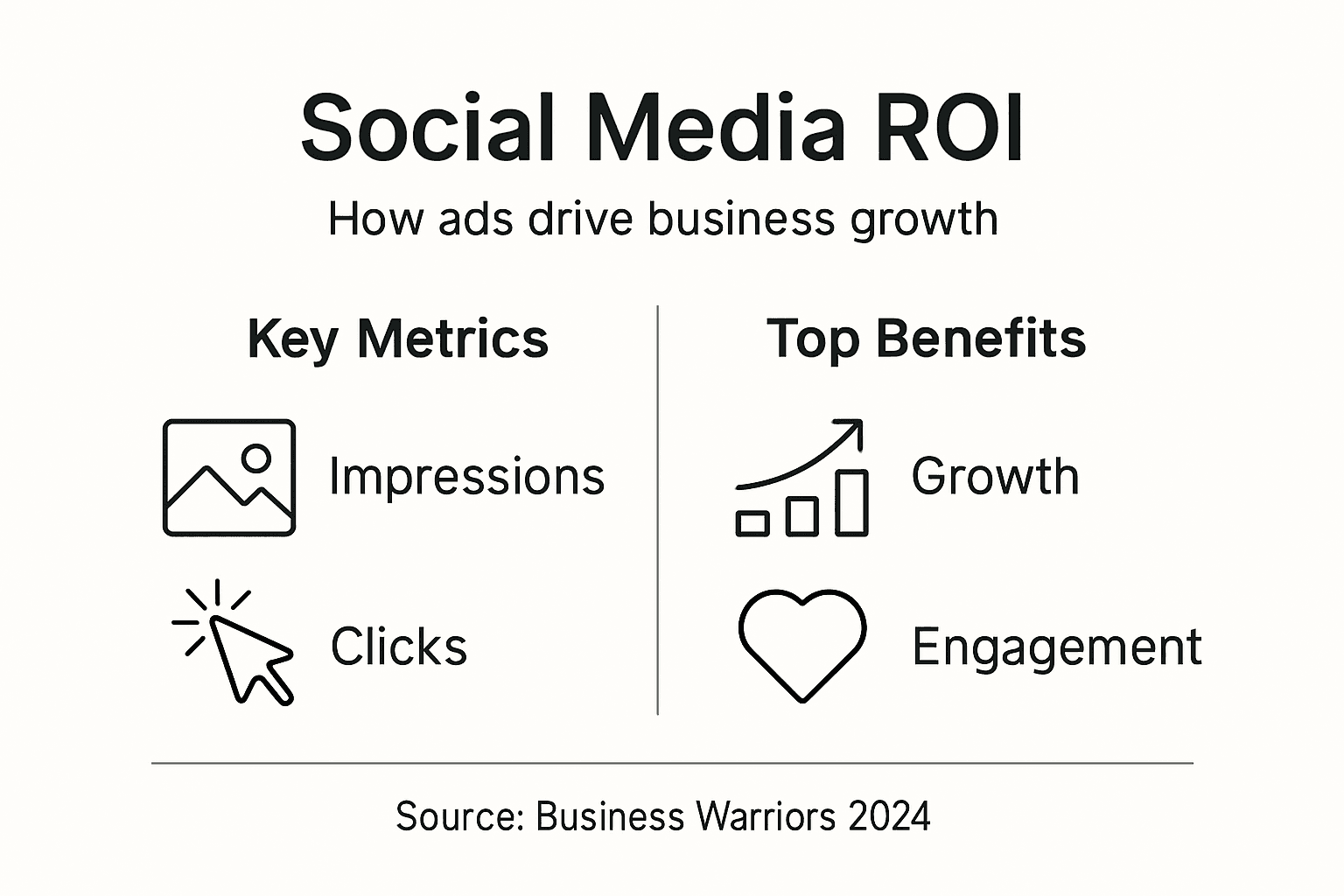
Marketing industry reports reveal that successful businesses approach social media advertising as a strategic investment rather than an expense. By implementing robust tracking mechanisms and understanding the nuanced relationship between advertising spend and business outcomes, companies can develop data-driven marketing strategies that systematically improve financial performance. Advanced machine learning algorithms now enable predictive analytics that help businesses forecast potential campaign performance and allocate budgets more effectively.
Pro Tip: Implement a comprehensive tracking system that measures both direct conversions and long-term brand value to gain a holistic understanding of your social media advertising performance.
Unlock Business Growth with Strategic Social Media Advertising
If you are eager to transform your social media advertising efforts into consistent business growth, understanding how to leverage advanced targeting and engagement strategies is essential. This article highlights the power of precision targeting, retargeting, and data-driven campaign optimisation techniques to boost brand awareness and conversions. Many business owners struggle with knowing exactly how to translate social media activity into measurable results and a steady stream of qualified leads.
At Business Warriors, we specialise in applying Jarrod Harman’s proven “Marketing Vortex” Method to create integrated, scalable sales and marketing systems. Whether you want to master Facebook and Instagram ads, expand through Google Ads and email marketing, or develop compelling social content that drives engagement, our expertise in service-based industries ensures your marketing budget delivers.
Learn how to apply concepts like lookalike audiences, pixel tracking, and dynamic content optimisation with actionable insights from Uncategorized Archives – Jarrod Harman.
Ready to turn your social media presence into a powerful growth engine that fills your client list? Visit Jarrod Harman and connect with us today. Explore tailored strategies backed by real results and take the first step to dominate your niche with confidence.
Frequently Asked Questions
What is social media advertising?
Social media advertising involves promoting products or services on social media platforms using targeted content to reach specific audiences based on demographics and behaviours.
How does social media advertising improve business growth?
By leveraging precise audience targeting and advanced analytics, social media advertising allows businesses to engage users effectively, boosting brand awareness and encouraging higher conversion rates.
What are key features of social media advertising platforms?
Key features include retargeting, pixel tracking, custom audience creation, lookalike audience generation, and detailed analytics, which enhance campaign effectiveness and insights into consumer behaviour.
Why is audience targeting important in social media advertising?
Audience targeting is crucial because it enables businesses to identify and engage specific customer segments with tailored messages, significantly increasing engagement and conversion rates.