21 May 2026
Lead management strategy for service businesses in 2026
Discover a powerful lead management strategy for service businesses. Improve efficiency, boost conversions, and turn inquiries into loyal clients!
TL;DR:
- Most service businesses lose leads due to slow, unclear, and disjointed internal processes rather than poor quality. Implementing a structured lead management system that emphasizes speed, automation, and clear handoffs significantly improves conversion rates. Regular review and simplification of these processes ensure consistent improvement and sustained success.
Most service businesses lose leads not because their quality is poor, but because their internal processes are slow, unclear, and disjointed. A well-built lead management strategy is the operational backbone that turns enquiries into paying clients, and it matters far more than ad spend or audience targeting alone. If your team is still routing leads manually, skipping nurture sequences, or failing to follow up within the first hour, you are already losing business to competitors who have simply organised themselves better. This guide gives you a practical framework to fix that.
Table of Contents
- Key takeaways
- The six stages of lead management strategy
- Speed and smart routing: the conversion multiplier
- Aligning marketing and sales for cleaner handoffs
- Lead nurturing across channels that convert
- Metrics and dashboards that sharpen your strategy
- My perspective on lead management that actually works
- Build a system that converts, not just attracts
- FAQ
Key takeaways
| Point | Details |
|---|---|
| Speed determines conversion | Leads contacted within 5 minutes are 21 times more likely to qualify than those reached after 30 minutes. |
| Automation removes human delay | Automated routing and SLA enforcement reduce response time and lift conversion rates by 20 to 30 per cent. |
| Alignment prevents lead leakage | Shared MQL and SQL definitions between marketing and sales stop leads falling through the cracks at handoff. |
| Nurture must be multichannel | Mixing email, SMS, voice, and social touchpoints at decreasing frequency keeps leads engaged without oversaturation. |
| Measurement drives improvement | Tracking pipeline velocity, lead ageing, and MQL to SQL conversion rate gives you the data to iterate and improve. |
The six stages of lead management strategy
Before you can improve your lead management strategy, you need to know exactly what it consists of. Most service businesses treat their pipeline as a single stage: someone enquires, someone follows up. The reality is more precise than that, and the precision is where conversions are made or lost.
A complete lead lifecycle runs through six defined stages: capture, qualify, assign, contact, nurture, and convert. Each stage needs a clear owner, defined entry and exit criteria, and at least one metric that tells you whether it is working.
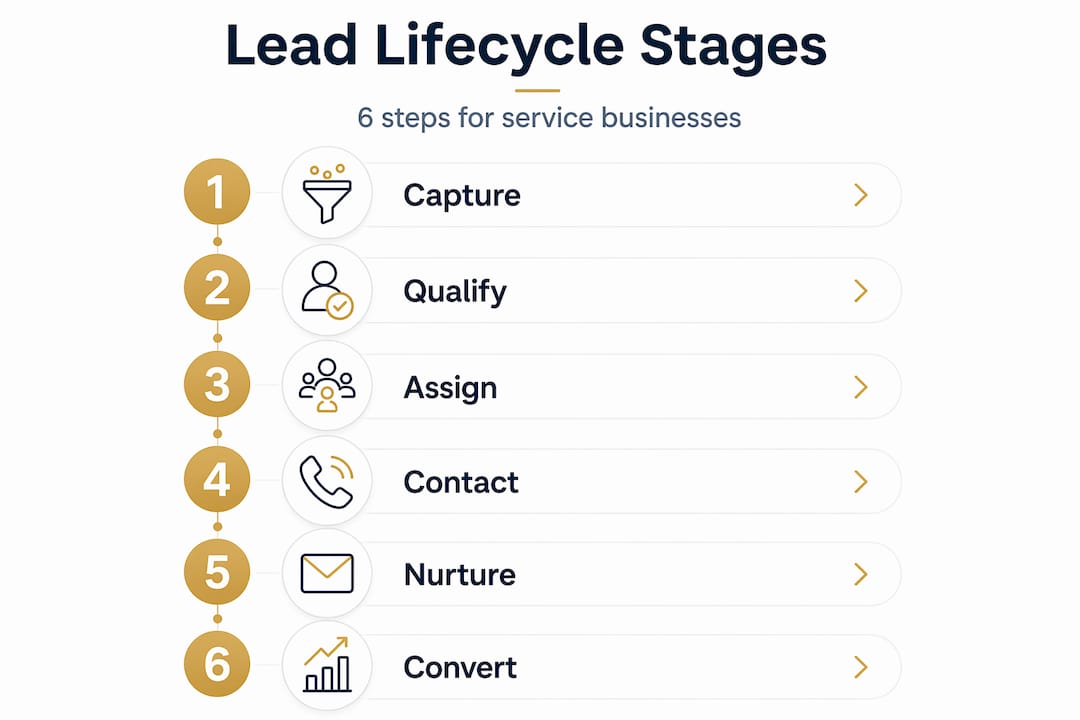
| Stage | Owner | Key metric |
|---|---|---|
| Capture | Marketing team | Cost per lead, volume by source |
| Qualify | Marketing or SDR | MQL rate, disqualification rate |
| Assign | CRM automation | Time to assignment, routing accuracy |
| Contact | Sales rep or BDM | Time to first contact, contact rate |
| Nurture | Marketing automation | Engagement rate, sequence completion |
| Convert | Sales rep | Close rate, revenue per lead |
CRM lead management is most effective when each of these stages has automation supporting the human decision. Your CRM should handle routing, trigger alerts, log engagement, and escalate overdue leads without anyone needing to manually check a spreadsheet. The common pitfalls are skipping the qualify stage entirely (sending every enquiry straight to sales), and abandoning leads that do not convert on first contact instead of moving them into a structured nurture sequence.
Effective lead management also means knowing what “done” looks like at each stage. A lead is not ready to assign until it has been scored. A lead is not ready to convert until it has been contacted at least twice. Without those exit criteria documented, your pipeline becomes a dumping ground rather than a system.
Speed and smart routing: the conversion multiplier
If there is one metric that service businesses consistently underestimate, it is response time. Leads contacted within 5 minutes are 21 times more likely to qualify than those reached after 30 minutes. Yet the average lead response time across most industries sits at 42 hours. That gap is not a sales problem. It is an operational one.

The causes are predictable: manual routing processes, mismatches between lead source and rep speciality, and no formal SLA defining when a lead must be contacted. Automated routing and SLA enforcement dramatically reduce idle time and improve accountability across sales teams. When a lead submits a form at 8pm on a Thursday, automation can assign it, trigger a holding communication, and alert the right rep before 8am Friday.
Here is where CRM lead management pays for itself. Treating your CRM queues as the front door for every lead, as high-performing Salesforce teams do, means no lead is ever unowned. Every record in the queue has an assigned rep, a defined response window, and an escalation path if that window is missed.
AI has made routing significantly more accurate. AI-powered lead-to-account matching achieves 95% accuracy, which reduces misrouting and shortens the time reps spend researching a lead before they call. Rather than a rep guessing the right context for a conversation, the system surfaces the relevant information automatically. That shifts the conversation from assumption-based to relevance-driven, which is exactly the kind of AI for sales engagement that actually moves numbers.
Pro Tip: Set up fallback queues and escalation paths before you launch any campaign. If your primary rep does not act within the defined SLA window, the lead should automatically reassign or trigger a manager alert. This single rule prevents more lost leads than any scoring model.
Aligning marketing and sales for cleaner handoffs
The most common source of lead leakage in service businesses is not bad leads. It is the handoff between marketing and sales, where shared definitions and context transfer almost always break down.
Misaligned MQL and SQL definitions combined with delayed follow-up cause significant drop-offs in conversion. The fix starts with a formal agreement on what qualifies a lead for each stage, built jointly by both teams.
Here is how to structure that alignment process:
- Define your MQL criteria together. Agree on the specific signals that indicate marketing readiness: a combination of fit (industry, location, business size) and intent (page visits, form fills, content downloads).
- Use a simple dual-dimension scoring model. A three-bucket model using Hot, Warm, and Nurture classifications outperforms complex point systems because reps actually use it.
- Create a lead handoff package. When a lead moves to sales, the rep should receive the lead’s engagement history, identified pain points, and a recommended talk track. Sales reps convert better when handed leads with this level of context rather than just a name and phone number.
- Automate the handoff trigger. When a lead hits MQL threshold, your CRM should automatically create a task, notify the assigned rep, and log the handoff timestamp.
- Define SLA at handoff. How many hours does the sales rep have to make first contact? What happens if they miss it? These rules should be written down and enforced by your automation, not by a manager chasing people in a Slack channel.
Pro Tip: Schedule a monthly 30-minute review between your marketing lead and sales lead to compare disqualification reasons. If sales is rejecting 40 per cent of MQLs, the scoring criteria needs adjusting. If they are converting 90 per cent, the bar may be too high and you are under-investing in top of funnel.
Regular feedback loops between teams are not a nice-to-have in sales lead optimisation. They are the mechanism by which your lead management system actually learns and improves over time.
Lead nurturing across channels that convert
Most leads are not ready to buy when they first enquire. For service businesses, the decision cycle can range from days to months. A structured nurture strategy is what keeps your business in front of the right people until they are ready to act.
Effective nurturing is built on three principles: spacing, channel diversity, and genuine value per touch. Sending five emails in a week and then going silent is not nurturing. It is noise followed by abandonment.
Nurture sequences with varied channels and spaced outreach consistently increase lead engagement. A well-structured cadence might look like this:
- Day 1: Automated email with a useful resource (case study, guide, or video)
- Day 3: SMS or a short voice message from the assigned rep
- Day 7: Retargeting ad served through Meta or Google
- Day 14: LinkedIn connection or message if B2B context applies
- Day 21: Second email with a fresh angle or client result
- Day 30: Final follow-up call with a clear, low-friction offer
Integrating your SEO content strategy into this cadence makes each touchpoint more credible. When a lead receives an email linking to a well-ranked article that answers their specific question, it reinforces your authority far more than a templated sales pitch. Paid advertising works in the same way: retargeting leads with content they have already shown interest in, rather than a generic offer, keeps engagement rates high without increasing spend.
AI tools now allow you to adapt nurture sequences based on individual lead behaviour. If a lead opens every email but never clicks, you send a different follow-up than if they clicked three links but did not book. That level of personalisation at scale was not possible without automation. A solid lead nurturing process will document these decision branches so the system runs without manual input.
Pro Tip: Pause the nurture sequence immediately once a lead replies or books. Continuing automated outreach after a prospect has engaged not only annoys them, it signals that your business is not paying attention, which destroys trust at the worst possible moment.
Metrics and dashboards that sharpen your strategy
Tracking the right numbers is what separates businesses that improve from those that repeat the same mistakes every quarter. Sales lead optimisation is not a one-time project. It is an ongoing process of measuring, identifying bottlenecks, and testing fixes.
The KPIs that matter most for service business lead management are:
| Metric | What it tells you |
|---|---|
| Lead response time | How quickly your team acts on new enquiries |
| MQL to SQL conversion rate | How well marketing is qualifying before handoff |
| Pipeline velocity | How fast leads move from enquiry to closed deal |
| Lead ageing | How many leads are sitting untouched past SLA |
| Funnel leakage rate | Where in the pipeline leads are dropping off |
High-performing teams track and review these metrics regularly, adjusting their strategy based on real data rather than gut feel. Build a live dashboard in your CRM that surfaces these numbers daily, not just in monthly reports. When lead ageing spikes on a Tuesday, you want to know Wednesday morning, not at the end-of-month review.
AI analytics layers add another dimension to how to manage leads at scale. Behavioural pattern recognition can flag leads that are showing strong buy signals even before they re-engage directly. That gives your reps a reason to reach out proactively, which dramatically outperforms waiting for inbound replies.
A/B testing your routing rules and nurture sequences is often overlooked in smaller organisations, but it is one of the highest-leverage activities available. Test whether leads assigned by industry vertical convert better than those assigned by geography. Test whether a three-touch or five-touch nurture sequence produces more bookings. Let data guide those decisions.
My perspective on lead management that actually works
In my experience working with service businesses across Australia, the most common lead management problem is not a lack of leads. It is a lack of operational discipline around the leads that already exist.
I have seen businesses spending tens of thousands per month on paid advertising while their average response time sits above 24 hours. That is not a marketing problem. It is an operational one, and no amount of ad spend fixes it. Speed, ownership clarity, and context at handoff consistently move the needle faster than any creative refresh or audience adjustment.
The advice I find myself giving most often is this: treat your lead management system as an evolving machine, not a one-time build. Your scoring model will drift out of alignment. Your nurture sequences will go stale. Your routing rules will stop matching your team structure after a hire or a departure. The businesses that win are the ones that schedule regular reviews, look at the actual data, and make small, deliberate adjustments.
I have also seen the trap of overcomplicated scoring models that reps simply ignore. Simplicity and transparency drive adoption. A three-bucket model that your team actually uses outperforms a 40-point system that sits unused in your CRM settings. The best lead management strategy is not the most sophisticated one. It is the one that gets followed, every single day.
, Business Warriors
Build a system that converts, not just attracts
Your lead management strategy is only as good as the system that supports it. At Jarrodharman, we help service businesses build and integrate that system from the ground up, covering SEO strategy, Google Ads, Meta advertising, email automation, and everything in between. The Marketing Vortex Method is designed specifically for service-based businesses that need their marketing and sales infrastructure to work together as one engine, not a collection of disconnected tools.

We have worked with salons, clinics, law firms, and national franchise networks to reduce lead response times, build nurture sequences that actually convert, and create dashboards that give leadership real visibility over pipeline health. If you are serious about improving your lead conversion results in 2026, reach out for a personalised consultation. We will show you exactly where your current system is leaking and what to do about it.
FAQ
What is a lead management strategy?
A lead management strategy is a structured process for capturing, qualifying, routing, nurturing, and converting leads into paying clients. It defines who owns each stage, what automation handles, and how success is measured.
How fast should you contact a new lead?
Within five minutes where possible. Leads reached within 5 minutes are 21 times more likely to qualify than those contacted after 30 minutes, making response time one of the highest-impact variables in conversion.
What is the difference between an MQL and an SQL?
An MQL (marketing qualified lead) meets the criteria your marketing team has set for readiness to pass to sales. An SQL (sales qualified lead) has been reviewed by a sales rep and confirmed as a genuine opportunity worth pursuing.
How does automated lead management improve conversion?
Automated routing and SLA enforcement remove manual delays, ensure every lead is owned immediately, and trigger escalation when response windows are missed. This directly reduces idle time and improves follow-up consistency across your team.
How do you build a lead nurture sequence for a service business?
Start with a marketing automation checklist and map out your typical decision timeline. Then build a sequence that mixes email, SMS, retargeting, and direct outreach at decreasing frequency, stopping immediately once the lead engages or books.