


TL;DR:
- Content marketing offers Australian service businesses a 320% ROI by building trust and attracting leads.
- A clear, consistent strategy integrating audience research, content types, and distribution is essential for success.
- Combining human creativity with AI tools enhances results, but genuine storytelling and authority establish long-term growth.
Australian service businesses are sitting on a goldmine. Strategic content marketing delivers an average 320% ROI and 30-50% organic traffic growth for local service operators, yet most owners struggle to translate that potential into actual bookings and revenue. The gap is not a lack of information. It is a lack of a clear, repeatable system. Whether you run a clinic, a consultancy, a salon, or a trades business, this guide walks you through exactly how to build a content engine that attracts leads, nurtures prospects, and converts them into paying clients throughout 2026 and beyond.
Table of Contents
- Why content marketing fuels business growth in Australia
- Building a content marketing strategy that works in 2026
- Leveraging AI and smart tools to supercharge your content
- Proven tactics: Turning content into leads and sales
- What most content marketing guides miss: Creative leadership over tools
- Get expert help to accelerate your content marketing success
- Frequently asked questions
Key Takeaways
| Point | Details |
|---|---|
| Content boosts leads | Targeted content marketing consistently drives organic and sales growth for Australian service businesses. |
| Strategic planning matters | Results come from structured, goal-driven content strategies—ad hoc posting rarely works. |
| AI is a support tool | Use AI for speed and insight, but rely on human creativity for lasting results. |
| Measured actions win | Tracking metrics and evolving tactics turns content into real business outcomes. |
Why content marketing fuels business growth in Australia
Content marketing is not just blogging. For service-based businesses, it is the single most powerful way to build trust at scale before a prospect ever picks up the phone. When someone searches for a physiotherapist in Perth or a bookkeeper in Brisbane, they are not just looking for a name. They are looking for evidence that you understand their problem and can solve it. That is precisely what great content delivers.
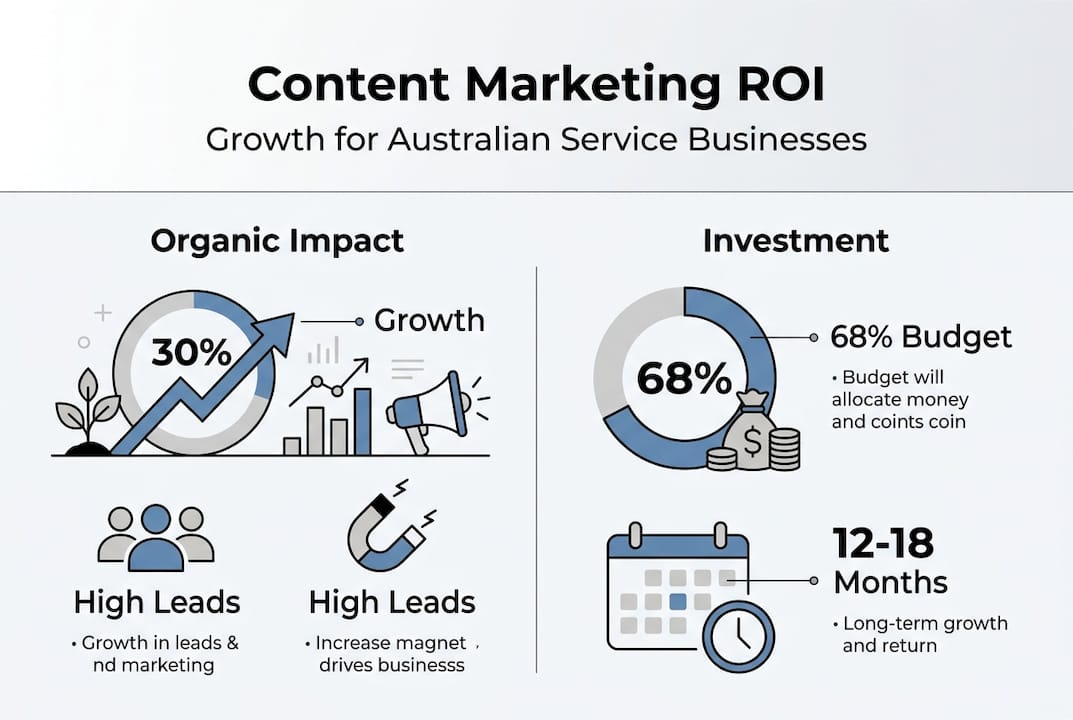
The numbers back this up. Australian service businesses investing in content see 30-50% organic growth and dedicate nearly 70% of their digital budgets to content activities. The average annual content investment sits around AUD 45,000, which sounds significant until you compare it to the returns. A 320% ROI means every dollar spent generates more than three dollars back. Traditional advertising rarely comes close to that figure.
| Channel | Average ROI | Lead quality | Time to results |
|---|---|---|---|
| Content marketing | 320% | High (intent-driven) | 12-18 months |
| Google Ads | 200% | Medium | Immediate |
| Print advertising | 50-80% | Low | Short-term |
| Social media ads | 150-180% | Medium | Short-term |
The industries leading this trend in Australia include health and wellness, professional consulting, legal services, and trade businesses. Each of these sectors relies heavily on trust, and content is the most efficient trust-building tool available.
Here is what makes content marketing particularly powerful for service businesses:
- It attracts people who are already searching for your solution
- It positions you as the authority before the sales conversation begins
- It keeps working around the clock without ongoing ad spend
- It compounds over time, unlike paid campaigns that stop the moment you pause the budget
“Content marketing is not a sprint. It is a long game that rewards patience and consistency with compounding returns that paid advertising simply cannot replicate.”
The 12-18 month lead time for organic results is the part that trips most business owners up. They invest for three months, see modest gains, and pull back. That is the exact moment the compounding would have started. Explore content marketing tips and Australian content marketing examples to see how local businesses have pushed through that early plateau and come out ahead.
Building a content marketing strategy that works in 2026
A strategy without structure is just a wish list. The businesses that consistently generate leads from content follow a clear framework. Here is how to build one that actually holds up.
Step-by-step content strategy framework:
- Define your goals. Are you chasing more enquiries, higher-value clients, or faster sales cycles? Your goal shapes everything else.
- Research your audience deeply. Go beyond demographics. Understand the questions they type into Google at 10pm when they are worried about their business.
- Choose your content types. Blog articles, video, podcasts, email newsletters, and case studies all serve different purposes at different stages.
- Plan your distribution. Creating content without a distribution plan is like printing flyers and leaving them in your office.
- Set your baseline metrics. Track organic traffic, lead conversions, and time-on-page from day one so you have something to measure against.
Two popular planning frameworks are worth comparing:
| Framework | Best for | Strength | Weakness |
|---|---|---|---|
| Hub-and-spoke model | B2B service providers | Builds topical authority fast | Requires significant upfront content volume |
| Campaign-based planning | B2C service businesses | Flexible and seasonal | Can lack long-term SEO momentum |
For most Australian service businesses, a hybrid approach works best. Use the hub-and-spoke model to build your core SEO foundation, then layer in seasonal campaigns around key moments like financial year end, school holidays, or industry events.
Content strategies built on consistent, audience-focused content deliver markedly higher ROI over time. The keyword there is consistent. A content calendar with two quality pieces per month beats a burst of ten articles followed by three months of silence every single time.
Pro Tip: Map every content piece to a specific stage of the buyer journey. Awareness content educates, consideration content compares, and decision content converts. If all your content sits at the awareness stage, you are generating traffic but not leads. Review the content marketing stages framework and work with a content strategist to audit your current mix.
Leveraging AI and smart tools to supercharge your content
AI has changed the speed at which content can be produced. That is a genuine advantage. But speed without strategy produces noise, not results. Here is how to use AI as an accelerator rather than a replacement.

89% of B2B marketers use AI for content creation in 2026, though effectiveness relies on creative strategy, not replacement. The businesses winning with AI are not the ones generating the most content. They are the ones using AI to do the thinking work faster so their human team can focus on the creative and relational work that actually builds trust.
Effective AI applications for service businesses include:
- Content ideation: Feed AI your top-performing pages and ask it to identify content gaps in your topic cluster
- Distribution timing: Use AI analytics tools to identify when your specific audience is most active and schedule accordingly
- Competitor analysis: AI tools can surface what your competitors rank for and where their content is weakest, giving you a clear entry point
- SEO optimisation: AI can analyse search intent patterns and suggest structural improvements to existing content
- Email subject line testing: Generate 20 variations in seconds and A/B test to find what resonates
The risk sits in over-reliance. Generic AI output sounds like everyone else’s generic AI output. Your audience notices. Businesses that let AI write everything without a strong editorial voice end up with content that ranks but does not convert, because it lacks the specific insight and personality that makes readers trust you enough to enquire.
Businesses blending AI efficiency with human creativity see up to 30% ROI improvement compared to purely manual or purely automated approaches. That balance is the sweet spot.
Pro Tip: Use AI to optimise your content for large language models (LLMs) like ChatGPT and Gemini, which are increasingly used as search tools. Structure your content with clear questions and direct answers. But for your key client-facing pages and case studies, write with a human voice. That is where trust is built. Check out the latest marketing trends and organic growth strategies for more on this shift.
Proven tactics: Turning content into leads and sales
Traffic is vanity. Leads are the goal. Here is how to bridge the gap between someone reading your content and actually reaching out to work with you.
Build intentional lead magnets for every major service:
- Create a specific resource for each core service. A clinic might offer a free symptom checklist. A consultancy might offer a business audit template. Make it genuinely useful, not a thinly veiled sales brochure.
- Gate your highest-value resources. A detailed industry report or a step-by-step guide is worth an email address. Keep the gate low-friction but present.
- Use case studies strategically. A well-written case study showing a real client result is one of the highest-converting content assets a service business can produce. Explore lead-driving content examples to see what works.
- Build a nurturing sequence. Once someone downloads your resource, follow up with a five-email educational series that deepens the relationship before making any offer.
- Retarget content readers with paid ads. Someone who spent four minutes on your blog post is a warm prospect. Show them a case study or testimonial ad to move them further along.
Capture strategies that consistently work:
- Exit-intent popups on high-traffic pages offering a relevant lead magnet
- Embedded content upgrades within blog posts (a downloadable version of the content)
- Free consultation offers positioned at the end of decision-stage content
“Visionary and aspirational content is outperforming traditional pain-point focused assets as commoditisation of content increases.”
This is a critical shift. Audiences are fatigued by problem-agitation content. They respond to content that shows them what success looks like and how to get there. Balance your content mix between solution-based how-to articles and aspirational content that paints a picture of what their business could look like. See B2B content ideas and scaling strategies for practical examples of this in action.
Measure what matters: conversion rate from content pages, cost per lead from organic versus paid, sales velocity for leads that came through content versus cold outreach, and revenue attributed to specific content assets. These four metrics tell you whether your content is actually doing its job.
What most content marketing guides miss: Creative leadership over tools
Most guides spend 80% of their time on tools and tactics. That is understandable. Tools are tangible. But the businesses we see consistently outperform their competitors are not the ones with the best tech stack. They are the ones with the clearest point of view.
Over-reliance on tools leads to commoditised output. Original thought and client-centric storytelling stand out in crowded markets. We have seen this play out repeatedly. A single story about one client’s transformation, told with honesty and specificity, generates more enquiries than a month of generic tip-based content.
Service businesses win when they share their actual perspective on their industry. Not watered-down opinions designed to offend no one. Real positions, backed by experience. That is what builds a community of loyal readers who eventually become clients. The service business marketing strategies that endure are always rooted in genuine human connection, not algorithmic optimisation. Tools help you reach more people. Creative leadership makes those people care.
Get expert help to accelerate your content marketing success
Knowing the strategy is one thing. Executing it consistently while running a service business is another challenge entirely. At Business Warriors, we work with Australian service businesses to build content systems that generate real, measurable leads without adding more to your already full plate.
Our SEO and lead generation services are built around the Marketing Vortex method, an integrated approach that combines content, paid advertising, email, and social media into one cohesive growth engine. If you want a clear digital marketing growth guide tailored to your business, or you want to understand how we have helped businesses like yours scale, meet Jarrod Harman and explore what a strategic partnership could look like for you.
Frequently asked questions
How long does it take to see results from content marketing in Australia?
Australian service businesses typically see 30-50% organic growth within 12-18 months of consistent content activity. Early months build the foundation; the compounding effect kicks in from month six onwards.
What is a realistic budget for service business content marketing?
The average annual investment sits around AUD 45,000, with most businesses allocating 68% of their digital marketing budget to content-related activities. Smaller operators can start with less and scale as results build.
Can AI replace human content creators for service businesses?
AI enhances speed and ideation significantly, but the best results come when human strategy and creative judgement guide the process. AI without editorial oversight produces generic content that fails to convert.
How do I know if my content marketing is working?
Track lead conversions from organic traffic, sales velocity for content-sourced leads, and overall revenue attribution. Well-executed content marketing delivers up to 320% ROI, so if your numbers are not trending upward after 12 months, the strategy needs reviewing.
Recommended
- Content marketing tips to grow your Australian service business – Jarrod Harman
- Content marketing examples that drive leads: Australian services – Jarrod Harman
- Marketing Content Strategist – Driving Business Growth – Jarrod Harman
- 7 B2B Marketing Ideas for Australian Service Businesses – Jarrod Harman