24 May 2026
All digital marketing channels: your 2026 strategy guide
Unlock the power of all digital marketing channels with our 2026 strategy guide. Learn to focus your efforts for maximum impact!
TL;DR:
- Focusing on two or three aligned digital marketing channels yields better results than spreading efforts across many.
- Strategic measurement, attribution, and AI tools are essential for optimizing and scaling effective channels over time.
Most business owners know they need to show up online. Fewer know where to show up, or why chasing all digital marketing channels at once usually produces mediocre results across the board. The real question is not which channels exist but which combination will actually move the needle for your specific business, audience, and budget. This guide breaks down every major channel category, shows you how to build a focused, measurable mix, and gives you the frameworks to scale what works without burning your budget on what does not.
Table of Contents
- Key takeaways
- All digital marketing channels: a 2026 classification
- Choosing and prioritising the right channels
- Measurement, attribution, and optimisation
- Implementation: building and scaling your channel mix
- Emerging trends shaping digital channels in 2026
- My take on channel strategy
- Build your channel mix with Business Warriors
- FAQ
Key takeaways
| Point | Details |
|---|---|
| Focus beats breadth | Mastering 3 channels outperforms poorly managing 10, so start with a focused mix and expand deliberately. |
| SEO and AI search matter most | Organic search and AI-generated answers are now two distinct traffic sources that both require active strategy. |
| Attribution requires two methods | Multi-touch attribution shows correlation; incrementality testing reveals actual causation for your top channels. |
| Reinforce channels, do not isolate them | SEO, content, and email work best as a compounding system rather than three separate tactics. |
| Measure every channel against business outcomes | Unified data across all touchpoints stops individual channel KPIs from misleading your investment decisions. |
All digital marketing channels: a 2026 classification
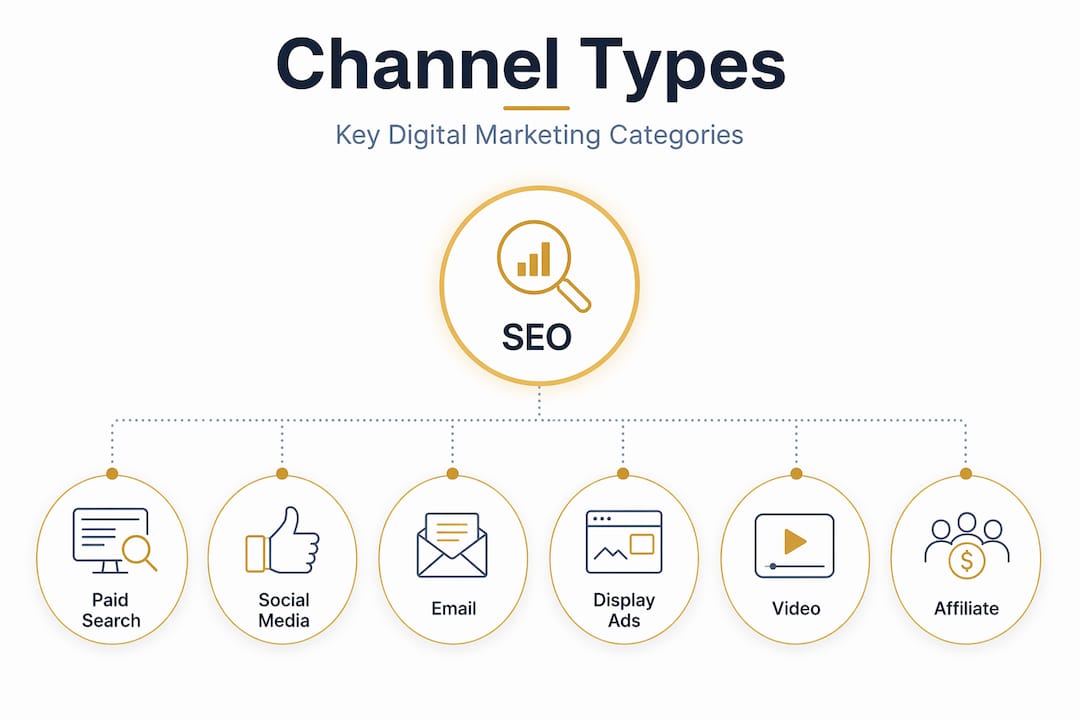
Before you can prioritise anything, you need a clear picture of what the channel categories actually are. Analytics platforms like Similarweb track 10 distinct channels: direct, organic search, paid search, organic social, paid social, referrals, affiliates, display advertising, email, and generative AI. That last one is new and worth paying attention to.
Here is how those channels break down in practice:
- Organic search (SEO): Traffic from unpaid search results on Google, Bing, and increasingly AI-powered answer engines. Your SEO strategy here covers on-page optimisation, technical SEO, backlink building, and now AI SEO to get your brand cited in large language model (LLM) responses.
- Paid search (SEM/Google Ads): Pay-per-click advertising on search engines. You get visibility immediately but pay for every click. Google Ads remains the dominant platform in Australia.
- Organic social: Unpaid posts, reels, stories, and content on platforms like Meta, Instagram, TikTok, and LinkedIn. This covers how to use social media to build audience and brand authority without direct ad spend.
- Paid social: Meta Ads, TikTok Ads, LinkedIn Ads, and similar formats where you pay for placement and targeting. Among the best digital advertising methods for precise audience targeting.
- Email marketing: Direct communication to subscribers via campaigns, automations, and sequences. Email marketing tactics consistently deliver high ROI because you own the list.
- Display advertising: Banner and visual ads placed across websites and apps via networks like Google Display.
- Referrals: Traffic from links on third-party websites, news sites, blogs, and industry publications.
- Affiliates: Performance-based partnerships where others promote your offers for a commission.
- Generative AI (Gen AI): Traffic sourced from AI tools like ChatGPT, Perplexity, and Google’s AI Overviews. Gen AI is now classified as a standalone digital marketing channel, which means brands that are not actively pursuing mentions in AI outputs are already missing a growing traffic segment.
According to research from HubSpot, most brands use 5 to 8 channels in 2026, with website and SEO (48.4%), email marketing (39.3%), and organic social content (38.6%) leading for B2B. The online marketing channels that consistently appear at the top are not random. They are the ones with compounding, long-term payoffs.
Choosing and prioritising the right channels
No single channel is the right answer for every business. Channel choice depends on the speed of results you need, your budget, and where your customers actually spend time online. A med spa in Perth targeting women aged 35 to 50 needs a very different starting mix compared to a national e-commerce brand.

A practical way to think about this is the channel mix model: start with two to three reinforcing channels rather than spreading your attention across everything available. The channels should complement each other. SEO drives organic discovery, content gives those visitors reasons to stay and trust you, and email converts and retains them. Each feeds the next.
When assessing which channels to prioritise, ask yourself these questions:
- How quickly do you need results? Paid search and paid social can generate leads within days. SEO and content marketing take months to build momentum but pay off far longer.
- What is your daily budget? Meta Ads and Google Ads require consistent spend. SEO and email have higher upfront effort but lower ongoing costs.
- Where does your customer research and discover businesses like yours? If your audience lives on Instagram, your organic social and paid social channels matter more than LinkedIn.
- Do you have the content creation capacity? Short-form video, blog content, and email campaigns all require production resources. If you cannot sustain them, do not start them.
One of the most common mistakes is choosing channels based on what competitors appear to be doing rather than what your audience data actually supports. A car dealership and a beauty clinic might both use Google Ads, but the search intent, ad format, and landing page strategy are completely different.
Pro Tip: Before adding a new channel to your mix, map out the full customer path on that channel from first impression to conversion. If you cannot describe that path clearly, you are not ready to invest in the channel yet.
Measurement, attribution, and optimisation
Once you have your channel mix running, the data gets complicated fast. Each channel will report its own conversions, and without a unified view, you will think every channel is performing brilliantly while the actual revenue picture tells a different story.
Multi-touch attribution measures correlation between channels and conversions, but it does not tell you whether a channel actually caused the sale. That distinction matters. If you turn off a channel and nothing changes, you were spending money unnecessarily.
Here is a structured approach to measurement:
- Set up unified tracking first. Connect your ad platforms, SEO data, email platform, and website analytics into a single reporting view. Without this, you are making decisions from incomplete information.
- Run multi-touch attribution models. Use first-touch, last-touch, and linear attribution in parallel to understand how different channels contribute at different stages of the customer journey.
- Conduct incrementality testing annually. Incrementality testing with holdout groups reveals true causal impact, which is the number that should drive your channel budget decisions.
- Optimise one stage at a time. Improving your landing page conversion rate lifts the performance of every channel sending traffic to it. Optimising one lifecycle stage compounds across the entire system.
- Cut ruthlessly, scale deliberately. Channels that consistently fail incrementality tests over two to three cycles should be deprioritised, not continually adjusted out of optimism.
“The goal is not to track everything. The goal is to make better decisions faster using data you can actually trust.”
AI is now actively reshaping this measurement process. Predictive analytics tools can forecast which channel combinations are likely to perform given your historical data, reducing the time between testing and scaling. For business owners running integrated marketing channels across SEO, paid ads, and social simultaneously, AI-assisted attribution is becoming less optional and more foundational.
Pro Tip: Run a geo-based incrementality test on your top spending channel before your next budget review. Compare conversion rates in regions where the channel is active against regions where it is paused. The result will likely surprise you.
Implementation: building and scaling your channel mix
Knowing the channels is one thing. Building a system that actually runs them without burning out your team is another. The execution reality behind covering all digital marketing channels is that you start with a strong foundation of two to three aligned channels and expand as expertise and capacity grow.
A practical starting framework for service-based businesses:
- Phase 1 (months 1 to 3): Launch Google Ads for immediate visibility and conversion data. Set up your SEO foundations: technical audit, on-page optimisation, Google Business Profile. Start building your email list with a lead magnet or booking incentive.
- Phase 2 (months 4 to 6): Introduce organic social content based on what your paid ads have confirmed resonates with your audience. Begin email marketing tactics like a welcome sequence and monthly newsletter. Start tracking referral traffic sources.
- Phase 3 (months 7 and beyond): Add paid social for retargeting and lookalike campaigns based on your now-validated customer profiles. Explore AI SEO by getting your brand mentioned in industry content that LLMs frequently cite. Test display advertising for brand awareness at scale.
Common execution challenges to anticipate:
- Content bottlenecks. SEO and social both need consistent content output. Build a simple content calendar with batching sessions to keep production manageable.
- Budget fragmentation. Spreading $50 per day across five channels means $10 per channel, which is rarely enough to generate meaningful data on any of them. Concentrate spend until you have clear winners.
- Team capacity. Marketing automation tools reduce manual workload for email sequences, social scheduling, and reporting. The time saved should go into strategy and creative, not more admin.
For businesses targeting AI-generated answers as part of their SEO strategy, the priority is getting cited in authoritative content. This means publishing detailed, original content on topics your audience searches for, earning mentions from industry publications, and structuring your website content so it is easy for AI models to parse and quote.
Pro Tip: Use your paid ad data as a research tool before investing in SEO. The keywords and ad copy that generate clicks and conversions tell you exactly what organic content to create next.
Emerging trends shaping digital channels in 2026
The digital marketing mix is not static. Several shifts are already changing how integrated marketing channels need to be managed:
- AI SEO and GEO (generative engine optimisation): Getting your brand cited in AI-powered search results and LLM responses is now a distinct strategy from traditional SEO. Businesses that appear in Google’s AI Overviews and ChatGPT answers are capturing intent before users even reach a search results page. Check out 2025 marketing trends for Aussie businesses for more on how this is playing out locally.
- Short-form video and social commerce: TikTok, Instagram Reels, and YouTube Shorts are not just awareness channels anymore. In-app purchasing and direct booking links are making social a full conversion channel, not just a top-of-funnel one.
- Data privacy and attribution complexity: Third-party cookie deprecation is forcing a shift to first-party data strategies. Brands that have invested in email lists and CRM systems are significantly better positioned than those relying solely on pixel-based retargeting.
- Niche communities over broad platforms: Marketers are moving from broad platforms to niche communities and shifting from owned to earned media, which means referral and affiliate channels deserve more strategic attention than most businesses currently give them.
- Automation across the full funnel: AI tools are now capable of personalising email sequences, adjusting paid ad bids in real time, and surfacing content recommendations based on individual user behaviour. The businesses scaling fastest are those using automation not to replace strategy but to execute it consistently.
My take on channel strategy
I have worked with businesses that insist on being everywhere at once, and I can tell you the result is almost always the same. They are present on every platform, producing mediocre content on all of them, and wondering why nothing is converting. Being present is not a strategy. Being strategic about where you invest your attention is.
In my experience, the businesses that grow consistently are not the ones with the most channels. They are the ones who picked two or three channels aligned to their audience and budget, got genuinely good at them, measured properly, and then expanded from a position of strength rather than anxiety.
AI and data tools have made this more accessible than ever. But they have also made it easy to confuse activity with progress. You can automate a bad strategy just as easily as a good one. The discipline is in the thinking before the doing, and in the patience to let a well-built channel compound before you abandon it for the next shiny option.
If you want to understand the role of digital marketing in building sustainable business growth, start by accepting that less, done with precision, consistently outperforms more, done with half the attention.
, Business Warriors
Build your channel mix with Business Warriors
If you are serious about putting all digital marketing channels to work without the guesswork, Business Warriors is built exactly for that.

At Business Warriors, we use the Marketing Vortex method to combine SEO, Google Ads, Meta advertising, email marketing, and social media into one integrated system. Every channel is chosen based on your audience, your budget, and your growth goals. Whether you are a service-based business in Perth or a national brand looking to scale, we give you the data-backed strategy and the execution support to make it work. Explore our digital marketing consultant Perth page and see how a focused, measurable channel mix can change the trajectory of your business.
FAQ
How many digital marketing channels should a business use?
Most brands use 5 to 8 channels, but starting with 2 to 3 that reinforce each other is more effective than spreading budget thinly across all of them at once.
What are the main types of digital marketing channels?
The main channel categories are organic search (SEO), paid search, organic social, paid social, email, display advertising, referrals, affiliates, and generative AI, which is now tracked as a standalone traffic source.
How does AI SEO differ from traditional SEO?
Traditional SEO targets search engine ranking pages, while AI SEO (also called GEO) focuses on getting your brand cited in AI-generated answers from tools like ChatGPT, Perplexity, and Google’s AI Overviews, which represent a growing share of online discovery.
What is the best way to measure performance across multiple channels?
Use multi-touch attribution to understand channel contribution across the customer journey, then run incrementality testing annually on your top channels to confirm which ones are genuinely causing conversions rather than just correlating with them.
What is the most cost-effective digital marketing channel long term?
Email marketing consistently delivers high ROI because you own the audience list and do not pay per reach. Organic SEO also compounds over time, making it one of the most cost-efficient channels once it gains traction.