


TL;DR:
- Building a scalable marketing system relies on measuring key metrics like CAC and CLV.
- Focus on proven channels, testing incrementally, and maintaining disciplined measurement to sustain growth.
- Advanced tactics include AI personalization, hyper-local SEO, and strict compliance to stay competitive.
Spending money on digital marketing without seeing a reliable stream of new clients is one of the most frustrating experiences a service business owner can face. You’re posting, running ads, maybe even doing some SEO, but growth feels unpredictable and your cost per client keeps creeping up. The good news is that sustainable client acquisition isn’t about doing more of everything. It’s about building a scalable system with the right metrics, channels, and processes working together. This guide walks you through every stage, from assessing your readiness to launching campaigns and staying ahead with innovative tactics, so you can grow with confidence and stop guessing.
Table of Contents
- Assessing readiness: numbers, strategy, and mindset
- Preparing your toolkit: channels, creatives, and controls
- Execution: launch, test, and optimise your campaigns
- Verification and troubleshooting: metrics that keep you scaling
- Innovative tactics: stay ahead with AI, localisation, and compliance
- Why disciplined scaling beats chasing digital marketing fads
- Ready to scale your digital marketing? Let’s go
- Frequently asked questions
Key Takeaways
| Point | Details |
|---|---|
| Check readiness first | Only scale digital marketing if you know your numbers and have the capacity to handle growth. |
| Invest in the right mix | Balance SEO, local, social, and paid channels with careful testing and tracking of each. |
| Optimise with data | Use dashboards and split tests to improve campaigns and increase ROI as budgets expand. |
| Innovate and comply | Adopt AI and new tactics, but always ensure compliance with Australian laws. |
Assessing readiness: numbers, strategy, and mindset
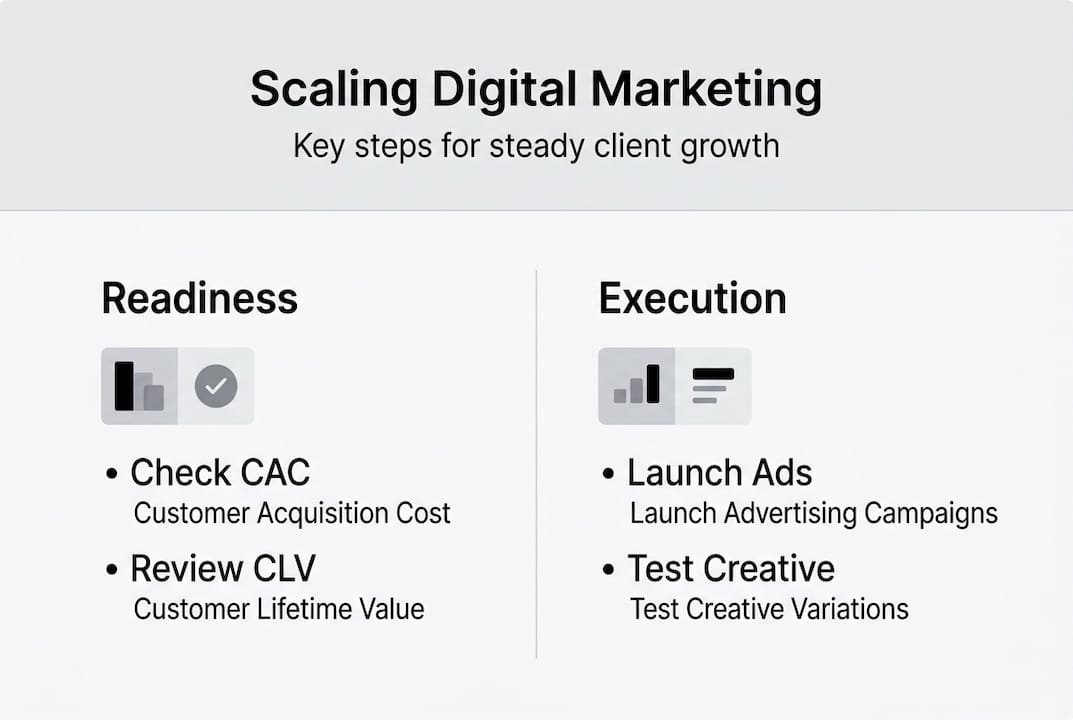
Before you scale anything, you need to know your numbers. The two most important figures are your Customer Acquisition Cost (CAC), which is how much you spend to win one new client, and your Customer Lifetime Value (CLV), which is the total revenue that client generates over their relationship with you. According to CAC benchmarks for Australian service businesses, professional services firms in Australia typically spend between $300 and $1,200 to acquire a single client. That’s a wide range, and where you sit depends heavily on your niche, your sales process, and how well your marketing converts.
The ratio that matters most is CAC:CLV. Aim for at least 1:3, meaning every dollar you spend acquiring a client should return three dollars in lifetime revenue. If your ratio is worse than that, scaling will only accelerate losses.
| Channel | Typical CAC (AUD) | Typical CLV (AUD) | CAC:CLV ratio |
|---|---|---|---|
| SEO (organic) | $200–$500 | $3,000–$10,000 | 1:6 to 1:20 |
| Google Ads | $300–$800 | $3,000–$10,000 | 1:4 to 1:12 |
| Meta Ads | $250–$700 | $2,000–$8,000 | 1:3 to 1:10 |
| Email marketing | $100–$300 | $2,000–$8,000 | 1:7 to 1:20 |
Before scaling, check these readiness factors. You need benefits of scaling marketing to be real and measurable in your business, not just theoretical.
- Your core offer is proven and clients are getting results
- Cash flow can support a 60 to 90 day lag before paid campaigns break even
- Your team can deliver for more clients without quality dropping
- Your current marketing is already returning a positive ROI, even at small scale
Pro Tip: Calculate your CAC:CLV ratio before increasing any budget. If it’s below 1:3, fix your offer or conversion process first. Scaling a leaky funnel just wastes money faster.
Preparing your toolkit: channels, creatives, and controls
With your business readiness clear, now gather the tools and platforms to build a scalable digital marketing engine. The biggest mistake service businesses make at this stage is jumping straight into paid ads without the infrastructure to measure what’s working. A recommended media mix for service businesses includes a balance of paid, earned, and owned channels, with incremental budget increases tied to measurement at every step.
| Channel | Typical monthly cost | ROI potential | Ramp-up time |
|---|---|---|---|
| SEO | $800–$3,000 | Very high (long-term) | 3–6 months |
| Google Ads | $1,000–$5,000+ | High | 2–4 weeks |
| LinkedIn Ads | $1,500–$4,000 | High (B2B) | 2–4 weeks |
| Email marketing | $200–$800 | Very high | 1–2 weeks |
| Meta Ads | $500–$3,000 | Medium to high | 1–3 weeks |
Focusing on boosting online visibility through SEO alongside paid channels gives you a compounding return over time. Pair that with strong local SEO strategies to capture high-intent searches in your area.
Here’s your foundational setup checklist:
- Install Google Analytics 4 and connect it to your CRM so every lead is tracked from first click to closed sale
- Set up a CRM (HubSpot, ActiveCampaign, or similar) to manage leads and automate follow-up sequences
- Choose an email platform and build at least one nurture sequence before launching paid campaigns
- Schedule content across your social channels using a tool like Buffer or Hootsuite
- Allocate 20 to 30 per cent of your budget to test campaigns before committing to full spend
Pro Tip: Build your reporting dashboard before you spend a single dollar on ads. Knowing your ROAS (Return on Ad Spend) and CAC from day one means you make decisions based on data, not gut feel. Good social media tips for service brands will also help you get organic traction while paid campaigns ramp up.
Execution: launch, test, and optimise your campaigns
With tools and platforms prepared, move on to executing and optimising your campaigns for scale. The key principle here is stepwise growth. Never scale spend on a campaign that hasn’t proven itself at a lower budget first.
- Launch pilot campaigns with 20 to 30 per cent of your planned budget across your top two channels
- Run each campaign for at least two weeks before drawing conclusions, longer for SEO
- Identify your best-performing ad sets, landing pages, and audiences based on CAC and conversion rate
- Increase spend by 20 to 30 per cent on winning campaigns only, not across the board
- Expand to additional channels once your primary channel is stable and profitable
- Build a local SEO agency style approach into your strategy for long-term organic growth
For testing and personalisation, use these methods:
- Split test (A/B test) ad headlines, images, and calls to action every two to three weeks
- Use geo-targeting to focus spend on your highest-converting suburbs or cities before expanding nationally
- Personalise email sequences based on how leads entered your funnel, whether via Google, social, or referral
- Leverage AI for client acquisition to automate personalised follow-ups and reduce manual workload
“Consistent A/B testing across ad creative and landing pages typically delivers a 20 to 30 per cent lift in conversion rates for service businesses. That improvement compounds over time and directly reduces your CAC.”
Don’t skip the creative refresh cycle. Ads fatigue quickly, especially on Meta. Rotate new creative every three to four weeks to maintain performance.

Verification and troubleshooting: metrics that keep you scaling
Now that campaigns are live, focus on the measurement and troubleshooting that ensure your scale-up stays profitable. Tracking is not optional. Businesses that scale without proper measurement almost always hit a wall within three to six months because they can’t identify what’s working or why performance is slipping.
Monitor these KPIs weekly:
- ROAS: Aim for a minimum of 3:1 before scaling spend
- CAC: Should be stable or declining as campaigns mature
- Conversion rate: Track at every stage, from click to lead to sale
- Lead volume: Watch for sudden drops that signal audience fatigue or budget issues
- Sales follow-up speed: Leads contacted within five minutes convert at dramatically higher rates
According to advanced tracking best practices, pairing strong ROAS and CAC monitoring with sales coaching for your team is one of the highest-leverage moves a service business can make. Your marketing can generate perfect leads, but poor follow-up kills conversions.
| Issue | Likely cause | Fix |
|---|---|---|
| High CAC, low conversions | Weak offer or targeting | Audit landing page and audience segments |
| Leads not converting to sales | Poor follow-up or sales script | Implement CRM automation and sales training |
| ROAS declining over time | Ad fatigue or audience saturation | Refresh creative and expand targeting |
| Low lead volume | Budget too low or wrong channel | Increase test budget or shift channel mix |
When to scale further: if your CAC is stable or falling and your conversion rate is improving over three consecutive weeks, that’s your green light to increase budget by another 20 to 30 per cent. Use [lead conversion strategies](https://jarrodharman.com/lead-conversion strategies-results) and optimise your sales funnels to squeeze more value from every lead you generate.
Innovative tactics: stay ahead with AI, localisation, and compliance
To ensure lasting advantage, explore these advanced digital tactics for staying ahead in a competitive market. The businesses winning in 2026 are not necessarily the ones with the biggest budgets. They’re the ones using smarter tools and staying compliant while their competitors cut corners.
Here are the tactics worth prioritising right now:
- Use AI tools to personalise email campaigns at scale, sending different messages based on lead behaviour, location, and service interest
- Set up automated follow-up sequences that trigger based on actions like visiting your pricing page or opening an email three times without booking
- Create hyper-local content targeting specific suburbs or regions in Google Search and Google Maps, as AI-driven personalisation and hyper-local targeting consistently outperform generic campaigns in service industries
- Build Google Business Profile posts and local landing pages for each service area you want to dominate
- Use AI for marketing to speed up creative testing, generate ad variations, and identify winning copy faster
On compliance: all email marketing in Australia must follow the Spam Act 2003, which requires clear consent, sender identification, and an easy unsubscribe option. Privacy obligations under the Australian Privacy Act also apply to how you collect and store lead data. Ignoring these isn’t just a legal risk. It damages trust with your audience.
For local SEO, ensure your NAP (Name, Address, Phone) details are consistent across every directory and citation. Inconsistencies confuse Google and suppress your local rankings.
Pro Tip: Use AI creative tools to generate five to ten ad variations at once, then let the platform optimise toward the best performer. This cuts your testing time in half and surfaces winning creative much faster than manual methods.
Why disciplined scaling beats chasing digital marketing fads
Here’s something most marketing content won’t tell you: the majority of service businesses that plateau do so not because they lack innovation, but because they abandon disciplined processes the moment something shiny appears. A new platform launches, a competitor seems to be crushing it on TikTok, and suddenly the proven system gets shelved in favour of experimentation with no measurement framework.
The businesses we see consistently grow through scaling strategies that work are the ones that treat their marketing like a financial portfolio. They test incrementally, document what works, and double down on proven channels before exploring new ones. They don’t chase every trend. They build compounding advantages through repetition and refinement.
The uncomfortable truth is that most “growth hacks” produce a spike followed by a plateau. Disciplined, data-driven scaling produces a curve that keeps climbing. Your competitors are probably distracted by the next big thing. That’s your opportunity to own the fundamentals and win consistently.
Ready to scale your digital marketing? Let’s go
If this guide has shown you anything, it’s that scaling digital marketing is a process, not a gamble. The right framework makes the difference between burning budget and building a predictable client acquisition engine.
At Business Warriors, we use the proven marketing vortex method to help service businesses across Australia build scalable, omnichannel marketing systems that generate consistent leads and sales. Whether you’re starting your scale-up or ready to accelerate, our step-by-step marketing growth framework gives you a clear path forward. Want to see how it works in practice? Meet Jarrod Harman and find out how we can build your growth system together.
Frequently asked questions
What is the ideal marketing budget for scaling a service business in Australia?
Start with $150 to $300 per month for organic content and small paid test campaigns, then increase spend incrementally as you identify what’s delivering a positive return.
Which digital channel delivers the best ROI for service-based businesses?
SEO, Google Search, and LinkedIn consistently deliver the highest ROI for Australian service businesses, with SEO offering the strongest compounding returns over time.
How can I measure if my digital marketing scale-up is working?
Track your CAC and conversion rates weekly, and ensure your CAC:CLV ratio stays at 1:3 or better. A stable or declining CAC alongside improving conversion rates is your clearest signal that scaling is working.
What are the biggest mistakes when scaling digital marketing?
The most common issues are skipping proper tracking and sales coaching, scaling spend before campaigns are proven, and failing to follow up with leads quickly enough to convert them.