


Running your service business on manual marketing feels like pushing a boulder uphill every single day. You post on social media, send individual emails, and chase every lead personally, yet growth remains unpredictable and exhausting. Scaling marketing campaigns enables service-based businesses to transition from founder-dependent lead generation to repeatable systems, generating consistent leads and sales without proportional time increases. This shift transforms your business from a daily grind into a predictable revenue engine. We’ll explore why scaling matters, which metrics guide your decisions, what challenges women-led businesses face, and how to balance growth with profitability.
Table of Contents
- Key takeaways
- Why scaling marketing campaigns is crucial for service-based businesses
- Understanding key marketing metrics for scaling successfully
- Challenges unique to women-led service businesses when scaling marketing
- Balancing the pros and cons: should you scale or stay small?
- How Jarrod Harman can help you scale marketing campaigns
- Frequently asked questions
Key Takeaways
| Point | Details |
|---|---|
| Repeatable systems | Document your marketing process and automate the most time consuming tasks first. |
| Key metrics | Track ROAS and CAC to guide scaling decisions and prioritise budget where it delivers the most value. |
| Barriers for women led | Women led service businesses face unique barriers like caring responsibilities and founder driven marketing that can burn out founders. |
| Growth vs margins | Balance growth with profitability by weighing revenue gains against margin preservation and using automation or capped client intake. |
Why scaling marketing campaigns is crucial for service-based businesses
Manual marketing keeps you trapped in a cycle where every client depends on your direct involvement. You create each social post, respond to every enquiry, and personally nurture leads through your sales process. This approach works initially but becomes your biggest growth barrier. When you’re the bottleneck, your business can only grow as fast as your available hours allow.
Automation builds predictable lead capture and nurturing systems that work while you sleep. Implementing lead generation campaigns explained through automated funnels means prospects enter your system, receive valuable content, and move towards booking without your constant attention. Email sequences nurture relationships, chatbots answer common questions, and booking systems handle scheduling. Your role shifts from doing everything to overseeing systems that do the heavy lifting.
Scaling creates stable revenue streams independent of founder presence. When marketing runs on repeatable processes rather than your daily effort, you can take holidays, focus on delivery, or work on strategic growth without watching leads dry up. This stability transforms your business from a demanding job into a genuine asset.
Pro Tip: Start by documenting your current marketing process step by step. Identify which tasks you repeat weekly, then prioritise automating the most time-consuming activities first.
Women-led SMEs often stall without systems due to caring duties and workload pressures. Research shows that women-led service businesses face unique barriers like caring responsibilities and founder-driven marketing, with solopreneurs risking burnout from manual processes and decision fatigue. Balancing school runs, family commitments, and business demands leaves little energy for consistent marketing execution.
“The difference between a struggling service business and a thriving one often comes down to whether the owner has built systems that work independently of their daily involvement.”
Implementing clear processes empowers scaling without sacrificing quality. When you how to nurture leads for business growth through documented workflows, new team members can execute your marketing strategy consistently. Quality remains high because systems ensure every prospect receives the same excellent experience, regardless of who manages the process.
Understanding key marketing metrics for scaling successfully
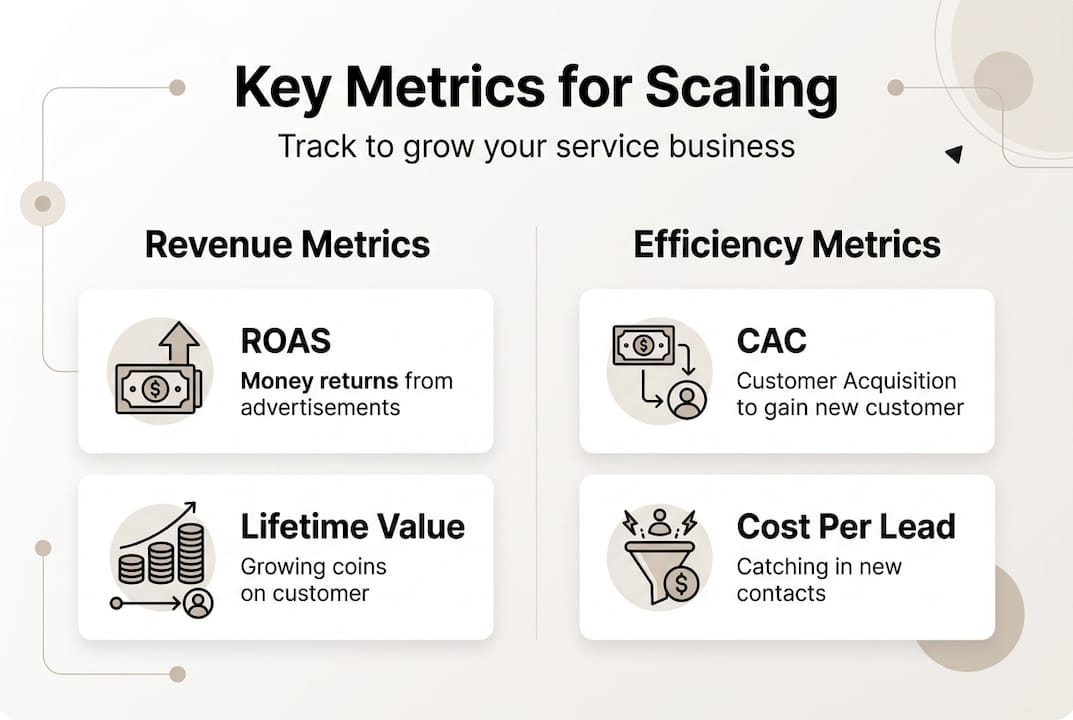
Knowing which numbers matter separates profitable scaling from expensive mistakes. Return on ad spend (ROAS) measures how much revenue each advertising dollar generates. Service business benchmarks show ROAS of 2.5x to 6.2x depending on budget, meaning every dollar spent returns between $2.50 and $6.20 in revenue. Lower budgets typically achieve higher ROAS because you target your warmest audiences first.

Customer acquisition cost (CAC) varies by segment and tells you what you pay to win each new client. The same research indicates service CAC ranges from $141 to $600 depending on your industry, service complexity, and target market. A beauty salon acquiring clients at $150 each operates very differently from a law firm spending $500 per client. Understanding your specific CAC helps you budget marketing spend realistically.
| Metric | Service business benchmark | What it tells you |
|---|---|---|
| ROAS | 2.5x to 6.2x | Revenue return per ad dollar spent |
| CAC | $141 to $600 | Cost to acquire one new customer |
| LTV:CAC ratio | 3:1 to 12:1 | Long-term profitability of acquisition |
| CPL | $144 to $181 | Efficiency of lead generation campaigns |
Lifetime value to CAC ratio gives insight into profitability of campaigns by comparing what clients spend over their relationship with you against what you paid to acquire them. A healthy LTV:CAC ratio sits between 3:1 and 12:1, meaning each client generates three to twelve times what you spent acquiring them. Below 3:1 suggests you’re overspending on acquisition or undermonetising clients. Above 12:1 often indicates you’re underinvesting in growth opportunities.
Pro Tip: Calculate your average client lifetime value by multiplying average transaction value by purchase frequency and typical client lifespan. This number guides how much you can afford to spend acquiring new clients.
Cost per lead (CPL) benchmarks help measure lead generation efficiency before prospects become paying clients. Service businesses typically see CPL between $144 and $181, though this varies significantly by industry and lead quality. A $150 lead who converts at 30% costs you $500 per client, whilst a $100 lead converting at 10% costs $1,000 per client. Quality matters more than quantity.
Use these metrics as guideposts before and during scaling efforts. Track them weekly when actively scaling campaigns, adjusting your strategy based on what the numbers reveal. If CAC climbs above profitable levels, pause expansion and optimise conversion rates. When how to generate leads online business growth campaigns show strong metrics, invest more budget to capture additional market share.
Challenges unique to women-led service businesses when scaling marketing
Eighty-two per cent of small businesses have no employees, creating a reality where the founder handles everything from service delivery to marketing execution. This solopreneur model works initially but becomes unsustainable when you want to scale. Every marketing task competes with client work, administration, and business development for your limited hours.
Caring responsibilities add pressure and reduce available marketing hours significantly. School holidays, sick children, and family commitments create unpredictable schedules that disrupt consistent marketing execution. Unlike corporate roles with backup support, service business owners carry the full weight of both business and family demands simultaneously.
Founder-driven marketing leads to burnout and inconsistent lead flow because your marketing stops whenever life gets busy. Prospects entering your funnel during a hectic fortnight receive delayed responses or no follow-up at all. This inconsistency damages conversion rates and wastes the money you spent generating those leads initially.
- Decision fatigue from choosing what to post, which platform to prioritise, and how to respond to enquiries drains mental energy
- Manual processes like individually messaging prospects or creating unique content daily consume hours that could go towards strategic growth
- Guilt about taking time away from family to work on marketing creates emotional stress that compounds physical exhaustion
- Lack of documented processes means you can’t delegate effectively even when you want to bring on help
Building systems and automating reduces decision fatigue and workload by removing repetitive choices from your daily routine. When you establish that blog content publishes every Tuesday, email sequences run automatically, and role of niche marketing guides your targeting, you eliminate hundreds of micro-decisions weekly. Your energy goes towards strategic choices rather than tactical execution.
“Systemisation isn’t about working more hours, it’s about making the hours you do work generate exponentially better results through strategic automation and clear processes.”
Strategically capping clients can preserve margins while scaling gradually, giving you time to build infrastructure before expanding capacity. Limiting your roster to 20 clients whilst you develop systems prevents overwhelm and maintains service quality. Once automation handles marketing and administration smoothly, you can increase capacity without proportional stress increases. Marketing psychology scale service business principles help you understand how to grow sustainably whilst protecting your wellbeing.
Balancing the pros and cons: should you scale or stay small?
Scaling enables predictable revenue through automation but typically lowers profit margins as you invest in systems, team members, and expanded infrastructure. A solo practitioner keeping 60% of revenue as profit might see margins drop to 20% or even 10% when running a scaled agency with staff, software subscriptions, and operational overhead. The trade-off is volume: earning 10% of $1 million generates more absolute profit than 60% of $200,000.
Staying small keeps higher profit margins and business agility because you avoid fixed costs and maintain complete control. Research shows that staying small preserves margins of 60% for solo operators versus 10% for agencies, whilst maintaining agility and avoiding the fragility that comes with team dependency. You can pivot quickly, take extended breaks, and keep operations lean.
| Approach | Typical margin | Annual revenue | Absolute profit | Lifestyle impact |
|---|---|---|---|---|
| Stay small (solo) | 60% | $200,000 | $120,000 | High flexibility, personal delivery |
| Scale (small team) | 30% | $500,000 | $150,000 | Moderate flexibility, mixed delivery |
| Scale (agency) | 10% | $1,000,000 | $100,000 | Lower flexibility, team delivery |
A $200,000 solo business at 60% margin can be preferable to a $1 million agency at 10% margin depending on your priorities. The solo operator takes home $120,000 with complete control, minimal stress, and maximum flexibility. The agency owner grosses $100,000 after expenses whilst managing team dynamics, client escalations, and operational complexity. Neither choice is inherently better; they serve different goals.
Pro Tip: Calculate your “freedom number”, the annual income that covers your lifestyle comfortably with savings. If you can hit this number staying small, scaling for ego or external validation rarely improves life satisfaction.
Automate and cap clients before hiring to maintain control whilst testing whether scaled operations suit your personality. Implement email automation, booking systems, and scaling online marketing guide strategies whilst keeping client numbers manageable. This approach lets you experience some scaling benefits without the commitment and risk of building a team.
- Automation provides scaling benefits like consistent lead flow and reduced manual work without the overhead of employees
- Capping clients at a profitable level protects your margins whilst you test whether you genuinely want to grow beyond solo operations
- Strategic pricing increases can boost revenue without adding complexity or reducing margins
- Productising services through packages and clear processes prepares you for potential scaling whilst improving current operations
Consider personal goals, lifestyle preferences, and risk tolerance before deciding which path aligns with your vision. Some business owners thrive on building teams and creating employment opportunities. Others value autonomy, simplicity, and direct client relationships above revenue growth. Your business should serve your life, not consume it.
How Jarrod Harman can help you scale marketing campaigns
Scaling your marketing feels overwhelming when you’re managing everything solo, but proven frameworks remove the guesswork and accelerate results. Jarrod Harman specialises in helping service-based business owners build marketing vortex method service businesses that generate consistent leads without constant founder involvement. This systematic approach combines automation, strategic targeting, and conversion optimisation into a cohesive system designed specifically for service businesses.
The Marketing Vortex Method helps service businesses automate lead nurturing through integrated funnels that capture prospects, deliver value, and guide them towards booking. Rather than piecing together disconnected tactics, you implement a complete system where each element reinforces the others. Digital marketing step by step growth guidance ensures you build your marketing infrastructure in the right sequence, avoiding costly mistakes and wasted effort.
Clients gain measurable results and predictable revenue streams by following frameworks tested across hundreds of service businesses. You’ll understand exactly how to generate leads online business growth strategies work for your specific industry, with clear metrics showing what’s working and what needs adjustment. This data-driven approach replaces guesswork with confidence.
Frequently asked questions
What are the first steps to start scaling my marketing campaigns?
Begin by analysing your current marketing performance, tracking metrics like conversion rates, cost per lead, and customer acquisition cost. Implement or improve lead capture systems through optimised landing pages and automated email sequences that nurture prospects consistently. Focus on one or two scalable channels initially rather than spreading effort across every platform. Build a how to create sales funnel step guide tailored to your service offerings, ensuring each stage moves prospects closer to booking.
How can I measure if scaling my marketing efforts is successful?
Monitor return on ad spend to ensure campaigns generate positive returns, targeting the 2.5x to 6.2x benchmark range for service businesses. Track customer acquisition cost against industry standards, watching for increases that signal reduced efficiency. Evaluate your lifetime value to CAC ratio quarterly, aiming for the healthy 3:1 to 12:1 range that indicates sustainable growth. Watch for consistent lead volume and stable conversion rates, adjusting campaigns based on data rather than gut feeling. Regular analysis using scaling online marketing guide principles keeps your growth profitable.
What common challenges should I expect when scaling my service business marketing?
Founder dependence creates bottlenecks when every marketing decision requires your personal attention, leading to delays and missed opportunities. Managing time becomes increasingly difficult as marketing demands compete with service delivery and family responsibilities. Decision fatigue from constant tactical choices drains energy better spent on strategy. Fluctuating client demand tests your systems, revealing weaknesses in your processes during busy periods. Strategic client capping and systemisation through marketing psychology scale service business approaches help you navigate these challenges whilst maintaining service quality and personal wellbeing.
Should I hire a team or automate first when scaling my marketing?
Automate repetitive marketing tasks before hiring to maximise efficiency and protect profit margins. Software handles email sequences, social media scheduling, lead capture, and basic customer service at a fraction of employee costs. This approach lets you test scaled operations without the commitment and overhead of team members. Once automation runs smoothly and you’re consistently hitting capacity, hiring becomes a strategic choice rather than a desperate reaction to overwhelm. Many successful service business owners discover they can reach their revenue goals through automation and strategic pricing without ever building a large team.
How do I know if my service business is ready to scale marketing campaigns?
Your business is ready when you have proven service delivery that generates satisfied clients and positive reviews consistently. You need documented processes for client onboarding, service delivery, and results tracking that work reliably. A marketing budget of at least $50 daily provides enough data to test and optimise campaigns effectively. Most importantly, you must have capacity to serve additional clients, either through your own availability or systems that reduce your direct involvement. Scaling marketing before you’re operationally ready creates a frustrating situation where you generate leads you can’t serve properly, damaging your reputation and wasting marketing investment.