


You’ve refined your service offering, built a beautiful website, and posted consistently on social media. Yet leads remain unpredictable and conversions underwhelm. The missing piece isn’t more content or bigger ad budgets. It’s understanding the psychology principles marketers use that influence how your ideal clients make buying decisions. Marketing psychology reveals why people choose one business over another, why they hesitate or commit, and how to ethically guide them toward solutions that genuinely serve their needs. This article unpacks the core principles of marketing psychology and shows you how to apply them strategically to scale your service business online with confidence and authenticity.
Table of Contents
- Key takeaways
- Core principles of marketing psychology and how they influence consumer behaviour
- Applying marketing psychology specifically for female service business owners
- Optimising your website and lead capture with psychological triggers
- Discover expert digital marketing strategies tailored for your business
- Frequently asked questions
Key Takeaways
| Point | Details |
|---|---|
| Scarcity and urgency | Use time bound offers or limited access to prompt quicker decisions without feeling pushy. |
| Social proof credibility | Showcase testimonials and client stories to build instant trust with new visitors. |
| Reciprocity value upfront | Provide genuine value up front with freebies or useful resources to encourage engagement. |
| Authority positioning | Highlight credentials, case studies and thought leadership to boost perceived expertise. |
Core principles of marketing psychology and how they influence consumer behaviour
Marketing psychology applies insights from behavioural science to understand and ethically influence how people make purchasing decisions. At its foundation are several key principles that reveal human behaviour patterns you can leverage in your marketing. Scarcity creates urgency by limiting availability, whether through time-bound offers or exclusive access. When clients perceive something as rare or ending soon, their desire intensifies and hesitation decreases.
Loss aversion explains why people fear losing something more than they value gaining an equivalent benefit. Frame your messaging around what clients risk missing rather than only what they gain. Distinctiveness ensures your brand stands out emotionally and visually in a crowded market. Research from Zappi shows that top-performing ads score significantly higher on distinctiveness metrics compared to average campaigns:
“The most distinctive ads achieve emotional connection scores 40% higher than industry benchmarks, driving both immediate response and long-term brand recall.”
Social proof leverages the human tendency to follow others’ actions, especially when uncertain. Testimonials, case studies, and client counts build trust by showing that others have successfully chosen your service. Reciprocity triggers goodwill when you give value first, whether through free resources, consultations, or educational content. People naturally feel inclined to return the favour by engaging further or purchasing.
Authority establishes credibility through expertise, credentials, or media features that position you as the trusted expert in your field. Anchoring uses initial information to shape subsequent judgements, like displaying a higher-priced package first to make mid-tier options feel more reasonable. Commitment and consistency tap into our desire to align actions with previous statements, which is why micro-commitments like email sign-ups often lead to larger purchases.
Here are the core principles to prioritise in your marketing:
- Scarcity and urgency to prompt faster decision-making without feeling pushy
- Social proof through testimonials, reviews, and client success stories to build immediate trust
- Reciprocity by offering genuine value upfront, establishing goodwill before any ask
- Authority positioning via credentials, case studies, and thought leadership content
- Loss aversion framing that highlights what clients risk by delaying action
Understanding these principles gives you a strategic framework to craft messaging that resonates emotionally while respecting your audience’s intelligence. The goal isn’t manipulation but alignment, helping ideal clients recognise that your service solves their specific problem. When applied ethically, these psychology principles accelerate trust-building and conversion without compromising authenticity. Female service business owners particularly benefit from social proof strategies that showcase real client transformations and community validation.
Applying marketing psychology specifically for female service business owners
Female entrepreneurs aged 35 to 50 in service industries face unique challenges and opportunities when applying marketing psychology. Traditional demographic targeting often misses the mark because it ignores the deeper psychological drivers that influence buying behaviour. Your customer avatar is a lie if it relies solely on age and income brackets. Instead, focus on psychographic profiles that reveal emotional needs, aspirations, and pain points your ideal clients actually experience.

Authentic storytelling becomes your most powerful tool. Female business owners connect deeply with vulnerability and real narratives that mirror their own journeys. Share the struggles you’ve overcome, the lessons learned from failures, and the genuine reasons you’re passionate about your service. This transparency builds trust faster than polished corporate messaging ever could. Brand archetypes provide a psychological framework to emotionally connect with your target audience. The Sage archetype appeals to clients seeking wisdom and expertise, while the Caregiver resonates with those wanting nurturing support and guidance.
Niche clarity paired with long-tail keywords ensures your marketing reaches precisely the right people. Instead of targeting “beauty services,” focus on “organic facial treatments for sensitive skin in Perth” or “holistic wellness coaching for busy mums.” This specificity attracts clients who feel you understand their exact situation. Case studies demonstrate the measurable impact of psychology-backed marketing strategies for service businesses. Nurse Fern grew website sessions from 15,000 to 94,000 and Instagram followers from 10,000 to 71,800 by implementing brand archetypes, authentic storytelling, and conversion-optimised content.
Here are five audience-focused marketing tactics tailored for female service entrepreneurs:
- Lead with transformation stories that show before-and-after client journeys, emphasising emotional and practical outcomes
- Create micro-content series addressing one specific pain point per post, building authority through consistent value delivery
- Host live Q&A sessions or workshops that invite real-time interaction, deepening relationships and trust
- Develop referral incentive programmes that reward existing clients for introducing friends, leveraging social proof and reciprocity
- Build an email nurture sequence that educates first and sells second, respecting the buyer’s journey and decision timeline
Pro Tip: Partner with micro-influencers whose personal brand archetype aligns with yours. A Caregiver-aligned influencer promoting your wellness service feels authentic, while a mismatched personality creates cognitive dissonance that undermines trust.
The key is consistency between your messaging, visual identity, and client experience. If your brand archetype is the Sage, your content should educate and inform rather than entertain or provoke. If you embody the Explorer, showcase innovation and bold approaches that challenge industry norms. Female entrepreneurs often underestimate the power of aligning every touchpoint with a coherent psychological profile. When prospects encounter consistent messaging that speaks directly to their needs, conversion rates soar because they feel understood at a fundamental level. Explore social marketing ideas designed specifically for service-based businesses to amplify these psychology-driven strategies across platforms.
Optimising your website and lead capture with psychological triggers
Your website is the digital storefront where marketing psychology principles either convert visitors into leads or send them elsewhere. The 5-second test determines whether your site passes this critical threshold: can a first-time visitor understand who you serve, what you offer, and what to do next within five seconds? If not, you’re losing 40-60% of potential leads before they even scroll. Clarity trumps creativity when it comes to conversion-optimised design.
Psychological triggers embedded throughout your site guide visitors toward taking action. Scarcity appears in limited-time offers or availability notices that create urgency without feeling manipulative. Social proof displays as testimonials, client logos, review ratings, and case study highlights positioned strategically on landing pages and service descriptions. Authority signals include credentials, media features, awards, and years of experience placed prominently but not boastfully. Each trigger works synergistically to reduce hesitation and build confidence in your expertise.
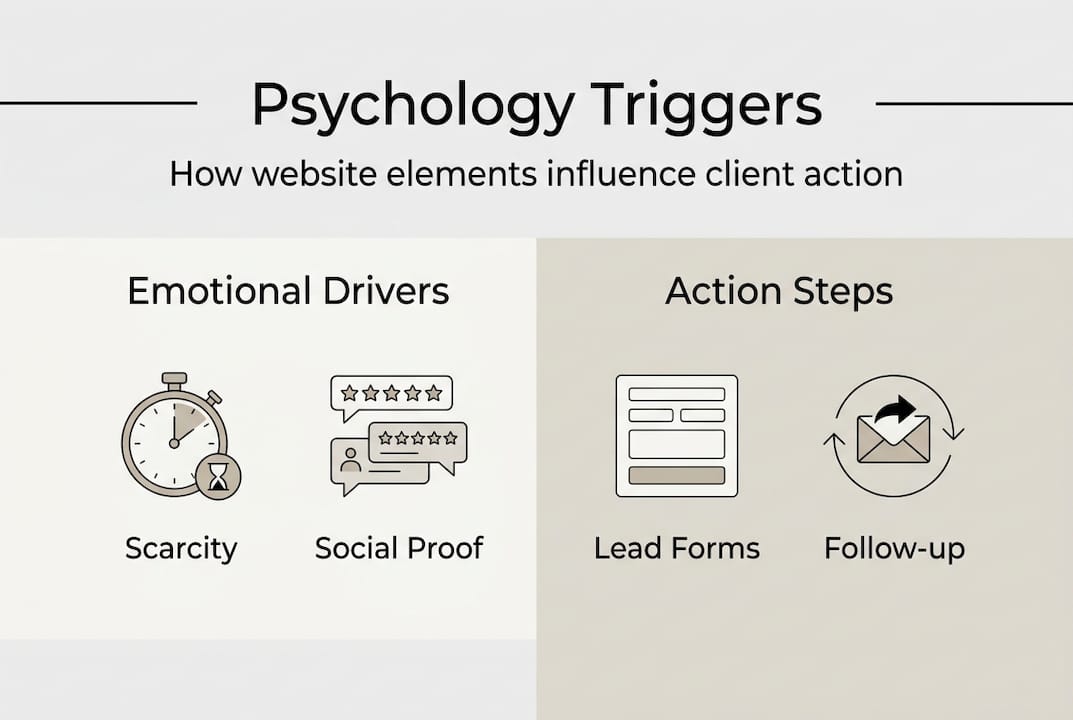
Automated follow-up systems dramatically improve lead capture and nurturing outcomes. The data below compares conversion rates with and without psychology-driven automation:
| Lead capture approach | Conversion rate | Follow-up response time | Client retention |
|---|---|---|---|
| Manual follow-up only | 12-18% | 24-48 hours | 45% |
| Automated email sequences | 32-41% | Immediate | 68% |
| Automated + personalised touch | 48-57% | Immediate + 4 hours | 82% |
The difference is stark. Immediate automated responses maintain momentum while prospects are most engaged, and personalised follow-up adds the human touch that builds genuine relationships. Your email sequences should educate and nurture rather than hard-sell, providing value that reinforces your authority and keeps your service top-of-mind.
Here are website design elements that improve user trust and conversion:
- Clear, benefit-focused headlines that speak directly to visitor pain points within the first screen
- Prominent calls-to-action using action-oriented language and contrasting colours to draw attention
- Trust badges including security seals, industry certifications, and payment processor logos near forms
- Video testimonials featuring real clients sharing specific results and emotional transformations
- Simple navigation with intuitive menus that guide visitors logically through your service offerings
- Mobile-optimised layouts ensuring seamless experience across all devices and screen sizes
Pro Tip: Implement personalised email sequences triggered by specific visitor behaviours, like downloading a lead magnet or viewing a pricing page. Tailor messaging based on their demonstrated interests rather than sending generic blasts to your entire list.
Community-building and referral incentives tap into social proof and reciprocity simultaneously. When existing clients feel part of an exclusive group, they naturally advocate for your business. Create a private Facebook group, members-only content library, or VIP client events that foster connection and loyalty. Referral programmes work best when the incentive benefits both the referrer and the new client, creating a win-win dynamic that feels generous rather than transactional.
Beware of over-automation that strips away the human element. Robotic email sequences with zero personalisation reduce perceived effort and undermine trust. Balance efficiency with authenticity by injecting personality into automated messages, using conversational language, and responding personally to replies. Your prospects can sense when they’re being processed through a faceless funnel versus genuinely cared for by a real person who understands their needs. Learn more about optimising sales funnels to balance automation with authentic connection throughout the buyer journey.
Discover expert digital marketing strategies tailored for your business
Applying marketing psychology principles effectively requires both strategic insight and tactical execution. You’ve learned the core concepts, but translating them into measurable business growth demands expertise, testing, and continuous optimisation. That’s where partnering with specialists who understand the unique challenges of female service business owners becomes invaluable.
Jarrod Harman’s approach combines psychology-backed marketing strategies with proven systems designed specifically for service-based businesses ready to scale online. Whether you’re looking to refine your brand messaging, build conversion-optimised funnels, or implement automated lead nurture sequences, expert guidance accelerates results and prevents costly missteps. Explore digital marketing ideas to grow your business and discover how tailored strategies align with your unique goals and audience.
Key benefits of working with marketing specialists include:
- Strategic clarity on which psychology principles deliver the highest ROI for your specific service niche
- Done-for-you implementation of conversion-optimised websites, funnels, and email sequences
- Ongoing testing and refinement to maximise lead quality and client lifetime value
Ready to move from theory to measurable growth? Visit digital marketing step by step growth for a clear roadmap, or learn how to generate leads online with systems designed for sustainable business expansion. Your next level of success starts with expert strategies that turn psychology principles into predictable revenue.
Frequently asked questions
What is marketing psychology and how can it help my business?
Marketing psychology applies behavioural science insights to understand and ethically influence how people make buying decisions. It helps your business by revealing why ideal clients hesitate, what triggers trust, and how to guide them toward solutions that genuinely serve their needs, resulting in higher conversion rates and stronger client relationships.
How does authentic storytelling enhance connection with my ideal clients?
Authentic storytelling builds emotional resonance by sharing real struggles, vulnerabilities, and transformations that mirror your clients’ own experiences. When prospects see themselves in your narrative, they feel understood at a deeper level, which accelerates trust and positions your service as the natural solution to their challenges.
What are the basics of lead capture optimisation?
Lead capture optimisation ensures visitors can easily provide contact information in exchange for value, like a guide or consultation. Key elements include clear calls-to-action, simple forms asking only essential information, immediate automated follow-up confirming their action, and nurture sequences that educate and build trust before any sales pitch.
How does ethical persuasion differ from manipulation?
Ethical persuasion focuses on win-win outcomes where both you and your client benefit genuinely from the relationship. It respects client autonomy, provides transparent information, and solves real problems. Manipulation prioritises your gain over client welfare, uses deception or pressure tactics, and often leads to buyer’s remorse and damaged reputation.
How do I start implementing marketing psychology without feeling overwhelmed?
Start with one principle that aligns naturally with your current marketing, like adding client testimonials for social proof or creating scarcity with limited availability. Test its impact on conversions, refine based on results, then layer in additional principles gradually. Use a content marketing checklist to systematically implement psychology-driven tactics without complexity overload.
Recommended
- Social media strategy tips to boost sales for services – Jarrod Harman
- How to Scale Online Business for Consistent Growth – Jarrod Harman
- 7 Essential Business Scaling Strategies for Aussie Service Owners – Jarrod Harman
- Complete Guide to Scaling Online Marketing – Jarrod Harman
- Instagram Ad Mangement • Design Box Digital