


Juggling client growth and lead generation can leave even the most experienced Australian business owner wishing for smarter solutions. The rise of artificial intelligence is giving service-based entrepreneurs access to tools that deliver hyper-personalised marketing strategies, helping them connect with ideal clients faster and more efficiently. This article breaks down how AI technologies are making marketing success more accessible, uncovering practical ways to boost client acquisition and transform customer engagement with precision.
Table of Contents
- AI In Marketing Explained For Businesses
- Key Types Of AI Marketing Technologies
- How AI Enhances Lead Generation Strategies
- Personalisation And Customer Experience Benefits
- Risks, Ethical Challenges, And Common Mistakes
Key Takeaways
| Point | Details |
|---|---|
| AI Revolutionises Marketing | Businesses can enhance customer engagement and decision making through AI, enabling hyper-personalised marketing strategies. |
| Core AI Technologies | Key technologies like machine learning, natural language processing, and generative AI can significantly improve targeting and customer communication. |
| Lead Generation Transformation | AI enhances lead generation precision, allowing businesses to identify and nurture high-potential customers effectively. |
| Ethical Considerations | Organisations must address risks like algorithmic bias and data privacy to establish trust and ensure responsible AI usage in marketing. |
AI in Marketing Explained for Businesses
Artificial Intelligence (AI) is rapidly transforming marketing strategies, offering businesses unprecedented capabilities in customer engagement and strategic decision making. Generative AI technologies are revolutionising how companies interact with customers, create content, and develop personalised marketing approaches.
At its core, AI in marketing represents a sophisticated approach to understanding and predicting customer behaviour through advanced data analysis and machine learning algorithms. Businesses can now leverage AI to segment audiences more precisely, personalise messaging, and optimise marketing campaigns with remarkable accuracy. This technology enables marketers to move beyond traditional demographic targeting, instead creating hyper-personalised experiences that resonate with individual customer preferences and buying patterns.
The practical applications of AI in marketing are extensive and continually expanding. From chatbots providing instant customer support to predictive analytics that forecast purchasing trends, AI empowers businesses to make data-driven decisions quickly. AI-powered marketing capabilities span multiple domains including content creation, customer segmentation, ad targeting, and performance optimization.
Pro tip: Start small with AI integration by selecting one specific marketing function like customer segmentation or email personalization, and gradually expand your AI implementation strategy.
Key Types of AI Marketing Technologies
In the evolving landscape of digital marketing, various AI technology types play critical roles in transforming marketing strategies. These technologies range from basic reactive systems to advanced machine learning algorithms that can predict and personalise customer interactions with remarkable precision.
Key AI marketing technologies include machine learning algorithms, natural language processing, and generative AI systems. Machine learning enables marketers to analyse vast datasets, identifying complex patterns in customer behaviour and predicting future trends. Natural language processing powers sophisticated chatbots and content generation tools, allowing businesses to create personalised communication at scale. Generative AI technologies are particularly revolutionary, enabling dynamic content creation, personalised marketing messages, and intelligent customer interaction strategies.
The complexity of AI marketing technologies can be categorised into different levels of sophistication. Reactive machines represent the most basic form, executing predefined tasks, while more advanced systems like limited memory AI can learn from historical data and adapt marketing strategies in real-time. Theory of mind and self-aware AI represent future potential, where systems might understand emotional nuances and make increasingly autonomous marketing decisions.
Here’s a summary of core AI marketing technologies and their business advantages:
| Technology Type | Main Function | Business Benefit |
|---|---|---|
| Machine Learning | Data analysis and prediction | Improves targeting accuracy |
| Natural Language Processing | Automates customer communications | Enhances engagement quality |
| Generative AI | Creates dynamic, custom content | Scales personalisation |
| Limited Memory AI | Learns from historical data | Real-time strategy adjustment |
Pro tip: When exploring AI marketing technologies, start by identifying specific marketing challenges in your business and match them with appropriate AI solutions that offer incremental, measurable improvements.
How AI Enhances Lead Generation Strategies
Artificial intelligence is revolutionising lead generation by transforming traditional marketing approaches into sophisticated, data-driven strategies. Modern businesses can now leverage advanced AI technologies to identify, qualify, and nurture potential customers with unprecedented precision and efficiency.
The core strengths of AI in lead generation include predictive lead scoring, automated data collection, and hyper-personalised outreach. Machine learning algorithms analyse vast datasets to predict customer behaviour, identifying high-potential leads with remarkable accuracy. By integrating AI with customer relationship management (CRM) systems, businesses can prioritise leads more effectively, ensuring sales teams focus their efforts on the most promising prospects. AI-powered lead generation platforms enable real-time customer engagement, deploying personalised communication strategies across multiple channels simultaneously.

Key AI capabilities in lead generation encompass intelligent data analysis, automated customer segmentation, and dynamic content personalisation. These technologies can detect subtle patterns in customer interactions, allowing businesses to create more targeted marketing campaigns. Advanced natural language processing enables chatbots and automated communication tools to interact with potential leads in increasingly sophisticated and human-like ways, dramatically improving engagement rates and conversion potential.
Pro tip: Implement AI lead generation tools incrementally, starting with one specific function like lead scoring or email personalisation, and gradually expand your AI integration strategy to maximise learning and minimise implementation complexity.
Personalisation and Customer Experience Benefits
AI-driven personalisation transforms customer experiences by creating uniquely tailored interactions that dramatically improve engagement and satisfaction. Modern businesses can now leverage machine learning algorithms to understand individual customer preferences, delivering precisely targeted content and recommendations that feel incredibly personal and relevant.
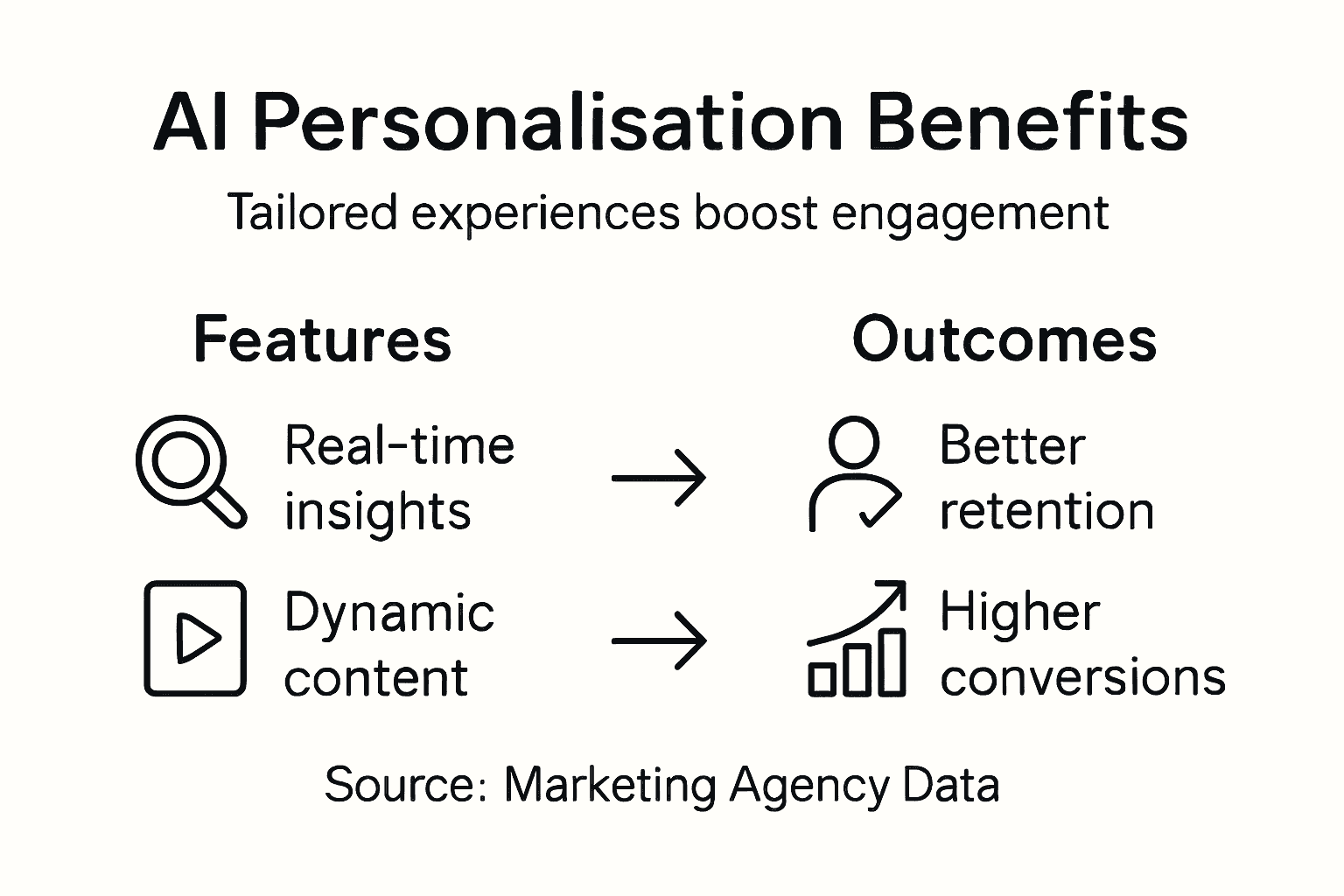
The core benefits of AI personalisation include predictive customer insights, real-time content adaptation, and hyper-targeted communication strategies. Advanced machine learning models analyse complex behavioural patterns, enabling businesses to anticipate customer needs before they are explicitly expressed. Systematic reviews of AI personalisation reveal significant improvements in customer loyalty, with technologies capable of segmenting audiences with unprecedented granularity and developing nuanced engagement approaches that resonate on an individual level.
Technological innovations in AI personalisation extend beyond simple recommendation engines. Natural language processing and deep learning algorithms now interpret subtle contextual cues, enabling businesses to create dynamic customer experiences that adapt in real-time. These sophisticated systems can personalise everything from marketing messaging to product suggestions, website layouts, and customer support interactions, creating a seamless and intuitive experience that feels uniquely crafted for each individual customer.
Pro tip: Start implementing AI personalisation by focusing on one critical customer touchpoint, such as email marketing or website content recommendations, and progressively expand your strategy as you gain insights and demonstrate tangible results.
Risks, Ethical Challenges, and Common Mistakes
Ethical challenges in AI marketing represent a critical consideration for businesses embracing advanced technologies. While AI offers remarkable capabilities, it simultaneously introduces complex ethical dilemmas that require careful navigation and proactive management.
The primary risks associated with AI marketing technologies include algorithmic bias, data privacy concerns, and potential manipulation of consumer behaviour. Machine learning algorithms can inadvertently perpetuate existing societal biases, creating discriminatory marketing practices that unfairly target or exclude certain demographic groups. Privacy concerns in digital marketing highlight the delicate balance between personalisation and consumer autonomy, with advanced AI systems potentially crossing boundaries of acceptable data usage and individual privacy protection.
Common mistakes businesses make when implementing AI marketing technologies involve insufficient transparency, neglecting algorithmic accountability, and overrelying on automated systems without human oversight. These errors can lead to significant reputation damage, legal challenges, and erosion of consumer trust. Organisations must develop robust ethical frameworks that prioritise fairness, accountability, and clear communication about how AI technologies collect, analyse, and utilise customer data.
This table compares common risks in AI marketing with strategies to address them:
| Risk Factor | Potential Issue | Mitigation Strategy |
|---|---|---|
| Algorithmic Bias | Unfair targeting of customers | Regular audits and updates |
| Data Privacy | Breach of customer trust | Clear data usage policies |
| Overautomation | Loss of human oversight | Human-in-the-loop processes |
| Lack of Transparency | Erosion of trust | Transparent communication |
Pro tip: Implement a comprehensive AI ethics review process that includes regular audits of your algorithms, transparent data usage policies, and mechanisms for customers to understand and control their data interactions.
Unlock the Power of AI to Transform Your Client Acquisition Today
If you’re grappling with the complexities of AI-driven marketing technologies like machine learning and generative AI to enhance lead generation and personalisation, you are not alone. Many businesses face challenges in translating sophisticated AI tools into scalable client acquisition strategies that deliver measurable results. This article highlights the need to move beyond trial and error with AI by integrating proven marketing systems designed for real business growth.
At Business Warriors | Digital Marketing Agency, we specialise in harnessing advanced AI concepts within our innovative Marketing Vortex Method. Our approach fuses omnichannel tactics such as SEO, Google and Meta Ads, email marketing and dynamic social media content to create personalised, data-driven campaigns. This proven system not only boosts lead generation accuracy but also refines customer engagement through hyper-targeted messaging — the very capabilities you want to master as shown in this Uncategorized Archives – Jarrod Harman collection.
Discover how to turn AI from a daunting challenge into your competitive advantage. Visit https://jarrodharman.com today and take the first step towards scalable online client acquisition backed by transparent, results-focused strategies. Your next level growth starts by partnering with experts who understand both complex AI marketing technologies and your unique business goals.
Frequently Asked Questions
What are the main benefits of using AI in marketing?
AI in marketing enhances customer engagement by providing personalised experiences, optimising campaigns through data analysis, and enabling predictive insights that improve targeting accuracy.
How can businesses integrate AI technologies into their marketing strategies?
Businesses can start small by focusing on one specific function such as customer segmentation or email personalisation before gradually expanding their AI implementation, ensuring measurable improvements.
What risks should businesses consider when adopting AI in marketing?
Key risks include algorithmic bias, data privacy concerns, and over-reliance on automation without human oversight. It’s crucial to establish ethical frameworks and conduct regular audits to mitigate these issues.
How does AI improve lead generation strategies?
AI enhances lead generation through predictive lead scoring, automated data collection, and hyper-personalised outreach, allowing businesses to identify and nurture leads with unprecedented efficiency.