


Nearly 60 percent of Australian beauty businesses miss critical insights by relying on outdated marketing attribution models. For female owners in Australia’s beauty and wellness industry, understanding which marketing channels truly drive leads can make the difference between wasted spend and meaningful growth. This guide breaks down the strategies and models that help you see exactly where your marketing budget delivers the strongest results.
Table of Contents
- Defining Marketing Attribution in Australia
- Attribution Models and How They Differ
- How Attribution Impacts Marketing Budgets
- Common Mistakes in Attribution Analysis
- Practical Steps to Improve Campaign ROI
Key Takeaways
| Point | Details |
|---|---|
| Understanding Marketing Attribution | Marketing attribution helps businesses in the beauty sector track the effectiveness of various marketing channels in driving customer conversions and revenue. |
| Utilising Multiple Attribution Models | Businesses should experiment with different attribution models to gain insights into how various touchpoints influence the customer journey and optimise marketing strategies. |
| Impact on Budget Allocation | Effective attribution analysis allows beauty businesses to allocate marketing budgets strategically, maximising return on investment while avoiding wasteful spending. |
| Avoiding Common Mistakes | Companies should avoid oversimplifying customer journeys by relying on single-touch models and ensure comprehensive data integration for accurate attribution insights. |
Defining Marketing Attribution in Australia
Marketing attribution is a strategic process in digital marketing that enables businesses, especially in the beauty and wellness sector, to understand precisely how different marketing channels contribute to customer conversions and revenue generation. By tracking marketing touchpoints, businesses can make data-driven decisions about where to invest their marketing budgets for maximum impact.
At its core, marketing attribution involves systematically analysing and assigning credit to various marketing interactions that ultimately lead a potential customer to make a purchase. For beauty businesses in Australia, this might include tracking interactions across social media platforms, Google Ads, email marketing campaigns, and organic search results. The goal is to understand which specific marketing efforts are most effective in driving leads and generating revenue.
There are multiple attribution models businesses can utilise, ranging from simple single-source approaches to sophisticated multi-touch methodologies. These models help beauty entrepreneurs identify the precise marketing channels and strategies that resonate most with their target audience. By implementing robust attribution tracking, businesses can optimise their marketing spend, personalise customer experiences, and develop more targeted engagement strategies.
Pro tip: Invest in analytics tools that provide comprehensive multi-channel attribution tracking to gain deeper insights into your marketing performance and customer journey.
Attribution Models and How They Differ
In the complex world of digital marketing, different attribution models provide unique frameworks for understanding how marketing channels contribute to customer conversions. These models range from simple single-touch approaches to sophisticated multi-touch methodologies, each offering distinct insights into the customer journey for beauty businesses across Australia.
The primary categories of attribution models include single-touch models like first-click and last-click, which assign full conversion credit to either the initial or final marketing touchpoint. Multi-touch models, by contrast, distribute credit across multiple interactions, recognising the nuanced path customers take before making a purchase. For beauty entrepreneurs, these models can reveal critical insights about how social media, email marketing, Google Ads, and organic search collectively influence customer decision-making.

More advanced algorithmic attribution models leverage statistical methods to dynamically assign credit based on each touchpoint’s specific impact. These data-driven approaches help businesses move beyond simplistic linear crediting, providing a more nuanced understanding of marketing performance. By analysing complex interaction patterns, beauty businesses can develop more targeted marketing strategies that precisely align with customer engagement preferences and behaviour.
Pro tip: Experiment with different attribution models and compare their insights to develop a more comprehensive understanding of your marketing channel effectiveness.
Here’s a comparison of popular marketing attribution models used by Australian beauty businesses:
| Attribution Model | Credit Distribution | Strengths | Limitations |
|---|---|---|---|
| First-click | 100% to the first channel | Highlights customer acquisition | Ignores conversion influencers |
| Last-click | 100% to the last channel | Identifies immediate converter | Overlooks earlier engagements |
| Linear | Equal across all channels | Reflects full customer journey | Can dilute major influences |
| Algorithmic | Dynamic by impact | Reveals real channel effectiveness | Requires advanced data analysis |
How Attribution Impacts Marketing Budgets
Accurate marketing attribution is a critical strategic tool for beauty businesses looking to optimise their marketing investments and justify expenditure. By understanding precisely how different marketing channels contribute to revenue generation, entrepreneurs can make data-driven decisions about budget allocation, reducing wasteful spending and maximising return on investment.
The choice of attribution model significantly influences budget planning. Traditional last-click models often misleadingly overvalue bottom-of-funnel channels, potentially leading to skewed budget distributions that don’t reflect the true customer journey. Multi-touch and algorithmic attribution approaches provide a more nuanced perspective, revealing the complex interactions across social media, email marketing, Google Ads, and organic search that collectively drive customer conversions.
Modern marketing teams are increasingly leveraging advanced attribution techniques to transform budget allocation from a guessing game into a strategic science. By integrating data from multiple sources and employing sophisticated statistical methods, beauty businesses can develop granular insights into channel performance. This approach enables more precise forecasting, helps identify emerging marketing opportunities, and ensures that every marketing dollar is deployed with maximum potential for generating revenue.
Pro tip: Regularly review and recalibrate your attribution models to ensure they accurately reflect your evolving customer acquisition strategies and market dynamics.
Common Mistakes in Attribution Analysis
Marketing professionals often fall into several critical traps when conducting attribution analysis errors, which can significantly distort their understanding of marketing performance. These mistakes typically stem from oversimplification, data misinterpretation, and relying on outdated or incomplete tracking methodologies that fail to capture the nuanced customer journey in the beauty and wellness sector.
One of the most prevalent errors is over-reliance on single-touch attribution models, particularly the last-click approach. This method dramatically oversimplifies customer interactions by crediting the final touchpoint, effectively rendering invisible the multiple marketing efforts that contributed to the customer’s decision-making process. For beauty businesses, this means potentially misunderstanding the true impact of awareness-stage marketing activities like social media engagement, content marketing, and brand storytelling.
Another significant mistake involves poor data integration and siloed marketing channels. Many businesses fail to create a unified view of customer interactions across platforms, leading to fragmented and incomplete attribution insights. This disconnect can result in misallocated marketing budgets, missed opportunities for optimisation, and an inability to understand the genuine effectiveness of different marketing strategies. Advanced attribution requires robust data collection, comprehensive tracking mechanisms, and a holistic approach that considers the entire customer lifecycle.
Pro tip: Implement cross-channel tracking and invest in sophisticated analytics platforms that can provide a comprehensive, integrated view of your marketing performance.
Practical Steps to Improve Campaign ROI
Marketing professionals can dramatically enhance campaign performance by leveraging customer data strategically and implementing targeted optimization techniques. For beauty businesses, this means developing a nuanced approach that goes beyond generic marketing strategies and focuses on precise, measurable outcomes that directly impact revenue generation.
The first critical step involves establishing clear, measurable goals and developing robust tracking mechanisms across all marketing channels. This requires integrating data from multiple sources, including social media platforms, email marketing systems, Google Ads, and website analytics. By creating a unified view of customer interactions, beauty entrepreneurs can identify the most effective touchpoints and allocate their marketing budgets with unprecedented precision, ensuring that every marketing dollar generates maximum return.
Advanced marketers are now employing sophisticated data-driven techniques to optimise campaign performance. This includes continuous A/B testing of messaging, refining audience targeting parameters, and using behavioural data to personalise marketing experiences. For beauty businesses, this might mean segmenting audiences based on specific skincare concerns, purchasing histories, or engagement levels, then crafting hyper-targeted campaigns that speak directly to each customer’s unique needs and preferences.
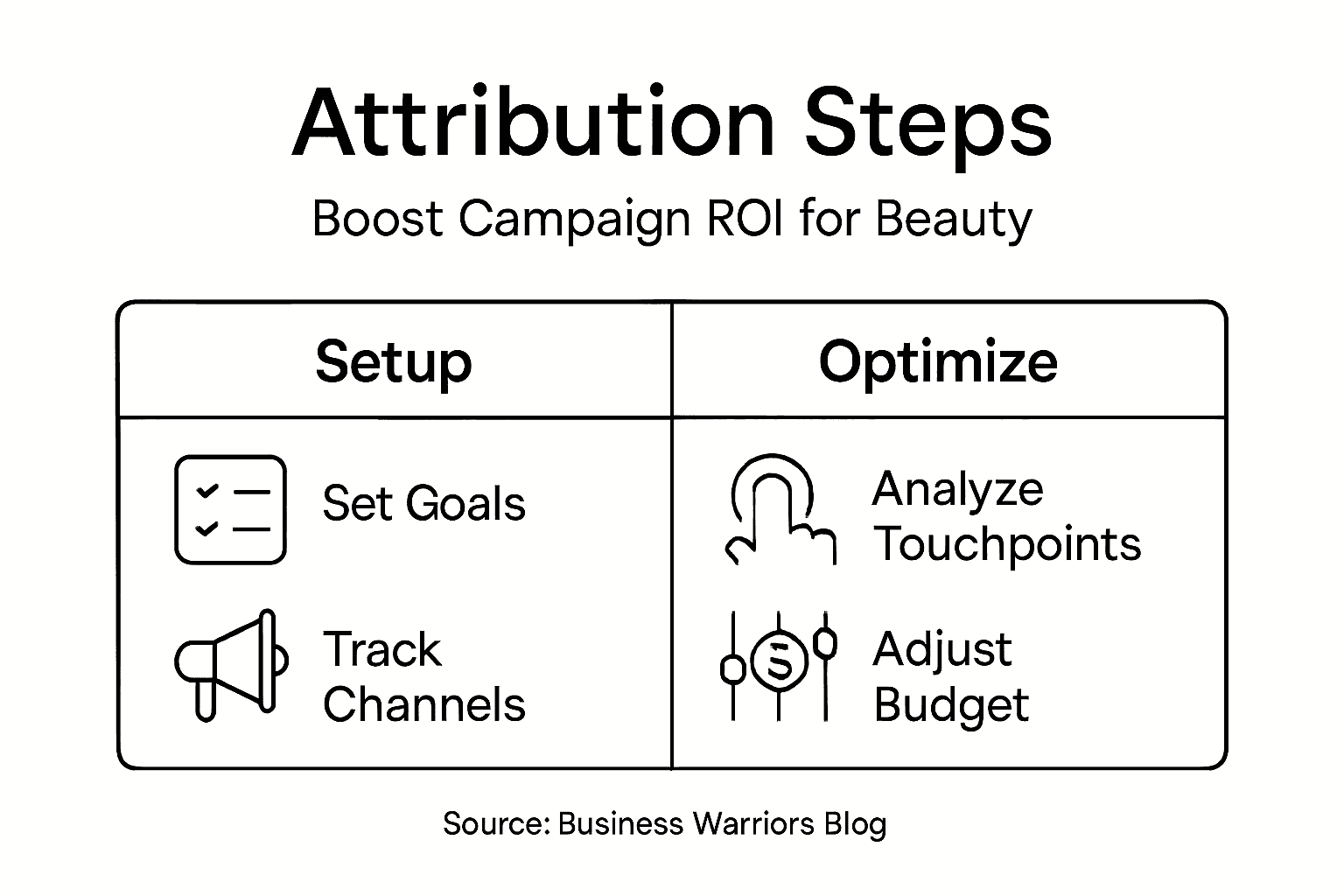
Pro tip: Develop a comprehensive dashboard that aggregates performance metrics across all marketing channels, enabling real-time insights and rapid strategic adjustments.
Below is a summary of essential steps for improving marketing ROI in the beauty sector:
| Step | Purpose | Implementation Tip |
|---|---|---|
| Set measurable campaign goals | Direct efforts towards outcomes | Use clear revenue & engagement KPIs |
| Integrate multi-source data | Build unified customer profiles | Link platforms with analytics API |
| Perform ongoing A/B testing | Refine messaging and targeting | Test headlines & offers frequently |
| Segment and personalise campaigns | Boost engagement and conversions | Target by interests or behaviour |
Unlock the Full Potential of Your Marketing Attribution to Drive More Leads
Understanding the complex ways your marketing channels contribute to sales is vital for beauty businesses seeking sustainable growth. This article highlights how accurate multi-touch and algorithmic attribution models reveal the true impact of every customer interaction — from social media engagement through to Google Ads and email campaigns. Many businesses struggle with oversimplified last-click attribution that hides critical touchpoints and leads to misallocated budgets. If you want to master this intricate customer journey and turn insights into ongoing bookings, expert guidance can make all the difference.
At Business Warriors, we specialise in supporting service-based Australian businesses just like yours by implementing proven, scalable systems such as the innovative Marketing Vortex strategy. It integrates SEO, paid advertising, email marketing, and social content into one powerful, omnichannel engine designed to boost leads consistently — with transparent reporting to track exactly how each channel contributes to your growth. Visit Jarrod Harman’s website to explore how his marketing expertise can help you optimise budget allocation and improve campaign ROI through smarter attribution.

Ready to eliminate guesswork and maximise return on every marketing dollar Invest in targeted strategies that work by connecting with Jarrod and the Business Warriors team today. Discover personalised solutions tailored to your business needs and start scaling your beauty or wellness brand confidently with a partner who understands your market. Find out more at Business Warriors Marketing Vortex and take the critical step towards marketing clarity and consistent growth now.
Frequently Asked Questions
What is marketing attribution in beauty businesses?
Marketing attribution is the process of analysing and assigning credit to various marketing channels that contribute to customer conversions and revenue generation. It helps beauty businesses understand which marketing efforts drive leads and sales.
What are the different types of attribution models?
Attribution models can be classified into single-touch models like first-click and last-click, which credit one channel, and multi-touch models that distribute credit across multiple interactions. Advanced algorithmic models dynamically assign credit based on each touchpoint’s impact.
How can marketing attribution impact my marketing budget?
Marketing attribution allows businesses to understand how different channels contribute to revenue, enabling data-driven decisions for budget allocation. This reduces wasteful spending and maximises return on investment by identifying the most effective marketing strategies.
What common mistakes should I avoid in attribution analysis?
Common mistakes include over-reliance on single-touch models, like last-click attribution, and poor data integration across channels. It’s crucial to adopt a holistic approach that considers all customer touchpoints to accurately assess marketing performance.
Recommended
- 7 Essential Types of Digital Advertising for Beauty Brands – Jarrod Harman
- B2B Lead Generation: Powering Business Growth Online – Jarrod Harman
- Salon Marketing Ideas to Boost Client Bookings Fast – Jarrod Harman
- Marketing for a Salon: Build a Profitable Client Pipeline – Jarrod Harman
- Understanding What is Omnichannel Attribution | Reddog Consulting Group