


Running a service-based business means you wear every hat, and adding “marketing expert” to that list can feel like a lot. You know your craft inside out, but turning that expertise into a steady stream of online leads? That’s where many women in business hit a wall. The good news is that a structured, tailored approach built on focus and trust makes campaign success repeatable, not accidental. This guide walks you through every stage, from setting your foundation to measuring real results, so you can launch with confidence and grow on your own terms.
Table of Contents
- Set your foundation: goals, branding, and ideal clients
- Gather your marketing essentials and choose channels
- Launch your campaign: step-by-step process
- Follow up, nurture leads, and avoid common mistakes
- Measure, optimise, and scale your campaigns
- Take your marketing campaigns further with expert support
- Frequently asked questions
Key Takeaways
| Point | Details |
|---|---|
| Focus on key channels | Choose up to three marketing channels that align with where your ideal clients spend their time for better results. |
| Build trust first | Prioritise social proof, clear value, and personalised follow-up to boost conversions in service-based marketing. |
| Measure and optimise | Track ROI, cost per lead, and conversion rates monthly for continual growth and smarter campaigns. |
| Repeatable systems | Implement simple processes and nurture flows for sustainable campaigns, even with a small team or solo business. |
Set your foundation: goals, branding, and ideal clients
Before you write a single caption or run a single ad, you need clarity. What does a successful campaign actually look like for your business? More bookings? More enquiries? A specific revenue target? Vague goals produce vague results, so get specific from the start.
Clarifying your ideal client is the single most important step before any campaign launches. Think about who she is: her age, her frustrations, what she searches for at 10pm when the kids are in bed. When you know her deeply, your messaging writes itself.
Your branding needs to do heavy lifting here too. For women aged 35 to 50 running service businesses, trust is the currency that converts. That means leaning into marketing psychology strategies like social proof, testimonials, and real client case studies. These elements signal credibility before a prospect ever speaks to you.
Here’s what a strong campaign foundation includes:
- A clear value proposition that speaks directly to your ideal client’s pain points
- At least three client testimonials or before-and-after case studies
- A consistent visual identity across all platforms
- A defined campaign goal with a measurable outcome
- A realistic timeline and budget allocation
Pro Tip: A one-page marketing plan focusing on just one to three channels keeps your actions simple and sustainable. Complexity is the enemy of consistency.
With your campaign purpose clear, your next step is understanding which tools and resources will set you up for a smooth launch.
Gather your marketing essentials and choose channels
You don’t need a massive tech stack to run effective campaigns. You need the right assets in place and a clear channel strategy. Here’s a quick reference for the essentials:
| Asset | Purpose | Recommended tool |
|---|---|---|
| Booking or enquiry page | Convert traffic into leads | Calendly, Acuity Scheduling |
| Landing page | Campaign-specific conversions | WordPress, Leadpages |
| Testimonial section | Build trust and credibility | Google Reviews, Trustpilot |
| Lead capture form | Grow your email list | Mailchimp, ActiveCampaign |
| Social media profiles | Visibility and community | Instagram, Facebook, LinkedIn |
| Email sequence | Nurture and convert leads | Klaviyo, MailerLite |
Choosing the right channels matters more than being everywhere. LinkedIn works well for professional services like consulting or legal. Instagram suits visual businesses like salons, spas, and clinics. Facebook Groups build community and referral networks, which are gold for service businesses.
Starting with zero-budget organics and selecting one to three channels is the smartest move for busy women in services. Here’s a quick breakdown:
- Organic channels: Lower cost, builds long-term trust, slower results. Includes SEO, referrals, and community engagement. Learn more about how to increase online visibility through organic strategies.
- Paid channels: Faster results, requires budget discipline, scalable when optimised. Includes Google Ads, Meta Ads, and sponsored content.
- Hybrid approach: Start organic to validate your message, then amplify with paid once you know what converts. This is the approach outlined in beyond social media marketing for female-led businesses.
With your tools and channels selected, it’s time to map out your campaign step by step.

Launch your campaign: step-by-step process
A 7 to 8 step framework is what most successful women-owned service businesses follow when launching campaigns. Here’s how to work through it:
- Clarify your goal. Define what success looks like in numbers: bookings, leads, revenue.
- Build your brand assets. Testimonials, imagery, copy, and your value proposition.
- Select your channels. Pick one to three based on where your ideal client spends time.
- Create and publish content. Batch your content in advance so you stay consistent without burning out.
- Set up tracking. Install Google Analytics, Meta Pixel, or your CRM’s tracking before you go live.
- Follow up with leads. Respond within 24 hours. Speed matters more than most people realise.
- Measure your results. Review weekly during the campaign, monthly for trends.
- Optimise and scale. Double down on what works. Cut what doesn’t.
Here’s how organic and paid approaches compare across key campaign stages:
| Campaign stage | Organic approach | Paid approach |
|---|---|---|
| Awareness | SEO, social posts, referrals | Google Ads, Meta Ads |
| Lead capture | Free lead magnets, email opt-ins | Paid landing pages, retargeting |
| Nurture | Email sequences, community posts | Retargeting ads, sponsored content |
| Conversion | Testimonials, direct outreach | Offer-based ads, urgency campaigns |
| Timeframe | 2 to 6 months | Days to weeks |
Trust is the thread running through every stage. Use real client stories, engage genuinely in your community, and never overpromise. For more on scaling marketing campaigns effectively, the principles stay the same whether you’re spending $50 a day or $500.
Pro Tip: Use a 90-day testing cycle. Make small, deliberate tweaks rather than scrapping everything and starting again. Patience plus data beats gut feeling every time.
Once your campaign is live, consistent follow-up and nurturing separate the average campaigns from the ones that truly convert.
Follow up, nurture leads, and avoid common mistakes
Most leads don’t convert on first contact. That’s not failure, that’s just how buying decisions work. The businesses that win are the ones with a system for staying in touch without being pushy.
Implementing follow-up systems like email or WhatsApp can double conversion rates for women in service-based businesses. A simple email drip campaign, a WhatsApp check-in three days after an enquiry, or a referral request sent to happy clients are all low-tech, high-impact moves. The role of email marketing in nurturing leads is consistently underestimated, and marketing automation examples show just how much time you can save with the right setup.
Here are the most common mistakes to avoid:
- Too many channels at once. Spreading yourself thin kills quality and consistency.
- No follow-up system. Leads go cold fast. A 24 to 48 hour response window is critical.
- Ignoring your data. If you’re not reviewing what’s working, you’re guessing.
- Inconsistent posting. Sporadic content signals an unreliable business to potential clients.
- Skipping the ask. Many women in business hesitate to ask for referrals. Don’t.
Referrals convert at the highest rate of any channel because trust is transferred from one person to another. Never neglect your existing network when launching a new campaign.
Building a repeatable nurture flow doesn’t require expensive software. A simple email sequence of five to seven messages, spaced over two to three weeks, combined with genuine community engagement, is enough to move most leads from curious to committed.
Measuring your performance and learning from results ensures every campaign you launch gets stronger and smarter.
Measure, optimise, and scale your campaigns
Data is not the enemy of creativity. It’s the thing that tells you where to put your energy. Once your campaign is running, these are the numbers that matter most:
- Cost per lead (CPL): How much you’re spending to acquire each enquiry
- Conversion rate: The percentage of leads who become paying clients
- Customer acquisition cost (CAC): Total spend divided by new clients gained
- Return on ad spend (ROAS): Revenue generated for every dollar spent on ads
- Email click-through rate (CTR): Benchmark for Australian service campaigns sits at 2 to 4%
For context, service B2B Google Ads ROAS sits between 2.5x and 5x, while SEO median ROI clocks in at 27x over time. Aim for at least a 5:1 return before scaling any paid channel. More detail on how SEO and lead generation work together can help you build a long-term growth engine alongside your paid activity.
Review your metrics monthly. Use a simple spreadsheet if you’re not ready for a full dashboard. The goal is to spot patterns, not obsess over daily fluctuations. A measuring leads and ROI framework from Salesforce outlines a practical approach for service businesses at any stage.
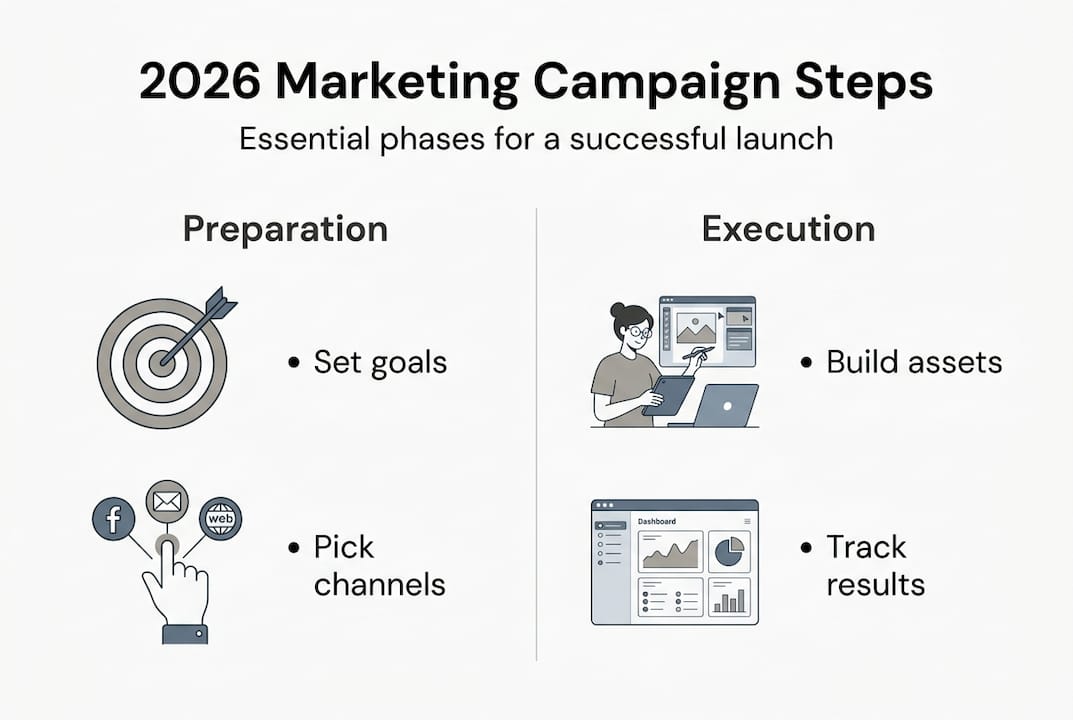
Scale when you see consistent ROI across at least two channels over a 90-day period. That’s your signal that the system works and is ready for more fuel.
Take your marketing campaigns further with expert support
You’ve got the roadmap. Now imagine having a team that handles the execution while you focus on delivering exceptional service to your clients. That’s exactly what Business Warriors is built for.
The Marketing Vortex Method is designed to systemise your entire campaign process, from planning and asset creation through to reporting and optimisation. It’s not a one-size-fits-all approach. It’s built around your business, your clients, and your goals. Whether you’re ready to launch your first lead generation campaign or want to know how to generate leads online for free before committing to a paid budget, there are resources and expert guidance available to help you move forward with clarity and confidence.
Frequently asked questions
How long does it take to see marketing campaign results?
Paid campaigns can deliver results within days, while SEO and organic strategies typically take two to three months to gain meaningful traction. Plan your expectations accordingly.
Which channels should I start with for my service business?
Choose one to three channels where your ideal clients already spend time. LinkedIn, Facebook Groups, and Instagram are consistently reliable starting points for service-based businesses.
What’s the most common marketing mistake to avoid?
Spreading effort across too many channels and skipping lead follow-up are the top pitfalls. A 90-day focused approach consistently outperforms scattered, short-term efforts.
How do I build trust with my marketing?
Client testimonials, real case studies, and value-driven content are your most powerful trust signals. Service campaigns succeed when authenticity and social proof lead the message rather than direct selling.