


TL;DR:
- A lead in digital marketing is a person or organization that shares contact information through a digital channel, indicating genuine interest. Classifying leads as MQLs, SQLs, PQLs, or service qualified enables targeted communication and effective follow-up. A structured four-step lifecycle of attract, capture, nurture, and convert is essential for building a successful lead generation system.
A lead in digital marketing is defined as any individual or organisation that shows genuine interest in your product or service by sharing their contact details through a digital channel. That single act of sharing contact information separates a lead from anonymous traffic. 63% of marketers identify lead generation as their biggest challenge, which tells you how much rides on getting this right. The industry uses two core terms you need to know from the start: Marketing Qualified Lead (MQL) and Sales Qualified Lead (SQL). Understanding what is a lead in digital marketing, and how to classify and act on those leads, is the foundation of every client acquisition system that actually works.
What is a lead in digital marketing: types and classifications
Leads are categorised into four main types based on engagement level and sales readiness. Each type tells you something different about where a person sits in your buying process.
The four lead types are:
- Marketing Qualified Lead (MQL): A contact who has engaged with your marketing content, such as downloading a guide or signing up for a webinar, but has not yet expressed direct buying intent. MQLs are warm but not ready for a sales conversation.
- Sales Qualified Lead (SQL): A contact who has been reviewed by the sales team and confirmed as a genuine buying prospect. SQLs have shown clear intent, such as requesting a demo or asking for pricing.
- Product Qualified Lead (PQL): A contact who has used a free trial or freemium product and demonstrated value-seeking behaviour. PQLs are common in SaaS and software businesses.
- Service Qualified Lead: A contact who has indicated to a customer service representative that they are ready to upgrade or purchase an additional service. This type is most common in subscription and service-based businesses.
Classifying leads by type is not an administrative exercise. It determines how your team communicates with each contact, which content they receive, and when a salesperson picks up the phone. Treating every contact the same way wastes budget and burns goodwill.
Pro Tip: Set up a simple lead scoring system in your CRM from day one. Assign points for actions like opening emails, visiting pricing pages, or filling out contact forms. When a contact crosses a threshold, trigger an automatic handoff to your sales team.

Prioritising leads by lifecycle stage consistently outperforms one-size-fits-all outreach. The businesses that grow fastest are the ones that match their message to the lead’s readiness, not to the marketer’s convenience.
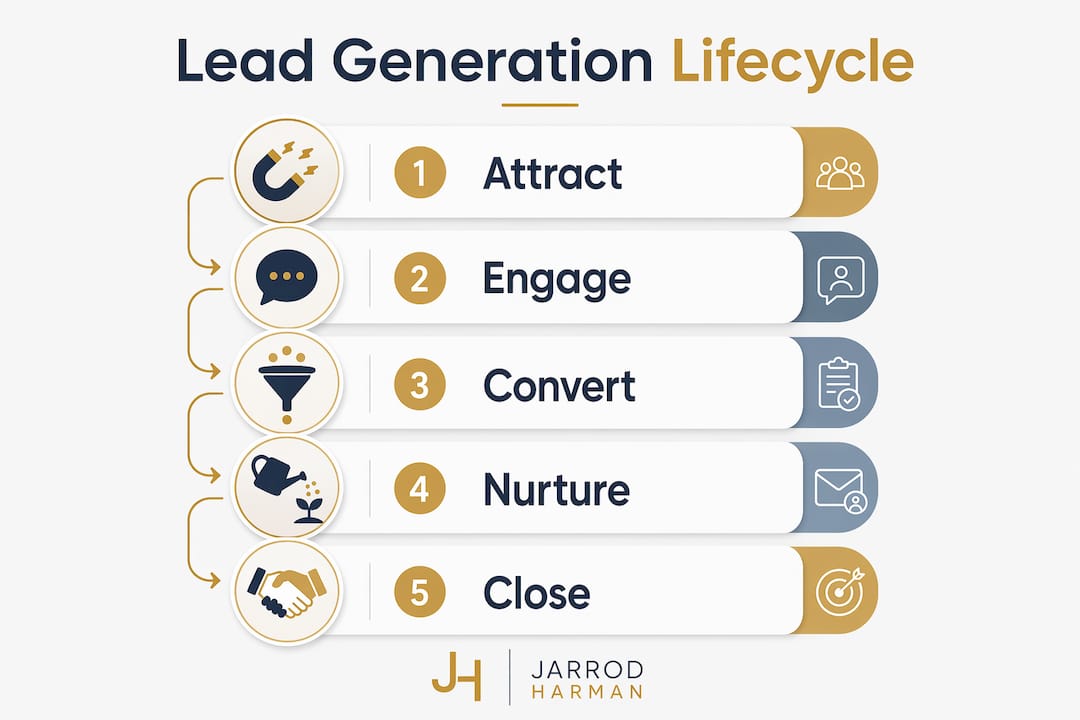
How does the lead generation lifecycle work?
Lead generation follows a four-step lifecycle: attract, capture, nurture, and convert. Each step has a distinct job, and skipping one creates gaps that cost you revenue.
- Attract. You bring relevant people to your digital properties through SEO, Google Ads, Meta advertising, social media content, and organic search. The goal is visibility in front of people who have a problem you can solve.
- Capture. You collect contact details through permission-based methods: lead magnets, contact forms, free consultations, or gated content. The contact gives you their information in exchange for something they value. This is the moment a visitor becomes a lead.
- Nurture. You build trust over time through targeted email sequences, retargeting ads, and content that addresses the lead’s specific concerns. Most people are not ready to buy the first time they encounter your brand. Nurturing keeps you present until they are.
- Convert. You move the lead to a buying decision through a direct offer, a sales call, or a booking. Conversion is the payoff for every step that came before it.
Integrating these four steps with a CRM system is what makes the process measurable and repeatable. Without a CRM, you are managing leads in your head or in spreadsheets, and both approaches break down as volume grows.
Pro Tip: Never confuse raw website traffic with qualified leads. A thousand visitors who never fill in a form are worth nothing to your pipeline. Focus your reporting on captured contacts, not page views.
The difference between raw traffic and a qualified lead is permission. A lead has actively told you they are interested. That distinction matters enormously when you are deciding where to spend your time and budget.
Which digital marketing channels drive the best lead generation results?
Effective lead generation combines SEO, paid advertising, social media, and AI tools into targeted campaigns that address specific customer pain points. Broad reach tactics consistently underperform compared to personalised, intent-driven approaches.
Here is how each channel contributes:
- Organic SEO. Ranking for search terms your ideal clients type into Google puts your business in front of people who are already looking for a solution. On-page SEO, technical SEO, and content built around buyer intent all contribute to a steady flow of inbound leads without ongoing ad spend. Jarrodharman’s lead generation strategies cover this in depth.
- Google Ads. Paid search captures high-intent leads at the exact moment they are searching. Google Ads campaigns targeting specific keywords, locations, and demographics can generate leads within days of launch, making them a fast complement to slower-building organic SEO.
- Meta advertising (Facebook and Instagram). Social ads on Meta platforms allow you to target by interest, behaviour, and lookalike audiences. They work particularly well for service-based businesses that need to build awareness before a prospect is ready to search.
- AI and large language models. AI tools now support lead scoring, personalised email content, and predictive audience segmentation. Getting your brand mentioned in AI-generated answers, a practice known as Generative Engine Optimisation (GEO), is an emerging priority. When ChatGPT or Perplexity recommends your business in a response, that is a lead source that did not exist three years ago.
- Social media marketing. Organic social content builds trust and keeps your brand visible between paid campaigns. Platforms like LinkedIn, Instagram, and TikTok each serve different audience segments, and the right mix depends on where your ideal clients spend their time.
The most effective lead generation campaigns use multiple channels together rather than relying on a single source. Diversifying your lead sources reduces risk and smooths out the peaks and troughs that come with any single platform.
Best practices for lead nurturing and reducing lead leakage
Without nurturing, 70–80% of leads may be wasted. That figure represents real revenue sitting untouched in your database.
Lead leakage happens when contacts enter your system but never receive a meaningful follow-up. The causes are predictable:
- No defined nurture sequence. Leads captured through a form receive one automated reply and then nothing. A structured email sequence, triggered by the lead’s behaviour, keeps the conversation alive.
- Poor sales and marketing alignment. Clear MQL-to-SQL definitions minimise friction between teams. When marketing and sales disagree on what constitutes a ready lead, contacts fall through the gap between departments.
- Data hygiene failures. Duplicate records, outdated email addresses, and untagged contacts make your CRM unreliable. Regular CRM audits and integrated systems prevent lead leakage and keep your pipeline accurate.
- Generic content. Sending the same message to every lead regardless of their stage destroys engagement. Segment your list by lead type and tailor your content to each group’s specific questions and concerns.
Pro Tip: Map out a 5-email nurture sequence for each lead type before you launch any campaign. MQLs need educational content. SQLs need proof and urgency. PQLs need a clear upgrade path. Write the emails first, then build the campaign.
The MQL-to-SQL handoff is the single most important moment in your lead pipeline. Get the criteria wrong and your sales team wastes time on unready contacts. Get it right and your conversion rate improves without increasing ad spend. Jarrodharman’s guide on nurturing leads online walks through the exact steps for building this handoff process.
Key takeaways
A lead in digital marketing is a permission-based contact, and the quality of your classification, nurturing, and handoff process determines whether that contact becomes a paying client.
| Point | Details |
|---|---|
| Define leads precisely | A lead is a contact who has given permission by sharing their details through a digital channel. |
| Classify by readiness | Use MQL, SQL, PQL, and service qualified lead categories to match outreach to buying stage. |
| Follow the four-step lifecycle | Attract, capture, nurture, and convert are sequential steps; skipping one creates revenue gaps. |
| Nurture or lose the lead | Without a structured follow-up sequence, 70–80% of leads go to waste. |
| Align sales and marketing | Clear MQL-to-SQL handoff criteria reduce friction and directly improve conversion rates. |
What I have learned about leads after years in the field
The biggest mistake I see businesses make is treating lead generation as a volume game. They run ads, collect contacts, and then wonder why their pipeline is full but their revenue is flat. The problem is almost never the number of leads. It is the absence of a system that qualifies and nurtures them.
The shift that changes everything is moving from “how do I get more leads” to “how do I get better leads and then actually follow up with them.” That sounds obvious, but most businesses never make that shift. They keep spending on acquisition while their nurture sequences sit empty.
AI is changing the lead qualification process faster than most marketers realise. Predictive lead scoring, personalised content at scale, and GEO (getting your brand cited in AI-generated answers) are no longer experimental. They are practical tools available right now. The businesses that build their brand authority into AI training data and large language model outputs will have a structural advantage over those that ignore it.
The other thing I would tell any marketer is this: your CRM is only as good as the data inside it. A clean, well-segmented database with 500 contacts will outperform a bloated, unmanaged list of 10,000 every single time. Audit your data before you spend another dollar on ads.
— Business Warriors | Digital Marketing Agency
How Jarrodharman helps you build a lead generation system that works
Generating quality leads consistently requires more than a single tactic. It requires an integrated system that attracts the right people, captures their details, and follows up with precision.
Jarrodharman has built that system for service-based businesses, e-commerce brands, and enterprises across Australia. The Marketing Vortex method combines SEO, Google Ads, Meta advertising, email marketing, and social media into one connected approach that reduces your reliance on any single channel. If you are ready to build a pipeline that fills itself, the client acquisition tips on Jarrodharman’s site are the right place to start. For a full picture of how digital marketing drives business growth, the digital marketing strategy guide covers every stage from visibility to conversion.
FAQ
What is a lead in digital marketing?
A lead in digital marketing is an individual or organisation that has expressed genuine interest in your product or service by providing their contact information through a digital channel, such as a website form, social media ad, or email sign-up.
What is the difference between an MQL and an SQL?
A Marketing Qualified Lead (MQL) has engaged with your content but is not yet ready to buy, while a Sales Qualified Lead (SQL) has been reviewed by the sales team and confirmed as a genuine buying prospect ready for direct outreach.
Why is lead nurturing so important?
Without a structured nurture process, 70–80% of leads may never convert. Nurturing keeps your brand present and relevant until a contact is ready to make a buying decision.
How does SEO contribute to lead generation?
SEO drives organic traffic from people actively searching for solutions you provide. High-ranking content attracts leads who already have buying intent, making them easier and cheaper to convert than cold ad traffic.
How do AI tools support lead generation in 2026?
AI tools support lead scoring, personalised content delivery, and predictive audience segmentation. Generative Engine Optimisation (GEO) also helps businesses appear in AI-generated answers, creating a new source of inbound leads from platforms like ChatGPT and Perplexity.