9 August 2026
Different types of online advertising: a guide for marketers
Discover the various types of online advertising and how to use each format effectively, from search and social to video and retargeting.
Online advertising breaks into several core formats including search, display/banner, social, video, shopping/product listing ads (PLAs), native, affiliate, email, programmatic/DSP, and retargeting. The one-line selector rule: use search for high intent, social and display for awareness and audience building, video and native for consideration and storytelling, shopping for product-driven purchase intent, and retargeting to convert warm audiences who already know you.
Global internet advertising expenditure has grown into one of the largest media categories on earth, which tells you something about where buyers actually spend their attention. The formats that capture that attention vary enormously in cost, creative complexity, and the stage of the funnel they serve best.
The principal ad types at a glance:
- Search ads (Google Ads, Microsoft Advertising): text ads triggered by keyword queries; best for high-intent buyers ready to act
- Display/banner ads: image or HTML5 ads served across publisher networks; best for awareness and retargeting
- Social ads (Meta, TikTok, LinkedIn): feed, story, and carousel formats; best for audience building and consideration
- Video ads (YouTube, TikTok, Meta): pre-roll, in-stream, and short-form; best for brand recall and consideration
- Shopping/PLA ads (Google Shopping): product-image ads with price; best for e-commerce purchase intent
- Native ads: sponsored content that matches the host page’s editorial style; best for content-led consideration
- Affiliate ads: performance-based placements through publisher networks; best for cost-controlled acquisition
- Email advertising: sponsored placements or dedicated sends to opted-in lists; best for retention and upsell
- Programmatic/DSP: automated real-time bidding across thousands of placements; best for scale and audience precision
- Retargeting: ads served to users who visited your site or engaged with your content; best for converting warm audiences
Pro Tip: Before you allocate a single dollar, write your primary campaign objective in one sentence. The format almost always follows from that sentence.
Key takeaways
The most important principle in digital advertising is this: match your ad format to your customer’s intent stage, measure by the KPI that reflects your actual objective, and integrate formats so each channel amplifies the next.
| Point | Details |
|---|---|
| Match format to intent | Use search and shopping for high-intent buyers; use social, video, and display for awareness and consideration. |
| Pricing model follows objective | CPC for direct response, CPM for awareness, CPA for affiliate and performance programmatic, CPV for video. |
| First-party data is now essential | Cookie deprecation makes CRM lists and server-side tracking the foundation of accurate targeting and attribution in Australia. |
| SEO and paid media compound together | Paid campaigns that amplify authoritative content build domain authority and earn brand mentions in AI/LLM responses over time. |
| Business Warriors | Jarrodharman’s Marketing Vortex integrates SEO, Google Ads, Meta, email, and funnels into one measurable system for Australian businesses. |
Table of Contents
- 1. What are the different types of online advertising?
- 2. How do you choose the right ad format for your campaign?
- 3. Pricing models, budgets, and campaign timelines in Australia
- 4. How to measure success: KPIs, attribution, and reporting
- 5. Australian compliance, privacy, and platform policy
- 6. Integrating ad formats: the Marketing Vortex in practice
- 7. Emerging targeting technologies you should know about
- 8. How to build a cohesive strategy across ad formats
- 9. Cross-device and cross-platform attribution: the real challenge
- 10. Common campaign pitfalls and how to fix them fast
- 11. What most agencies get wrong (and how to fix it quickly)
- 12. Business Warriors can build your integrated ad strategy
- Sources
1. What are the different types of online advertising?
Semrush catalogues numerous distinct digital ad formats, which can feel like a lot until you group them by what they actually do in a funnel. Below is a practical reference for each major format.
Search advertising
Search ads appear at the top and bottom of Google and Bing results pages when someone types a matching query. Google Ads and Microsoft Advertising both use a pay-per-click (PPC) auction: you bid on keywords, write text ads, and pay only when someone clicks. Because the user has already expressed intent through their search, conversion rates tend to run higher than most other formats. The trade-off is cost: competitive categories in Australia (legal, finance, home services) can push cost-per-click (CPC) well above $10.
Best for: bottom-funnel conversion, lead generation, local service discovery.
Pricing: CPC.
KPIs: click-through rate (CTR), CPC, conversion rate, cost per acquisition (CPA).
Shopping / product listing ads
Google Shopping ads pull product data from a merchant feed and display an image, price, and store name directly in search results. They require a Google Merchant Centre account and a clean product catalogue. For e-commerce businesses, shopping ads connect format choice directly to purchase intent in a way that text-only search ads cannot match.
Best for: e-commerce, product-driven intent, price-comparison shoppers.
Pricing: CPC.
KPIs: return on ad spend (ROAS), revenue, cost per conversion.
Display / banner advertising
Display ads are image, animated, or HTML5 creatives served across the Google Display Network, publisher sites, and ad exchanges. They reach users who are not actively searching, so they work best for awareness and retargeting rather than immediate conversion. Banner blindness is a real limitation: users have trained themselves to ignore static rectangles in predictable positions, which is why responsive display ads and rich media formats tend to outperform static banners.
Best for: brand awareness, retargeting, broad reach.
Pricing: CPM (cost per thousand impressions) or CPC.
KPIs: impressions, CPM, CTR, view-through conversions.
Social media advertising
Meta (Facebook and Instagram), TikTok, LinkedIn, Pinterest, and Snapchat all offer paid placements within their feeds, stories, and reels. The targeting depth is what separates social from every other format: you can reach people by age, location, interest, job title, life event, and lookalike audiences built from your own customer lists. Social media ads deliver particular advantages for service-based brands because you can build trust through creative before a user ever visits your website.
LinkedIn is the standout for B2B: job-title and company-size targeting is unmatched. TikTok’s short-form video format reaches younger demographics at relatively low CPMs. Meta remains the dominant platform for most Australian SMEs running awareness-to-conversion campaigns.
Best for: awareness, audience building, consideration, lead generation.
Pricing: CPM, CPC, cost per lead (CPL).
KPIs: reach, frequency, engagement rate, CPL, CPA.
Video advertising
YouTube (Google Ads), TikTok, Meta Reels, and LinkedIn Video all support paid video placements. YouTube offers skippable in-stream ads (cost per view, CPV), non-skippable bumper ads (CPM), and discovery ads. Video is the highest-recall format in digital advertising and the one most likely to earn a brand mention in an AI-generated response, because authoritative video content feeds the training data that large language models (LLMs) draw on.
Best for: brand awareness, product demonstration, consideration.
Pricing: CPV, CPM.
KPIs: view rate, completed views, brand lift, CTR.
Native advertising
Native ads match the look and feel of the editorial content around them. Sponsored articles on news sites, promoted listings on content discovery platforms, and in-feed sponsored posts all qualify. Because they do not look like ads, they tend to earn higher engagement than display. The downside is disclosure: the Australian Competition and Consumer Commission (ACCC) requires that sponsored content be clearly labelled, so “sponsored” or “promoted” tags are non-negotiable.
Best for: content-led consideration, SEO amplification, brand storytelling.
Pricing: CPM, CPC, flat-rate sponsorships.
KPIs: time on page, engagement rate, CTR, assisted conversions.
Affiliate advertising
Affiliate programs pay publishers a commission when a referred user completes a defined action (purchase, sign-up, download). You set the commission rate; publishers promote your offer through their own channels. Cost is only incurred on results, which makes affiliate a capital-efficient acquisition channel. The risk is brand safety: low-quality affiliates can damage reputation or generate fraudulent conversions, so vetting and monitoring publisher quality matters.
Best for: e-commerce acquisition, cost-controlled lead generation.
Pricing: CPA (cost per acquisition).
KPIs: conversion rate, CPA, affiliate revenue contribution.
Email advertising
Email advertising covers both sponsored placements within third-party newsletters and paid sends to your own opted-in list. For owned-list campaigns, the cost is the email service provider (ESP) fee rather than a media buy. Sponsored newsletter placements (common in Australian industry publications and media brands) work on a CPM or flat-rate basis. The Spam Act 2003 governs commercial email in Australia and requires consent, sender identification, and an unsubscribe mechanism.
Best for: retention, upsell, re-engagement, high-LTV audiences.
Pricing: flat rate, CPM, or ESP subscription cost.
KPIs: open rate, click rate, revenue per email, unsubscribe rate.
Programmatic / DSP advertising
Programmatic advertising automates real-time bidding across thousands of publisher placements through demand-side platforms (DSPs) like Google Display & Video 360, The Trade Desk, and Amazon DSP. An auction runs in milliseconds each time a page loads: the DSP bids based on audience data, and the winning ad is served. The scale is unmatched, but practitioners must guard against low-quality “made-for-advertising” inventory by using placement exclusions, domain blocklists, and third-party verification tools such as Integral Ad Science (IAS) or DoubleVerify.
Best for: large-scale awareness, audience-precision targeting, cross-channel reach.
Pricing: CPM, CPA (programmatic guaranteed uses fixed CPM).
KPIs: impressions, viewability rate, CPM, frequency, CPA.
Retargeting
Retargeting (also called remarketing) serves ads to users who have already visited your website, watched your video, or engaged with your app. It is the highest-ROI format for most businesses because the audience is already warm. Google Ads, Meta, and most DSPs support retargeting via pixel or first-party audience lists. Understanding how remarketing sequences work before you set up a campaign saves significant wasted spend.
Best for: converting warm audiences, cart abandonment recovery, upsell.
Pricing: CPM, CPC.
KPIs: CPA, ROAS, conversion rate, frequency.
In-app / mobile advertising
In-app ads appear inside mobile applications: banner ads, interstitials, rewarded video, and playable ads. Apple’s App Tracking Transparency (ATT) framework has reduced cross-app tracking on iOS, which affects audience precision. Android remains more permissive. Mobile-first creative (vertical video, large tap targets, minimal text) is non-negotiable.
Best for: app installs, mobile-first audiences, gaming and entertainment verticals.
Pricing: CPM, CPC, cost per install (CPI).
KPIs: install rate, CPI, in-app events, retention rate.
Format comparison at a glance:
| Format | Best for | Primary pricing | Targeting precision | Creative complexity | Typical KPIs |
|---|---|---|---|---|---|
| Search | High-intent conversion | CPC | High (keyword + audience) | Low (text) | CTR, CPA, CVR |
| Shopping/PLA | E-commerce purchase intent | CPC | Medium (product feed + query) | Medium (feed + images) | ROAS, revenue |
| Display/banner | Awareness, retargeting | CPM / CPC | Medium (contextual + audience) | Medium (image/HTML5) | Impressions, CTR |
| Social | Awareness, consideration, leads | CPM / CPC / CPL | Very high (demographic + interest) | High (image + video) | Reach, CPL, CPA |
| Video | Brand recall, consideration | CPV / CPM | High (audience + context) | High (video production) | View rate, brand lift |
| Native | Content-led consideration | CPM / CPC | Medium (contextual) | Medium (article + image) | Engagement, CTR |
| Affiliate | Cost-controlled acquisition | CPA | Low (publisher-driven) | Low (creative assets) | CPA, revenue |
| Retention, upsell | Flat / CPM | High (first-party list) | Low–medium (copy + design) | Open rate, revenue | |
| Programmatic/DSP | Scale, audience precision | CPM | Very high (data-driven) | Medium (display + video) | Viewability, CPM, CPA |
| Retargeting | Warm-audience conversion | CPM / CPC | Very high (first-party) | Low–medium | CPA, ROAS, CVR |
| In-app/mobile | Mobile-first audiences | CPM / CPI | Medium (device + behaviour) | Medium (vertical video) | CPI, in-app events |
The most consistent finding across format research is that matching ad type to customer intent stage matters more than budget size. Search captures users who are already looking; social and display build the awareness that makes search ads more effective. Run them together and the whole outperforms the sum of its parts.
, Semrush, online advertising guide
2. How do you choose the right ad format for your campaign?
The US Chamber of Commerce groups online advertising into four practical types for small businesses: paid search, social, native, and display. That is a useful starting point, but the real decision comes from mapping your objective to the intent level of your audience.
Decision flow:
- Define your objective. Awareness (reach new people), consideration (educate and engage), conversion (drive a purchase or lead), or retention (keep existing customers buying).
- Identify your audience’s intent level. Are they actively searching for a solution, or do they not yet know they need you?
- Choose your primary format. High intent = search or shopping. Low intent = social, display, or video. Warm audience = retargeting.
- Add supporting formats. Pair search with retargeting to recapture non-converters. Pair social awareness with email nurture for considered purchases.
- Define your creative and measurement plan. What assets do you have? What does success look like in numbers?
- Set a test budget and timeline. Most formats need two to four weeks of data before optimisation decisions are meaningful.
Pre-launch checklist:
- Conversion tracking installed and verified (Google Tag Manager, Meta Pixel, server-side events)
- Audience segments defined (custom audiences, lookalikes, keyword lists)
- Creative assets produced and sized to platform specifications
- Landing page matches ad message and loads in under three seconds on mobile
- UTM parameters applied to all destination URLs
- Budget allocated across formats with a clear test-versus-scale threshold
- KPIs agreed and dashboard built before spend begins
Two quick examples:
An e-commerce brand selling skincare products starts with Google Shopping for purchase-intent queries, adds Meta carousel ads targeting lookalike audiences for awareness, and runs a retargeting sequence for cart abandoners. A service business (say, a med spa in Brisbane) runs Google Search for “laser hair removal near me” queries, uses Meta lead-form ads to build a prospect list, and follows up with email nurture. The formats differ; the logic is the same: match intent, then sequence.
For digital advertising tips that apply across business types, the principle of testing one variable at a time before scaling is the single most reliable way to avoid wasted spend.
3. Pricing models, budgets, and campaign timelines in Australia
How ad pricing works
Four models cover almost every format:
- CPC (cost per click): you pay when someone clicks. Standard for search and social direct-response campaigns.
- CPM (cost per thousand impressions): you pay for exposure. Standard for awareness campaigns, display, and programmatic.
- CPA (cost per acquisition): you pay when a defined action occurs. Standard for affiliate and performance-based programmatic.
- CPV (cost per view): you pay when a video is watched to a threshold (usually 30 seconds or the full ad). Standard for YouTube.
Australia-specific budget guidance
Australian auction prices reflect a smaller market than the US or UK, but competitive categories still carry significant CPCs. Scaling decisions should follow data, not calendar.
Campaign timeline expectations
- Week 1–2: account setup, pixel/tracking verification, creative production, audience builds, campaign launch.
- Week 2–4: learning phase. Most platforms (Google, Meta) require a minimum number of conversions before smart bidding stabilises. Do not make major changes during this window.
- Week 4–8: first optimisation cycle. Review creative performance, audience overlap, search term reports, and placement data.
- Month 3+: scale what works, pause what does not, introduce new creative variants.
When working with an agency or platform rep in Australia, confirm that invoicing is in AUD and that GST is applied correctly.
4. How to measure success: KPIs, attribution, and reporting
KPI taxonomy by funnel stage
Trying to judge an awareness campaign by its CPA is one of the most common measurement errors in digital advertising. Match the metric to the objective.
| Funnel stage | Ad formats | Primary KPIs |
|---|---|---|
| Awareness | Display, video, social (reach), programmatic | Impressions, reach, CPM, frequency, brand lift |
| Consideration | Social (engagement), video, native, email | CTR, engagement rate, video view rate, time on site |
| Conversion | Search, shopping, retargeting, social (lead gen) | CVR, CPA, ROAS, revenue, leads |
| Retention | Email, retargeting, social (existing customers) | Repeat purchase rate, LTV, email revenue, churn rate |
Attribution: the practical reality
Last-click attribution is the default in most platforms and consistently overstates the contribution of search and retargeting while understating social and display. Data-driven attribution (available in Google Ads and Google Analytics 4) distributes credit across touchpoints based on observed conversion paths. For smaller budgets with fewer than a few hundred monthly conversions, data-driven attribution needs more data than you have, so a simple time-decay or linear model is more honest.
Multi-touch attribution across platforms (Meta + Google + email) requires either a third-party attribution tool or a disciplined UTM-plus-CRM approach. The key is consistency: pick a model, document it, and compare periods on the same basis.
Reporting cadence
- Weekly: spend pacing, CPA/ROAS vs. target, creative fatigue signals (rising CPM, falling CTR).
- Monthly: full-funnel performance, audience insights, creative winners and losers, budget reallocation recommendations.
- Quarterly: channel mix review, LTV analysis, incrementality assessment, strategy adjustments.
A good dashboard includes: total spend, impressions, clicks, CTR, conversions, CPA, ROAS, and creative performance broken down by format. Add an incrementality lift test at least once per quarter to understand what your paid activity is actually adding beyond organic.
5. Australian compliance, privacy, and platform policy
Australian advertisers operate under a specific regulatory environment that affects how you collect data, target audiences, and disclose sponsored content.
Key regulators and standards
- The Office of the Australian Information Commissioner (OAIC) administers the Privacy Act 1988 and the Australian Privacy Principles (APPs). Any business with an annual turnover above $3 million (and many smaller businesses in sensitive sectors) must comply with the APPs when collecting and using personal data for ad targeting.
- The Spam Act 2003 governs commercial email: consent, identification, and unsubscribe are mandatory.
- The ACCC enforces consumer law requirements around advertising disclosure, including native and influencer content.
First-party data and cookie deprecation
Third-party cookies are progressively losing support across browsers. For Australian advertisers, the practical response is to build first-party data assets: CRM lists, email subscribers, loyalty programme members, and server-side event tracking. Server-side tagging (via Google Tag Manager server-side or Meta’s Conversions API) sends event data directly from your server rather than relying on browser-based pixels, which improves both accuracy and privacy compliance.
Practical steps:
- Audit your consent management platform (CMP) to confirm it meets APP requirements for data collection disclosure
- Implement Meta Conversions API and Google’s enhanced conversions to maintain signal quality as cookies deprecate
- Build CRM-based custom audiences in Meta and Google Ads as a first-party targeting layer
- Review platform data-sharing settings in Google Ads and Meta Business Manager to confirm data is not being used beyond your intended purposes
Accessibility and disclosure
- Add alt text to all display and social image ads
- Caption all video ads (auto-captions are a starting point, but manual review catches errors)
- Label native and sponsored content clearly (“Sponsored”, “Promoted”, or “Advertisement”) per ACCC guidance
- Do not rely solely on auto-play video for message delivery; assume sound is off
Pro Tip: Before launching any campaign that uses audience data sourced from a third party (data broker lists, co-registration leads), confirm the data was collected with consent that covers your intended use. The OAIC has published guidance on this and enforcement is increasing.
For a detailed walkthrough of compliance considerations specific to Australian service businesses, the online advertising guide for Australian service businesses covers the practical steps in plain language.
6. Integrating ad formats: the Marketing Vortex in practice
The strongest campaigns do not run a single format in isolation. They sequence formats across the funnel so each touchpoint builds on the last.
A practical integrated campaign for a service business might look like this:
- SEO and content foundation: publish authoritative content targeting high-volume informational queries. This content earns organic traffic, backlinks, and increasingly, brand mentions in AI-generated answers from LLMs like ChatGPT, Perplexity, and Google’s AI Overviews. Paid campaigns can amplify this content’s reach, but the content itself must be worth amplifying.
- Awareness layer: run YouTube pre-roll and Meta video ads to reach cold audiences in your target geography. Optimise for video views and reach, not conversions.
- Consideration layer: retarget video viewers and site visitors with social carousel ads, native sponsored content, or Google Display. Introduce lead magnets (guides, webinars, free consultations).
- Conversion layer: run Google Search ads for high-intent queries. Use Meta lead-form ads for lower-friction conversions. Retarget engaged users with a direct offer.
- Retention layer: email sequences for new clients, retargeting for lapsed customers, and loyalty-focused social content.
This is the core logic behind the Marketing Vortex method: each channel feeds the next, and the whole system is more durable than any single format.
Agency briefing checklist:
- Campaign objective (one sentence, measurable)
- Target audience (demographics, geography, intent stage, existing CRM data)
- Existing assets (website, creative library, video, product feed)
- Tracking access (Google Analytics 4, Google Ads, Meta Business Manager, CRM)
- Target KPIs and acceptable CPA/ROAS thresholds
- Budget by channel and total monthly cap
- Reporting format and cadence preference
- Any compliance constraints (regulated industry, data restrictions)
Good monthly agency reports include: spend vs. budget, CPA/ROAS vs. target, top-performing creative, audience insights, and a clear recommendation for the next 30 days. Quarterly reports add channel mix analysis, LTV trends, and a strategic review.
7. Emerging targeting technologies you should know about
AI-driven targeting has moved from a feature to a default. Google’s Performance Max campaigns use machine learning to allocate budget across Search, Display, YouTube, Gmail, and Maps simultaneously, optimising toward a conversion goal without manual channel selection. Meta’s Advantage+ Shopping Campaigns do the same across Facebook and Instagram placements. Both reduce manual work but also reduce transparency: you see aggregate results, not placement-level data.
Programmatic guaranteed is a private deal between an advertiser and a publisher, executed through programmatic infrastructure at a fixed CPM and guaranteed impression volume. It combines the targeting precision of programmatic with the brand-safety certainty of a direct buy. Large Australian publishers (Nine, News Corp Australia, Seven West Media) offer programmatic guaranteed deals through their ad platforms.
Contextual AI is experiencing a revival as cookie-based behavioural targeting loses signal. Rather than targeting a user based on their browsing history, contextual AI analyses the content of the page being loaded and serves an ad relevant to that content. Tools like Seedtag and GumGum use computer vision and natural language processing to match ads to page context at scale. For Australian advertisers concerned about privacy compliance, contextual targeting sidesteps many of the consent requirements that apply to personal data.
AI and LLM visibility is the emerging frontier. When a user asks ChatGPT or Perplexity “what is the best digital marketing agency in Perth,” the answer draws on indexed content, backlinks, brand mentions, and structured data. Paid campaigns that drive traffic to authoritative, well-structured content pages increase the probability of that content being cited. This is where SEO strategy and paid media intersect most directly: the content your paid campaigns amplify today is the content that earns non-click brand mentions in AI answers tomorrow.
8. How to build a cohesive strategy across ad formats
Running search, social, and display as separate campaigns managed by separate teams is one of the most common structural failures in digital advertising. Each channel sees a partial picture of the customer journey, optimises toward its own metrics, and competes for budget without a shared conversion model.
A cohesive strategy starts with a single customer journey map that identifies every touchpoint from first awareness to repeat purchase. From that map, you assign formats to stages, set shared KPIs (not just channel-specific ones), and build a unified attribution model so every team is measuring the same outcomes.
Audience consistency matters too. The lookalike audience you build in Meta should mirror the customer segment your Google Search campaigns are converting. Your email suppression list should be uploaded to both platforms so you are not paying to acquire customers you already have. CRM data is the connective tissue that makes cross-channel targeting coherent rather than accidental.
SEO sits at the centre of this system, not at the edge. Organic search rankings reduce your dependence on paid traffic for informational and navigational queries, lower your blended CPA, and build the domain authority that makes your content more likely to be cited by AI systems. The role of digital marketing in modern business growth is increasingly about building these compounding assets, not just running campaigns.
9. Cross-device and cross-platform attribution: the real challenge
A user sees your YouTube ad on their phone during lunch, searches Google on their laptop that afternoon, and converts on their tablet that evening. The YouTube ad gets nothing. That is not just inaccurate; it leads to budget decisions that defund the channels doing the most work.
Cross-device attribution requires a logged-in user graph (Google’s and Meta’s are the largest) or a probabilistic matching model. Google Analytics 4 uses both: it can stitch sessions across devices when users are signed into a Google account, and it applies modelling when they are not. The result is more accurate than Universal Analytics but still imperfect.
Practical solutions for Australian advertisers:
- Use GA4’s cross-device reports as a directional guide, not a precise measurement
- Implement a CRM-based attribution layer: track which channel sourced each lead and which converted, independent of platform-reported data
- Run geo-based incrementality tests (run ads in one city, hold out another, compare conversion rates) to measure true incremental lift
- Use UTM parameters consistently across every paid channel so GA4 can attribute sessions correctly even without cross-device matching
The honest answer is that perfect attribution does not exist. The goal is to be less wrong over time, not to find a model that gives you certainty.
10. Common campaign pitfalls and how to fix them fast
Most campaign failures trace back to a small set of recurring errors.
Tracking not verified before launch. Conversion events fire on the wrong page, or not at all. Fix: use Google Tag Assistant and Meta’s Test Events tool to confirm every event fires correctly before you spend a dollar.
Wrong objective selected in the platform. Running a “traffic” campaign when you want leads trains the algorithm to find clickers, not converters. Fix: always select the objective that matches your actual business goal, even if the estimated reach looks lower.
Audience too broad or too narrow. A Meta campaign targeting “all of Australia, 18–65, interested in health” gives the algorithm too little signal. An audience of 500 people gives it too little volume. Fix: aim for audience sizes between 200,000 and 2 million for most Australian campaigns, and let the platform’s machine learning do the narrowing.
Creative fatigue ignored. When CPM rises and CTR falls on the same audience, the creative is exhausted. Fix: rotate at least two to three creative variants per ad set and refresh monthly.
No negative keywords in search campaigns. Without negatives, search ads match irrelevant queries and waste budget. Fix: review the search terms report weekly for the first month and add negatives aggressively.
Programmatic inventory quality unchecked. CPM budgets can leak to low-engagement, low-quality sites without placement exclusions. Fix: apply a domain blocklist, exclude mobile app inventory unless you are specifically targeting in-app, and use a verification tool to monitor viewability.
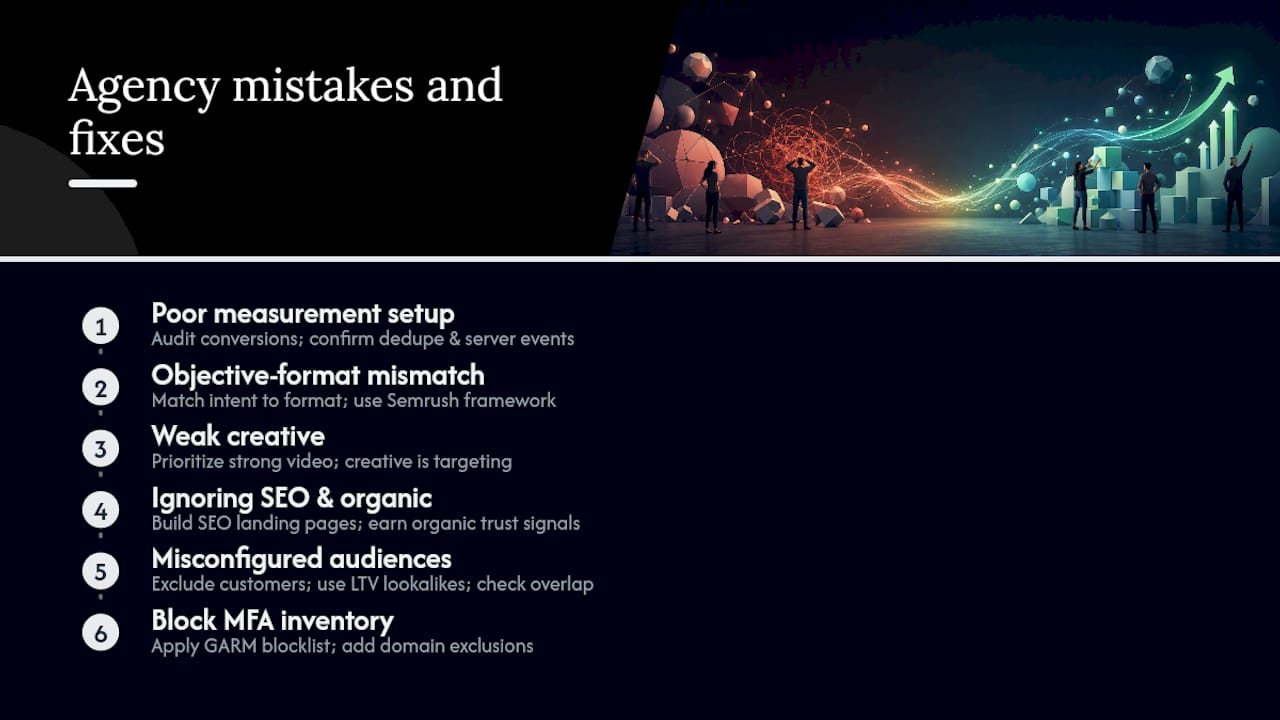
11. What most agencies get wrong (and how to fix it quickly)
The gap between a campaign that breaks even and one that compounds returns is almost never the platform or the budget. It is almost always one of five things.
Poor measurement setup is the most common. Agencies launch campaigns before confirming that conversion tracking is accurate, then optimise toward phantom data. The fix takes two hours: audit every conversion action in Google Ads and Meta Events Manager, confirm deduplication is configured, and verify that server-side events are firing.
Wrong objective-to-format mapping is the second. Running a brand-awareness video campaign and judging it by CPA is a category error. Running a search campaign for a product nobody is searching for yet is another. The Semrush format-selection framework is a useful reference: intent drives format, not preference.
Weak creative is the third, and the one most often underestimated. On Meta and TikTok, creative is the targeting. A strong video ad will find its audience; a weak one will not convert regardless of how precisely you target.
Ignoring SEO and organic touchpoints is the fourth. Paid campaigns that drive traffic to thin, low-authority pages convert poorly and cost more per click over time. Building SEO-optimised landing pages and content assets reduces CPA and builds the domain authority that earns AI/LLM brand mentions. The social media advertising advantages for service brands are amplified significantly when the destination page earns organic trust signals.
Misconfigured audiences is the fifth. Retargeting audiences that include existing customers, lookalikes built from a conversion list of fewer than 100 people, or interest audiences that overlap heavily with each other all waste budget. Fix: exclude current customers from acquisition campaigns, build lookalikes from your highest-LTV customer segment, and use audience overlap tools to check for cannibalism.
Pro Tip: In programmatic and display campaigns, exclude “made-for-advertising” (MFA) sites by applying the Global Alliance for Responsible Media (GARM) blocklist and adding your own domain exclusions based on placement reports. MFA inventory looks cheap on a CPM basis but delivers near-zero engagement and inflates impression counts without driving any real business outcome.
12. Business Warriors can build your integrated ad strategy
Most service businesses and SMEs in Australia are running at least one of the formats above in isolation, wondering why the results plateau. The problem is rarely the channel. It is the absence of a system that connects them.

Business Warriors, led by Jarrod Harman from Perth, builds integrated Marketing Vortex campaigns that combine SEO, Google Ads, Meta advertising, email marketing, and funnel development into a single, measurable system. The agency works with service-based businesses, e-commerce brands, and enterprises across Australia that are serious about growth: clients with real budgets, a willingness to invest in creative, and a need for transparent reporting on what is actually working.
If you are ready to move from running individual campaigns to building a compounding marketing system, book a discovery call with Jarrod Harman to map out which formats fit your objectives and what an integrated strategy would look like for your business.
Sources
When implementing campaigns, go to the source for creative specifications, policy requirements, and technical setup guides. The following are the primary references:
- 26 Types of Digital Advertising: The Ultimate List
- Global internet advertising expenditure , Statista
- 7 Types of Online Advertising for Ecommerce Businesses – Shopify
- How to Advertise Online | CO- by US Chamber of Commerce
- Online advertising , Wikipedia
For platform-specific creative specs (image dimensions, video length limits, file formats), always check the platform’s own documentation directly. Specs change frequently and third-party summaries go out of date.