13 May 2026
Online advertising guide for Australian service businesses
Discover what online advertising is and how Australian service businesses can leverage it to convert clicks into clients effectively.
TL;DR:
- Over 90% of Australians encounter digital ads weekly, but most service businesses struggle to connect ad spend with new clients. Effective online advertising relies on targeted campaigns, proper conversion tracking, and continuous optimization to generate measurable growth and ROI. Success requires disciplined systems that prioritize client acquisition outcomes over vanity metrics.
Over 90% of Australians are exposed to digital ads every single week, yet the vast majority of service business owners still can’t point to a direct line between their ad spend and new clients walking through the door. That gap between visibility and actual business growth is costing Australian businesses thousands of dollars every year. If you’ve ever boosted a Facebook post, run a Google Ad, and then wondered where all the bookings were, this guide is for you. We’re going to cut through the confusion, explain how online advertising actually works, and give you practical strategies to turn clicks into paying clients.
Table of Contents
- What online advertising really means
- How online advertising works: The workflow and pricing models
- Metrics and conversion: Why clicks don’t always equal clients
- Practical strategies for service businesses: Getting real results
- The uncomfortable truth: Online advertising is powerful only when paired with conversion discipline
- Where to get expert help for client acquisition and digital advertising
- Frequently asked questions
Key Takeaways
| Point | Details |
|---|---|
| Digital ads are measurable | Online advertising allows real-time tracking and optimisation you can’t get from traditional media. |
| Clicks aren’t clients | Focus on conversion tracking to ensure your ads deliver genuine business results, not just website traffic. |
| Target high-intent audiences | For service businesses, capturing demand and preventing wasted spend is the foundation for success. |
| Use market benchmarks | Australian ad costs vary; always use tools and local benchmarks for planning and performance. |
| Disciplined strategy wins | Combining demand capture, clear targeting, and conversion discipline is key for real growth. |
What online advertising really means
Let’s start with a clear definition, because the term gets thrown around loosely. Online advertising is the practice of paying to place promotional messages for products, services, or brands across digital channels. That covers a wide territory: search engines, social media platforms, websites, mobile apps, video platforms, and even podcasts.
For a service-based business in Australia, the most relevant channels typically fall into a few categories:
- Search advertising: Ads that appear when someone searches Google or Bing for a specific service, such as “emergency plumber Perth” or “laser hair removal Brisbane”
- Social media advertising: Paid placements on Facebook, Instagram, TikTok, and LinkedIn, targeting users based on demographics, interests, and behaviours
- Display advertising: Banner or visual ads that appear on third-party websites across the internet
- Video advertising: Pre-roll or mid-roll ads on YouTube or other video platforms
- Retargeting ads: Ads shown specifically to people who have already visited your website or engaged with your content
It’s worth understanding the difference between paid and organic reach. Organic reach refers to the visibility you earn without paying, such as appearing in Google search results through SEO or growing a social following through consistent posting. Paid reach, or online advertising, is when you pay a platform to show your message to a specific audience. Both matter, but they serve different purposes and operate on different timelines.
The core benefit of online advertising over traditional media like print or radio is measurability. You can see exactly how many people saw your ad, how many clicked, and what action they took afterwards. That level of insight lets you understand digital advertising fundamentals before you spend a single dollar, rather than guessing at results like you would with a newspaper ad.
A practical example: a physio clinic in Melbourne running Google Ads for “sports physio near me” can see precisely how many people clicked the ad, called the clinic, or booked an appointment online. That same clinic running a radio spot has no real way to know whether a single new client came from it.
How online advertising works: The workflow and pricing models
Understanding the mechanics behind online advertising helps you make smarter decisions with your budget. The typical advertising workflow includes setting an objective, choosing platforms, defining audiences, setting budgets and bids, creating ads, then launching and optimising based on tracked results. Breaking that down into clear steps makes it far less intimidating.
Step-by-step advertising workflow:
- Define your objective: Are you trying to generate enquiries, get phone calls, drive website traffic, or increase bookings? Your objective shapes every other decision.
- Choose your platform: Google Ads suits high-intent searches. Meta (Facebook and Instagram) suits awareness and interest-based targeting. LinkedIn works well for B2B service providers.
- Define your target audience: Location, age, interests, job title, search behaviour, or custom audiences built from your existing customer data.
- Set your budget and bid strategy: Decide how much you’ll spend daily or monthly, and how you want to pay for results.
- Create your ad creative: Write compelling copy, design visuals or videos, and craft a clear call to action.
- Launch and monitor: Go live, then check performance data regularly to identify what’s working and what needs adjustment.
- Optimise continuously: Pause underperforming ads, scale the ones delivering results, and test new variations.
Now, the pricing models. This is where many business owners get confused. Online advertising often operates on performance pricing models like cost-per-click (CPC), cost-per-thousand impressions (CPM), and can be bought and optimised against conversion outcomes (CPA).
| Pricing model | What you pay for | Best used when | Risk level |
|---|---|---|---|
| CPC (cost per click) | Each click on your ad | Driving website traffic or enquiries | Medium |
| CPM (cost per thousand impressions) | Every 1,000 times your ad is shown | Brand awareness campaigns | Lower |
| CPA (cost per acquisition) | A completed action (booking, purchase, lead) | Performance-focused campaigns | Low if set up correctly |
For most service businesses, CPC and CPA models are the most relevant. You want to pay for genuine interest or completed actions, not just eyeballs. Understanding these models helps you structure a strong lead generation campaign from the very beginning, rather than discovering expensive lessons after the fact.
The objective you set also determines the type of campaign you run. A beauty clinic might run a leads campaign to collect names and phone numbers via a Facebook form. A law firm might run a search campaign targeting people actively looking for family law advice. The goal shapes the format, the platform, and the pricing model you choose.
To understand how those leads move through your funnel after the ad click, it helps to map out your online lead generation process so every step is connected and accountable.
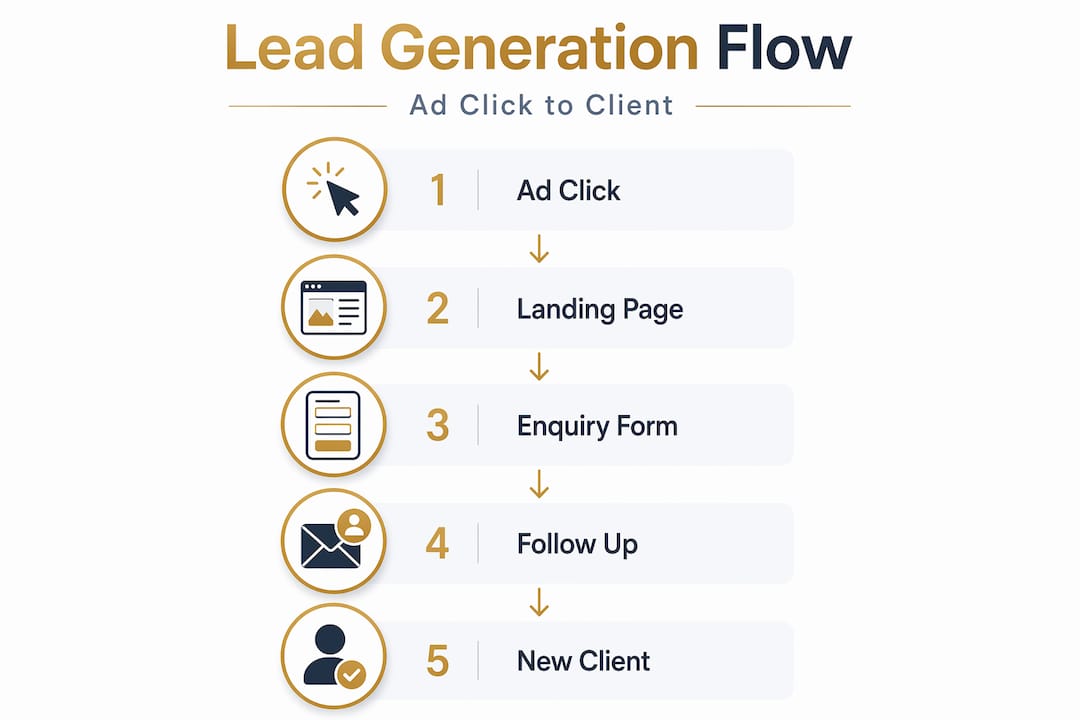
Metrics and conversion: Why clicks don’t always equal clients
This is the section where things get uncomfortable for a lot of business owners, because the truth is that clicks are vanity. Clients are the real metric.
CPC traffic does not equal revenue automatically; poor conversion tracking or mismatched goals can make campaigns look successful while delivering weak business outcomes. We’ve seen it countless times: a business owner gets excited because their ad received 500 clicks last month, but only two of those clicked through to an enquiry. The campaign looked active, but the business barely moved.
Here’s a real-world comparison to illustrate the problem:
| Campaign | Monthly clicks | Enquiries | New clients | Cost per click | Total spend |
|---|---|---|---|---|---|
| Campaign A | 800 | 12 | 4 | $2.50 | $2,000 |
| Campaign B | 200 | 18 | 9 | $4.00 | $800 |
Campaign A looks more impressive on the surface. More clicks, more activity, more spend. But Campaign B delivered more than double the clients at less than half the cost. This is why tracking conversions, not just clicks, is absolutely critical.
Conversion tracking means connecting your ad platform to the actual actions that matter to your business: phone calls, contact form submissions, online bookings, live chat enquiries. Every platform offers tracking tools, and setting them up correctly from day one saves you from wasting months of budget on activity that doesn’t convert.
“Clicks mean nothing unless they lead to a conversation. The goal of advertising is not to generate traffic. It is to generate clients.”
Common tracking pitfalls to watch for include:
- Tracking page views as conversions: Someone landing on your services page is not the same as an enquiry
- Not tracking phone calls: Many service businesses lose their best leads through unanswered or untracked calls
- Attribution gaps: A client might click your Google Ad, leave, then come back via a Facebook ad before booking. Which campaign gets credit?
- Vanity metrics focus: Reach, impressions, and likes tell you nothing about revenue
Pro Tip: Before launching any campaign, build a simple conversion tracking checklist. Confirm that your thank-you page triggers a conversion event, your phone number has call tracking enabled, and your ad platform is correctly reading completed actions, not just page visits.
Understanding online lead generation fundamentals helps you build campaigns that are wired for real outcomes from the start. And pairing that with proven client acquisition tips means you’re not just generating clicks, you’re generating clients.
Practical strategies for service businesses: Getting real results
Now that you understand the foundation, let’s talk about what actually works for service-based businesses in Australia. These are strategies drawn from real campaign experience, not generic marketing theory.
Focus on high-intent targeting. The most valuable clicks come from people who are already looking for what you offer. On Google Ads, this means bidding on specific, service-focused search terms like “Botox clinic Gold Coast” rather than broad terms like “beauty treatments.” On Facebook and Instagram, this means using custom audiences built from your existing client list, or targeting people who have already visited your website.
Prevent wasted spend with negative keywords and geofencing. Negative keywords tell Google not to show your ad for irrelevant searches. If you run a premium med spa in Sydney, you probably don’t want your ad appearing for “cheap fillers near me.” Geofencing restricts your ads to a specific geographic area, so you’re not paying for clicks from people who will never travel to your location.
Optimise your landing pages, not just your ads. The ad gets the click. The landing page gets the client. Too many business owners spend all their energy on ad creative and then send people to a generic homepage that doesn’t match what the ad promised. According to expert insight on demand capture, if you want online advertising to drive client acquisition for a local service business, you need to use landing pages that align exactly to the service the ad promises. A targeted page for “deep tissue massage Melbourne” outperforms a general “our services” page every single time.
Practical strategies to implement this week:
- Write ad copy that mirrors the exact language your clients use when they search
- Create separate landing pages for each core service you advertise
- Add genuine social proof to landing pages: real client reviews, before-and-after results, and specific outcomes
- Include a single, clear call to action on each page, not five competing options
- Test click-to-call buttons on mobile, since most service enquiries happen on phones
Use market-specific benchmarks, not generic averages. Benchmarks vary heavily by industry and competition, so always use platform tools and market-specific data for planning your Australian campaigns. A Google Ads cost-per-click for a legal firm in Sydney will be dramatically different from that of a hair salon in Adelaide. Comparing your numbers to global averages will lead you to make poor budget decisions.
Pro Tip: Pull the Google Keyword Planner data for your specific service and suburb before setting your monthly budget. This gives you a realistic cost-per-click estimate for your actual market, not a global average that has no bearing on your situation.

Understanding lead nurturing strategies helps you stay connected with prospects who click but don’t immediately book. And adopting cutting-edge lead generation methods gives your campaigns a competitive edge in busy markets.
The uncomfortable truth: Online advertising is powerful only when paired with conversion discipline
Here’s something most marketing agencies won’t tell you: the majority of service businesses are wasting a significant portion of their ad budget every single month. Not because online advertising doesn’t work. Because they’re running ads without conversion discipline.
Conversion discipline means you track every outcome. You review your data weekly, not monthly. You kill underperforming ads quickly instead of giving them another chance out of hope. You test one variable at a time so you actually know what changed the result. You connect your ad activity directly to revenue, not just to clicks or leads.
Most business owners come to us having run campaigns for six to twelve months, spending $1,500 to $5,000 per month, with no clear picture of what those campaigns actually generated in real dollar terms. They can tell you their click-through rate. They can’t tell you their cost per new client.
The businesses that get genuine ROI from online advertising are the ones who treat it like a sales system, not a publicity exercise. They build the tracking infrastructure first. They review the numbers with the same discipline they apply to their accounts. They understand that an ad campaign without conversion tracking is like running a retail store with no cash register.
Digital marketing is not set-and-forget. It’s an ongoing, iterative process. The guide to scaling digital marketing shows clearly that the businesses growing fastest are the ones building systems, not just running ads.
If you take one thing from this article, let it be this: clicks are currency only if you have a conversion system to receive them.
Where to get expert help for client acquisition and digital advertising
If you’re serious about turning your ad spend into consistent client bookings, the next step is getting a strategy that’s built specifically for your service business and your market.
At Business Warriors, we’ve developed the Marketing Vortex Method, an integrated approach that combines Google Ads, Meta advertising, SEO, and conversion optimisation into one cohesive system. It’s designed specifically for service-based businesses across Australia that are ready to stop guessing and start growing. You can explore proven client acquisition strategies tailored to your industry, or use our digital marketing scaling guide to understand what a growth-focused campaign structure looks like for a business at your stage.
Frequently asked questions
How much does online advertising cost for Australian service businesses?
Costs vary depending on industry, competition, and platform, so always use market-specific benchmarks rather than one-size-fits-all averages when planning your budget.
What platforms work best for client acquisition?
Google Ads and Facebook are proven for targeting high-intent audiences; choose platforms based on your service type and where your ideal clients spend their time, as online advertising operates differently across each digital channel.
How can I tell if my ads are actually bringing in new clients?
Track conversions, not just clicks, by setting up proper analytics and linking ad activity to enquiries or bookings, because CPC traffic does not automatically equal revenue without the right tracking in place.
Can online ads be optimised over time?
Yes, digital ad performance is tracked in real time, and online advertising offers the ability to adjust spending, targeting, and creative based on live data, making it far more adaptable than traditional media.
Recommended
- Why Advertise on Social Media: Real Results for Aussie Businesses – Jarrod Harman
- 7 B2B Marketing Ideas for Australian Service Businesses – Jarrod Harman
- Internet marketing for Australian service businesses in 2026 – Jarrod Harman
- Social media marketing advantages for Aussie service businesses – Jarrod Harman