12 May 2026
Lead generation agency strategies for consistent client growth
Discover proven strategies from a lead generation marketing agency that drive consistent client growth. Unlock your path to success today!
TL;DR:
- Service businesses often overlook that systematic qualification frameworks, not just traffic volume, are essential for sustainable client growth. Implementing clear lead definitions, optimizing forms, scoring enquiries, and establishing feedback loops with CRM improve lead quality and conversion rates. High-performing agencies rely on these structured processes over raw lead volume, ensuring pipeline velocity and revenue growth.
Most service business owners believe the answer to sluggish client acquisition is simply more traffic. Push more ads, rank for more keywords, post more content. But here’s the reality: traffic without a qualification framework is just noise. Australian agencies that consistently deliver results for their clients aren’t winning because of volume. They’re winning because they’ve built systematic processes that separate genuine buyers from casual browsers, then move those buyers efficiently through a pipeline designed to convert. This guide unpacks exactly how those frameworks operate, with practical mechanics you can apply or demand from any agency you work with.
Table of Contents
- Understanding the lead generation pipeline: MQL versus SQL
- Optimising lead capture: Form mechanics and privacy cues that drive results
- Lead scoring and handoff: The mechanics for improving quality and conversion
- Measuring lead generation success: CPL benchmarks and sustainability metrics
- Building feedback loops: CRM integration and qualification frameworks
- The hidden agency advantage: Why most service business owners overlook qualification frameworks
- Connect with proven agency strategies for consistent client growth
- Frequently asked questions
Key Takeaways
| Point | Details |
|---|---|
| Define lead stages | Segmenting MQLs from SQLs boosts conversion and pipeline quality for service businesses. |
| Optimise forms and privacy cues | High-performing agencies use form design and privacy placement to capture better leads. |
| Apply scoring and handoff | Lead scoring and systematic handoff processes reduce junk leads and improve sales outcomes. |
| Benchmark for sustainability | Using LTV:CAC ratios and channel CPL benchmarks helps measure the success of your lead generation agency. |
| Feedback loops refine quality | CRM integration and ongoing feedback frameworks are key to sustaining growth and pipeline velocity. |
Understanding the lead generation pipeline: MQL versus SQL
Before any lead generation strategy can work at scale, your agency needs a shared language around what a “lead” actually means. This sounds basic, but the absence of clear definitions is one of the most common reasons service businesses waste budget on campaigns that generate enquiries but no actual clients.
The two most important categories in any agency-managed pipeline are marketing-qualified leads (MQLs) and sales-qualified leads (SQLs). An MQL is a prospect who has demonstrated enough engagement to suggest they’re a potential fit, perhaps they downloaded a guide, submitted a contact form, or attended a webinar. An SQL, by contrast, has been assessed against specific buying criteria: budget, need, timeline, and decision-making authority.
Understanding the B2B lead generation pipeline distinctions between these two stages is crucial because they require fundamentally different responses. MQLs need nurturing. SQLs need a sales conversation. Treating them the same way, which many service businesses do, burns opportunities at both ends.
A common B2B methodology is to separate marketing volume from sales buying intent using an MQL to SQL framework, ensuring shared lead definitions between marketing and sales teams. This prevents the classic disconnect where marketing celebrates a flood of form fills, while sales complains that none of them are worth calling.
“The single biggest pipeline failure we see in service businesses isn’t a lack of leads. It’s a lack of agreement on what a lead actually is.”
| Lead type | Primary signal | Typical action | Conversion goal |
|---|---|---|---|
| MQL | Behaviour and engagement | Nurture sequence | Progress to SQL |
| SQL | Budget, need, timeline fit | Sales call or proposal | Convert to client |
| Cold prospect | No signal yet | Awareness content | Become MQL |
When your agency operates with these definitions clearly documented and agreed upon by both marketing and sales, every part of the pipeline becomes measurable and improvable.
Optimising lead capture: Form mechanics and privacy cues that drive results
With a clear qualification framework established, the next challenge is capturing leads efficiently and in a way that complies with Australian privacy obligations. Your lead capture forms are frequently the highest-leverage point in the entire funnel, yet they’re also the most neglected.

Lead capture optimisation, including form structure, privacy placement, personalisation, and low-commitment options, is widely recognised as a core conversion lever because it directly affects both lead quality and conversion rate from existing traffic. Improving your forms doesn’t require more ad spend. It just requires smarter design.
Here’s what consistently works for Australian service businesses:
- Reduce field count: Every additional field reduces submission rates. For initial enquiries, name, email, and one qualifying question is typically sufficient.
- Position privacy notices prominently: Australian audiences are increasingly privacy-conscious. Place a brief, plain-language privacy statement directly beneath the submit button.
- Use personalised language: Forms that address the specific problem the visitor arrived with, rather than generic “contact us” copy, convert significantly better.
- Offer low-commitment entry points: Free consultations, audits, or guides lower the perceived risk and attract higher-quality leads than hard-sell offers.
- Match form length to offer value: A request for a free checklist warrants two fields. A request for a tailored proposal can justify five or six.
Getting more website leads from your existing traffic is often far more cost-effective than increasing that traffic. According to SME marketing trends for 2026, personalisation and privacy-first design are two of the strongest levers for improving website conversion rates in the Australian market.
Pro Tip: Test a single-question form variant where you ask one highly specific qualifying question instead of a generic message field. For a med spa, that might be “What’s your primary treatment goal?” The answers pre-qualify the lead and give your sales team a warm conversation starter.
Once you’ve improved your forms, the next step is thinking about how you’ll nurture leads online through automated sequences that maintain momentum between initial enquiry and sales conversation. You can also review lead conversion results from similar service businesses to benchmark what’s achievable. The goal of optimising your website for leads is to make every page a contributing part of your pipeline, not just your contact page.
Lead scoring and handoff: The mechanics for improving quality and conversion
Efficient lead capture creates a volume of enquiries. Lead scoring determines which of those enquiries deserve immediate sales attention and which need further nurturing. Without a scoring system, your sales team ends up spending equal time on a highly motivated prospect and someone who filled out a form by accident.
A practical service-business approach is aligning scoring thresholds and handoffs, including what qualifies as an MQL or SQL, routing rules, and service-level agreements, to reduce junk pipeline and improve conversion from lead to genuine opportunity.
Here’s a simple process to implement lead scoring for a service business:
- Define your ideal client profile: Industry, business size, location, buying timeline, and budget range.
- Assign point values to behaviours: Visiting your pricing page might be worth 10 points. Downloading a case study, 5 points. Booking a discovery call, 20 points.
- Set your MQL threshold: For example, any lead reaching 25 points enters your nurture sequence.
- Set your SQL threshold: Any lead reaching 50 points gets routed to a sales team member within 24 hours.
- Document your SLA: Agree in writing that SQLs will be contacted within a set timeframe. Two business hours is a strong benchmark.
A well-constructed lead generation checklist will include these scoring and handoff parameters as standard. When you’re reviewing a lead generation campaign with your agency, ask specifically how they’re scoring leads and what triggers a handoff. If they can’t answer clearly, that’s a red flag.
| Score range | Lead status | Recommended action | Response SLA |
|---|---|---|---|
| 0 to 24 | Cold prospect | Add to awareness nurture | No immediate action |
| 25 to 49 | MQL | Enter email nurture sequence | Follow-up within 3 days |
| 50 to 74 | Warm SQL | Priority sales contact | Contact within 24 hours |
| 75 and above | Hot SQL | Immediate sales action | Contact within 2 hours |
Pro Tip: Build your SLA into your CRM as an automated alert. If a hot SQL hasn’t been contacted within two hours, the system should flag the lead to a senior team member automatically. This single process change alone can dramatically improve conversion rates for service businesses with high-intent leads.
Measuring lead generation success: CPL benchmarks and sustainability metrics
You can run the best qualification framework in the world and still make poor investment decisions if you’re measuring the wrong things. Too many service business owners fixate on cost per lead (CPL) as their primary metric. CPL matters, but it tells an incomplete story.
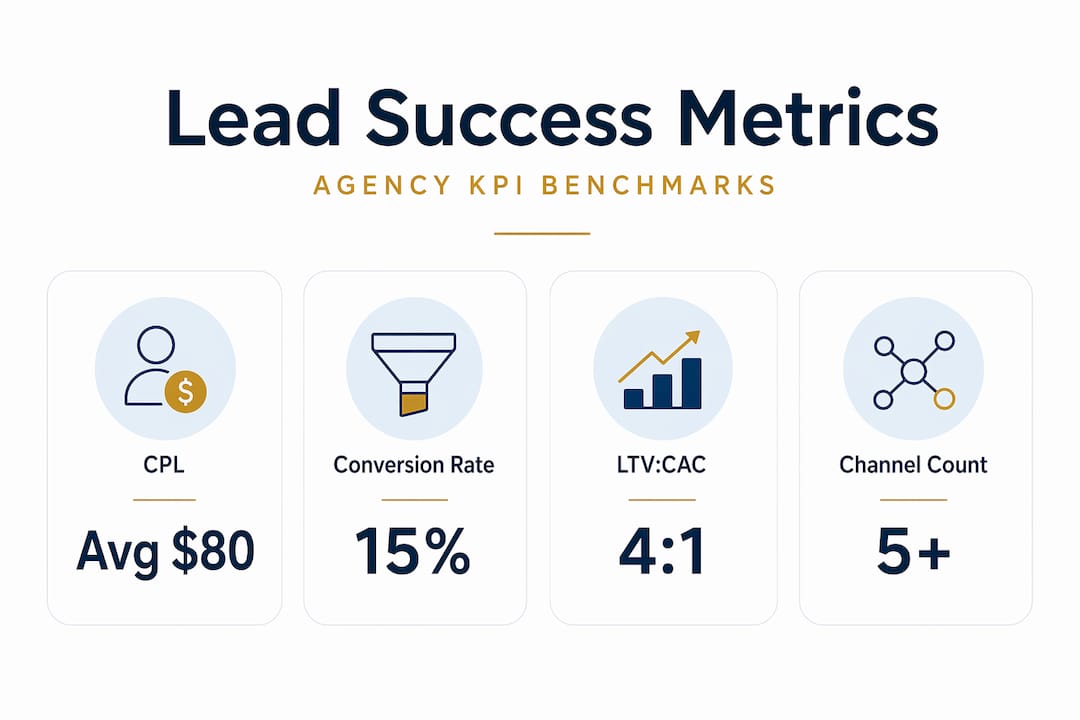
The 2025 CPL benchmark data across channels shows higher CPL on LinkedIn versus Google Ads, and recommends using customer acquisition cost (CAC) and the LTV to CAC ratio as the sustainability yardstick, rather than relying only on CPL.
Here’s why that distinction matters for your business:
- A Google Ads lead might cost $45 and close at 8%, giving a CAC of $562.
- A LinkedIn lead might cost $120 but close at 22%, giving a CAC of $545.
- Despite the higher CPL, LinkedIn delivers nearly identical CAC and often attracts higher-value clients with longer retention.
For service businesses, the key benchmarks to track are:
- CPL by channel: Know what you’re paying per lead on Google Ads, Meta, LinkedIn, and organic SEO separately.
- Lead to opportunity rate: What percentage of leads become genuine sales conversations?
- Opportunity to client rate: What percentage of sales conversations convert to paying clients?
- Customer lifetime value (LTV): What does the average client spend over their entire relationship with your business?
- LTV to CAC ratio: A healthy ratio is 3:1 or higher. If your LTV is $9,000 and your CAC is $3,000, you’re at exactly the minimum sustainable threshold.
Understanding how to increase website leads with omnichannel strategies also shifts the CPL conversation. When a prospect sees your Google Ad, reads your blog, follows you on Instagram, and then books through your website, attributing that acquisition to a single channel distorts your CPL data. Omnichannel measurement gives you a truer picture of what’s actually driving growth.
Building feedback loops: CRM integration and qualification frameworks
Measurement only creates value when it feeds back into your systems and changes how you operate. This is where most agencies fall short. They report on results but don’t systematically use those results to refine their qualification frameworks.
Well-defined, measurable qualification programmes are positioned by leading B2B lead generation agencies as the route to pipeline velocity and lead quality, specifically because they include feedback loops from CRM and sales outcomes. When your CRM tracks which leads converted and which didn’t, your marketing team can reverse-engineer what made the difference and update their targeting, messaging, and scoring criteria accordingly.
Here’s what a functional feedback loop looks like in practice:
- CRM captures lead source, score, and journey: Every touchpoint is logged so you can see exactly how each client was acquired.
- Sales team logs outcomes: Won, lost, or no decision, with brief notes on the reason.
- Marketing team reviews monthly: Which lead sources and behaviours correlated with closed clients? Which led to dead ends?
- Scoring model is updated: Behaviours that predicted conversions get higher scores; those that didn’t get reduced or removed.
- Campaign targeting is refined: Audiences and keywords that attracted converting clients get more budget.
Effective campaign ROI tracking tools make this feedback loop faster and more precise. When integrated with your CRM, they allow your agency to see which specific campaigns produced revenue, not just leads.
Effective sales funnel optimisation depends on this kind of ongoing refinement. If you want to generate leads online for business growth at a consistent level, the feedback loop isn’t optional. It’s the engine that prevents your pipeline from degrading over time as the market shifts.
“The agencies that consistently outperform aren’t the ones with the best ad creative. They’re the ones with the best feedback systems.”
The hidden agency advantage: Why most service business owners overlook qualification frameworks
Having worked extensively across service-based industries in Australia, here’s an honest observation that rarely gets mentioned in marketing conversations: most business owners judge their agency on traffic and lead volume. And most agencies, accordingly, report on traffic and lead volume. Both parties end up optimising for the wrong thing.
The businesses that experience real, sustained growth from agency partnerships are the ones that demanded something different from the start. They asked for shared lead definitions. They requested documented scoring thresholds. They pushed for CRM integration on day one, not month six. They treated qualification as a business process, not a marketing afterthought.
What separates a high-performing agency relationship from a mediocre one isn’t the quality of the ad creative or the SEO strategy, though those matter. It’s the rigour of the qualification framework connecting marketing effort to actual revenue. In the Australian market, where privacy expectations are high and consumer trust takes time to build, shortcuts in this area are especially costly.
The B2B lead generation approach that actually works long-term is one where compliance, personalisation, and pipeline velocity are all treated as interconnected. Volume is a vanity metric. Qualified pipeline velocity is the number that builds businesses.
If you’re evaluating an agency or reviewing your current arrangement, ask one question: “Can you show me our MQL to SQL conversion rate and what changes you’ve made to improve it in the last 90 days?” The answer will tell you everything.
Connect with proven agency strategies for consistent client growth
Transforming your lead generation from a guessing game into a systematic, measurable engine takes the right frameworks and experienced hands to implement them.
At Business Warriors, we’ve built our entire methodology around qualification-first marketing. Our client acquisition strategies for service businesses are grounded in exactly the kind of MQL to SQL frameworks, CRM feedback loops, and CPL benchmarking covered in this guide. If you’re ready to see what proven strategies for attracting clients in Australia actually look like in practice, or you want to understand how the Marketing Vortex method integrates these elements into a single, cohesive system, we’d welcome the conversation. Reach out for a tailored lead generation audit and let’s identify exactly where your pipeline is leaking.
Frequently asked questions
What’s the difference between MQL and SQL in agency lead generation?
MQLs are prospects who meet marketing engagement criteria, while SQLs show purchase intent and satisfy sales qualification requirements. According to shared lead definitions between marketing and sales, aligning these two categories is a foundational step in any effective B2B lead generation framework.
How do privacy cues in lead forms impact conversion rates in Australia?
Clear privacy statements placed near the submit button reduce friction and build trust with Australian audiences who are increasingly cautious about data sharing. Form structure and privacy placement are directly linked to both submission rates and lead quality.
What benchmarks should I use to measure lead generation agency performance?
Track CPL by channel, lead to client conversion rate, and LTV to CAC ratio as your primary sustainability metrics. B2B CPL benchmarks for 2025 show LinkedIn typically delivers higher CPL than Google Ads, but the LTV to CAC ratio, ideally 3:1 or higher, is a more reliable indicator of long-term campaign health.
How do CRM feedback loops improve agency-led lead generation?
CRM integration allows agencies to track which lead sources, behaviours, and scoring criteria actually correlate with closed clients, then refine targeting and qualification accordingly. Measurable qualification programmes with CRM-backed feedback loops are specifically identified as the mechanism behind consistent pipeline velocity and improved lead quality.