9 May 2026
Key responsibilities of a social media manager explained
Discover the true responsibility of a social media manager in Australia! Learn how effective strategies boost engagement and lead generation.
TL;DR:
- Effective social media management for Australian service businesses involves strategic content creation, audience engagement, and data analysis tailored to local preferences and regulations. In-house managers offer deeper brand insight, while agency teams provide broader expertise and scalability, both aiming to turn audiences into clients. Successful management requires collaboration across teams, clear measurement of impactful KPIs, and strategic integration with overall business goals to maximize lead generation.
Social media management looks deceptively simple from the outside. You post a photo, write a caption, hit publish, and wait for the likes to roll in. If only it were that easy. For Australian service-based businesses competing in crowded markets, from beauty clinics in Melbourne to law firms in Perth, the reality is far more demanding. A social media manager’s role spans strategy, content creation, community building, data analysis, and cross-team collaboration. Understanding the full scope of this role is the first step to using it effectively for consistent lead generation and client engagement.
Table of Contents
- What does a social media manager do in Australia?
- Essential daily responsibilities for client engagement
- Measuring success and continuous improvement
- Collaboration and strategic alignment for business growth
- What most business owners miss about social media manager responsibilities
- How to apply effective social media management in your business
- Frequently asked questions
Key Takeaways
| Point | Details |
|---|---|
| Role goes beyond posting | Effective social media managers strategically plan, create, analyse, and engage to drive business goals. |
| Daily engagement is key | Consistent community management and real-time responses foster trust and generate leads. |
| Success is measured | Data-driven reporting and experimentation are critical for continuous improvement and client acquisition. |
| Collaboration enhances results | Managers who partner across teams align social media strategy with overall business objectives. |
| Strategic skills required | Combining organic content, paid boosts, and metrics helps service businesses stand out and grow. |
What does a social media manager do in Australia?
The role of a social media manager is often misunderstood, even by business owners who employ one. Many assume the job is simply about keeping the feed active. In practice, the full scope of a social media manager in Australia includes planning, creating, publishing, and analysing content, developing content calendars, engaging with audiences, monitoring metrics, responding to trends and issues in real time, and collaborating across marketing, communications, design, and leadership. That is a significant workload, and it varies depending on the size of the organisation and whether the role is in-house or with an agency.
For service-based businesses in Australia, there are additional layers to consider. Australian audiences have distinct communication preferences. They respond well to authenticity, humour, and straight talking, and they are quick to disengage from content that feels overly corporate or scripted. Regulatory considerations also apply, particularly in industries like beauty, health, and legal services, where claims made on social media must meet specific advertising standards set by bodies such as the Australian Competition and Consumer Commission (ACCC) and the Therapeutic Goods Administration (TGA).
The difference between an in-house manager and an agency-based one is also worth noting. An in-house manager typically has deeper knowledge of your specific brand voice and client relationships, but may have a narrower skill set. An agency team brings broader expertise, access to more tools, and scalable capacity, though they may require more onboarding to truly understand your business. Understanding these manager tasks for boosting client sales helps you set realistic expectations and get more from whoever you hire.
| Factor | In-house manager | Agency team |
|---|---|---|
| Brand knowledge | Deep, ongoing | Requires onboarding |
| Skill range | Narrower, focused | Broader, multi-specialist |
| Cost structure | Fixed salary | Retainer or project-based |
| Scalability | Limited by one person | Easily scalable |
| Strategic input | Variable | Often built in |
Whichever model you choose, the fundamentals of the role remain the same. The goal is to build an audience that converts into paying clients, and that takes far more than a consistent posting schedule. Explore growth strategies for service brands to understand how a well-structured role can accelerate that process.
Essential daily responsibilities for client engagement
With the overall role in mind, let’s explore what a typical social media manager achieves daily to ensure client engagement.

At a busy service business, a social media manager’s day starts well before any content goes live. There are approvals to process, comments to respond to, direct messages to action, and a content calendar to review against the day’s priorities. Typical Australian hiring expectations for social media managers include always-on content execution across multiple platforms, publishing quality assurance and approvals, community management including tone of voice frameworks and escalation pathways, performance tracking and reporting, and partnering with paid advertising specialists or running tactical paid boosts.
Here is a practical breakdown of the core daily tasks:
- Review and publish scheduled content across Instagram, TikTok, and Facebook, ensuring captions, tags, and media all meet brand standards before going live.
- Monitor comments and direct messages within agreed response time windows, often within one to two hours during business hours for service businesses.
- Engage proactively by commenting on relevant posts, joining conversations in community groups, and interacting with followers to maintain visibility in the algorithm.
- Flag and escalate issues such as negative reviews, complaints, or potential PR problems according to the escalation pathway agreed with management.
- Check analytics dashboards to spot engagement drops, identify top-performing posts, and adjust the next day’s content accordingly.
- Coordinate with the design or content team to ensure upcoming posts are ready, edited, and approved ahead of schedule.
A critical but often overlooked daily task is community management tone. This means every response, every comment reply, every direct message must reflect the brand’s voice consistently. For a beauty clinic, that voice might be warm and empowering. For a law firm, it might be professional and reassuring. Getting that tone wrong, even occasionally, erodes trust fast.
“Community management is not just about replying to comments. It is about making every person who interacts with your brand feel seen, valued, and more likely to book.”
Pro Tip: Build a simple response template library covering common questions, compliments, and complaints. This keeps tone consistent across team members and saves significant time each week, especially when managing multiple platforms simultaneously.
Effective planning of media campaigns feeds directly into these daily tasks. When the strategy is clear, the daily execution becomes faster and more purposeful. Use a social media checklist to make sure nothing falls through the cracks as your content volume grows. If you want to build stronger connections with your audience, reviewing a solid guide to social media engagement will give you proven frameworks to apply immediately.
Measuring success and continuous improvement
Once the daily routine is flowing, it is crucial to measure what is working and iterate for better results.
Measurement is where many service business owners disconnect from their social media manager. They either ignore reporting altogether or focus only on vanity metrics like follower counts and likes. Neither approach serves your business. The metrics that matter are those tied directly to client acquisition: profile visits that lead to website clicks, direct message enquiries, booking link taps, and conversions from social campaigns to actual appointments or consultations.
A well-structured social media manager role includes monthly reporting responsibilities that track performance across Instagram, TikTok, and Facebook, produce insights, document experiments, and make clear recommendations for the following month. This creates a feedback loop that continuously improves your results rather than repeating the same approach indefinitely.
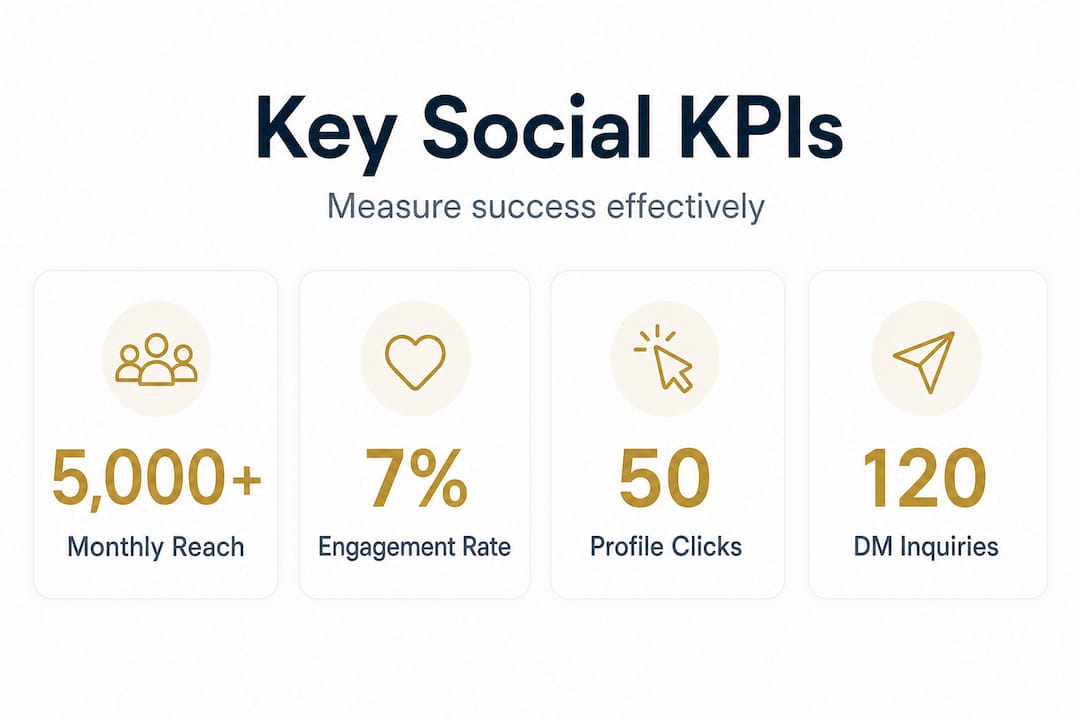
| KPI | What it measures | Why it matters |
|---|---|---|
| Reach and impressions | How many people see content | Awareness and brand visibility |
| Engagement rate | Interactions divided by reach | Audience connection quality |
| Profile link clicks | Clicks to website from bio | Intent to learn more |
| DM enquiries | Direct contact via platform | Warm lead generation |
| Conversion rate | Enquiries that become bookings | Revenue impact of social |
| Follower growth rate | New followers over time | Audience building momentum |
The improvement cycle works in three stages. First, you collect data over a set period, typically one month. Second, you identify patterns: which content formats performed best, which captions drove the most enquiries, which posting times generated the highest reach. Third, you run a structured experiment in the next period, changing one variable while keeping others stable, to test whether your hypothesis is correct.
Pro Tip: Set up a simple spreadsheet that tracks your top five KPIs each week. Even a 15-minute weekly review with your manager creates accountability and surfaces problems before they become expensive.
When social organic performance is paired with paid social campaigns, the results compound quickly. A well-performing organic post, for example a client testimonial video with strong engagement, can be boosted with a small ad spend to reach a much larger, targeted audience. This is why the collaboration between your social media manager and your paid advertising specialist is so important. Use media plan templates to map this integration clearly, and review strategy tips for boosting sales to align organic and paid efforts for maximum return.
Collaboration and strategic alignment for business growth
These measurement efforts are only effective when aligned with broader business strategy, which requires collaboration.
A social media manager who works in isolation from the rest of the business is a social media manager working at half capacity. The UniSQ career guide confirms that the role involves collaborating across marketing, communications, design, and leadership, with significant variation depending on whether the role is in-house or agency-based and the size of the organisation.
For service businesses, this collaboration takes several practical forms:
- With the owner or director: Monthly strategy check-ins to align content themes with business priorities, upcoming promotions, and seasonal campaigns.
- With the client-facing team: Regular feedback on the questions clients are asking in-person, which can directly inform FAQ-style content and Instagram Stories.
- With the design or creative team: Briefing requests clearly and on time to avoid last-minute scrambles that compromise quality.
- With the paid advertising specialist: Sharing organic performance data to inform audience targeting and creative selection for paid campaigns.
- With the broader marketing team: Ensuring social media activity supports the overall content marketing calendar, email campaigns, and website updates.
“The best-performing social media strategies we see are never siloed. They are built into the broader business rhythm, connected to sales goals, client feedback, and seasonal planning from the very start.”
The size of your business shapes how this collaboration works in practice. A solo operator running a beauty clinic may have their social media manager collaborate directly with them and their receptionist. A larger med spa group with multiple locations might have a dedicated marketing manager, a head of client experience, and a regional director all involved in strategic alignment.
Strategic alignment also means your social media manager understands what success looks like for the business, not just for the social channels. If your goal is to increase laser treatment bookings by 30 percent over the next quarter, the social strategy needs to reflect that. Content themes, calls to action, paid boosts, and community management responses should all ladder up to that objective. Explore growth strategies for service brands to see how this alignment plays out in practice for Australian service businesses.
What most business owners miss about social media manager responsibilities
Most business owners who hire a social media manager expect faster results than the role naturally delivers, and they underestimate the strategic depth required to get those results. This is not a criticism. It is a predictable outcome when the role is misunderstood from the start.
The biggest misconception is that posting more frequently will automatically generate more leads. It will not. What generates leads is the right content, in the right format, for the right audience, paired with a clear pathway for that audience to take action. A social media manager who understands this will spend less time creating content and more time understanding your ideal client’s behaviour, testing what resonates, and building systems that scale.
The hidden value in a skilled social media manager is the reporting and feedback loop. Every month of consistent tracking builds a clearer picture of what your specific audience responds to. That data is genuinely valuable. It tells you which services your followers are most curious about, which concerns they raise most often, and which types of content make them trust you enough to book. Ignoring that data is like having a map and choosing not to look at it.
The third and most underestimated element is strategic integration. Social media does not exist in isolation from your sales process. The journey from a first Instagram view to a confirmed booking involves multiple touchpoints: seeing your content, visiting your profile, clicking your website link, reading about your service, and finally making contact. A strong social media manager thinks about that entire journey, not just the post itself. Boosting your online presence is not about volume. It is about building a connected, intentional path from visibility to conversion.
When you treat social media management as a strategic, multi-dimensional discipline rather than a content production task, the return on investment shifts dramatically. You stop measuring success in likes and start measuring it in bookings, enquiries, and revenue.
How to apply effective social media management in your business
Understanding what a social media manager actually does is one thing. Applying it effectively in your business is where the real growth happens. If you are a service business owner in Australia looking to turn your social media effort into a consistent source of leads and bookings, the detail in this article gives you a strong foundation to assess your current approach and identify the gaps.

At Business Warriors, we work with service-based businesses across Australia to build social media systems that do more than fill a feed. From mastering manager tasks to full-scale strategy implementation, we bring the expertise, tools, and frameworks your business needs to compete. If you are ready to connect your social media activity to real client acquisition results, we are ready to help you get there. Reach out to the Business Warriors team today and let us build a strategy that works as hard as you do.
Frequently asked questions
What makes the social media manager role different for service businesses in Australia?
Australian service businesses require managers to adapt to local regulations, audience expectations, and platform behaviour unique to markets like health, beauty, and legal services. The role also varies depending on organisation size and whether the manager is in-house or agency-based.
How do social media managers measure their impact on client acquisition?
They use KPIs like DM enquiries, profile link clicks, and conversion rates alongside structured monthly reporting. Tracking performance and producing monthly insights, experiments, and recommendations is a standard part of the role.
Do managers need to work across multiple platforms?
Yes. Running daily publishing and quality assurance across Instagram, TikTok, and Facebook is commonly expected for Australian roles, with some businesses also requiring LinkedIn or Pinterest management.
What are escalation pathways in social media management?
Escalation pathways are pre-planned procedures for handling negative feedback, complaints, or sensitive PR situations. Community management frameworks that include these pathways are a standard responsibility for Australian social media managers.
Why is collaboration with paid advertising specialists important?
Organic and paid social strategies perform better when they share data, creative assets, and audience insights. Partnering with paid specialists for paid social performance support is a commonly expected part of the full social media management role.