5 May 2026
The vital role of social media executives in business growth
Discover the vital role of social media executives in driving business growth. Learn how expert strategy can transform your online presence!
TL;DR:
- Effective social media for service-based businesses requires strategic direction, audience engagement, and data-driven planning. A skilled social media executive manages content creation, campaign strategy, paid advertising, and performance analysis to generate measurable leads and revenue. Investing in hybrid executives or agencies can significantly improve return on investment by precisely targeting local audiences and optimizing campaigns.
Posting three times a week and hoping for enquiries is not a social media strategy. It’s wishful thinking. Many service-based business owners in Australia invest real time into their social platforms yet see little return in bookings, leads, or revenue. The gap between being active online and actually growing through social media almost always comes down to one thing: expert direction. A skilled social media executive does far more than schedule content. They manage presence, create content, engage audiences, and align strategy with business goals to generate measurable outcomes. This article breaks down exactly what that looks like in practice.
Table of Contents
- What does a social media executive really do?
- Strategic skills: Beyond daily posting
- Side-by-side: Tactical executive vs strategist vs hybrid
- ROI and realities for Australian service businesses
- Common pitfalls and edge case considerations
- Why most owners underestimate the true value of a social media executive
- Expert support to unlock your social media results
- Frequently asked questions
Key Takeaways
| Point | Details |
|---|---|
| Strategic leadership matters | A dedicated social media executive brings results beyond posting by aligning activities to real service business goals. |
| Hybrid expertise delivers best ROI | Businesses gain most by engaging executives with both day-to-day and strategic skills tailored for lead generation. |
| Australian platform insights | Facebook outperforms for local services, with typical returns of $4.50 per $1 spent and targeted cost per lead. |
| Avoid common pitfalls | Protect your investment by preventing over-reliance on one platform and preparing for crises strategically. |
What does a social media executive really do?
To understand why expert direction matters, let’s demystify the core duties involved.
Most business owners picture a social media executive as someone who writes captions and uploads images. The reality is significantly more involved. A strong executive operates across several interconnected functions, each of which directly affects your ability to attract and convert leads.
According to industry guidance, social media executives manage presence, curate content, engage audiences, and align strategies with broader business goals. For a service-based business like a med spa, law firm, or beauty clinic, this translates into a very specific set of outcomes.
Here is what that work actually looks like day to day:
- Content creation and curation: Producing original posts, videos, and stories that reflect your brand voice, showcase your expertise, and speak to the problems your ideal clients are trying to solve
- Audience engagement: Responding to comments, messages, and reviews in a timely and considered way that builds trust and keeps potential clients in the conversation
- Analytics and performance tracking: Reviewing reach, engagement rate, click-through rate, cost per lead, and booking conversions to understand what is working and what needs adjustment
- Strategic alignment: Making sure every post, campaign, and interaction supports the broader business objective, whether that is filling appointment slots, generating enquiries, or building repeat clientele
- Brand awareness and trust-building: Creating a consistent presence that positions your business as the go-to authority in your local market or niche
“A common misconception is that social media is a junior function. For service businesses competing in tight local markets, it is one of the most commercially critical roles in your entire operation.”
The difference between a business owner who handles their own socials and a skilled executive is not effort. It is expertise, systems, and strategic intent. You can check executive lead generation insights to see how this approach plays out across different service industries. Understanding the marketing advantages for services is the foundation before you invest any further.
Strategic skills: Beyond daily posting
While day-to-day activities keep the wheels turning, it is the strategic thinking of a social media executive that sets the pace for genuine business growth.
The executives who deliver the strongest results for service businesses are not just reactive. They plan weeks ahead, map campaigns to business seasons, and make data-informed decisions about where to invest your advertising budget for the lowest cost per lead.

Key responsibilities include developing strategies, content calendars, paid advertising, crisis management, and KPI reporting. For a business generating leads through social media, each of these carries real commercial weight.
Here is a practical breakdown of the strategic work involved:
- Platform and audience strategy: Choosing where to focus your efforts based on where your ideal clients actually spend time. For most Australian service businesses, this means Facebook and Instagram as primary platforms, with TikTok growing rapidly for visual service niches like beauty and wellness.
- Content calendar planning: Mapping out content themes, promotional periods, and campaign launches in advance so your messaging is cohesive and intentional rather than reactive.
- Paid advertising management: Running Meta Ads with proper audience segmentation, split testing creative, and optimising bids to bring your cost per lead down over time. This is where most DIY social media efforts fall short.
- Influencer and partnership coordination: Identifying relevant local or niche collaborators whose audiences overlap with yours, then structuring partnerships that generate genuine exposure and leads. You can explore influencer collaboration steps to understand how this fits into a broader strategy.
- KPI reporting and iteration: Reviewing performance data weekly and monthly, identifying what is and is not working, and making adjustments before wasted budget compounds.
Pro Tip: Ask any social media executive candidate to show you a content calendar they have built and a paid campaign they have managed from start to finish. Their ability to explain the strategy behind those decisions tells you far more than their follower count or design skills.
Strong service brand growth strategies always sit underneath effective execution. Without that strategic layer, even the most beautiful content produces inconsistent results.
Side-by-side: Tactical executive vs strategist vs hybrid
Given the breadth of required skills, it is crucial to identify which executive structure fits your business ambitions.
Not all social media executives operate the same way. Tactical executives handle daily operations and content, while strategic leaders focus on vision, team management, and KPIs. Service businesses typically need a hybrid approach to generate consistent leads and sales.
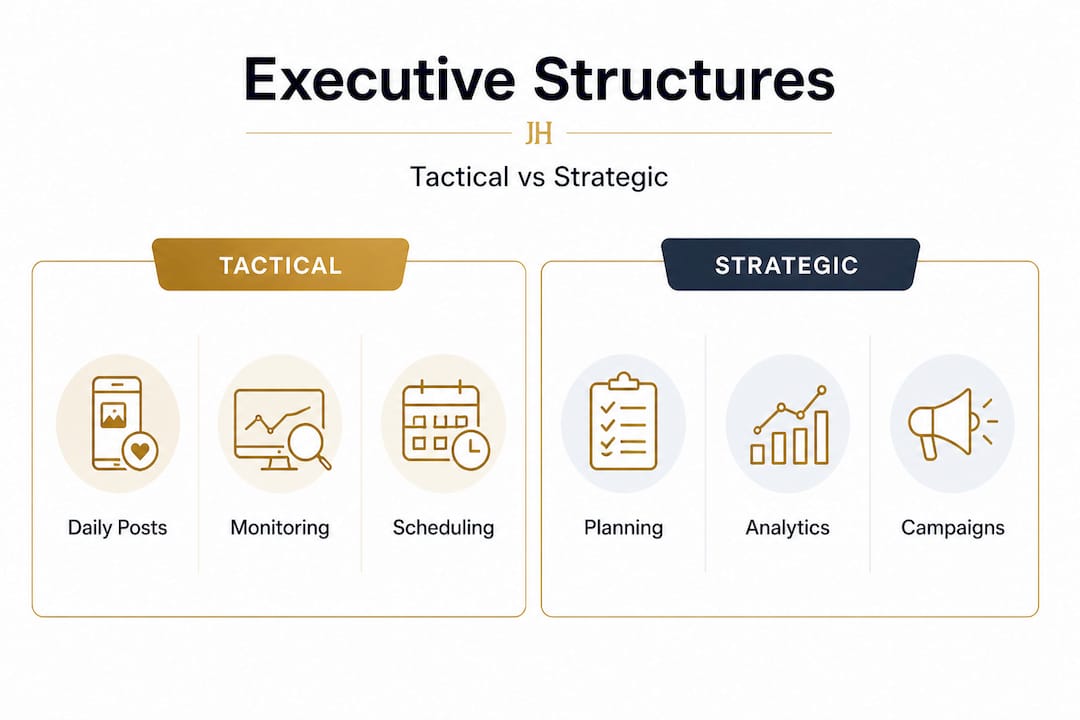
Here is a direct comparison of the three role types:
| Role type | Primary focus | Typical deliverables | Best suited for |
|---|---|---|---|
| Tactical executive | Daily posting, community management, basic reporting | Content calendar, scheduled posts, comment responses | Large teams needing execution support |
| Strategic leader | Vision, KPIs, team oversight, long-term campaigns | Strategy documents, budget plans, performance reviews | Enterprise or multi-location brands |
| Hybrid executive | Strategy plus hands-on execution | Campaigns, ads, reporting, content, and analytics | Small to medium service businesses |
For a salon owner, clinic director, or service provider running a tight team, the hybrid model delivers the most value. You get someone who can think like a strategist and act like an executor without requiring a full department behind them.
Pro Tip: When evaluating candidates or agencies, look for demonstrated experience in both ad management and organic content strategy. Someone who only knows one side will leave money on the table.
The clearest path to lead generation via social media runs through a hybrid executive who understands your specific service niche, your local market, and the full funnel from awareness through to booking.
ROI and realities for Australian service businesses
Once you understand the possible executive models, it is time to review how hiring the right expertise can boost your returns in the real world.
Australia has a distinct social media landscape, and the numbers reflect real opportunity for service businesses that invest correctly. Australian service businesses achieve an average $4.50 return per $1 spent on social media, with Facebook dominant for local targeting and cost per lead between $8 and $25 for trades and services.
Here is how that plays out across different scenarios:
| Scenario | Monthly ad spend | Average CPL | Leads generated | Estimated bookings |
|---|---|---|---|---|
| Local beauty clinic | $1,500 | $15 | 100 | 30 to 40 |
| Med spa (metro) | $3,000 | $20 | 150 | 50 to 60 |
| Service trades business | $2,000 | $12 | 165 | 55 to 70 |
These figures assume competent campaign management. Without an experienced executive overseeing targeting, creative, and budget allocation, those CPLs can double or triple quickly.
Key market realities for Australian service businesses include:
- Facebook’s continued dominance: Despite predictions of its decline, Facebook remains the most effective platform for local service targeting in Australia, particularly for the 35 to 55 age group
- Instagram’s visual strength: For beauty, wellness, and aesthetics businesses, Instagram drives significant brand awareness and enquiry through both organic content and paid placements
- Engagement quality improvements: Australia’s recent under-16 social media ban is actively improving the quality of engagement on major platforms, concentrating active users in the 18-plus demographic where your buyers actually sit
- Local targeting precision: A skilled executive uses suburb-level geo-targeting, interest layering, and lookalike audiences to ensure your ad budget reaches people most likely to book
“The business owners who see the strongest returns from social media are not necessarily spending the most. They are spending it with the most precision, guided by someone who knows exactly what levers to pull.”
You can explore the full case for social media ROI for Aussies to see platform-specific benchmarks and realistic projections for your industry.
Common pitfalls and edge case considerations
Understanding what can go wrong, and why, is just as vital as knowing what works best.
Even businesses with strong social media executives can stumble if certain risks are not actively managed. Australia’s digital environment has some specific nuances that make these considerations especially relevant.
Key pitfalls to watch for include:
- No crisis management protocol: A single negative review, a misunderstood post, or a public complaint can escalate quickly without a documented response plan. Every service business needs a clear process for managing social media crises before they happen, not after.
- Platform dependency: Building your entire lead generation model around one platform is a serious risk. Algorithm changes, account restrictions, or platform-specific downturns can cut off your lead flow overnight. A diversified approach across at least two to three platforms protects your business.
- Inconsistent engagement: Sporadic posting and delayed responses signal unreliability to potential clients. Consistent, quality engagement is not just nice to have. It directly affects how the algorithm distributes your content.
- Ignoring the impact of the under-16 ban: Australia’s under-16 social media ban improves engagement quality for the 35 to 50 demographic, which is your primary buying audience. This policy shift is actively working in your favour if you are targeting adult service consumers.
- Failing to pivot strategies: What worked six months ago may not work today. A good executive conducts regular strategic reviews and adjusts campaigns based on current data, platform updates, and shifts in audience behaviour.
Pro Tip: Schedule a quarterly social media audit with your executive or agency. Review platform performance, audience growth, cost per lead trends, and content engagement to make sure your strategy stays current and effective.
Why most owners underestimate the true value of a social media executive
With so much at stake, let us step back and share a hard-earned perspective.
There is a pattern we see repeatedly with service-based business owners across Australia. They are exceptional at what they do. They run tight operations, deliver outstanding results for clients, and genuinely care about their reputation. But when it comes to social media, they treat it like a minor administrative task rather than a core growth function.
The reasoning is understandable. Social media feels accessible. Anyone can post. Anyone can reply to a comment. So it gets delegated to the newest team member or squeezed into the business owner’s already packed schedule. The result is inconsistent output, zero strategic direction, and a stream of activity that generates almost no leads.
Here is the uncomfortable truth: that approach is not just ineffective, it is actively costing you money. Every month without a proper social media strategy is a month your competitors are building the brand awareness and trust that converts browsers into bookings.
The business owners who invest in genuine social media expertise, whether that is a skilled in-house executive or a specialist agency, almost always report the same outcome. Their lead volume becomes more predictable, their cost per acquisition drops, and their brand starts to carry real weight in the local market. For Aussie marketing tips tailored to service businesses, the pattern holds consistently.
The shift in mindset required is simple but significant. Stop viewing social media as a posting schedule. Start viewing it as a lead generation and client acquisition system. The executive who runs that system is not a support role. They are a revenue-generating function, and they deserve to be resourced accordingly.
When evaluating whether a candidate or agency truly has strategic capability, ask them one question: “What would you change about our current social media approach in the first 30 days and why?” A tactical thinker will talk about aesthetics and posting frequency. A genuine strategist will talk about audience targeting, funnel alignment, and measurable outcomes.
Expert support to unlock your social media results
If you’re ready to turn new understanding into action, these resources deliver expert-backed results.
At Business Warriors, we have spent years helping Australian service businesses turn inconsistent social media activity into predictable lead generation engines. Our Marketing Vortex method integrates social media strategy with SEO, paid advertising, and email marketing into a single connected system, so every touchpoint works together to drive bookings and revenue.
Whether you are starting from scratch or trying to improve the results you are already getting, our social media marketing guide walks you through the strategic foundations every service business needs. You can also explore our detailed breakdown of manager tasks to boost sales to understand exactly how expert oversight translates into commercial outcomes. If you are serious about consistent leads and a measurable return on your marketing investment, we are here to make that happen.
Frequently asked questions
How is a social media executive different from a manager?
A social media executive typically leads both strategy and execution, whereas a manager is often focused on implementation and day-to-day activity. Key executive responsibilities include developing strategy, managing paid advertising, overseeing KPI reporting, and coordinating campaigns.
What platforms matter most for Australian service businesses?
Facebook remains the most effective platform for local targeting and consistent lead generation across Australian service industries. Facebook dominates for local targeting with cost per lead typically ranging between $8 and $25 for service-based businesses.
How does under-16 exclusion impact results?
Removing users under 16 from the active platform audience concentrates engagement among adult buyers, which is precisely the demographic most service businesses are targeting. The under-16 ban improves engagement quality for the 35 to 50 age group.
What ROI can I expect from hiring a social media executive?
With expert management, Australian service businesses average $4.50 return for every $1 invested in social media, though results depend heavily on industry, budget, and strategic execution quality.
How can I avoid common social media mistakes as an owner?
Diversify across multiple platforms, document a crisis response protocol before you need it, and conduct regular strategy reviews. Crisis management protocols are essential, and avoiding over-reliance on a single platform protects your lead flow from unexpected disruptions.