2 May 2026
How to start a social media business in Australia
Learn how to start a social media business in Australia with practical steps to grow your service-based company in a competitive market.
TL;DR:
- Most Australian social media businesses thrive by building long-term recurring client relationships.
- Legal compliance, clear contracts, and niche specialization are key to long-term success.
- Combining organic growth with targeted paid advertising maximizes lead generation and credibility.
Generating consistent leads and sales in a crowded digital market is genuinely hard. If you run a service-based business in Australia, you already know the frustration of inconsistent enquiries, patchy word-of-mouth, and watching competitors seemingly appear everywhere online. The good news? 78% of Australian businesses now use social media as a core marketing channel, and Australian social commerce is worth $1.8 billion. Starting a social media business, or hiring the right help, is no longer optional for service providers who want to grow. This guide walks you through every practical step to launch, operate, and scale a social media business in Australia.
Table of Contents
- What you need to start a social media business in Australia
- Develop your unique service offering
- Build your business plan and legal foundation
- Launch, market, and scale your social media business
- Common mistakes and how to avoid them
- Our perspective: the real keys to a thriving social media business
- Take your next step with expert help
- Frequently asked questions
Key Takeaways
| Point | Details |
|---|---|
| Choose the right structure | Sole trader is simplest; a company gives you more protection but needs more setup. |
| Legal compliance is must | Register for tax, get an ABN, and always comply with privacy and advertising regulations. |
| Package your services smartly | Focus on high-value solutions like strategy, content, ads, and reporting designed for local businesses. |
| Retainers beat one-off jobs | Recurring clients bring stability, prioritise long-term contracts over ad hoc gigs. |
| Market to your niche | Tailor your messaging and channels to B2B service businesses in Australia for best results. |
What you need to start a social media business in Australia
After understanding the opportunity, the next logical step is knowing what you actually need before trading begins. The good news is that a social media business has relatively low physical overhead, but the legal and structural groundwork matters enormously.
The first decision is your business structure. Sole traders and companies operate quite differently. A sole trader setup is simple, cheap to establish, and suits people testing the waters. A proprietary limited company (PTY LTD) provides personal liability protection, looks more professional to corporate clients, and is necessary if you plan to bring on investors or directors. The catch is that a company requires at least one resident Australian director and involves annual ASIC fees.
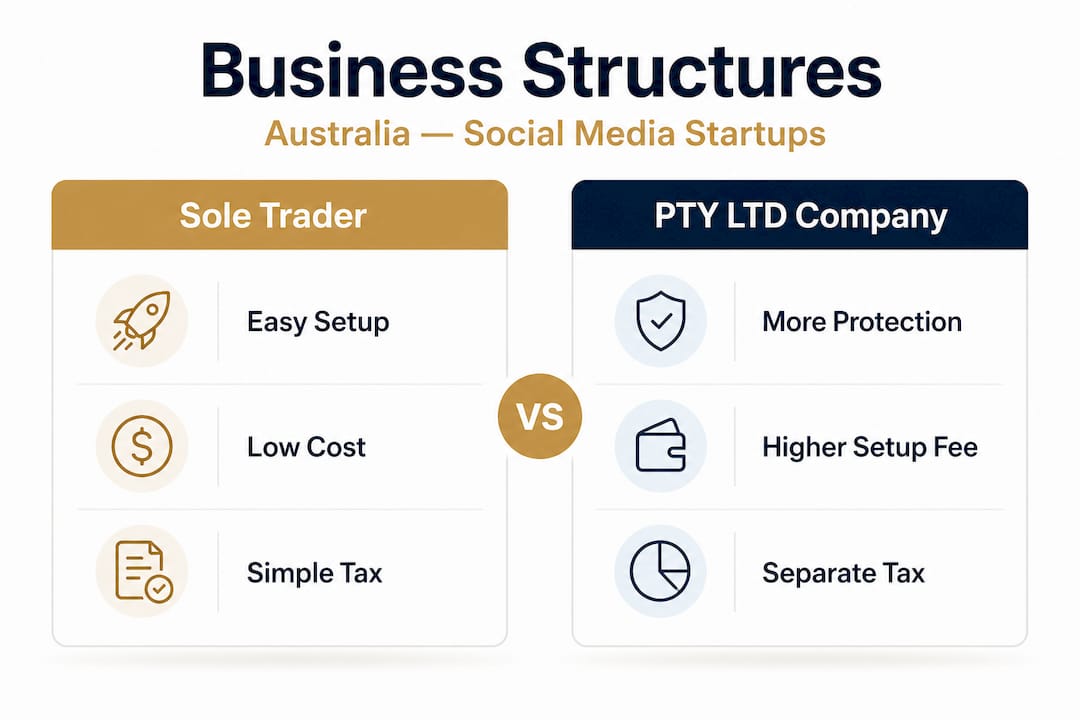
| Feature | Sole trader | PTY LTD company |
|---|---|---|
| Setup cost | Low (ABN only) | Higher (ASIC registration + fees) |
| Liability | Personal | Limited to company assets |
| Tax | Personal income tax rate | Company tax rate (25% for small business) |
| Credibility | Suits freelancers | Preferred by larger clients |
| Complexity | Simple | Requires accountant/bookkeeper |
Once your structure is chosen, register your ABN, TFN, and GST through the Australian Business Register and the ATO. GST registration is mandatory once your annual turnover exceeds $75,000. If you form a company, you will also need an ACN through ASIC. There is no specific licence required to run a social media business, but you must comply with the Australian Consumer Law (ACL), the Spam Act 2003, and the Privacy Act 1988.
Key registrations and compliance requirements:
- ABN (Australian Business Number): required for invoicing and tax
- TFN (Tax File Number): needed for your business tax obligations
- GST: register when turnover exceeds $75,000 per year
- ACN: required only if you register as a company
- Privacy Act 1988: governs how you collect and store client and consumer data
- Spam Act 2003: covers commercial electronic messages and opt-out obligations
- Australian Consumer Law: prohibits misleading conduct and false advertising
Pro Tip: Before spending anything on branding or tools, spend $300 to $500 on a one-hour consultation with a commercial lawyer familiar with digital marketing. The cost of fixing a compliance problem later is many times higher.
A solid social media marketing plan template at this stage will save you weeks of second-guessing later. Document your target client, your intended services, and your revenue goals from day one.
Develop your unique service offering
Once legalities are covered, the next step is shaping what makes your social media business stand out in the Australian market. This is where most new operators stumble because they try to do everything for everyone and end up doing nothing especially well.

The most successful social media businesses in Australia establish a clear USP, meaning a unique selling proposition focused on a specific industry or client type. For service-based businesses targeting owners aged 35 to 50, LinkedIn is a powerful channel for B2B relationships, while Facebook and Instagram remain the workhorse platforms for consumer-facing services. Specialising in beauty and wellness, professional services, or trades gives you a story to tell and proof points to reference.
Here are the core services you should consider packaging:
- Social media strategy: audience research, platform selection, content calendar development
- Content creation: copywriting, graphic design, short-form video, photography briefs
- Paid advertising: Meta Ads (Facebook and Instagram), LinkedIn Ads, TikTok Ads
- Community management: responding to comments, DMs, and reviews within agreed timeframes
- Analytics and reporting: monthly performance summaries tied to client business goals
Packaging these into clear tiers helps clients understand what they are buying and helps you manage your time and team.
| Package tier | Included services | Typical monthly price (AUD) |
|---|---|---|
| Starter | Strategy + content (8 posts) + reporting | $1,200 to $1,800 |
| Growth | Starter + paid ads management (Meta) | $2,500 to $4,000 |
| Scale | Growth + LinkedIn + video + community | $5,000 to $9,000+ |
Pricing should reflect your expertise, not the hours you work. Clients pay for outcomes, not effort. When you can boost sales for services with a measurable result, that value justifies a premium. Understanding the advantages for service businesses will also help you articulate your value to potential clients who are still sceptical about social media investment.
Build your business plan and legal foundation
With your offer established, you now need the right business foundation and legal safeguards. A business plan is not a formality. It is a decision-making tool you will refer back to constantly in the first 12 months.
Your plan should cover these five essential sections:
- Executive summary: your business model, target clients, and revenue goals in plain language
- Market analysis: who your local and national competitors are, and where the gaps exist
- Service and pricing structure: what you offer, at what price, and why that pricing is sustainable
- Financial projections: monthly revenue targets, fixed costs (software, insurance, contractor fees), and break-even point
- Operations and HR: how you will deliver services, who you will hire as a freelancer or employee, and what tools you will use
Registering your ABN and GST formally establishes your business in the eyes of the ATO and your clients. Do not skip this step even if your first few clients are informal referrals.
On the team side, most new social media businesses start with specialist freelancers, typically a strategist, a copywriter, and a graphic designer. Use written contracts for every single freelancer engagement. Those contracts should cover scope of work, revision rounds, approval processes, intellectual property ownership, and indemnity clauses. Without these, a dispute over who owns the content you created for a client can become genuinely expensive.
“The businesses that grow fastest in social media marketing are the ones that treat compliance and contracts as competitive advantages, not admin headaches. Clients trust agencies that operate professionally from day one.”
Legal pitfalls to watch for:
- Using client testimonials without written permission (a breach of ACL)
- Sending promotional emails without an unsubscribe mechanism (Spam Act violation)
- Storing client data on overseas servers without disclosing this in your privacy policy (Privacy Act issue)
- Not having a signed service agreement before commencing paid ad campaigns
Using a business plan template built specifically for Australian marketing businesses will help you avoid missing sections that matter for local compliance.
Pro Tip: Require a signed service agreement and a 50% deposit before starting any work. This single habit eliminates most payment disputes and keeps your cash flow healthy.
Launch, market, and scale your social media business
With your business structure and plan in place, it is time to attract your first paying clients and grow your reputation. Launching is not just about switching on your Instagram page. It is about being credible and findable from the moment a potential client searches for you.
Start with these foundational steps:
- Branding: a clear name, logo, colour palette, and consistent visual identity across all platforms
- Website: a one-page or five-page site with a portfolio, services, pricing indication, and contact form
- LinkedIn profile: optimised with a headline, about section, and three case studies or results
- Google Business Profile: set up and verified so local clients can find you in search
For marketing, the most effective combination for Australian service businesses is organic growth strategies paired with targeted paid advertising. Organic content builds trust over time. Paid ads generate leads quickly. Under $500 per month in ad spend is viable for Australian small to medium businesses starting out with Meta Ads or LinkedIn Ads.
The advantages for small businesses of a blended approach are real. You build an audience that trusts you while simultaneously running lead generation campaigns that deliver enquiries this week. Understanding why advertising on social media works so well for service businesses comes down to the targeting precision available: you can reach business owners in a specific postcode, industry, and age range for a fraction of what traditional media costs.
Compliance matters at the launch stage too. You must comply with AANA advertising codes, disclose paid content with a clear label such as #ad or #sponsored, and moderate user-generated content (UGC) on your channels to avoid exposure to defamation claims. These are not optional nice-to-haves. They are legal obligations that apply to any Australian business running social media campaigns.
Pro Tip: Target your first 10 outreach messages on LinkedIn specifically at service business owners in your city aged 35 to 50. A personalised message referencing their industry converts far better than a generic pitch.
For sustainable growth, move clients onto monthly retainers as quickly as possible. Retainers create predictable revenue, allow you to plan your team’s workload, and align your incentives with your client’s long-term success.
Common mistakes and how to avoid them
Even with a solid plan, common missteps can derail progress. Here is how to sidestep the most frequent blunders that new social media business owners make in Australia.
-
Skipping contracts and compliance: Handshake deals feel faster but create serious risk. A client who disputes ad results with no signed agreement leaves you with no recourse. Always formalise the relationship before starting work.
-
Trying to serve everyone: A business that targets “all businesses” wins none. The moment you say you specialise in beauty and wellness clinics in Perth, or law firms in Melbourne, you become instantly more relevant and referable.
-
Relying on one-off projects: Retainers over one-off projects are the consensus among experienced practitioners. One-off jobs create feast-and-famine cycles. Monthly retainers provide income predictability and let you deliver better results because you understand the client’s business deeply over time.
-
Underpricing your services: New operators consistently underprice because they fear rejection. This attracts clients who micromanage and leave quickly. Pricing at a level that reflects genuine value attracts clients who respect expertise and stay longer.
-
Failing to track time and costs: Even on a flat-rate retainer, you need to know your real cost of delivery. If a $2,000 per month client is consuming 40 hours of your time, you are effectively earning $50 per hour before expenses. Track everything from the start.
Pro Tip: Review every client account monthly against your cost of delivery. If any client is consuming more than 30% more time than budgeted, raise the price or renegotiate scope before resentment builds.
Our perspective: the real keys to a thriving social media business
Having covered the steps, it is worth reflecting on what actually drives sustained success in this space, because a lot of the advice you will find online focuses on the mechanics and glosses over the business model.
The most overlooked truth is this: most social media businesses fail not because of bad content or weak ads, but because they never build recurring revenue. They chase the next project instead of locking in long-term client relationships. A single retainer client worth $3,000 per month is more valuable than six one-off projects at $500 each, not just financially but in terms of the depth of results you can deliver.
The businesses that genuinely thrive focus obsessively on client results, not just outputs. Outputs are posts published and ads running. Results are new bookings, enquiries, and revenue generated for the client. When your clients grow, they refer others, upgrade their packages, and stay for years. This is the engine behind every successful social media agency we have seen or worked alongside.
Compliance and professionalism also differentiate you more than people realise. In a market where many social media freelancers operate without contracts, proper privacy policies, or formal business structures, showing up with clear agreements, transparent reporting, and documented processes signals credibility immediately. Implementing B2B marketing ideas that are built around long-term relationship value rather than short-term wins is what separates the agencies that scale from those that stay stuck at two or three clients.
Niche focus is not a limitation. It is a growth accelerator. The more specifically you can say “we help med spas in Australia grow bookings through Meta Ads and organic Instagram,” the easier every marketing, sales, and delivery conversation becomes.
Take your next step with expert help
You have the roadmap. Now the question is execution speed and avoiding the costly detours that slow most new social media businesses down.
At Business Warriors, we have built a 360° marketing strategy called the Marketing Vortex that integrates SEO, paid advertising, social media, email, and web development into one system designed for Australian service businesses. Whether you are looking for client acquisition tips to land your first retainer clients or advanced lead generation strategies to scale past your current ceiling, we have the experience and the proven frameworks to support your growth. Reach out to the Business Warriors team and let us help you build a social media business that delivers real, measurable results.
Frequently asked questions
Do I need a licence to start a social media business in Australia?
No specific licence is required, but you must comply with ACL, Spam Act, and Privacy Act obligations from day one. Registering your ABN and business structure is the primary legal requirement.
What is the minimum cost to start a social media business?
Low startup costs are possible if you begin as a freelancer using existing skills and free tools, but budget for ABN registration, basic insurance, contract templates, and a simple website to present professionally.
Which social media platforms work best for Australian service businesses?
LinkedIn is strongest for B2B targeting, while service owners aged 35 to 50 are most effectively reached through a combination of LinkedIn for professional outreach and Meta platforms for retargeting and brand awareness.
What are typical service offerings for a social media business?
Strategy, content creation, advertising, community management, and reporting form the core service set, and most successful agencies package these into tiered monthly retainers rather than selling individual services.
How can I make my social media business stand out?
Define a USP focused on a niche such as Australian SMB lead generation or a specific industry vertical, then back it with documented case studies showing measurable client outcomes.
Recommended
- Advantages of Social Media for Aussie Small Businesses – Jarrod Harman
- 7 Proven Social Media Marketing Tips for Aussie Businesswomen – Jarrod Harman
- Social media marketing advantages for Aussie service businesses – Jarrod Harman
- Why Advertise on Social Media: Real Results for Aussie Businesses – Jarrod Harman
- How to Do Social Media Management Well – Fylde Digital – Web Design SEO Social Media