29 April 2026
How to attract high-value clients for service businesses
Learn how to attract high value clients for your service business with proven strategies that transform your client base and boost profitability!
TL;DR:
- Focusing on fewer high-value clients provides sustainable growth and reduces burnout.
- Clear, specific positioning and targeted outreach attract premium clients more effectively.
- Consistency, patience, and system-based follow-up are key to reliably acquiring high-value clients.
Relying on a constant stream of low-ticket, high-churn clients is exhausting. You work harder, earn less, and spend more time managing difficult relationships than actually growing your business. The truth is, landing a smaller number of high-value clients consistently is the single biggest lever available to any Australian service business owner who wants to scale without burning out. This guide walks you through a proven, step-by-step framework covering everything from identifying your ideal client to building a repeatable system that keeps premium prospects flowing into your pipeline month after month.
Table of Contents
- Clarify your ideal high-value client
- Position your brand to attract high-value clients
- Leverage strategic lead generation tactics
- Nurture prospects into high-value clients
- Refine and scale what works
- Our perspective: High-value client attraction takes discipline, not just smart tactics
- Accelerate your high-value client acquisition journey
- Frequently asked questions
Key Takeaways
| Point | Details |
|---|---|
| Know your ideal client | Identifying and targeting the right client profile is the foundation of high-value client attraction. |
| Position your brand with authority | Clear and strong positioning differentiates you and attracts the clients willing to invest at the highest level. |
| Use targeted lead generation | Choose proven strategies and channels for consistent, high-quality leads rather than relying on generic outreach. |
| Nurture and qualify leads | Following up and educating prospects is key to converting them into high-value, long-term clients. |
| Refine and scale | Monitor your results and scale what works for predictable, sustainable business growth. |
Clarify your ideal high-value client
Start with the foundation: defining who you truly want as a client.
Most service business owners skip this step because it feels abstract. They want to help everyone, so they market to everyone, and they end up attracting no one in particular. A high-value client is not simply someone who pays more. For service businesses in Australia, a high-value client is typically someone who has an urgent, well-funded problem your service solves, who respects your expertise, and who is likely to return and refer others. These clients are worth significantly more over their lifetime than the average booking or project.
Getting specific about your ideal client profile saves you time and money. Your marketing becomes sharper, your messaging resonates more deeply, and your conversion rates improve because you are speaking directly to the person most likely to say yes. These client acquisition tips reinforce that specificity in targeting consistently outperforms broad, unfocused outreach for service businesses.
Here is a simple table of attributes worth defining when building your ideal client profile:
| Attribute | Questions to answer |
|---|---|
| Budget | Can they comfortably invest in your service without hesitation? |
| Industry | Which industries are you most equipped to serve? |
| Decision-maker | Are you talking to the person who actually signs off on spending? |
| Urgency | Do they have a pressing problem that needs solving now? |
| Values | Do they appreciate quality over the cheapest option available? |
| Location | Are they local, national, or can you serve them remotely? |
Use the following questions to sharpen your ideal client profile further:
- Which past clients produced the best revenue with the least friction?
- What problems do your best clients have in common before they find you?
- What objections do your worst-fit clients raise that your best clients never do?
- How much does your ideal client typically spend on services like yours each year?
- What outcome do they care most about: speed, prestige, certainty, or cost savings?
Pro Tip: Pull up your last 10 to 15 invoices and rank each client on a scale of one to ten across satisfaction, profitability, and ease of working together. The clients scoring highest across all three categories are the template for your ideal profile. Build your marketing around cloning them.
Position your brand to attract high-value clients
Once you are clear on your ideal client, the next step is making your business irresistible to them.
Positioning is simply how your business is perceived relative to competitors in the mind of your ideal client. It answers the question: “Why should I choose you over everyone else?” Most service providers make the same mistake here. They describe what they do rather than the transformation they deliver. A med spa that says “we offer laser treatments” is describing a service. One that says “we help busy professionals in their forties look as confident as they feel” is communicating a transformation. High-value clients pay for the second one.
Compare the difference between weak and strong positioning:
| Positioning type | Example statement |
|---|---|
| Weak | “We provide marketing services for small businesses.” |
| Strong | “We help Australian clinic owners book 30 or more new patients per month using paid advertising.” |
| Weak | “We offer legal advice for businesses.” |
| Strong | “We protect fast-growing startups from costly commercial disputes before they happen.” |
| Weak | “We do social media management.” |
| Strong | “We turn service business owners into the go-to authority in their local market within 90 days.” |
The difference is specificity, outcome focus, and a clear target audience. Research across repeat booking strategies consistently shows that businesses with tightly defined positioning convert prospects into clients at a far higher rate than generalist competitors.
To communicate authority, your website, social media profiles, and sales conversations need to consistently reflect three things: evidence (case studies, results, testimonials), specificity (who you serve and what you achieve for them), and confidence (clear pricing or pricing ranges, no apologetic language, strong calls to action).
Pro Tip: Ask a trusted peer outside your industry to read your homepage and answer in one sentence what you do and who you serve. If they struggle, your positioning needs work. Clear positioning should be instantly obvious to a complete outsider.
Leverage strategic lead generation tactics
With your brand position set, effective outreach and lead generation is where high-value prospects are brought into your world.
Not all lead generation channels are created equal when it comes to attracting premium clients. Social media posts and boosted content can build awareness, but for high-value prospects, direct and trust-based channels consistently outperform them. The three highest-impact channels for Australian service businesses targeting premium clients are LinkedIn outreach, strategic referral programmes, and targeted webinars or workshops. These lead generation strategies have been validated across multiple service niches in the Australian market.
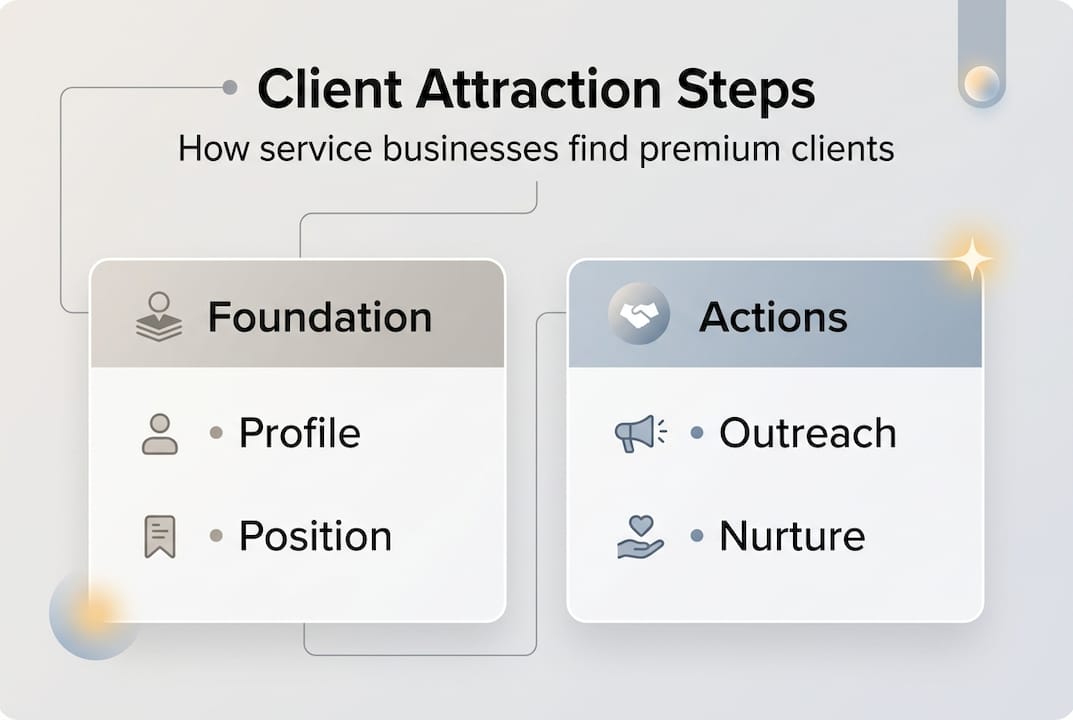
Understanding how B2B lead generation works at a structural level helps you choose the right approach for your specific audience. For service businesses targeting other businesses or high-net-worth individuals, relationship-led tactics consistently outperform cold advertising alone.
Here is a step-by-step approach to launching a LinkedIn outreach campaign for high-value clients:
- Optimise your LinkedIn profile so it speaks directly to your ideal client’s outcomes, not your career history.
- Use LinkedIn’s search filters to identify prospects by industry, job title, company size, and location in Australia.
- Send a personalised connection request with a brief, genuine message referencing something specific about their profile.
- Follow up with a value-first message sharing a relevant insight, case study, or resource with no sales pitch attached.
- After two or three value exchanges, invite them to a short discovery call framed around their goals, not your services.
- Track all outreach in a simple CRM so no warm conversation falls through the cracks.
Tools and resources worth using to streamline your lead generation include:
- LinkedIn Sales Navigator for advanced prospect searching and list management
- HubSpot CRM free tier for tracking conversations and pipeline stages
- Calendly for frictionless booking of discovery calls
- Zapier to automate data capture between your lead forms and your CRM
- Loom to send personalised short video messages that dramatically improve reply rates
The combination of systematic outreach and automation means you spend your energy on conversations, not administration.
Nurture prospects into high-value clients
Attracting the right leads is only half the battle. The rest is guiding them naturally through your sales process.

The biggest gap in most service businesses is not lead volume but lead follow-up. High-value prospects are busy, often cautious, and evaluating multiple options simultaneously. A single email or one phone call is rarely enough to convert them. Research consistently shows that most sales require five or more follow-up touchpoints, yet the majority of service providers give up after one or two attempts.
Best practices for a high-converting nurture sequence include:
- Send a personalised email within one hour of a new enquiry acknowledging their specific situation
- Follow up with a phone call or voice message within 24 hours of the initial contact
- Share a relevant case study or testimonial in the second follow-up email that mirrors their industry or problem
- Use a third touchpoint, such as a personalised video message or article, to add further value before asking for a meeting
- Schedule automated reminder emails for prospects who have gone quiet after an initial conversation
- Keep every touchpoint personal, specific, and focused on their outcome rather than your services
The most common mistake in nurturing is confusing persistence with pressure. Staying visible and valuable is entirely different from chasing. Every message you send should make the prospect’s decision easier, not feel like a sales push.
Pro Tip: Before spending an hour preparing a detailed proposal, qualify every prospect using four simple questions. What is the problem costing them right now? Have they set aside a budget to fix it? Who else needs to approve the decision? And what happens if they do nothing? These four questions reveal whether a lead is worth prioritising or requires more nurturing. This approach, based on online lead nurture tips, saves significant time and keeps your pipeline clean.
Refine and scale what works
Converting your first high-value clients is only the beginning. Sustainable growth means building a repeatable system.
Tracking the right numbers turns guesswork into a growth engine. Most service businesses track revenue but ignore the metrics that actually explain where their growth comes from. The data points that matter most for a high-value client acquisition system are cost per lead, lead-to-meeting conversion rate, meeting-to-client conversion rate, average client lifetime value, and payback period on marketing spend.
| Metric | What it tells you | Target benchmark |
|---|---|---|
| Cost per lead | How efficiently your campaigns generate interest | Varies by channel, minimise over time |
| Lead to meeting rate | How well your outreach converts to conversations | 20% or above is strong |
| Meeting to client rate | How effective your sales process is | 30% to 50% for warm referrals |
| Client lifetime value | Total revenue generated per client relationship | Should grow quarter on quarter |
| Marketing payback period | How many months to recoup your acquisition spend | Under six months is healthy |
Use this simple optimisation loop to scale consistently:
- Test one new message, channel, or offer at a time so you know exactly what is driving results.
- Measure the output against your baseline metrics after a minimum of four weeks of consistent activity.
- Improve by doubling down on what outperformed expectations and cutting what fell below your benchmarks.
- Scale spend, time, and resources behind the tactics that are producing the best return on investment.
These cutting-edge methods for scaling lead generation show that businesses who stick to an iterative improvement process consistently outperform those who chase new platforms or trends.
The most dangerous trap at this stage is “shiny object syndrome.” Every few months a new platform or tactic emerges promising to revolutionise lead generation. Businesses that abandon working systems to chase the new thing typically restart from zero. Consistency beats novelty every time when it comes to attracting premium clients.
Our perspective: High-value client attraction takes discipline, not just smart tactics
Having covered all the actionable steps, here is an honest perspective on what really makes this work in the real world.
Every strategy in this guide is proven to work. The tactics are not the issue. The issue is that most Australian service business owners implement them for four to six weeks, see inconsistent early results, and then pivot to something different. They mistake the absence of instant results for evidence that the approach is wrong. It rarely is.
The businesses that consistently attract premium, high-value clients share one trait above all others: they are relentlessly consistent over a sustained period. They refine their positioning quarterly. They show up in their lead generation channels even when it feels like no one is listening. They follow up one more time than their competitors are willing to.
The biggest mistake we see is businesses treating high-value client acquisition like a campaign rather than a system. Campaigns have end dates. Systems keep running, keep improving, and keep delivering.
The proven acquisition strategies we see working for Australian service businesses are not exotic. They are disciplined applications of fundamentals, executed consistently over time. Discipline, patience, and a willingness to measure and refine your approach are what separate businesses that occasionally land great clients from those that attract them reliably, month after month.
Accelerate your high-value client acquisition journey
Ready to consistently attract high-value clients? The frameworks, strategies, and systems in this guide give you a strong starting point, but implementing them with expert support accelerates everything.
At Business Warriors, we help Australian service businesses build marketing systems that attract premium clients consistently, from positioning and lead generation to nurture sequences and paid advertising. Our Marketing Vortex method, detailed across our online client acquisition tips and marketing vortex method guide, brings every channel together into one integrated, measurable system. If you are ready to stop leaving high-value clients to chance and start building a pipeline that works for you, we would love to show you exactly how we do it.
Frequently asked questions
What qualifies as a high-value client for service businesses?
A high-value client generates significant revenue, is likely to return for repeat business, and prioritises your expertise over finding the cheapest available option.
How long does it take to attract high-value clients?
With a clear strategy and consistent effort, most Australian service businesses begin attracting high-value clients reliably within three to six months.
What is the best channel for finding high-value clients in Australia?
LinkedIn and warm referrals remain the most effective channels for connecting with high-value clients for service-based businesses operating in Australia.
How do I qualify whether a lead is a potential high-value client?
In your first conversation, ask about their specific problem, available budget, and who holds decision-making authority to assess whether they are a strong fit.
What mistakes should I avoid when trying to attract high-value clients?
Avoid targeting too broadly, underpricing your services, following up inconsistently, and failing to clearly communicate what makes your business the right choice.