


More than 60 percent of Australian beauty businesses struggle to keep repeat clients coming back, even with strong word of mouth and great service. For female owners aged 35 to 50, building a loyal client base is essential for consistent bookings and steady growth. With so many choices available to clients, understanding what drives retention gives your business the edge to go beyond one-off visits and create lasting relationships.
Table of Contents
- Step 1: Identify Your Ideal Client And Retention Goals
- Step 2: Strengthen Client Relationships Through Personal Touch
- Step 3: Optimise Your Service Delivery Processes
- Step 4: Introduce Loyalty Programs And Incentives
- Step 5: Monitor Retention Rates And Adjust Strategies
Quick Summary
| Key Insight | Explanation |
|---|---|
| 1. Identify Your Ideal Client | Understand specific client demographics and behaviours to craft personalised marketing strategies and retention goals. |
| 2. Foster Personal Connections | Implement regular communication and personalised experiences to build genuine client relationships that enhance loyalty. |
| 3. Streamline Service Delivery | Evaluate and optimise service processes for efficiency to improve client satisfaction and trust in your business. |
| 4. Design Effective Loyalty Programs | Create tailored rewards that resonate with clients’ preferences to encourage repeat business and referrals. |
| 5. Monitor and Adjust Retention Strategies | Regularly analyse retention metrics and client feedback to refine strategies and enhance client engagement and satisfaction levels. |
Step 1: Identify your ideal client and retention goals
Successful client retention begins with understanding precisely who your most valuable customers are and what specific outcomes will define your business growth. This strategic approach transforms generic marketing into targeted relationship building that creates lasting connections.
To pinpoint your ideal client, start by examining client demographics and communication preferences that align with your service offerings. Analyse your current customer base and look for patterns in age, income level, professional background, and specific needs that match your unique service capabilities. Create a detailed profile that goes beyond basic demographics and captures the motivations, challenges, and aspirations of your most profitable clients.
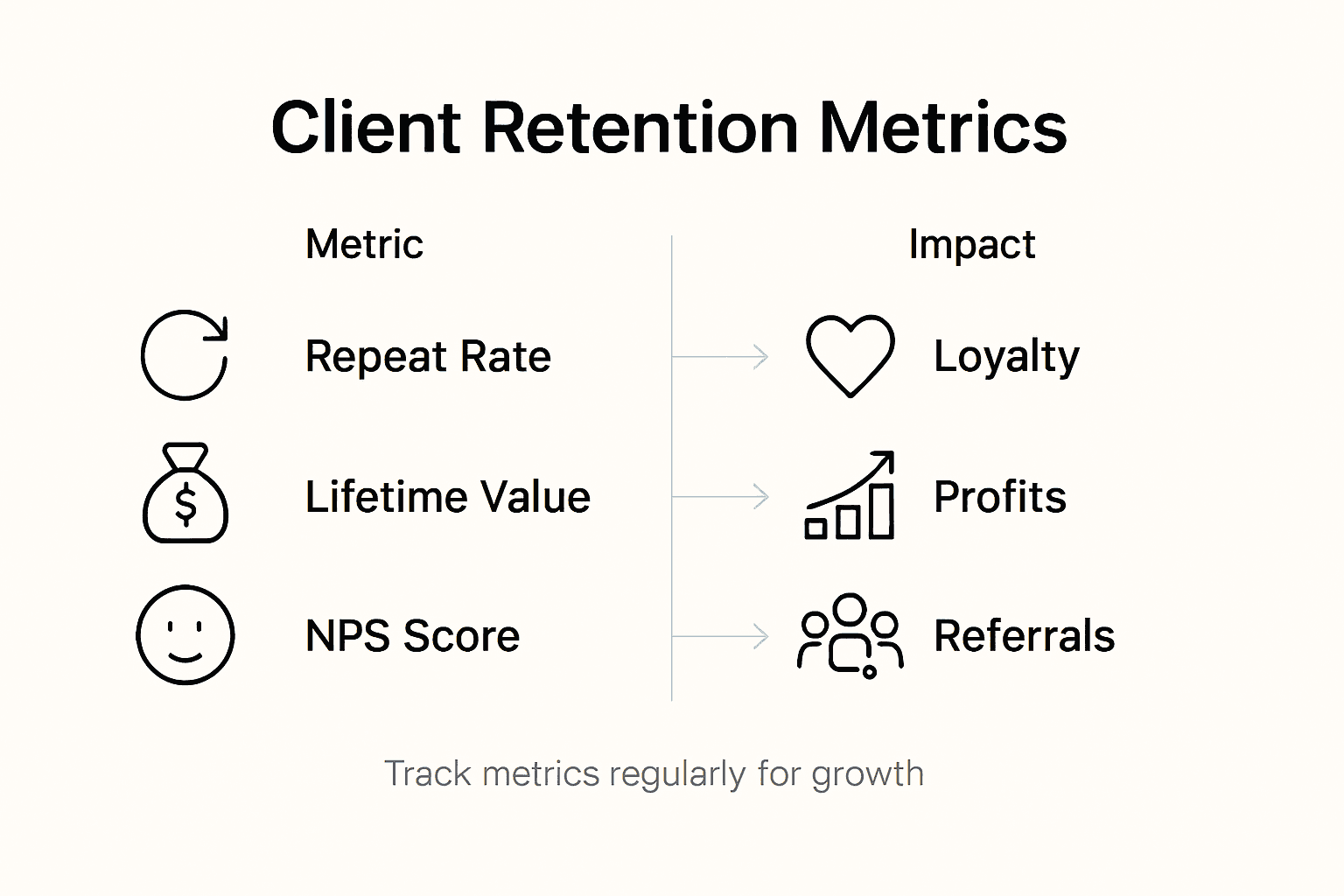
Establish clear retention goals by connecting client satisfaction metrics directly to your revenue targets. This means defining specific benchmarks such as repeat booking rates, average customer lifetime value, and net promoter scores. Develop a systematic approach to tracking these metrics, which will help you understand exactly how well you are meeting client expectations and where improvements can be made.
Here’s a summary of essential client retention metrics and their business significance:
| Metric | Purpose | Business Impact |
|---|---|---|
| Repeat booking rate | Measures loyalty frequency | Indicates suitability of services |
| Customer lifetime value | Estimates total revenue per client | Guides resource allocation decisions |
| Net promoter score | Tracks brand advocacy | Drives referral and growth strategies |
Practical Advice: Create a living document profiling your ideal client that your entire team can reference and continuously update based on emerging insights and changing market dynamics.
Step 2: Strengthen client relationships through personal touch
Building meaningful client relationships goes far beyond transactional interactions transforming your service from a simple business exchange into a genuine partnership based on trust and understanding. Your goal is to create an experience that makes clients feel uniquely valued and consistently supported.
To achieve this, implement strategic personal connection techniques that demonstrate genuine care and commitment. This means developing a systematic approach to regular communication that extends beyond standard service delivery. Schedule personalised check-ins that go deeper than surface level discussions by asking about their specific business challenges, personal goals, and areas where they might need additional support. Create customised advice packages tailored to each client’s unique circumstances demonstrating that you view them as individual partners rather than generic customers.
Consider developing an exclusive client engagement program that provides additional value through educational resources, webinars, or specialised events. These initiatives help showcase your expertise while simultaneously building stronger emotional connections. Track client interactions meticulously ensuring no communication falls through the cracks and that every touchpoint feels intentional and meaningful.
Practical Advice: Design a client relationship management system that allows your team to capture personalised details about each client’s preferences professional journey and communication style.
Step 3: Optimise your service delivery processes
Streamlining your service delivery processes is the backbone of consistent client satisfaction and long term business success. By creating a systematic approach to service excellence, you transform potential friction points into opportunities for building trust and demonstrating your professional commitment.

Analysing the entire client journey through advanced data analytics allows you to identify and eliminate inefficiencies that might frustrate clients. Map out each touchpoint in your service delivery workflow scrutinising every interaction from initial contact through to post service follow up. Look for bottlenecks where communication breaks down or where clients might experience unnecessary waiting times or complexity. Implement technology solutions that automate routine tasks while preserving the personalised human element that makes your service unique.
Develop a balanced approach that combines reactive problem solving with proactive client engagement. This means not just responding to issues as they arise but anticipating potential challenges before they become problems. Create standardised service protocols that ensure consistent quality while maintaining enough flexibility to adapt to individual client needs. Regularly collect and analyse client feedback using surveys automated tracking systems and direct conversations to continuously refine and improve your service delivery model.
Practical Advice: Invest in a robust client management system that provides real time insights into service performance and allows your team to track and respond to client interactions with precision and speed.
Step 4: Introduce loyalty programs and incentives
Loyalty programs are powerful tools that transform occasional customers into dedicated advocates for your business. By strategically designing rewards that resonate with your clients, you create a compelling reason for them to choose your services repeatedly and recommend you to others.
Designing incentive programs that align with client behavior and preferences requires careful consideration of what truly motivates your specific client base. Develop a multi tiered loyalty structure that offers both financial and non monetary rewards. This might include percentage discounts on future services, exclusive access to specialised workshops, priority booking options, or personalised recognition that makes clients feel genuinely valued. Ensure your incentive program feels authentic and tailored rather than a generic marketing tactic.
Balancing short term rewards with long term relationship building is crucial. Track the performance of your loyalty program meticulously analysing which incentives generate the most engagement and repeat business. Consider implementing a points system that allows clients to accumulate value over time, creating a sense of progression and investment in your service. Regularly communicate the benefits of your loyalty program, showing clients exactly how their continued commitment translates into tangible advantages.
Here’s a comparison of popular loyalty program incentive types and their benefits:
| Incentive Type | Client Motivation | Business Benefit |
|---|---|---|
| Discount on future services | Immediate savings | Boosts repeat business |
| Priority booking | VIP experience | Reduces client churn risk |
| Personalised recognition | Emotional connection | Enhances client advocacy |
Practical Advice: Create a loyalty program tracking system that provides transparent, real time updates on client rewards and allows for seamless redemption of points or benefits.
Step 5: Monitor retention rates and adjust strategies
Effective client retention requires a dynamic approach that goes beyond simple measurement. You need a sophisticated system that transforms raw data into actionable insights that continuously improve your business performance and client relationships.
Implementing comprehensive retention metrics and data analysis allows you to develop a proactive strategy for understanding and addressing client churn. Establish key performance indicators that track client engagement beyond surface level metrics. This means measuring not just repeat business but also tracking client satisfaction scores communication frequency referral rates and long term value. Use advanced statistical modeling to predict potential client dropoff and create targeted intervention strategies before relationships become at risk.
Develop a robust feedback mechanism that encourages ongoing dialogue with your clients. Schedule regular check ins quarterly reviews and satisfaction surveys that provide genuine opportunities for clients to share their experiences. Analyse these insights systematically looking for patterns that reveal underlying reasons for potential disengagement. Be prepared to swiftly adjust your service delivery communication approach and value proposition based on the data you collect. Remember that retention is an active process requiring constant refinement and personalised attention.
Practical Advice: Invest in a flexible analytics platform that provides real time insights and allows for rapid strategy adjustments based on emerging client behavior trends.
Elevate Client Retention with Proven Digital Marketing Strategies
The article sheds light on the crucial challenge service businesses face in retaining clients by building personalised relationships and streamlining service delivery. Key pain points include identifying ideal clients, tracking retention metrics like repeat booking rates, and creating loyalty programs that truly resonate. Business owners know that consistent client loyalty drives revenue growth but often struggle with transforming sporadic interactions into deep, ongoing partnerships.
At Business Warriors, we understand these hurdles and bring the power of Jarrod Harman’s unique Marketing Vortex Method to your marketing arsenal. Our approach integrates SEO, Google Ads, social media, and email marketing into a seamless system that targets your ideal clients precisely, nurtures these relationships actively, and ensures loyal customer engagement patterns. If you want to stop worrying about client churn and start fostering meaningful connections that multiply your bookings and sales, it is time to act with a strategy that guarantees measurable results.
Discover how expert online client acquisition and retention can revitalise your service business at Jarrod Harman’s Website. For practical insights and success stories, explore Business Warriors’ Marketing Vortex strategy and learn why so many service-based businesses trust us to elevate their marketing outcomes.
Take advantage of proven systems to build repeat business and client advocacy today.
Ready to transform client retention challenges into growth opportunities? Visit https://jarrodharman.com now to connect with Jarrod and the Business Warriors team who can help you launch a precise, customised marketing plan to increase your leads, bookings, and long-term client loyalty.
Frequently Asked Questions
How can I identify my ideal client for improved retention?
To identify your ideal client, analyse your current customer base for patterns in demographics such as age, income level, and professional background. Create a detailed profile that reflects their motivations and challenges, helping you tailor your services effectively.
What metrics should I track to measure client retention?
Key metrics to track include repeat booking rates, customer lifetime value, and net promoter scores. Establish clear benchmarks for these metrics and analyse them regularly to understand client satisfaction and areas needing improvement.
How can I strengthen client relationships?
Strengthening client relationships involves regular, personalised communication and providing tailored advice packages. Schedule check-ins that address their specific challenges and goals to foster a genuine partnership beyond transactions.
What are effective loyalty programs to retain clients?
Design loyalty programs that offer both financial and non-monetary rewards, such as discounts or exclusive access to events. Ensure these programs resonate with your clients’ preferences, and regularly communicate the benefits to enhance engagement.
How often should I monitor client retention rates?
Monitor client retention rates continuously and conduct regular reviews, such as quarterly analyses. This way, you can quickly identify trends and make data-driven adjustments to improve your service delivery and client satisfaction.
What feedback mechanisms should I implement?
Implement regular feedback mechanisms like satisfaction surveys and quarterly check-ins to gather insights from clients. Use this feedback to identify areas for enhancement and adjust your services promptly to better meet client expectations.
Recommended
- Salon Marketing Ideas to Boost Client Bookings Fast – Jarrod Harman
- How to Create Sales Funnel for Consistent Lead Generation – Jarrod Harman
- How to Increase Online Visibility for Service Businesses – Jarrod Harman
- Marketing for a Salon: Build a Profitable Client Pipeline – Jarrod Harman
- 7 Essential Types of Restaurant Marketing for Local Success