


If you run a service-based business in Australia, you already know the frustration. You invest time and money into marketing, get a burst of enquiries, then watch the pipeline dry up. Traditional funnels are often built on a straight line: attract, convert, done. But buyer journeys aren’t linear, and that rigid structure means you’re constantly starting from scratch. The marketing vortex flips that model on its head, creating a self-reinforcing loop that keeps clients circling back, referring others, and fuelling your growth continuously.
Table of Contents
- What is a marketing vortex and how does it work?
- Setting up your marketing vortex: Steps and essentials
- Building momentum: Executing your vortex for lead generation
- Troubleshooting and common mistakes in marketing vortex setups
- Measuring success: Metrics and KPIs for your marketing vortex
- Take your marketing vortex further with expert support
- Frequently asked questions
Key Takeaways
| Point | Details |
|---|---|
| Vortex vs funnel | Marketing vortex models outperform funnels by creating momentum from advocacy and data feedback. |
| Preparation essentials | Setting up your vortex requires digital tools, a feedback loop, and clear roles for your team. |
| Execution steps | Build momentum with content, advocacy, and real-time data to keep clients engaged and circulating. |
| Avoid common mistakes | Monitor feedback, balance automation, and adjust your loop to match real buyer journeys. |
| Measure and improve | Track engagement, referrals and retention to refine your vortex for ongoing sales growth. |
What is a marketing vortex and how does it work?
A marketing vortex is a cyclical, omnichannel system designed to pull prospects in, convert them into clients, and then keep them engaged so they generate more leads for you. Unlike a traditional funnel, which moves people in one direction and drops them off at the bottom, the vortex keeps spinning. Every satisfied client feeds back into the system through reviews, referrals, and repeat business.
Understanding marketing funnel basics is a useful starting point, but the vortex goes further. Where a funnel ends at the sale, the vortex treats that sale as the beginning of a new cycle. Vortex and flywheel models create momentum through customer advocacy and feedback, meaning your marketing gets more powerful over time, not less.
“The vortex doesn’t just capture leads. It creates a gravitational pull that keeps your best clients coming back and sending others your way.”
Here’s how the vortex compares to a traditional funnel:
| Feature | Traditional funnel | Marketing vortex |
|---|---|---|
| Direction | Linear, one-way | Cyclical, self-reinforcing |
| Client journey | Ends at purchase | Continues post-purchase |
| Lead source | Paid acquisition only | Advocacy, referrals, and paid |
| Feedback use | Rarely integrated | Core to the system |
| Momentum | Fades without new spend | Builds over time |
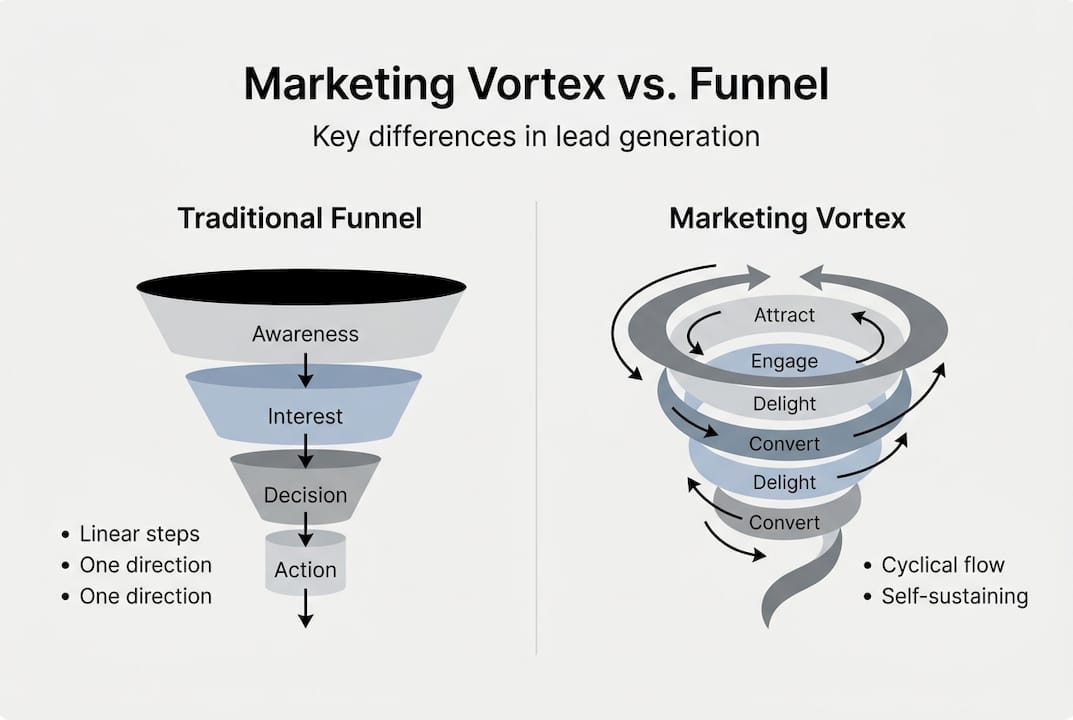
The vortex suits Australian service businesses particularly well because so much of this sector runs on trust and relationships. Whether you run a med spa in Melbourne, a law firm in Brisbane, or a salon in Perth, your reputation is your biggest asset. The vortex is built to amplify exactly that.
Key advantages of the vortex model include:
- Clients stay engaged between purchases through content and follow-up
- Word-of-mouth becomes a structured, measurable channel
- Feedback loops help you improve your offer in real time
- Marketing spend works harder because existing clients amplify it
Setting up your marketing vortex: Steps and essentials
Understanding the model is vital, but the next step is making it real for your business through practical preparation. Before you launch, you need the right tools, the right team mindset, and a clear map of your customer journey.

The vortex method for services works best when every touchpoint is intentional. Start by auditing what you already have: your website, your social media presence, your email list, and your review profiles. These are the entry points of your vortex.
Here’s a step-by-step setup checklist:
- Map your customer journey from first awareness through to post-purchase advocacy
- Audit your existing channels including SEO, Google Ads, Meta Ads, email, and social media
- Set up your CRM so no lead falls through the cracks
- Create a content calendar that keeps clients engaged at every stage
- Build your feedback system using surveys, review requests, and follow-up sequences
- Assign team roles so each channel has a clear owner
- Define your KPIs before you launch so you can measure momentum from day one
Here’s a quick overview of the core tools you’ll need:
| Tool category | Purpose | Example platforms |
|---|---|---|
| CRM | Lead tracking and follow-up | HubSpot, ActiveCampaign |
| Email marketing | Nurture sequences | Klaviyo, Mailchimp |
| Social media | Content and engagement | Meta, Instagram, TikTok |
| Paid advertising | Traffic generation | Google Ads, Meta Ads |
| Analytics | Performance tracking | Google Analytics, Meta Insights |
Building your social media marketing skills is also essential here, because social platforms are where much of the vortex’s advocacy happens. Your clients share, comment, and tag. That organic activity is free fuel for your loop.
Customer advocacy and data feedback are core to vortex-based systems, which means you need to build collection points into every stage of your process, not just at the end.
Pro Tip: Don’t wait until everything is perfect to launch. Start with two or three channels, get feedback early, and expand from there. A vortex that’s running imperfectly is still generating data you can use.
Building momentum: Executing your vortex for lead generation
With your vortex ready, let’s dive into the actionable steps to generate leads and build momentum. Execution is where most businesses either gain traction or stall. The difference usually comes down to consistency and systems.
An effective marketing vortex builds momentum via advocacy and feedback, so your job is to create the conditions for both. Here’s how to do it:
- Publish content consistently across your chosen channels, mixing educational posts, client stories, and behind-the-scenes content
- Follow up with every client after their appointment or purchase using an automated but personalised sequence
- Ask for reviews at the right moment, typically 24 to 48 hours after a positive experience
- Create a referral programme that rewards clients for sending new business your way
- Retarget warm audiences using Meta and Google Ads to keep your brand visible between purchases
- Analyse your data weekly and adjust your content and ad spend based on what’s working
You can explore real-world vortex case studies to see how other service businesses have applied these steps. The patterns are consistent: businesses that systemise their advocacy see compounding returns.
For content ideas and channel-specific tactics, social lead gen strategies offer a practical breakdown of what works across different platforms.
Key actions to keep your vortex spinning:
- Respond to every comment and review, positive or negative
- Repurpose content across channels to maximise reach without extra effort
- Use email sequences to re-engage clients who haven’t booked in a while
- Track referral sources so you know which clients are your best advocates
Pro Tip: Automation handles the volume, but a personal message from you or your team at a key moment, like a client’s first anniversary with your business, creates the kind of loyalty that no algorithm can replicate.
Troubleshooting and common mistakes in marketing vortex setups
As you start seeing your vortex in action, it’s crucial to avoid pitfalls and course-correct quickly. Most early-stage problems come from one of three sources: skipping the feedback loop, over-automating, or failing to map the vortex to how your actual clients behave.
Traditional funnels lose prospects because they don’t engage through feedback or advocacy. The vortex fixes this, but only if you actually use the feedback you collect. Ignoring low engagement or poor review rates is the fastest way to stall your momentum.
Common mistakes to watch for:
- Skipping the post-purchase follow-up and losing clients who would have returned
- Over-automating to the point where communications feel robotic and impersonal
- Ignoring negative feedback instead of using it to improve your service
- Treating the vortex like a funnel by focusing only on new leads and neglecting existing clients
- Failing to assign ownership of each channel, leading to inconsistent execution
For a deeper look at fixing underperforming systems, optimising funnels and building consistent sales funnels are worth reviewing alongside your vortex setup.
“Low engagement isn’t failure. It’s feedback. Use it to refine your loop, not abandon it.”
If your vortex feels slow, check these quick fixes first: increase your review request frequency, add a re-engagement email to your sequence, or refresh your content with a new format like short video. Small adjustments often produce outsized results.
Measuring success: Metrics and KPIs for your marketing vortex
Once you’ve solved common issues, tracking results and iterative improvement are the keys to ongoing success. The metrics you track in a vortex are different from traditional funnel KPIs because you’re measuring momentum, not just conversion.
Vortex models benefit from continuous improvement loops using real customer data, which means your reporting needs to capture the full cycle, not just the top of the funnel.
Core vortex KPIs to track:
- Engagement rate across email, social, and ads
- Referral volume and the percentage of new clients coming from existing ones
- Client retention rate and average time between purchases
- Review velocity (how many new reviews you’re generating per month)
- Cost per lead compared to the lifetime value of a client
- Re-engagement rate from dormant client sequences
For context on how these differ from standard funnel metrics, reviewing types of marketing funnels helps clarify what you’re moving away from. And if you need a structured approach to setting targets, sales funnel KPIs provides a solid framework to adapt.
Here’s a summary of actionable next steps based on your results:
| Result you’re seeing | What it means | Action to take |
|---|---|---|
| High engagement, low conversions | Offer or CTA needs work | Test new offers or booking incentives |
| Good conversions, low retention | Post-purchase experience lacking | Improve follow-up and loyalty sequences |
| Low referral volume | Advocacy isn’t being prompted | Launch a referral programme |
| Declining ad performance | Audience fatigue | Refresh creative and test new segments |
| Strong retention, slow growth | Top-of-funnel needs boosting | Increase content output and ad spend |
The vortex is a living system. The businesses that grow fastest are the ones that review their data regularly and make small, consistent improvements every month.
Take your marketing vortex further with expert support
If you’re ready to boost your vortex and take your lead generation to the next level, practical expert resources can make all the difference. Building a vortex from scratch takes time, and having the right guidance accelerates everything.

Jarrod Harman and the Business Warriors team have helped service-based businesses across Australia implement and scale the marketing vortex method with measurable results. From setting up your first feedback loop to running omnichannel campaigns that compound over time, the support is practical and tailored to your industry. If you want to sharpen your lead nurturing strategies or need a clear roadmap for online lead generation, the resources and coaching available through jarrodharman.com are built specifically for businesses like yours. The vortex works. The question is how fast you want it spinning.
Frequently asked questions
What makes the marketing vortex more effective than a traditional funnel?
Unlike funnels, the vortex model continually draws clients into your loop using advocacy and feedback, creating sustainable momentum. Traditional funnels fail in non-linear buyer journeys, while the vortex is designed to match how people actually make decisions.
How long does it take to see results with a marketing vortex?
Most businesses see gradual improvements in engagement and lead quality within 60 to 90 days if the vortex is executed consistently and the feedback loop is active from the start.
Can I use automation in my marketing vortex?
Yes, automation is useful for scaling your vortex, but genuine advocacy alongside automation is what drives real retention and referrals. Balance both for the best results.
What are the common mistakes to avoid in setting up a vortex?
Ignoring feedback, over-automating your communications, and failing to map your loop to actual client behaviour are the biggest pitfalls that slow momentum early on.
Is the marketing vortex model suitable for all service-based businesses?
The vortex is especially effective for businesses that rely on ongoing relationships and word-of-mouth, but it can be adapted to suit most service models across Australia.