1 May 2026
Lead generation programs: Proven strategies for service growth
Unlock growth with effective lead generation programs. Discover proven strategies tailored for women-owned service businesses to attract quality leads.
TL;DR:
- Consistent, quality lead flow is more crucial than chasing higher lead volume.
- Effective programs focus on lead quality, nurturing, and targeting ideal clients for long-term growth.
- Outsourcing lead generation often provides better results for busy service business owners.
Most service business owners know they need more leads. What they don’t realise is that chasing more leads is rarely the answer. The real problem is a lack of consistent, quality lead flow, and that’s a very different challenge to solve. Women-owned businesses make up a significant portion of the service sector, yet the gap between revenue potential and actual results remains wide. If you’re a female business owner aged 35 to 50 running a salon, clinic, spa, or any service-based business, this guide breaks down what actually works in lead generation programs today, and why the standard advice often falls short.
Table of Contents
- Why consistent lead generation matters for service businesses
- Key components of effective lead generation programs
- In-house vs outsourced lead generation: What’s best for service business owners?
- Practical steps to implement and maximise your lead generation program
- Expert perspective: What most guidebooks get wrong about lead generation for female service owners
- Professional support: Next steps for consistent growth
- Frequently asked questions
Key Takeaways
| Point | Details |
|---|---|
| Quality leads drive growth | Prioritising the right leads is more valuable than chasing volume for service businesses. |
| Outsourcing solves bottlenecks | Bringing in trained experts increases efficiency and consistency in lead generation. |
| Invest in proven systems | High earners succeed by investing in frameworks and support instead of relying on free tools. |
| Practical steps matter | Following a clear process improves results and prevents wasted effort. |
Why consistent lead generation matters for service businesses
Lead generation is the engine that keeps a service business alive. Without a reliable, repeatable system for attracting the right clients, even the most talented business owner will find herself stuck in a frustrating cycle of feast and famine. One month the bookings are full. The next, the phone goes quiet. Sound familiar?
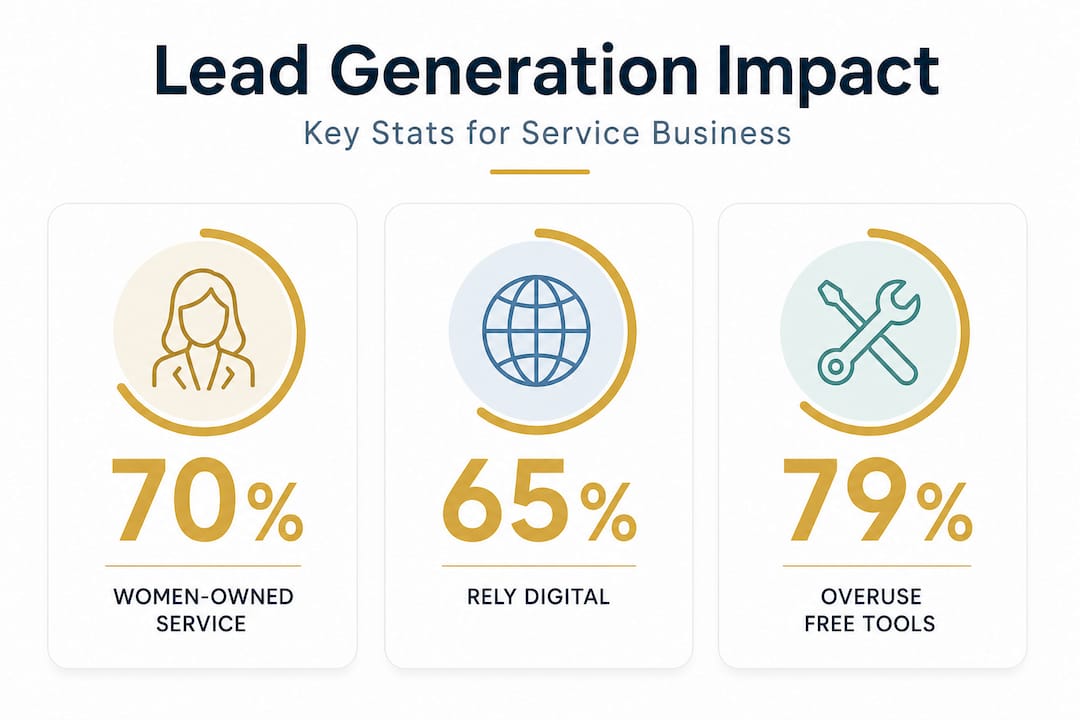
The numbers tell a clear story. Over 70% of women-owned businesses operate in the service sector, and 65% rely on digital marketing as their primary method of acquiring new clients. Yet the average revenue for these businesses sits around $192,000, with only 6.2% breaking through the $250,000 mark. That gap isn’t about skill or effort. It’s about systems.
Understanding lead generation for service businesses starts with recognising that your clients are relationship-driven. They don’t just buy a service. They buy trust, consistency, and results. That means your lead generation approach needs to reflect those values, not just push volume.
Here are the most common traps that hold service business owners back:
- Relying on word of mouth alone. Referrals are wonderful, but they’re unpredictable. You can’t scale a business on hope.
- Posting on social media without a strategy. Visibility without a conversion pathway is just noise.
- Treating all leads the same. Not every enquiry deserves the same energy. Low-quality leads drain your time and enthusiasm.
- Inconsistent follow-up. Most leads don’t convert on the first touch. Without a system, they fall through the cracks.
Research from the 2026 state of moms in business report found that 72% of service-based business owners experience sales misalignment, meaning their marketing attracts people who don’t actually convert. Meanwhile, 79% rely heavily on free tools and AI-generated content without a structured system behind it. The business owners who break through? They invest in expert coaching and proven systems.
“The most successful service businesses don’t just generate leads. They generate the right leads, consistently, through a system that works even when the owner isn’t actively selling.”
Now that we’ve seen the broader landscape, let’s look at the core features that differentiate successful lead generation programs.
Key components of effective lead generation programs
Not all lead generation programs are created equal. The ones that actually move the needle for service businesses share a handful of critical characteristics. Understanding these will help you evaluate any program, tool, or strategy you’re considering.

Lead quality over lead volume. This is the single most important shift you can make. Prioritising lead quality over raw numbers means focusing on lifetime client value rather than the revenue from a single appointment. A client who visits your med spa once a month for two years is worth exponentially more than ten one-time visitors. Your program should be designed to attract and retain the former.
Self-liquidating offers are a powerful tool here. These are low-cost entry offers (think a discounted first treatment or a free consultation) that cover their own advertising cost while bringing in a qualified lead. The goal isn’t to make money on the offer itself. It’s to identify clients who are serious, get them through the door, and then deliver an experience that converts them into long-term, high-value clients.
Here’s a quick comparison of what separates high-performing programs from average ones:
| Feature | Average program | High-performing program |
|---|---|---|
| Focus | Lead volume | Lead quality and lifetime value |
| Follow-up | Manual, inconsistent | Automated with personal touchpoints |
| Targeting | Broad demographics | Specific client avatars |
| Measurement | Vanity metrics (clicks, impressions) | Revenue, bookings, retention |
| Integration | Standalone tactics | Omnichannel system |
The key components to look for in any proven lead generation strategies include:
- A clearly defined ideal client profile. You need to know exactly who you’re trying to attract before you spend a single dollar on advertising.
- A compelling entry offer. Something low-risk that gets the right people to raise their hand.
- A nurture sequence. Email, SMS, or social touchpoints that build trust before the sale.
- A conversion mechanism. A booking page, a call, or a consultation that moves leads to paying clients.
- A retention system. Rebooking prompts, loyalty incentives, and ongoing communication to keep clients coming back.
When these elements work together, you get consistency. When even one is missing, the whole system leaks. Exploring cutting-edge lead generation methods can also reveal newer tactics worth layering into your existing framework.
Pro Tip: Before investing in any new lead generation tactic, audit your current follow-up process. Most service businesses lose leads not at the top of the funnel, but in the middle, where enquiries go unanswered or follow-up is inconsistent. Fix the leak before adding more water.
Understanding what makes a lead generation campaign work at a structural level will save you months of trial and error.
After understanding the key program elements, it’s vital to review options for executing these strategies, whether done in-house or outsourced.
In-house vs outsourced lead generation: What’s best for service business owners?
This is one of the most common decisions service business owners face. Do you manage your own lead generation, or do you hand it to an expert? The honest answer depends on your current stage, your budget, and your appetite for learning.
Let’s look at the data first. 61% of marketers identify lead generation as their single biggest challenge. Outsourced providers bring trained staff, multi-platform expertise, and established systems that most small business owners simply don’t have the time or resources to build themselves.
| Factor | In-house | Outsourced |
|---|---|---|
| Cost | Lower upfront, higher time cost | Higher upfront, lower time cost |
| Expertise | Limited to owner’s knowledge | Access to specialists |
| Scalability | Slow, dependent on hiring | Fast, built-in capacity |
| Accountability | Self-managed | External benchmarks and reporting |
| Risk | Higher (learning curve) | Lower (proven systems) |
Here’s when in-house lead generation makes sense:
- You have a dedicated marketing team member with real digital marketing experience.
- Your business is in an early stage and cash flow is tight.
- You have the time to learn and implement strategies consistently.
- You’re testing a niche offer before scaling with paid support.
And here’s when outsourcing is the smarter move:
- You’re already busy serving clients and can’t dedicate time to marketing.
- You’ve tried DIY strategies and results have been inconsistent.
- You’re ready to scale and need systems that can handle increased volume.
- You want access to tools and expertise that would cost more to build internally.
The reality for most service business owners aged 35 to 50 is this: you’re exceptional at what you do. You’ve built a real business. But marketing is a specialist skill, and trying to master it while running everything else often leads to half-measures that produce half-results. Reviewing a solid lead generation checklist can help you identify exactly where your current gaps are before making this decision.
One thing worth noting: outsourcing doesn’t mean handing over control. The best agency relationships are collaborative. You bring the industry knowledge and client insight. They bring the systems, platforms, and execution capability. Together, you build something that works. Combining this with smart lead generation content marketing strategies can amplify results even further.
With the decision made, let’s explore how to implement lead generation programs practically for sustainable results.
Practical steps to implement and maximise your lead generation program
Whether you’re starting from scratch or optimising what you already have, implementation is where most programs succeed or fail. Here’s a step-by-step approach that works for service businesses in 2026.
- Define your ideal client in detail. Go beyond age and location. What does she worry about? What does she want to feel after visiting your business? What has stopped her from booking before? The more specific you are, the more your marketing will resonate.
- Choose two to three core channels. Trying to be everywhere at once is a recipe for burnout. For most service businesses, Google Ads, Meta advertising, and email marketing form a powerful core. Add SEO for long-term organic growth.
- Build a simple but complete funnel. Ad or content piece, landing page, lead magnet or entry offer, automated follow-up sequence, booking link. Every step should flow naturally into the next.
- Set up tracking from day one. You cannot improve what you don’t measure. At minimum, track cost per lead, lead-to-booking conversion rate, and client lifetime value.
- Automate the routine, personalise the important. Use automation for appointment reminders, follow-up emails, and rebooking prompts. But make sure real human touchpoints exist at key moments, like after a first visit or when a client hasn’t returned in 60 days.
- Review and adjust monthly. Lead generation is not a set-and-forget activity. Look at your numbers every month and make one or two targeted improvements.
The 2026 state of moms in business report found that 79% of service business owners over-rely on free tools without the systems to back them up. Free tools have their place, but they rarely produce consistent results on their own. The business owners who boost sales online reliably are the ones who treat their marketing like an investment, not an afterthought.
Pro Tip: The single biggest mistake in implementation is skipping the follow-up sequence. Most leads need five to seven touchpoints before they book. If your system only sends one email, you’re leaving the majority of your potential clients on the table. Invest time in building a proper nurture sequence and watch your conversion rate climb.
Exploring effective lead generation strategies and service business lead strategies will give you additional frameworks to layer into your implementation plan.
Having explored actionable implementation, let’s share a candid perspective based on what actually works for female service business owners today.
Expert perspective: What most guidebooks get wrong about lead generation for female service owners
Here’s the uncomfortable truth most marketing guides won’t tell you: the advice that works for a tech startup or an e-commerce brand often fails spectacularly for a service business owner. And yet, most of the content out there treats lead generation as a one-size-fits-all problem.
The biggest mistake we see? Chasing volume. More leads sounds like more opportunity, but for a service business with limited appointment slots, a flooded inbox full of tyre-kickers is actually a liability. It wastes your time, demoralises your team, and distorts your data. Focusing on lead quality and lifetime client value is not just a nice idea. It’s the difference between a business that grows and one that spins its wheels.
Generic automation is another trap. Yes, automation saves time. But when every touchpoint feels robotic and impersonal, it erodes the trust that service businesses are built on. Your clients chose you because they want a human experience. Your marketing needs to reflect that, even when it’s automated.
The other issue is the obsession with free tools. We understand the appeal, especially when you’re watching your budget carefully. But free tools without a strategy are like having a beautiful shopfront with no signage. Nobody knows what you do or why they should care. The business owners who achieve real, sustained growth invest in content marketing for lead generation and expert-built systems that are tailored to their specific business, not borrowed from a generic template.
What actually works is a custom system that matches your sales strengths, speaks directly to your ideal client, and is built to grow with you. That takes investment, expertise, and a willingness to do things properly rather than cheaply.
Professional support: Next steps for consistent growth
For those ready to level up, here’s where expert resources and personalised guidance make all the difference.
Reading about lead generation is one thing. Building a system that actually delivers consistent bookings and revenue growth is another. If you’ve recognised yourself in any of the challenges described above, you’re not alone, and you don’t have to figure it out by yourself.
At Business Warriors, we specialise in helping service business owners across Australia build 360° lead generation strategies that combine SEO, Google Ads, Meta advertising, email marketing, and social media into one integrated system. Our Marketing Vortex method is designed to consistently attract leads that actually convert, not just fill your inbox with noise. We also offer SEO-driven lead generation for businesses ready to build long-term organic visibility alongside their paid campaigns. If you’re serious about growth, let’s talk about what a tailored system could look like for your business.
Frequently asked questions
What is the best lead generation program for female business owners?
The most effective lead generation programs prioritise lead quality over volume, align strategies with business strengths, and deliver measurable results specifically for service-based businesses. There is no single universal answer, but any strong program will include a defined client profile, a nurture sequence, and clear conversion tracking.
Should I outsource lead generation or manage it myself?
Outsourcing provides access to trained specialists and multi-platform expertise, making it the preferred option for most service businesses facing consistent lead generation challenges. If you’re already stretched thin running your business, outsourcing is almost always the faster path to results.
How can I improve lead quality rather than just volume?
Focus on lifetime client value, design entry offers that attract serious buyers, and build systems that filter out low-potential enquiries early. Matching leads to your sales strengths ensures your energy goes to the clients most likely to stay, spend, and refer others.
Why do service businesses struggle with consistency in lead generation?
Most service business owners face 72% sales misalignment and depend heavily on free tools without structured systems behind them. Top performers break this pattern by investing in expert support, proper automation, and accountability frameworks that keep lead generation running even during busy periods.
Recommended
- Top lead generation strategies for service businesses – Jarrod Harman
- How to Generate Leads in Digital Marketing: Proven Strategies – Jarrod Harman
- Lead Generation Strategies – Boost Sales Online Fast – Jarrod Harman
- How to Generate Leads Online for Business Growth – Jarrod Harman
- Marketing funnel explained: boost leads and conversions
- How website design drives lead generation: 2026 guide