3 May 2026
Why Facebook is good for marketing: more leads and sales
Discover why Facebook is good for marketing in 2026! Unlock new leads and sales with proven strategies that leverage its massive reach.
TL;DR:
- Facebook’s strength in 2026 lies in precise targeting and versatile ad formats for service businesses.
- Creative fatigue significantly increases advertising costs if creatives are not refreshed regularly.
- Building a structured, data-driven marketing funnel and continuous testing are key to success.
Facebook advertising has a reputation problem. Plenty of business owners in service industries believe the platform is either too crowded, too expensive, or simply past its prime. That belief is costing them real revenue. The platform is not dead, but it has become more competitive, which means the businesses that understand creative strategy and funnel measurement are pulling further ahead while everyone else burns budget and wonders why it is not working. This article breaks down what actually works in 2026, specifically for service-based businesses ready to generate consistent leads and bookings.
Table of Contents
- What makes Facebook a powerhouse for marketing in 2026?
- Lead generation benefits: how Facebook connects you with ideal clients
- Building your marketing funnel: turning Facebook interest into sales
- Avoiding wasted spend: smart strategies for 2026 Facebook campaigns
- What most Facebook marketing guides miss in 2026
- How to take your Facebook marketing to the next level
- Frequently asked questions
Key Takeaways
| Point | Details |
|---|---|
| Creative freshness matters | Updating your ad creative regularly is essential for keeping Facebook ad costs down and engagement up in 2026. |
| Quality over quantity leads | Using enhanced forms and qualifying questions delivers better clients, not just more leads. |
| Smart funnels boost results | A well-structured marketing funnel multiplies the conversion rate of your Facebook campaigns. |
| Watch for creative fatigue | Leaving ads unchanged causes sharp cost increases, test, refine, and refresh to stay efficient. |
| Strategy is more important than budget | Technical tricks alone can’t win, creativity and funnel attention outpace simple spend increases. |
What makes Facebook a powerhouse for marketing in 2026?
Facebook sits at roughly three billion monthly active users worldwide. That scale alone is remarkable, but raw audience size is not what makes the platform valuable. What makes Facebook genuinely powerful for service businesses is the combination of sophisticated targeting, diverse ad formats, and a rich ecosystem of tracking and nurturing tools that no other single platform currently matches.
Understanding the role of social media in a modern marketing strategy helps frame why Facebook remains central. The platform allows you to reach potential clients based on location, age, interests, income signals, life events, and behaviours. A med spa in Perth can target women aged 35 to 50 who have recently shown interest in skincare, wellness, or aesthetic treatments. A law firm can reach small business owners in a specific postcode who have engaged with business content in the past 30 days. That level of precision is genuinely difficult to replicate.
The ad formats available also suit service businesses extremely well:
- Lead Ads collect contact details without the user ever leaving Facebook
- Video ads showcase your team, clinic, or results in a compelling way
- Event ads drive registrations for open days, consultations, or workshops
- Stories and Reels deliver short, authentic content that builds trust fast
- Retargeting ads re-engage people who visited your website or watched your videos
The real reason many businesses struggle is not the platform itself. Performance depends heavily on account management, particularly creative freshness and funnel diagnosis, rather than on platform features alone. Most businesses set up one or two ads, let them run for months, and then blame Facebook when results decline.
Statistic: Creative fatigue can account for a 40 to 60 per cent increase in cost per acquisition in mature campaigns. If you have not refreshed your creatives recently, this is likely already happening to your account.
Pro Tip: Do a quick audit of your current Facebook ads. If any single creative has been running for more than four weeks without a refresh, pause it and replace it with a new angle, image, or hook. This single action often reduces cost per lead within days.
Lead generation benefits: how Facebook connects you with ideal clients
Knowing Facebook’s foundational strengths, it’s time to explore exactly how the platform drives qualified leads to your business. Facebook Lead Ads are one of the most practical tools available for service-based businesses, and yet most business owners use them in their most basic form and leave a lot of quality on the table.
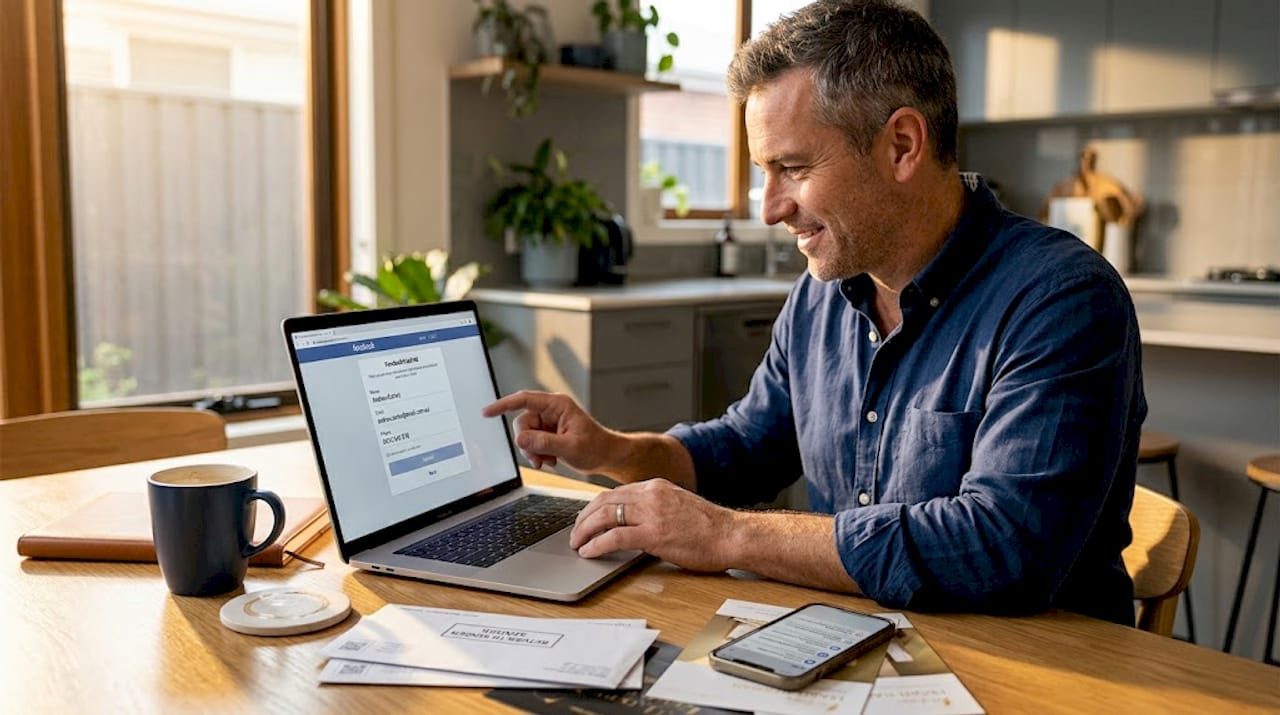
When a user taps a Lead Ad, a pre-filled form appears inside Facebook. Their name, email, and phone number are already populated from their profile. They submit with two taps and return to scrolling. The convenience is extraordinary for volume, but this frictionless process is also where quality can slip. Low-intent submissions increase when forms are too easy to complete, which is why qualifying questions and form structure matter enormously.
Here is a comparison of the three main lead collection approaches on Facebook:
| Form type | Ease for user | Lead quality | Best suited for |
|---|---|---|---|
| Basic Instant Form | Very high | Lower | Brand awareness, volume campaigns |
| Enhanced Instant Form (with qualifying questions) | Medium | Medium to high | Service businesses wanting qualified enquiries |
| Click-to-website form | Lower | Higher | High-ticket services with longer decision cycles |
The lead generation strategies that work best combine form structure with smart exclusions and targeted follow-up sequences. A beauty clinic running Lead Ads, for example, should ask at least one or two questions that require a real answer, such as “Which service are you most interested in?” or “Have you had this treatment before?” This small step removes casual clickers and surfaces people who are genuinely considering booking.
Key tactics to improve lead quality from Facebook:
- Add two to three qualifying questions to your Instant Form to filter low-intent submitters
- Use conditional logic so different answers direct users to different questions or outcomes
- Exclude people who have already submitted a form in the last 60 days to avoid duplicate enquiries
- Integrate your Lead Ads with your CRM so follow-up happens within minutes, not hours
- Use SMS verification as an optional step for higher-ticket offers to confirm serious intent
Pro Tip: Your follow-up speed is just as important as the lead itself. Studies consistently show that calling or messaging a new lead within five minutes dramatically increases the chance of conversion. Set up automatic SMS or email responses the moment a form is submitted so your business feels responsive even before your team picks up the phone.
Building your marketing funnel: turning Facebook interest into sales
Once leads are flowing, mastering the journey from first click to sale is vital. Here is how to build a funnel that converts, rather than one that simply collects names and emails and never closes.
A Facebook marketing funnel for a service business typically moves through four stages:
-
Awareness Run broad or interest-based video or image ads to introduce your brand to a cold audience. Focus on a specific problem your service solves rather than promoting your business name. People respond to their own challenges, not your logo.
-
Interest Retarget people who watched at least 50 per cent of your video, visited your website, or engaged with your page. Offer something more specific at this stage, such as a free consultation, a downloadable guide, or a before-and-after case study relevant to their situation.
-
Conversion Present a clear, low-friction offer to people who are already familiar with you. This is where Lead Ads, booking links, or direct sales pages do their best work. Remove all obstacles between the interested prospect and a confirmed appointment or purchase.
-
Nurture Use email sequences, retargeting ads, and social content to stay in front of people who enquired but did not book. Many service business clients need two to six touchpoints before they commit. A nurture sequence keeps you visible and builds trust in the meantime.
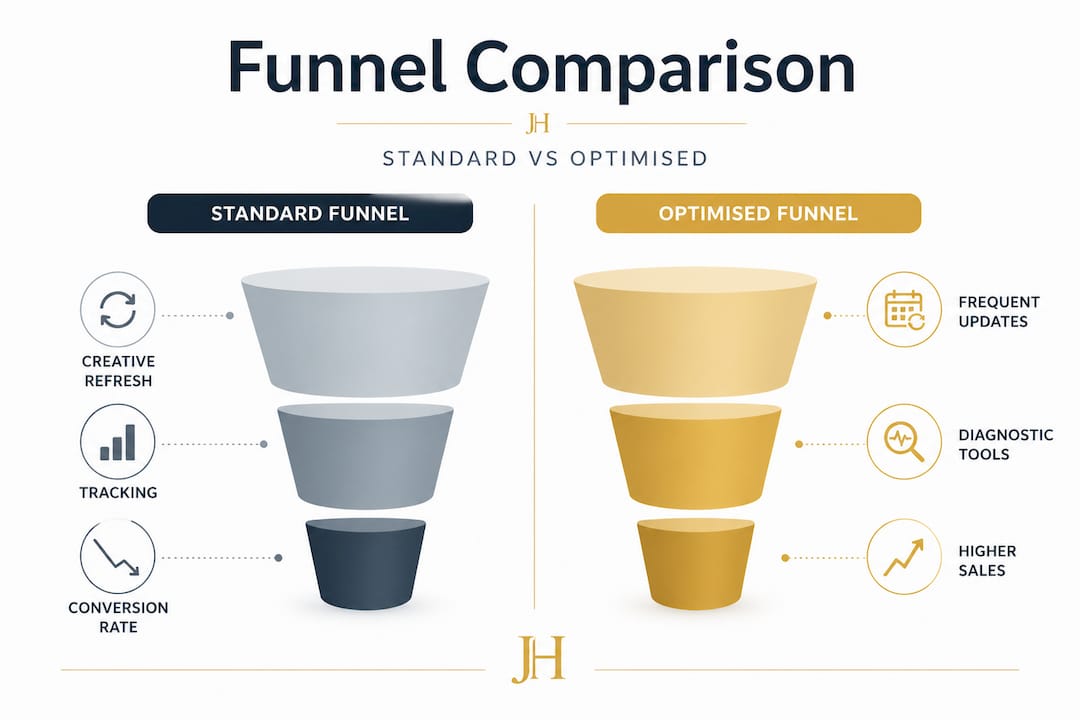
The difference between a standard funnel and an optimised one often comes down to measurement and timing. Funnel diagnosis and creative optimisation are now the deciding factors for campaign efficiency, not simply the budget you allocate.
Here is how the two approaches compare in practice:
| Factor | Standard funnel | Optimised funnel |
|---|---|---|
| Creative refresh | Every 2 to 3 months | Every 2 to 4 weeks |
| Cost per acquisition trend | Rising over time | Stable or declining |
| Drop-off diagnosis | Rarely reviewed | Weekly review of key stages |
| Audience exclusions | Basic | Layered and updated regularly |
| Follow-up sequence | Generic email | Segmented by form answer or behaviour |
If you want to go deeper on how to structure these stages, optimising sales funnels for online leads is a strong place to start. Building the initial architecture is covered thoroughly in building sales funnels, and connecting your content to each funnel stage is explained well in content funnel strategies.
Pro Tip: Use Facebook’s campaign overview panel to identify where people are dropping off in your funnel. If your click-through rate is high but your conversion rate is low, the problem is your landing page or offer, not your ad. If your reach is strong but click-through is low, your creative or headline is the bottleneck. Fix the right thing first.
Avoiding wasted spend: smart strategies for 2026 Facebook campaigns
To finish, let’s ensure your hard-won leads and ad spend work efficiently by showing where most businesses go wrong on Facebook and how to avoid these traps.
Creative fatigue is the single biggest silent drain on Facebook advertising budgets. Creative fatigue can inflate the cost per acquisition by 40 to 60 per cent in mature campaigns. Most business owners do not notice it happening because costs rise gradually. By the time they realise something is wrong, they have spent weeks at an inflated rate.
“After refreshing our ad creatives and restructuring the top-of-funnel targeting, one of our service business clients saw their cost per booked appointment drop by 38 per cent within three weeks. Nothing else changed. Same budget, same offer, same landing page. The creative was the entire issue.”
Top tactics to protect your return on ad spend (ROAS) in 2026:
- Monitor frequency closely. When your ad frequency exceeds three to four impressions per person in a given week, refresh the creative immediately.
- Use audience exclusions aggressively. Exclude existing clients, recent purchasers, and anyone who converted in the last 90 days to avoid wasting spend on people already in your ecosystem.
- Test one variable at a time. Change the headline, the visual, or the hook, but not all three simultaneously. This way you know what is actually driving improvement.
- Prioritise video over static images where possible. Video consistently outperforms static creative for service businesses because it demonstrates expertise, builds trust, and shows real people and real results.
- Segment your audiences by intent level. Cold audiences need education and awareness content. Warm audiences need social proof and a clear call to action. Sending the wrong message to the wrong audience wastes budget at every level.
Accessing digital advertising tips specific to business owners and understanding the broader advertising benefits of social media will help you build a clearer framework for every campaign decision you make.
Pro Tip: Set a weekly 15-minute calendar block to review your Facebook campaign metrics. Check frequency, click-through rate, cost per lead, and conversion rate. Small adjustments made weekly outperform major overhauls made monthly every single time.
What most Facebook marketing guides miss in 2026
Now that you know the mechanics, let’s step back and share an honest perspective rarely heard in mainstream guides.
Most Facebook marketing advice treats the platform like a vending machine. Put money in, get leads out. Adjust targeting. Increase budget. Repeat. What this approach completely ignores is the human element, specifically, that the person scrolling Facebook is being bombarded by dozens of ads every single session. Your ad has less than two seconds to earn their attention. The only thing that earns that attention is creative relevance.
The biggest myth we see repeated constantly is that Facebook ads are too expensive because of platform competition. The platform is more competitive, yes. But performance depends heavily on account management, which includes creative freshness and ongoing funnel diagnosis. The businesses that struggle are almost always running stale creatives, ignoring their funnel data, and hoping the algorithm will fix it for them. The algorithm rewards engagement. Engagement comes from creative relevance. Creative relevance comes from understanding your ideal client deeply.
The best campaigns we have seen are built on insight gathered directly from real clients. What words do your best clients use to describe their problem before they came to you? What outcome mattered most to them? What made them hesitant to reach out? These conversations are gold. When you bring that language directly into your ad copy, hooks, and visuals, your creative immediately resonates because it sounds like the person watching it, not like a marketer trying to sell them something.
For service-based businesses, marketing funnel consistency is the true competitive advantage in 2026. It is not the cleverest targeting setup or the largest budget. It is showing up with the right message, to the right person, at the right stage of their decision, week after week. That requires ongoing testing, message refinement, and a genuine commitment to learning what your audience responds to.
Pro Tip: Interview your three most recently converted clients. Ask them what almost stopped them from enquiring and what ultimately made them decide to book. Use their exact words in your next ad creative. This single exercise regularly produces the best-performing copy we have ever tested.
How to take your Facebook marketing to the next level
If you’re ready to unlock the full power of Facebook marketing for your business, here’s where to start.
Applying the strategies covered here, sharper creatives, smarter lead forms, structured funnels, and regular diagnostic reviews, creates compounding results over time. Leads become more qualified, cost per acquisition drops, and your follow-up system converts a higher percentage of enquiries into paying clients.
At Business Warriors, we have built the marketing vortex method specifically for service businesses like yours. It integrates Facebook and Meta advertising with SEO, email, and content so your marketing works as a unified system rather than a collection of disconnected campaigns. If you want a step-by-step approach to building this kind of system yourself, start with how to create a marketing vortex for consistent leads. Or, if you are ready to bring in a team that has done it before, visit Jarrod Harman’s site to explore how we work with service businesses across Australia and beyond.
Frequently asked questions
Is Facebook still a good place to advertise in 2026?
Yes, Facebook remains highly effective for service businesses, but success requires sharper creative, data-driven targeting, and constant funnel optimisation rather than a set-and-forget approach.
How can I stop getting low-quality leads from Facebook forms?
Add qualifying questions, use audience exclusions, and switch to higher-intent form types to filter out casual enquiries and surface people who are genuinely ready to book.
How often should I change my Facebook ad creative?
Refreshing creative every two to four weeks prevents fatigue, which can inflate your CPA by up to 40 to 60 per cent in campaigns that have been running for more than a month.
What is the best marketing funnel for Facebook ads?
A four-stage funnel covering awareness, interest, conversion, and nurture delivers the most consistent results, because it matches the right message to where each prospect sits in their decision-making journey.
Recommended
- Lead generation strategies: Social media marketing executive insights – Jarrod Harman
- 7 Essential Social Media Lead Generation Tools for Growth – Jarrod Harman
- How to Generate Leads Online for Business Growth – Jarrod Harman
- How to Generate More Leads from Your Website Easily – Jarrod Harman
- CrossFit Gym Marketing Agency | Growth & Lead Generation
- How to build real campaign momentum with data