4 May 2026
Position your content marketing for steady business growth
Unlock steady business growth by mastering your content marketing position. Learn how targeted strategies can boost your client leads!
TL;DR:
- A clear content marketing position is essential for attracting the right clients and generating inquiries.
- Focusing on business outcomes like inquiries and revenue is more effective than vanity metrics.
- Building a strategic team and process ensures consistent, high-quality content aligned with your brand position.
Most service business owners believe that posting more content means getting more clients. It doesn’t. The businesses that generate consistent leads online aren’t the ones publishing the most frequently. They’re the ones who’ve nailed their content marketing position. A women’s health dietitian who applied focused, SEO-optimised content achieved a 461% traffic increase alongside 85% email list growth, not by posting every day, but by getting crystal clear on what she stood for, who she served, and what her content needed to do. That’s the power of positioning, and it’s what separates service businesses that stay busy from those that stay visible but broke.
Table of Contents
- What is content marketing position?
- Choosing the right content marketing position for your business
- Building your content marketing team and processes
- Measuring success in content marketing position
- Why the right content marketing position changes everything for women-led service businesses
- Expert support for advancing your content marketing position
- Frequently asked questions
Key Takeaways
| Point | Details |
|---|---|
| Clear position drives growth | Defining your content marketing position helps attract the right clients and fuels business growth. |
| Authenticity and story matter | Authentic storytelling is key for service-based brands, especially women-led businesses. |
| Track real business outcomes | Measuring enquiries and revenue ensures your content delivers genuine returns, not just attention. |
| Seek expert support | When content marketing drains your time, expert help unlocks efficiencies and results. |
What is content marketing position?
Content marketing position is the specific place your brand occupies in your audience’s mind. It’s the answer to a deceptively simple question: when your ideal client thinks about the problem your service solves, do they think of you first?
This is different from having a content marketing strategy. Strategy covers the tactics, the blog schedule, the social media platforms, the email sequences, and the video plans. Position is the foundation underneath all of that. It defines why your content exists, who it speaks to, and what makes your perspective worth following. Without a clear position, your strategy is just activity.
For service-based businesses, this clarity is especially important because you’re not selling a product someone can see, hold, or return. You’re asking people to trust you with their time, money, and sometimes their health or legal situation. Your content is often the first signal they receive about whether you’re the right person to help them.
Here’s what a strong content marketing position looks like in practice:
- A defined audience: Not “women aged 25 to 55” but “women in their late 30s and 40s who’ve tried multiple diets and need a clinical approach, not another wellness trend.”
- A clear point of view: A position is opinionated. It says something specific, not something safe.
- Consistent language: The words and tone your audience uses become the words and tone you use.
- A gap in the market: You’re filling a space others haven’t, or filling a familiar space better.
“Content without position is just noise. The moment you define your corner of the market, everything from blog topics to social captions becomes easier to write, faster to produce, and more effective at attracting the right people.”
The content marketing tips that actually drive enquiries are always rooted in a clear position. That’s not a coincidence. Clarity creates confidence in the reader, and confidence drives action. For a deeper grounding in the fundamentals, the content marketing guide for Australian service businesses walks through this from the ground up.
Choosing the right content marketing position for your business
Once you understand what content marketing position means, the next challenge is choosing yours. This is where many business owners freeze, because the options feel overwhelming. Should you niche down tightly? Should you position yourself as a broad authority? Should you go educational, inspirational, or promotional?
The answer depends on three things: your market, your audience, and your genuine strengths.

Comparing your positioning options
| Positioning type | Best suited to | Risk | Reward |
|---|---|---|---|
| Niche authority | Specialists with a defined client type | Small audience size | High conversion, less competition |
| Broad authority | Established brands with resources | Harder to stand out | Wide reach, brand recognition |
| Story-led | Personal brands and solo operators | Requires vulnerability | Strong loyalty, high trust |
| Educational | Clinics, law firms, health services | Slow build | Long-term SEO and credibility |
Most service businesses, especially in beauty, wellness, health, and professional services, perform best with a story-led or educational position combined with a niche focus. The broad authority model is harder to sustain unless you have a team behind your content.
Steps to define your position
- List the three problems you solve better than anyone else. Not every problem you solve. The three you’re genuinely exceptional at.
- Write down who has those exact problems. Get specific about her age, situation, what she’s already tried, and what she’s afraid of.
- Search what content already exists on those topics. Where are the gaps? What’s being said poorly or not at all?
- Draft your positioning statement. “I help [specific person] achieve [specific outcome] through [your unique approach].”
- Test it with real content for 60 to 90 days. Track enquiries, not just views.
Authenticity is not optional here. Research on women-owned service businesses confirms that storytelling and genuine voice are critical advantages, and that the most effective approach balances 80% value-driven content with 20% promotional material. Chasing trending sounds on Instagram or copying competitors who look busy but aren’t converting will pull your positioning apart. Your real story, told with specificity and consistency, is your strongest asset.
Pro Tip: Resist the urge to measure your position’s success by likes and followers in the early stages. Track what changes in your enquiry inbox. That’s the real signal your position is landing.
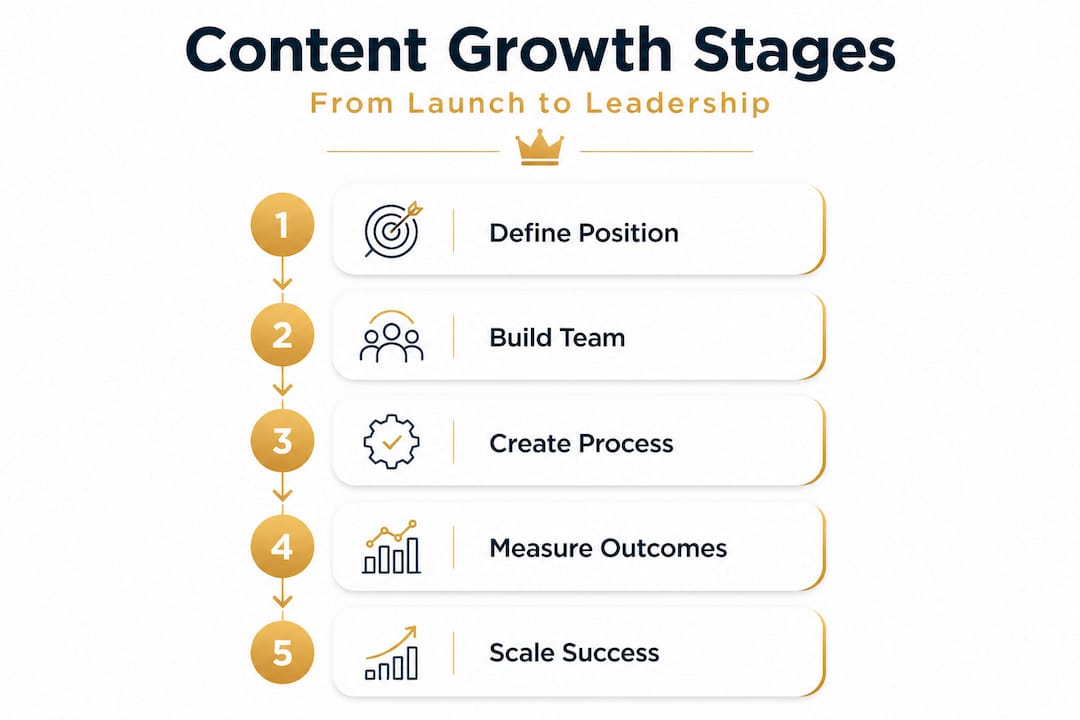
Understanding the content marketing stages your business moves through helps you match your positioning choice to where you are right now. And if you want a practical place to start, the content marketing checklist for business owners gives you a clear action framework.
Building your content marketing team and processes
Knowing your position is step one. Actually producing consistent, high-quality content that reflects it is step two, and this is where most service businesses fall over. Not because they lack ideas, but because they lack structure.
Let’s be direct: the person who runs your business, delivers your services, manages your team, and chases invoices cannot also be the sole creator, editor, scheduler, and analyst of all your content. Not without burning out. Not sustainably.
Here’s a realistic look at what each team setup offers:
| Team setup | Strengths | Weaknesses |
|---|---|---|
| Solo operator | Full control, low cost | Time drain, inconsistency risk |
| Contractor or freelancer | Flexible, skill-specific | Needs clear brief and direction |
| In-house content person | Deep brand knowledge | Training investment, overhead |
| Full-service agency | Strategy plus execution | Higher cost, needs clear goals |
The key roles in a functional content marketing operation include:
- Content strategist: Sets the direction, ensures everything aligns with the business position and goals.
- Copywriter or content writer: Produces blogs, emails, and social captions.
- Graphic designer: Keeps visual content on brand and professional.
- SEO specialist: Ensures content reaches the right people through search.
- Social media manager: Handles scheduling, community engagement, and platform-specific adaptation.
You don’t need all of these from day one. But you do need to know which roles are covered and who is accountable for what. Without that clarity, content marketing becomes chaotic and eventually stops altogether.
The single most powerful process you can implement is a content calendar. Not just a posting schedule, but a strategic document that maps content topics to business goals, tracks what’s been published, and identifies what needs to be produced next. This alone transforms content from a reactive stress to a proactive system.
Automation tools like scheduling platforms for social media, email marketing software with sequences, and repurposing workflows (turning one blog into three social posts and a newsletter) can dramatically reduce the time burden without reducing quality.
Pro Tip: If you’re spending more time thinking about content than actually serving clients, that’s your signal to bring in expert support. Outsourcing the execution while you focus on your zone of genius is not giving up control. It’s smart business. Explore what a marketing content strategist can bring to your positioning and process, and look at practical social media growth strategies that work without requiring you to be online all day.
Measuring success in content marketing position
This is the section most people skip. And it’s exactly why so many content marketing efforts stall. You cannot improve what you’re not measuring, but you also cannot make good decisions when you’re measuring the wrong things.
Vanity metrics are the seductive ones. Follower counts, post reach, video views, page views. They feel like success because the numbers go up. But a clinic with 10,000 Instagram followers and five enquiries a month is not winning at content marketing. A sole trader with 800 followers and 30 qualified enquiries a month absolutely is.
Here are the metrics that actually tell you your content position is working:
- Enquiries from content: Are people specifically mentioning your blog, your podcast, your Instagram posts when they contact you? This is the clearest direct signal.
- Qualified lead volume: Not all leads are equal. Are the leads coming in pre-sold on your service, or do they need convincing from scratch?
- Email list growth and engagement: A growing email list with strong open rates indicates your content is earning genuine attention.
- Revenue attributed to content: Use a simple intake question: “How did you hear about us?” Track this religiously.
- Conversion rate from content traffic: How many people who land on your website from a blog or social post actually take a next step?
“Tracking business outcomes instead of platform metrics is what separates businesses that grow from those that stay stuck in the content treadmill. Enquiries and revenue are your north star. Everything else is context.”
The expert recommendation is consistent and clear: track business outcomes like enquiries and revenue per lead, not vanity metrics. This is the standard we hold our clients to at Business Warriors, and it’s the standard you should demand of any content marketing effort you invest in.
SEO lead generation is one of the most powerful and measurable content outcomes available to service businesses. When your content ranks for the specific searches your ideal clients are making, every visit has intent behind it. And for real-world proof that this works across different service niches, look at content marketing examples from Australian service businesses that have turned content into consistent enquiries.
Why the right content marketing position changes everything for women-led service businesses
Here’s something most marketing advice won’t say out loud: the problem is rarely that you’re not producing enough content. The problem is almost always that your content doesn’t have a strong enough position behind it.
We see this constantly with service business owners who’ve been posting consistently for months or even years with little to show for it. The content is fine. The frequency is reasonable. But the position is vague. It could belong to anyone. And when your content could belong to anyone, it won’t attract anyone in particular.
The businesses that break through are the ones that make a choice. They decide who they’re for, what they believe, and what they will and won’t talk about. That decision creates a signal in the market. The right people feel seen. The wrong people self-select out. Enquiries improve in both volume and quality.
Here’s the contrarian truth: consistency of message beats consistency of posting every single time. Three well-positioned pieces of content per week will outperform seven scattered, trend-chasing posts. Every time.
For women-led service businesses specifically, authenticity is not a soft advantage. It’s a commercial one. Storytelling and genuine voice are what build the trust that converts a stranger into a client. Your experience, your perspective, your honest take on the industry, these are things no competitor can replicate, because they don’t have your story.
The other mistake we see is waiting too long to get expert support. Business owners often assume they need to figure out positioning themselves before bringing in a strategist. The opposite is usually more effective. Bringing in expertise early, when your position is still forming, saves months of trial and error and gives you a framework built for growth from the start. Explore what innovative marketing strategies look like when positioning and execution work together from the beginning.
Expert support for advancing your content marketing position
If this article has clarified one thing, it’s that content marketing position isn’t set and forget. It requires deliberate strategy, regular measurement, and a willingness to refine based on real business outcomes rather than surface-level metrics.

At Business Warriors, we help service-based business owners across Australia build content marketing positions that generate consistent, qualified enquiries. Our marketing vortex method integrates SEO, paid advertising, social media, and email into one coordinated system, so your content works across every channel simultaneously. If you’re ready to stop guessing and start building a position that actually fills your calendar, explore how the marketing vortex creates consistent leads and read our practical guide on scaling your online marketing so you know exactly what to expect as your business grows.
Frequently asked questions
How is content marketing position different from overall strategy?
Content marketing position focuses on how your brand is perceived by your ideal audience, while strategy covers all the tactics used to deliver your message across platforms and formats.
What KPIs should service-based businesses track?
Service businesses should track enquiries, qualified leads, and revenue per lead, avoiding vanity metrics like page views or social media follower counts that don’t reflect real business outcomes. Experts recommend focusing on business outcomes rather than platform-level data.
When should I seek expert help for content marketing?
It’s time to bring in expert support when content creation is taking more time than client delivery, or when your results have plateaued despite consistent effort. Research confirms that expert support is most valuable before burnout sets in, not after.
Can one person manage content marketing for a service business?
A solo approach is workable in the early stages, but becomes increasingly difficult to sustain as the business grows. Outsourcing specific roles or building a small support team significantly improves both consistency and results over time.
Recommended
- Content Marketing Checklist for Business Owners: Step-by-Step Success – Jarrod Harman
- Content marketing guide for Australian service businesses 2026 – Jarrod Harman
- Content Marketing Stages: Driving Growth for Services – Jarrod Harman
- The Essential Guide to Why Content Marketing Matters – Jarrod Harman
- Proven Content Promotion Strategies for Business Growth
- Why Content Marketing Is the Secret to Building Long Term Online Authority