7 May 2026
Lead acquisition strategies for consistent business growth
Unlock sustainable growth with a proven lead acquisition strategy. Discover how to build quality pipelines that convert leads into sales.
TL;DR:
- Most Australian service businesses waste money chasing leads without a reliable, consistent system to convert them effectively. Building a connected process, capture, qualify, follow-up, and nurture, is essential for sustainable growth and higher conversion rates. Focusing on profit-driven KPIs and automation tools like CRM systems helps align efforts, improve quality, and maximize return on investment.
Most service business owners believe that more leads automatically means more sales. It’s an easy assumption to make, and it’s costing Australian businesses serious money every single week. The truth is, chasing volume without a reliable system behind it is like filling a bucket with holes. You can pour in as much as you like, but the results will always disappoint. This guide cuts through the noise and gives you a practical framework for building lead acquisition that actually converts, focusing on quality, process, and the kind of consistency that supports real, sustainable growth.
Table of Contents
- Why lead acquisition needs a system, not just tactics
- Essential steps in constructing your lead acquisition strategy
- Lead qualification frameworks: boosting quality, not just volume
- Automation and nurturing: keeping leads warm without manual effort
- Measuring success: profit-centric KPIs vs vanity metrics
- Our take: lead acquisition wisdom for service business owners in Australia
- Discover proven lead acquisition strategies for your service business
- Frequently asked questions
Key Takeaways
| Point | Details |
|---|---|
| System beats tactics | Consistent lead acquisition relies on a coordinated process, not one-off marketing tricks. |
| Quality over volume | Qualified leads drive meaningful sales growth, while generic leads waste resources. |
| Automate follow-up | Quick, automated contact keeps leads warm and ensures no opportunity is lost. |
| Measure profit KPIs | Track customer acquisition cost and lifetime value to focus on sustainable results. |
Why lead acquisition needs a system, not just tactics
Many business owners jump from tactic to tactic looking for the magic bullet. They run a Facebook ad campaign one month, try a referral push the next, then pivot to Google Ads after that. Each approach creates a short burst of enquiries, and then the pipeline dries up again. Sound familiar?
The problem isn’t the tactics themselves. It’s the absence of a connected system that captures, qualifies, follows up, and nurtures every single lead that comes in. Lead generation for service-based businesses works best as a system that combines all four of those stages consistently, not as a series of disconnected one-off efforts.
Think of your lead acquisition process like a production line. Every stage needs to function smoothly for the end result to be reliable. If one stage breaks down, everything after it suffers. This is why two businesses can spend the same amount on advertising and get completely different outcomes. One has a system. The other doesn’t.
Here’s what a functioning lead acquisition system looks like in practice:
- Capture: A well-optimised landing page with a clear call to action, testimonials from real clients, and gated content (such as a free guide or checklist) that encourages prospects to share their details.
- Qualify: A short form or discovery call process that filters out tyre-kickers and identifies prospects who genuinely need your service.
- Follow up: An immediate response sequence triggered the moment a lead submits their details. Speed matters enormously here.
- Nurture: Ongoing communication through email, retargeting, and value-driven content that keeps your business top of mind until the prospect is ready to buy.
Learning how to focus on nurturing leads for business growth is one of the highest-leverage skills a service business owner can develop. The businesses that win are not always the ones with the biggest ad budgets. They are the ones whose lead nurturing process keeps working even when the owner is busy.
“A system built for consistency will always outperform a collection of tactics built for speed. The real competitive advantage is not spending more. It’s converting better.”
Pro Tip: Use an automated CRM to trigger an instant text message or email the moment a new lead submits a form. Research consistently shows that contacting a lead within five minutes of their enquiry dramatically increases your chances of booking a call. Waiting even an hour can reduce conversion rates by more than 80 per cent.
Essential steps in constructing your lead acquisition strategy
Once you understand why a system matters, the next step is building one that suits your specific service business. The good news is that the framework is largely universal. The details change based on your industry, but the stages remain consistent.
Here is a practical step-by-step process for constructing a reliable lead acquisition strategy:
- Define your ideal client. Before you run a single ad or publish a single piece of content, get crystal clear on who you want to attract. What problems do they have? What words do they use when searching for help? What makes them choose one provider over another?
- Build dedicated landing pages. Generic website homepages convert poorly. Create specific pages for each service or campaign that speak directly to one audience, one problem, and one outcome. Web assets including landing pages, gated content, and testimonials are foundational tools for generating quality leads.
- Connect your forms to a CRM. Every enquiry should flow automatically into a central database, not just an email inbox. This allows you to track, segment, and follow up without anything falling through the cracks.
- Set up a follow-up sequence. Map out at least three to five touchpoints after an initial enquiry. Include an immediate confirmation, a value-adding email within 24 hours, and a follow-up call or message within 48 hours.
- Implement a nurture sequence. For leads that aren’t ready to buy immediately, a scheduled email sequence keeps your business relevant over weeks or months.
- Measure and optimise. Review your conversion data at each stage and identify where leads are dropping off.
Exploring automation in lead generation is worth your time if you are serious about removing the manual burden from this process. For more detailed client acquisition tips, particularly for service-based businesses operating in competitive Australian markets, the right guidance can dramatically compress your learning curve.

Here is a summary of the key stages, the tools you will typically use, and what a successful outcome looks like at each point:
| Stage | Tools | Actions | Outcome |
|---|---|---|---|
| Capture | Landing pages, paid ads, SEO | Drive targeted traffic, collect enquiries | New lead enters CRM |
| Qualify | Forms, discovery calls, scoring | Filter intent and fit | Qualified prospects identified |
| Route | CRM workflows, team notifications | Assign to appropriate team member or sequence | Lead receives relevant follow-up |
| Nurture | Email sequences, retargeting ads | Deliver consistent value over time | Warm lead moves to booking |
| Convert | Sales calls, proposals, booking tools | Close the sale or book appointment | New client acquired |
Understanding how to get leads for digital marketing is particularly relevant at the capture and route stages, where most businesses leak the most opportunity.
Lead qualification frameworks: boosting quality, not just volume
Getting leads into your system is only half the battle. The other half is making sure your team spends time on the right ones. This is where qualification frameworks become genuinely valuable.
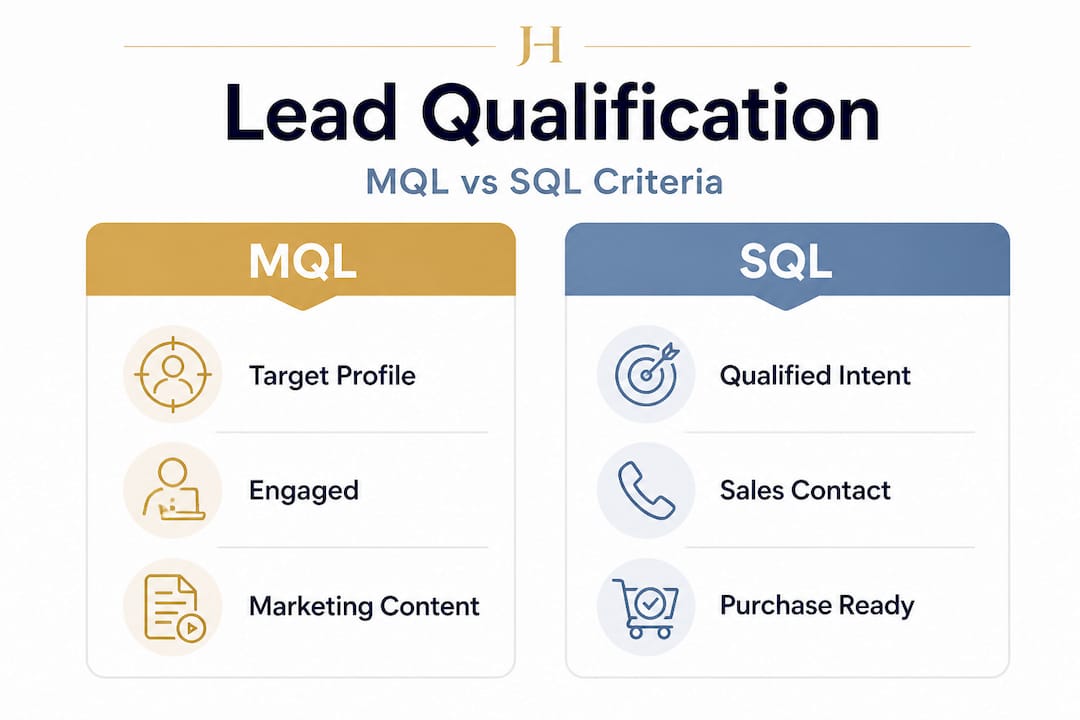
The two most commonly used terms are marketing-qualified leads and sales-qualified leads. A shared qualification framework separating MQLs from SQLs prevents wasted spend and helps align your marketing and sales efforts so nothing falls between the cracks.
Here is how they differ in practice:
| Framework | Criteria | Handoff trigger |
|---|---|---|
| Marketing-qualified lead (MQL) | Fits target profile, engaged with content, submitted a form | Passes to nurture sequence or sales team for initial contact |
| Sales-qualified lead (SQL) | Confirmed budget, clear need, decision-making authority | Ready for proposal, booking call, or direct sales conversation |
| Unqualified lead | Outside target profile, no intent signals, wrong geography | Removed from active pipeline, minimal follow-up |
One common edge case worth knowing about: some businesses have strong lead metrics on paper but a weak pipeline in reality. They might be generating 200 enquiries a month but closing fewer than five. This almost always points to a qualification problem, not a volume problem. They are attracting the wrong people or failing to filter early enough.
Signs your qualification process needs attention:
- You are spending significant time on calls with people who cannot afford your service.
- Your sales team describes most leads as “low quality” or “time wasters.”
- Conversion rates are low despite strong ad performance and high enquiry numbers.
- Prospects frequently go quiet after the initial contact.
- You cannot clearly define what makes a lead “ready to buy.”
Learning how to optimise your sales funnels starts with solving the qualification stage. When you tighten up who gets through to your sales team, your closing rate improves and your cost per acquisition drops, often significantly.
Pro Tip: Align your lead scoring criteria directly to the buyer journey stages. Early stage prospects need educational content, not a hard sales call. Sending someone a proposal before they understand the value of your service is a reliable way to lose a deal that could have been won with better timing.
Automation and nurturing: keeping leads warm without manual effort
One of the most common frustrations for service business owners is following up with leads manually. You are already running the business, delivering the service, managing the team, and handling admin. Adding a constant manual follow-up process on top of that is not sustainable.
This is where automation earns its place. Automated confirmations, CRM-connected forms, and scheduled nurture sequences ensure that leads are contacted quickly and consistently, even when your operations are at full capacity.
Practical automation options that work well for small service teams include:
- Instant confirmation emails that acknowledge a new enquiry and set expectations for next steps.
- SMS follow-ups triggered within minutes of form submission, which dramatically lift response rates.
- Email nurture sequences that deliver valuable content over a set period, keeping your brand relevant.
- Retargeting ad campaigns that re-engage visitors who browsed your website but did not enquire.
- Appointment reminder automations that reduce no-shows and keep your schedule productive.
- Re-engagement campaigns for leads that went quiet after initial contact.
Understanding online lead nurturing in depth will help you design sequences that feel personal even when they are fully automated. The goal is not to feel like a robot. It is to deliver the right message to the right person at the right moment, consistently.
The difference between businesses that nurture leads online effectively and those that do not often comes down to one thing: systems set up in advance rather than reactive effort. When a lead comes in at 9pm on a Friday, your automation responds immediately. Your competitor who relies on manual follow-up waits until Monday morning. By then, the lead has already booked with someone else.
Pro Tip: Always send an instant confirmation the moment a lead submits a form, even if it is just a simple “Thank you, we will be in touch within one business day” message. Silence after submission creates doubt. A fast acknowledgement builds trust immediately and sets a professional tone before any human interaction takes place.
Measuring success: profit-centric KPIs vs vanity metrics
Here is a trap that catches many business owners. They look at their monthly report and see impressive numbers: thousands of website visitors, hundreds of form submissions, strong social media engagement. Yet revenue has barely moved. This is the vanity metrics problem.
Vanity metrics feel good but tell you very little about the health of your lead acquisition system. Many lead generation providers market volume, but the safer approach is to insist on measurable outcomes tied to qualification, CRM handoff, and profit-centric KPIs such as customer acquisition cost and lifetime value, not just traffic or enquiry counts.
The metrics that actually matter for a service business are:
- Customer Acquisition Cost (CAC): How much does it cost, in total marketing and sales spend, to win one new client?
- Lifetime Value (LTV): How much revenue does a typical client generate over the full course of their relationship with your business?
- Lead-to-client conversion rate: What percentage of enquiries actually become paying clients?
- Qualified pipeline value: What is the total potential revenue currently sitting in your active pipeline?
- Cost per qualified lead: Not just cost per lead, but cost per lead that meets your qualification criteria.
Typical vanity metrics to stop prioritising:
- Total website visits
- Social media follower counts
- Raw enquiry numbers without qualification context
- Email open rates in isolation
- Ad impressions and reach
“If your marketing partner cannot tell you your cost per qualified lead or your lead-to-sale conversion rate, they are optimising for their report, not your revenue.”
Shifting your focus from vanity metrics to these profit-centric KPIs will immediately give you a clearer picture of what is working, what is wasting money, and where your biggest growth opportunities actually sit.
Our take: lead acquisition wisdom for service business owners in Australia
Here is the honest truth that most marketing content glosses over. Volume is not your friend if your system is broken. We have seen Australian service businesses spending thousands every month on ads, generating hundreds of enquiries, and still struggling to pay their own wages. The enquiries look impressive in a report. The bank account tells a different story.
The businesses that achieve consistent, sustainable growth are almost never the ones with the biggest ad budgets. They are the ones that have built a reliable process. They know exactly who they want to attract. They qualify leads before committing sales time. They follow up fast, and they nurture the ones who are not ready yet instead of writing them off.
CRM adoption and automated nurture sequences are two of the highest-impact changes a service business can make, and they are consistently the most under-utilised tools in the Australian market. Business owners often resist them because they feel complicated or impersonal. In practice, they are neither. They are the foundation of a business that generates consistent revenue without the owner having to do everything manually.
Chasing volume feels productive. Building a system feels slow. But a system compounds over time. Each improvement to your qualification criteria, your follow-up timing, or your nurture content makes the whole machine more effective. Volume without a system just burns your budget faster.
If you are serious about actionable client acquisition tips that go beyond generic advice, start by auditing your current process honestly. Where are leads dropping out? Where is the manual effort greatest? Those are your highest-value problems to solve first.
Discover proven lead acquisition strategies for your service business
Building an effective lead acquisition system takes more than good intentions. It takes the right strategy, the right tools, and the right guidance from people who have done it before in your market.
At Business Warriors, we work with Australian service businesses to build integrated marketing systems that generate consistent leads, qualify prospects automatically, and convert enquiries into paying clients. Our Marketing Vortex method combines SEO, paid advertising, email marketing, and CRM automation into a single connected system built for your specific business goals. Whether you are just starting to systemise your approach or you are ready to scale what is already working, explore our lead generation campaign frameworks and discover practical strategies for client acquisition tailored to Australian service industries.
Frequently asked questions
What is the difference between marketing-qualified and sales-qualified leads?
Marketing-qualified leads are prospects that fit your target profile and have engaged with your content, while sales-qualified leads have been vetted for purchase intent, budget, and readiness to buy, making them appropriate for direct sales follow-up.
How can I automate lead follow-up for my service business?
Connect your enquiry forms to a CRM and use email or SMS automation tools to trigger instant confirmations and scheduled nurture sequences the moment a new lead submits their details.
What KPIs should I use to assess lead acquisition effectiveness?
Track customer acquisition cost, lifetime value, conversion rate, and qualified pipeline growth rather than surface indicators, because profit-centric KPIs tied to CRM handoff give you a far more accurate picture of actual business performance.
Can testimonials and gated content really boost lead quality?
Yes, because web assets including testimonials and gated content build credibility and naturally filter your audience, encouraging only genuinely interested prospects to take action and increasing the overall likelihood of conversion.
Recommended
- How to Generate Leads Online for Business Growth – Jarrod Harman
- How to Nurture Leads for Consistent Business Growth – Jarrod Harman
- Lead generation programs: Proven strategies for service growth – Jarrod Harman
- Top online client acquisition tips for service businesses – Jarrod Harman
- Proven Local Marketing Strategies for Martial Arts Growth